Accidental Humanitarian - Dr Chris Stout
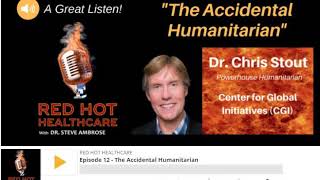
Dr. Chris Stout, a clinical psychologist at ATI Physical Therapy, founded the Center for Global Initiatives, an open-source platform offering 82 free global-health courses and humanitarian toolkits to NGOs. He turned mountain climbing into fundraising events and spent 10 days providing medical care in Bolivian prisons, where he contracted dysentery.
Chapters
A powerhouse accomplisher whose efforts have made a tremendous difference throughout the global healthcare community as well as in his own life. Dr. Chris Stout with us now on Red Hot health care. Let's go.
3, 11 and 21 and north.
All engines respond.
This is Red Hot Health Care. Interviews with today's leaders and all the news that matters. Here's your host, Steve Ambrose.
Hello and welcome to the show. I'm your host, Steve Ambrose, and you can subscribe to Red Hot Health Care on itunes, Stitcher and other podcast directories. Just send your comments or questions to stevedhothealthcare.com or hit me up on my Twitter handle, polymathsteve. Dr. Chris Stout is a licensed clinical psychologist, founding director of the center for Global Initiatives. He serves as vice president of research and data analytics at ATI Physical Therapy, a national organization heavily awarded and with over 650 locations. But wait, there's more. A clinical professor at the University of Illinois College of Medicine, Dr. Stout has published over 35 books and presented more than 300 papers in more than 20 countries. He is one of only 100 worldwide leaders appointed to the World Economic Forum's Global Leaders of Tomorrow. And, and he's been presented with five International Humanitarian Awards, plus four honorary doctorates. Dr. Stout has appeared on CNBC, honorary doctorates. Dr. Stout has appeared on CNBC, CNN, NBC, PBS, NPR, and Oprah. It's an honor to have you, Dr. Stout, and welcome to Red Hot Healthcare.
Thank you very much, Steve. A pleasure to be on.
It's really apparent to me, and I'm no psychologist, but you really, you really enjoy challenges and learning as well. And I'd like to know if that was hardwired into you, Dr. Stout. I mean, did your parents play a big role in that or did you gradually maybe work to acquire that mindset?
Yeah, I guess, you know, kind of a nature, nurture, you know, all the above kind of thing. I actually grew up in a divorced household. My folks split up before my first birthday. You know, kind of had about, you know, kind of the typical upbringing that, that a child would have in that situation. I periodically saw my father, he was a farmer, and about that often or experience, you know, doing, you know, a variety of things with him. But the flip side of that was that my mom became very, very, very overprotective. So, you know, that maybe some of the typical kinds of things that kids would do, I really didn't. I had a number of orthopedic problems and things like that with my lower extremities. So I really kind of wasn't very athletic. My mom was terrified if I would have ever gotten a bicycle that I would get run over, God knows what. So I think a lot of it, Steve, was probably pent up demand or something for some of the adventuresome kinds of things. And sort of the other part of that was that when I was a little boy and because of these orthopedic issues and having a very bad sweet tooth, I was very obese as a, as a young boy. And being obese and being named stout at the same time was also kind of a bully magnet kind of situation. So it was a little bit of a challenge. And then sadly, through a health situation with my grandmother, she had about a year long protracted battle with cancer that she ultimately lost. And through that process she, you know, we kind of went through, burned through insurance and then my mother got loans and really kind of a, you know, I think it's like one of the primary reasons that people kind of get into financial debt and hardship is health care costs and stuff today as well as it was decades ago. And that led to us. We were living with my grandmother and we had to sell the house to be able to recoup those medical debts after her passing. And one thing sort of led to another and it was looked kind of like it was probably a better idea for me than to go live with my father. So then for the next 10 years I lived with him on the farm. But before that move that last year, as my grandmother was being treated and pretty much hospitalized throughout that entire time, every day after school since my mom was at work, school since my mom was at work, I would spend two to three hours until she was off work to come pick me up at the hospital. We had a neighbor that would pick me up from school and drop me off at the hospital. So I sort of became the de facto mascot on the, the oncology ward back at Baylor Hospital in Dallas. And this was in the day where kids really were kind of forbidden from being, you know, on in hospitals. One because of being little petri dishes of germs, but also, you know, being potential, you know, getting into things that they shouldn't get into. But I was rather shy and kind of reserved and people kind of understood the situation, which was very benevolent on their part and, and then hence the mascot. So I got to go to a lot of places that nurses would take me to and doctors would take me to and yeah, I'd hang out in the doctor's lounge with surgeons and oncologists and Whatnot. So at age 12, kind of channeling my inner Doogie Howser or something, I guess at the time. But I feel like that all those things, the economic healthcare costs and the opportunity to hang with the cool kids at the hospital, so to speak, for such a period of time, I think sort of kind of set me on this trajectory. Not so much for the adventuresome stuff, but more so for where I find myself today. Working with big data and analytics and healthcare settings and membership on faculty at a college of medicine and having spent about 14 years, 15 years in a hospital healthcare setting as my first job. So I think all those things have kind of come together and conspired to lead to the activities and, and career that I've been involved with over the last 35 years.
Just to the audience, I want to make mention of this. If you think you're doing a lot in your life, you're not. Chris, I thought I was diverse and I have to say that you go through a lot of different sectors in business and interest, but just in healthcare. The interests I found include. The interests I found include physical therapy, disability workers comp, Internet of things, evidence based practice, global health, health policy, behavioral medicine, mental health ethics, and ACOs. And this is all, I mean, these are all areas that you have actually written on, you've put position papers out on, you've actually consulted on, you've been a sought out leader on. And I'd like to know how you've managed to stay relevant and wide at the same time.
Oh, thanks. Well, first of all, I have to say, you know, it takes one to know one, Steve, because I think you have a wonderfully diverse, you know, pattern of work and accomplishments yourself. So I take that as very high praise coming from you. Thank you. You know, to speak to some of your points, I think a lot of the convergence, what might seem very, very broad and very high load in my head, I see them as very much connected through a web of, you know, looking at the quantified self, Internet of things and being able to provide other kinds of services and monitoring and things like that in one's own home as opposed to the bedside in a hospital or doing outcome studies 25, 30 years ago and as did others. And that kind of collaborative work has now become what people then put together evidence based treatment protocols and treatment guidelines on. And then you take machine learning and artificial intelligence and Dr. Watson, so to speak, and put those things together and you come up with, you know, better diagnostics, you come up with intelligently enabled electronic medical records that can, you know, presumably if we're providing better diagnostics, we have more appropriate therapeutics, and we have that all done in a very efficient kind of way that has less wear and tear kind of way, that has less wear and tear on the patient and more compliant. So to me, all of those kinds of things, the nonprofit global health side of things, there's a lot of leapfrogging that goes on where you can sort of take these things that have been proofs of concepts in private practice, so to speak, or in Western medicine, and then look to apply them sort of just right out of the box without having to go through all the turmoil, so to speak, or the struggle of getting things to market and be able to use them in historically resource poor kinds of areas.
I want to know about the center for Global Initiatives. First of all, you founded it. I'd like to know why you founded it. And then give us a little idea of what CGI is and maybe what makes it different.
Sure, sure, I'd love to. Thank you, honestly. And I've written on this on LinkedIn a fair amount, but I kind of refer to it as being myself, being an accidental humanitarian. I mean, Steve, I would love to sit here and say, you know what I mean, Steve, I would love to sit here and say, you know what? Way back when I was in college, you know, I had this grand idea. I mapped out this articulate scheme and I just executed on it perfectly, you know, year by year, project by project. And nothing could be further from the truth. I had no conception of that. I had a variety of different kinds of changing visions over the course of undergrad and grad school and early career and those kinds of things. And kind of what it took was sort of, I think three things maybe kind of came together simultaneously. One was kind of back to the climbing. I went on a climbing expedition in 1992 to Kilimanjaro. And one of the porters was a fellow named Alois Uru, who has become just a very, very dear friend. And he was a porter making his way, earning a wage, carrying material up the sides of mountains with climbers. And he was doing that to fund his tuition to go to seminary. And he and I kept in touch and as literal pen pals, because this is the early 90s. There was no Internet. Even once there was Internet. There wasn't Internet for him in Tanzania. He went through seminary and he then became a chaplain. He was working with kids that were orphaned by virtue of losing their parents to aids. And it was just like, you know, He's a friend. And when you have a friend, you figure out what you can do to help a friend out. So we started doing little kinds of things at the hospital that I was working at to kind of send off gifts and things like that. So that was going on in parallel to that. I had an opportunity just because I'd always had this, this itch I wanted to scratch, to do a medical mission. And I like to travel. I like, as, you know, I like to climb and things like that. And I went on this mission to Vietnam and I did it with the Flying Doctors of America. And it was three weeks in Ha Long Bay in the Gulf of Tonkin. And the kind of work I did with, you know, shoulder to shoulder with the people that we were providing services for, as well as shoulder to shoulder with the people who were providing services to just really, you know, touched me in a way that I felt very much changed. And the third leg was then back to one of your comments about the World Economic Forum. I had this opportunity with the work that I was doing with them of presenting and working with these global leaders on projects and things like that, collaboratively together, that a number of those folks had started their own NGOs, non governmental organizations, or 501c3 nonprofits, if they were based in the United States. And they were really doing some amazing, amazing work. And this is one of the few areas in my life where I didn't have like a lot of goals or things really articulated and set up. This is like in my kind of, you know, free flowing, go with it, you know, see where things go kind of thing. And I had a mentor that said, unless you want to keep writing checks yourself, Chris, which is kind of what I was doing of sending money over there and sending materials and things like that. He said, you really need to start a 501C3, because if you have friends that want to support you, which you do, and they have $25, they want to make a donation to the Red Cross, or they want to make a donation to the work that Chris is doing, or they want to make a donation to the work that Chris is doing, you know, they may be torn, and the tipping point may be that if they give a donation to the Red Cross, they'll not only be doing something good, but they'll be getting a tax donation. If they do it to Chris, they'll be doing something good, but they won't get the tax donation. So you really need to kind of organize and put this into a 501 status and I said, I have no idea how to do that. He said, call my wife, she's an attorney, he is too, and she'll help put it together for you. So which was just really that again was one of these huge pivots and sea changes. So long story short, we did that within about a year's time. We got our 501C3 designation and then that sort of opened up a variety of other doors for funding and for other kinds of benefits and things that, you know, we're able to provide to our donors and, you know, kind of scale up a bit for the work that we were wanting to do.
And now a few words from your host. This show is a big part of my life, but my full time effort is spent in healthcare and community trust. Growing patient referrals, increasing enrollment, improving adherence, and yes, making sure that the technology you use works with patients. Not because of the technology, but because of the blend between that technology, your company strategy, underlying culture, and that your community knows you're truly on their side. And health technology companies, it's your responsibility too, because providers will start expecting better design, function, lower cost, and even advisory services to help with their results. I'm Steve Ambrose, a surprise you don't see coming. I work with health service providers and IT companies who are not looking solely to manage by numbers or in yesterday's non engaging models. If you'd like to speak with me, email steveambroseuclaimail.com youm may also learn more by visiting the About Steve page. You may also learn more by visiting the About Steve page on red hot healthcare.com now you know. And we're back to our show in 3, 2, 1. As far as CGI is concerned, tell us about some of the accomplishments raising funds through that organization.
Everybody on my board, myself, our web designer, the person that houses the server for our website, all our attorneys, everybody does their work as a volunteer in pro bono. So we all have day jobs, we all have other commitments, we all have other kinds of things, but nevertheless do what we can do to be able to move the work on with cgi. And one of the things that goes right back to the climbing and sort of a tip of the hat to my friendship with Alois was that when I have gone on subsequent climbs, every one of those climbs has been as a fundraiser. I thought, you know, to raise awareness as well as raising funds and to make this kind of, to raise awareness as well as raising funds and to make this kind of a bit more of a communal kind of thing. Let's commit every climb to being a fundraiser. So that's been fun. We've had other people join us on climbs. We've had some people say, you know, I'll pay you $10 for every, you know, meter that you climb, you know, so it's been kind of a neat, you know, community building, you know, fun kind of thing. But we have learned a lot of things that can help other people be able to scale their work or their projects or start their own 501C3s. So what we then did was sort of recalibrate our website to be a place where people can come totally free of charge and download books, download chapters of books, download a. We have a very robust Excel spreadsheet that people can download and keep for themselves and edit to their heart's content that talks about fundraising, volunteer management, board development, the technical stuff of having a 501C3. From the tax issues to building your website kind of a thing. Your website kind of a thing. And just in ways to have discounted travel for humanitarian airfare. We've got 82 different courses on global health with a partnership through another vendor that are all available for free 24 7. You know, just kind of everything that we could kind of think of. And when we think of something new or someone asks us for something that we don't have yet that we can get ahold of, then we'll add that to it. So we really sort of want to be this Johnny Appleseed of humanitarian work where people could come and we're not doing anything that someone else couldn't do. There's no secret sauce, so to speak, but it's just the fact that we've done it so other people don't have to do it. So now we've become this accelerant. You could spend months on Google and figure out all the websites and links and whatever's that we've been able to do. But we've already done that for you. So now you can just get to work on the project that you want to get to work on and not have to spend all that remarkably frustrating, mind numbing time doing all that background research.
Open source humanitarian humanitarian intervention. Is that what it's called?
Yeah. It's hard enough to do the work that you want to do or to do the work that you're doing in the humanitarian space. There's umpteen challenges, there's politics, there's corruption, there's expense, there's time, there's kind of, you name it. There's, you know, just a Lot of need out there. You know, we're not doing this to make money because we already have our day jobs to pay the mortgage and the pediatrician. So, Steve, there's a lot of people that really have no interest whatsoever in starting a 501C3, but have a burning passion to do work in a specific area on a specific topic, around a specific thing. And they, you know, they don't say, hey, gosh, I really. I have this passion to put together a board of directors. I have this passion to, you know, load up a website full of content, you know. No, they don't. They have a passion to do. To work with someone that they've. They've met or that they have some kind of, you know, the collegial relationship with or whatever it is that's gotten them to have an interest in the work or the area that it is that they're doing. They don't want to be slowed down. They don't want to be. To be able to do the work they want to do. So our idea is to be able to open source that material, be an accelerant for them, and help them do the work that they want to do, which then makes us feel good because then we feel like, in a sense, we're sort of scaling by proxy.
I do want to ask this question because I think that it's important and it goes towards perhaps the psyche and motivation, but maybe in just a few sentences, what is it about humanitarianism that attracted you to dedicate your life towards it?
Wow, great question, Steve. You know, I guess, I mean, there's almost sort of a. A mercenary aspect to it, believe it or not. I mean, it's such a. The feeling of helping someone, or the feeling in particular of helping someone that you care about or that, you know, or that's a. Like I keep mentioning, you know, that's a friend. I mean, everybody that I've worked with on a project, I have stayed with. I have, you know, I mean, it's like, you know, it's. It's a friendship. It's, you know, I have some. I've spent, you know, deeper times and deeper kinds of things with some of the people that I've worked with internationally than people that are my friends here within 20 miles of where I'm sitting today kind of a thing, but a great outlet for creativity. It feels good when I do it, and it's just. I get a lot of endorphins, I guess, in the process of doing it.
Yeah. So I take it with your free time you're not a bachelor watcher or a Netflix watcher.
That's one of my omissions. Yes, I'm totally worthless when it comes to what the scores were over the weekend or anything like that. I am worthless on a Monday morning. Hey, did you see this? Or did you see that? Or how about that game? So that's, that's one of my deficits. Absolutely.
On our website, we are going to have a link to cgi, to the center for Global Initiatives. I think it's an important organization and I think it'd be great to introduce the listeners to that Asian. And I think it'd be great to introduce the listeners to that as well. And once they go on the site, certainly they're going to be able to take advantage of all different options. So I would encourage our listeners to do that, for sure. I would be remiss if we didn't get into. You're spending 10 days in a Bolivian prison. There's no way we get through this interview without you talking about that.
You had to bring that up.
Yeah, jump right in. The water's warm. Jump right in.
Flying Doctors had developed a relationship with an NGO in Bolivia because it's very hard for American based NGOs to do humanitarian work in Bolivia for whatever cultural or political or whatever kinds of reasons. And I'm thinking, okay, well, I'm game. Let's go see what that's like. And as our team met in the United States before we headed south, I was meeting OB GYNs, and I was kind of scratching my head going, am I in the right place? What do we got? What's the deal? And I found out that we were going to a men's prison and two women's prisons. So that explained the obgyns, but what's the deal with the pediatricians? And then I learned that in Bolivia, as strange as this will sound, if you're a parent and you have children and there's no one at home to take care of your children and you've been sent to prison, your children come with you. Oh, my goodness, yes. So if you are a woman and you may be you're in a minimum security prison, then your kids. And these are all urban prisons in the capital city, La Paz, a very, very urban area, your kids leave the prison and they walk to the local school. Just like if you lived in an apartment that was whatever school district that your kids would go to and your kids go to school and your kids come back to the prison, AKA home, and do their homework or Whatever with you and blah, blah, blah. Just that mom can't go. If you're a mother in a maximum security prison, your children can't leave. Those doors do not open very often. So they actually have to have teachers be in the prison. So, Steve, it was the most surreal kind of thing to be in. You know, let your imagination go with what a Bolivian prison looks like. But we had us. We had this little. Two teachers in this little classroom, and we, you know, kind of during our down times, during our breaks, we'd go play with the kids. And the pills that we. Medications that we brought would be in pill bottles, but the pill bottles would be in boxes. And they said, if you don't mind, rather than throwing away the boxes when you're, you know, use the pill, taking the bottles out or use the medications, could we save those boxes? Because we'd like to use those like for stacking toys. I thought they're going to use pillboxes for substitute for blocks because that's how poor they are. They don't have. They don't have money for educational materials. They don't have money for toys or whatever. It's bad enough in the educational system outside of a prison, but then outside of a prison, but then just amplify that tenfold of what it's like to have funding inside a prison. And the social status, so to speak, of the guards and of the teachers is very, very low. And we were treating the guards because they stay there in bunks just like not 24 7, but they stay for long periods of time, almost like how firefighters would or something like that in the firehouse. So we were treating them just as we were treating the inmates, so to speak. And the men's prison, I'm blocking on the name of it. Hopefully I'll remember it before we finish. Oh, San Pedro. So if you type in marching powder in a Google search or San Pedro, it's sort of the most infamous prison, one of the most infamous prisons in the world. Because when you go there, and I should have said this, it's the same with the women's prison. When you get imprisoned in Bolivia, it's not like in the United States where you get your three hots and a cot, so to speak, in your cell, which doesn't sound very luxurious, but in Bolivia, cel, which doesn't sound very luxurious, but in Bolivia you get two meals a day and you get no cell. So you say, well, where do you stay? Well, you stay in the courtyard or you stay. You make a deal and get A roommate or you do something. So what happens in the men's prison? The men come in and they bring their entire families. So their wives are there, their kids are there. The kids go to school. During school hours, their wives may have work. So they then go to their job. And then in the evening, everybody comes home, so to speak. At the prison, you just, like, you would buy a condo or you would rent a condo. That's how people get to stay in their rooms. So some guys will, like, you know, partner up two or three or four people and get money from the outside or whatever. There'll be some guys that create crafts. There'll be another guy in his cell. He had a Xerox machine. So that was his business. He Xeroxed papers for people. There were three restaurants, Steve, that had. They were totally manned and managed by inmates. It was. It was just the most unbelievable thing. So we're providing medical services. So if you. There's a doctor that comes there to each prison one day for a piece of the day a week, but you pay for that care. And let's say you've got your last peso to pay for seeing this doctor, and then he says, you need this antibiotic. You're now out of luck in a different way because you have no money to buy the antibiotic because he's not going to give you a sample. And there's no. There is a pharmacy, but the pharmacy is not free. So you just, like if you went to the local Walgreens, you would have to pay for your prescription. Well, you have to pay for your prescription in the. In the prison as well. There is nothing except the two meals that are ever covered when you're in this prison. My. My coup de gras of this entire bizarre kind of Twilight Zone experience was that I contracted dysentery while I was there. So I can tell you, Steve, dysentery is. Dysentery would be bad. Like on Miami beach, you know, or, you know, whatever the best vacation spot in the world would be. But in a men's prison, having to go to prisoner's restroom without any kind of guards or any other kind of supervision and wondering if the lock on the door is working really well for, you know, was not the most pleasant of experiences. And I became a true believer in the power of Cipro during that experience.
Thank God for Cipro.
Exactly. Better living through chemistry, so.
Right. Exactly. Oh, my goodness. Well, I wanted to. As a final question here, if you had to give one piece of advice to people in general, people who Know that they should be helping more, doing more. Maybe they make excuses not to pull the trigger. Oh, I'm too busy. I've got this, I've got that. But what would be your one piece of advice?
The advice would be, and then I'll back it up with why. The advice would be just like, you know, paraphrasing from Nike. You know, just, just go out and do something. Just go do it at the local level. Like, like me working with Alois. I mean, that was, it was a friend helping a friend. That's, that's, I mean, that was, it was a friend helping a friend. That's, that's kind of all it takes. You don't need a big superstructure. You don't need a bazillion dollars, you don't need a grant from the Gates foundation. You don't need any of those things to be able to, to create a positive impact in just one person's life. And that impact doesn't have to be some huge, complicated, articulated, you know, time consuming kind of thing. And I oftentimes in talks will refer to it as the pox of the untils. And I think people sometimes suffer from this, and this is the point, I think, of your question, that they wait until, well, I'm going to wait until I graduate. I'm going to wait until I pay off my student loan. I'm going to wait until I get married or wait until I get divorced, or wait until I pay off my mortgage or wait until I retire. And after these years and years and years, accumulations of excuses of waiting until then lots of opportunities to have been helpful to other people, lots of opportunities to have been able to make that difference in the world, now may be absent. And now it may be the time where someone comes to help you sort of to help you sort of a thing. So to just really not wait that there's, you know, no matter what scale, no matter how small someone says, oh, well, that really won't make any difference. I would challenge them to say it will make a difference and it doesn't. A little difference is just as important as a huge difference. Scale does not matter. A difference is a difference.
How can people reach the center for Global Initiatives? We're going to have a link on our site. Is there a phone number they can call or an email they could reach out to?
Our website?
If you can just give that over our interview, that'd be great.
Easiest ways to use our tools right off the bat is go to centerforglobalinitiatives.org always open 24 7. We never close. If people would like to be in touch with me, they can reach me through my website, which is simply Dr. Chris. There's a little place there where you can put in your email address and people can follow me rchhrisstout on Twitter and I do a pretty prolific amount of as a LinkedIn influencer on LinkedIn.
Dr. Chris Stout, I want to thank you. It's been a privilege and a pleasure having you on Red Hot Healthcare.
It's been my privilege. Thanks a lot. Steve. Foreign,
You've been listening to Red Hot Health Care with Steve Ambrose. Subscribe to us on most major podcast directories. For media or business inquiries, reach out to mediaredhotealthcare.com thanks for listening. This is Daddy Coloda. We're out of here.
More from Dr.

2025 Mercedes-Benz CLE 450 4Matic Cabrio – Owner’s Views After a Year-and-a-Half as a Daily Driver

The Complete Guide to a Successful Everest Base Camp Trek – Post-Trek Debrief

The Complete Guide to a Successful EBC Trek – Post-Trek Debrief: What I Needed (and What I Didn’t)

What Went Wrong Customizing My New 2026 Porsche Carrera T …and what I did about it!

Coming May 1 At the Intersection of High Performance and Fulfillment: A Conversation with Alisa Cohn

From High Performance to Fulfillment: Lessons in Inner Mastery with Jim Murphy

Coming March 19: From High Performance to Fulfillment: Lessons in Inner Mastery with Jim Murphy

The New Humanitarians Volumes I - III:- Inspiration, Innovation, and Blueprints for Visionaries

The New Humanitarians Volumes I - III:- Inspiration, Innovation, and Blueprints for Visionaries

The New Humanitarians Vol I - III: Inspiration, Innovation, and Blueprints for Visionaries - Forward
