Beginner’s Guide to Racing - Land Speed Racing
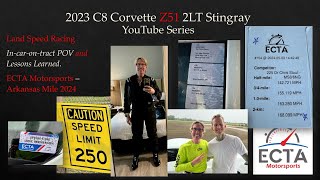
In this 30‑minute vlog Dr. Chris Stout walks viewers through his first foray into land‑speed racing at the Arkansas Mile, using a 2023 Corvette Stingray Z51. He begins by outlining the purpose of the series – to document a beginner’s experience, highlight what he did right, what he missed, and what he would change. The video covers pre‑track preparation (full fire‑proof Nomex suit, helmet, gloves, fire‑proof socks/shoes, and the mandatory tech‑inspection sticker), vehicle readiness (full service, 700‑mile drive, seat‑wheel memory presets, HUD adjustments, tire‑pressure considerations, torque checks, and optional aerodynamic hacks like pizza‑box covers or a car bra). Stout explains the layout of the Arkansas Mile runway, the available distance categories (half‑mile, mile, 2 km), the rookie‑pass system (three qualifying runs), and safety procedures (spotters, flag signals, wind considerations). He details his actual runs, noting a top speed of 168.009 mph, the class he competed in (MS 8.6NG – naturally aspirated, 8‑cylinder, <7 L), and the potential records he may have set. Throughout, he reflects on mistakes (no tire‑pressure tweaks, missed torque checks, accidental burnout, window left open) and what he would do differently (aerodynamic tape, earlier mode changes, better watch setup). The narrative also touches on the broader land‑speed community, the East‑Coast timing association, class hierarchy, and the camaraderie among participants. Finally, Stout previews five upcoming driver‑point‑of‑view videos that will show his arrival, rookie runs, track‑mode testing, and the final high‑speed run.
Chapters
Foreign. Hi everyone, welcome back. Chris Stout here talking about beginning racing in particular with a 2023 Corvette Stingray Z51. In this video after these remarks you'll be seeing things that I did and at the Arkansas mile land speed racing at half mile and 2K distances, things I didn't do, things I didn't mean to do, things I would do differently. Additional things I learned and then the probably the biggest part of this entire video will be the five videos that I shot there doing 168 miles an hour which was great. What it was like when I arrived at the track and getting ready to go through tech inspection, other cars, queuing up what my first rookie run results looked like and then setting things up for being in track mode for my last run. Prior to talking about this I would like you to take a look at if you are interested seriously interested in getting involved at some of the other videos. They're in the links below but I have one about track setup, about driver's gear. This was in particularly important here as well as an upcoming one I'm going to be doing at Road America and what I did at Black Hawk Farms. You need to be in a full fire suit and the kind of the shorthand version of that was to say that no skin can be exposed so I was in a Nomex suit, I had a hood on underneath my helmet, fireproof gloves, fireproof socks, fireproof shoes etc. So they take that very seriously and that's part of the spec or tech inspection as well. Other parts of this might be in particular with the Corvette of specs and tips, the Cosware toolbox, how to get track insurance, etc. Track Prep 2 this is what I call a yellow paper because I have a yellow notepad tabletop instruction about kind of what the steps were with car prep in particular in shop of what it looked like being done under the car etc. And then in car walkthroughs for modes and review and then also prepping yourself. I am a Hammer nutrition brand ambassador and I review some of the things in terms of physical training for this and proper hydration and nutrition. So in particular to land speed racing things that I did I had my car completely checked and serviced before going down. It was a 700 mile over 700 mile trip to get there from where I am in northeastern Wisconsin to Arkansas. And I must say too that car was amazingly comfortable to drive in. You know, still feeling like it's new and still being naive to the car in a variety of ways it was just really a lovely, lovely experience. Carplay was great. Listened to podcasts, listened to music, set the cruise control. Just really enjoyed it. Enjoyed how comfortable it was getting there. Things I did when I was on the track, I never looked at the dash. I was really focused of what was ahead. And your peripheral vision, you keep track of like where you're at in terms of kind of being done. One of the nice things is there's sort of a white patch on the Runway where you're at. And with that, you. You very much have a good visual display of, you know, where you need to get off the throttle and start hitting the brakes. Just a few things about the Arkansas mile as well. You do have choices of a half mile mile or 2k distances to compete in. I'll talk more about that in just a second. It's a two mile long Runway, so you have kind of about a mile runoff. But they really don't want you using those last few feet of that to have to deal with braking. Some of the cars there are so high performance that they have parachutes as well too. And the course itself, you'll see it in the very last video of what it looks like from the driver's point of view is 12 car lanes wide. So that's nice. You really don't use much more than a couple of inches left or right. You don't want to be turning much at high speeds, but that makes you feel comfortable in some sense that it's not narrow, but a little disorienting in another sense that you don't have kind of the typical visual cues you would have driving at highway speeds. I lowered my heads up display. I did not want to have any kinds of distractions. I tweaked my seat and wheel memory. If you have this kind of a car, you know that there's two positions for the driver. You can. And every time you get out of the car, if you have it set up this way, it sort of the wheel goes up and the seat goes back. When I would get out of the car to pop the engine bay or to walk around or whatever, it defaulted back to that. And then when I got in the car and started it up, it defaulted to kind of my touring setup. So I set up a secondary one on number two to kind of properly set me up and speed me up a little bit in getting prepped for each time on the track. So that's a little. I don't know, I'd call it a pro tip, but that just really helped me out and you know, saved me the hassle of not worrying about worrying about a period or taking the time to have to do it. Like I said too, every time that I wasn't queuing back up, I popped the engine bay when I was out of the car just to allow a little extra cooling. Even though this was in May, it was. Oh goodness. I think it was in the high 70s, low 80s when we were running and it was a cloudy overcast day. It had rained the day before, so it gets hot, it gets warm quick. And I sat there and watched my engine temperature as we were idling, queuing up, going from like 175 to 210 in a very short period of time. Other things I did I'm very happy with this. I was thinking I'd be happy to hit 164 from what I've done in my reading and research, but I was able to hit 168.009. That was the fastest I could do and I didn't want to push my luck or break anything since I needed to drive 700 miles back after doing this. And I think I'll update this in the notes below once I find out for sure. They're still, I guess, sorting out the numbers, but I think I might have set two, if not three records. I'm fairly sure about two. These are the different classes which are a tad bit complicated at least for to understand, but the 2k is the 2k distances and then obviously miles per hour past drivers and whatever classes. The Ms. 8.6Ng means that I was in kind of like a non modified modern car class with eight cylinders over six liters but under seven and then naturally aspirated gas. So that's what all the Ms. 8.6ng means. The one above it the 6CF and the one below it the 6 TG. I'm not sure which one's which. I think the 6 TG same everything else except that it's turbocharged and with the 6 CF I think means that it's supercharged. I'll talk more about these classes in a later slide, so hang on for that Things I didn't do I didn't tweak my tire pressures. It was recommended. So these are things to keep in mind if you might want to do this. Maybe drop my tire pressures to 25 to 28 psi to start. When I started getting out the morning after just driving from the parking lot at the hotel, I was at 30 psi at my cold temperature doing my runs at Boosted itself up via friction to about 34 psi after running. And then someone also suggested maybe boosting it up to 38. I had a little electric tire pump and I did not get it out. I did not use that. They also suggested checking torque on the lug nuts as a good safety feature. That was also suggested at Black Hawk Farms on road courses as well. I did not have a torque wrench or borrow one, so I did not do that. Then here's a hack for you. This is serious pizza box and tape modifications. There's a rather popular pizza place where the staff there get pizza during the course of the runs. And people say if you cover up your grill or your air intakes, etcetera, to be a little bit more aerodynamic, that you can usually get at least one mile per hour faster. So I really didn't want to go through doing that. One of my friends that I made there said maybe do the same thing with the pizza box. But since I had a bra on the car when I came down at 700 miles, didn't want any paint chips. He said I could, you know, put it in under that. But that was not with me. I only got to run one day, so that was not able to be done, but. And again, some just really cool cars and bikes. I'll talk about that later. Pardon me. In the upper right hand corner in this slide, it's basically, this is like passing your tech inspection. You get this little sticker that goes in the driver's side lower part of your windshield. Things I didn't mean to do. I accidentally just, I guess with great enthusiasm. After I'd done my three rally pass rookie passes, I kind of hit the gas maybe a little too fast. Even though I had all the nannies, all the traction control, etc. On, I accidentally did a burnout, which was kind of embarrassing, but I didn't mean to do that and didn't do any more after that first one. So just be wary of that. Even with all your nannies on if which they generally recommend to do. And on one of my runs because it gets so hot in the car, I would have windows down in between. And I accidentally left my passenger window down, which was an interesting cockpit kind of experience just with having that much wind and just not the able ability for it to blow through either, because I didn't have the driver's side down. So just make sure. And after I did that, once you learn and you never do that again, what I'd do differently, I probably would add the tape and pizza boxes and especially if I had more time and it was the next day, maybe I would do it instead of tape. I would do it with putting the car bra back on. I probably would fiddle with the tire pressures to kind of see what's what. I didn't change modes until my last run when I was really trying to get 169, 170 without success. But I'd probably mess with the mode sooner. I think I pretty much ran the entire time sort of like in my mode, which was just everything kind of tweaked but nothing turned off. And the final run, I put it into track mode, which I don't think was honestly a whole lot different than what I had otherwise. I have a suntoo sport watch that I run and ride bicycles and do other motorsports. They have a motorsports option. I did that at Blackhawk. It was neat to kind of see what that looked like. You can see that in some other videos, but it was just too much of a hassle. I couldn't wear it on my wrist because of my gloves and fire suit. I had it separately in the car. And it was just one other thing to fiddle with. And it just really didn't add anything to the experience. When I downloaded those you can kind of animate videos, it was just kind of me going in a straight line so that it really wasn't worth it. And I just. I had some family commitments and needed to make that drive back. I did it all in one day after racing for a day. Again, very comfortable. But otherwise things I would have done differently is stay longer and done some of these things. Pardon me, things that I learned. Part one. Why is there a East coast timing association? Basically a lot of guys out east in Gallups would build their bikes and cars wanting to run at Bonneville and get out there, slip their machines out there after days and hours of driving and whatnot and find out there was some something in spec that they didn't pass and then not be able to run. So this gave them an opportunity. If you think about it, if you. If you're doing high speeds, you really don't want to do that on the highway. There's really kind of no other places to be able to do it. So they would rent airstrips to be able to do this. It started on the East Coast. I actually went to my first one as a spectator when it was in Ohio called the Ohio mile back in 2014 or 15, I believe. So anyway, that was great. Now people can kind of do legit test runs, see how they feel, see how they're machines feel, see how they do, see what they need to do different. The car, the inspection that my car went through is exactly the same if I would have been out at Bonneville or anybody else's car or bike. So what's the difference between a standing mile and a flying mile? Flying mile is what you would do out at Bonneville. Where you go out, they have a much bigger miles to be able to do that in distances. And then what you're supposed to do within a short period of time after doing your first run is to turn around and make your run back. And I believe there's also some nuance to this that I'm not intelligent enough to know about with that. So if people have other knowledge about what these details are, please put it in the notes below so everybody can learn from you. But versus what we were doing was the standing mile. So just basically kind of a quasi rolling start. Don't do the burnouts, but then getting up to speed and then not having to make a circle back. So when you've done your half mile or 2k distance that you're going to be timed at and compared to then your kind of done for that, that one, you come back, you don't do turn around, come back that same direction. If you look at the. It's hard to see and it got rained on. But these are the different classes that I was running in that you saw. They, they mimic what we saw in the prior slide with the other record setting. So when you get into these different classes, you can you get these different stickers for whatever classes you're running in. A little note about that. You can run compete in classes higher than yours for a record. So for me a class higher is actually turbocharged or supercharged versus naturally aspirated, which I was. But if I had a turbo or a supercharger, I couldn't compete, so to speak, for a record in classes that did not have that, like the naturally aspirated classes. It just wouldn't be fair. So you can, you can go up higher but not so much down lower. You do three rookie trials. The first rookie trial is at a three quarter mile point. The basic idea is that you kind of know where you're at on the track. Things go by fast. Like I said, you really don't have the orientation on a Runway that you do at these speeds that you would driving on a highway. So what you might see in that corner or the upper right hand corner in that image is the 3/4 rookie, when you've done that and properly turned off, etc. And proper deceleration because they see your acceleration but deceleration, you'll see that in the video too of what that looks like, that tape. They sign off for that and then you do two more runs at the 2k sign off again, making sure that you properly decelerated, properly braked, etc. And when you've done those three total, then you're able to competitively race for whatever ones that you're going for. So three rookie trials take some time, but it's very, very much worth it. I should also say too, before you can even do that, after your car has gone through specific you can go, you need to go, you have to go follow through, like in a little parade lap around to just see where the flags are, see where the turnoffs are, etc. At a low speed at 50 miles an hour, following other cars in front of you to kind of see what's what. My personal on track experiences in doing this, things were good. Generally a little scary. I'll talk about that in just a second. But there was a point where things felt a little bit floaty. You do not want to be turning very much within, you know, these high speeds, otherwise you will flip. And cars like mine have a very flat bottom. It's. And it's that that's a legit thing to be concerned about. So aerodynamics and things like that are very, very important. I noted that after one of my runs they asked me where that was. I really kind of wasn't sure because I was so focused on just going straight and not turning. But I said I think maybe between three quarter and. And then they noted to me that there's a break surrounding the airfield is a, you know, agricultural fields and some woods and there's a break in those woods and there was a wind coming from that direction. They have wind socks and things of course, at the airfield. And there's a little bit of a breeze, they said a seven mile an hour breeze, which I typically wouldn't take think much about that. But that was enough to make things feel a little off. Not as tight and taut as that car feels on a road course or on the street. Talked about the ability to be in multiple classes and opportunities, set records up and down and again back to me emotionally it's scary. I will be the first to admit it was at first I was very anxious. But I will tell you it's good to have the driver's meetings to do the rookie passes, etc. I think that really adds to the safety and then having a much better experience. So if you're anxious at first, don't worry about that. That's just all part of being new and naive to it and getting some experience and some runs. Having said that, by run four or five, I really found experientially that I had an increase in my awareness. My concentration really dialed up. Maybe the little interstitial things that I was worried about kind of went away and I just had this. I felt at ease. Honestly. It felt much more comfortable. And just those few runs is actually just kind of paradoxical of all the things that, that you need to focus on or whatever. There's not to get woo woo. But it was kind of a zenish, very focused flow ish kind of kind of feeling which, which was cool. And I could see that being very addictive and well, I met a lot of people that were spending a lot of money on their cars to go fast. There's a lot going on in the car each round we set up. They're also very nice. They say you could get right up to the queue to hit the gas and if you don't feel right about something or whatever, you don't, you don't go. No car can start until all. Whatever car or bike, I should say, no vehicle can go until the other one is totally safe and off the track. They have spotters to make sure that there's no oil or fluid spills, that nobody's GoPro's cameras falling off, or any other car part that's on the track or whatever. So in that aspect you can really count on them to have a safe experience. For me, you know, I was trying to set up my watch. Like I said earlier, I would not do that anymore. I didn't have a. On my wrist, it was in my cup holder, etc. The PDR, when you first run, you have to set it up to be in learn mode because it considers it a like an autocross course because it's a, like a, not a loop, like a track, a regular road course track. So that you have to deal with that was kind of a hassle. I wasn't sure if I had set it up for some reason in my car that would like, you know, take a minute or more, way more than a minute to kind of reset itself and get back going. And I'm trying to queue up and I'm trying to get my gloves on. It just was very anxiety producing. And then each time that you would Go and do subsequently have to do that. I'm wearing fireproof gloves and my, you know, the touchscreen in the car wasn't accepting my fingered glove, my gloved finger when I pressed it. So I had to make sure my right hand glove was off each time that I pulled up. And it was just really a lot of, you know, weird chaos in the car that, you know, I really didn't expect. Have your windows up. You get really hot in the car fast. Even with clouds in April, 70, 80 degrees. You're wearing a helmet, a head sock and gloves for me. I also noticed that, you know, you've got, you're looking through a windshield, you're looking through the, your helmet shield, you're looking through, I'm looking through glasses. And I was told by my optometrist and I'm also getting cataracts. So my peripheral vision and just really trying to be sharp as to where I was at was also an anxiety producing thing. So those are kind of things to consider. Make sure that everything's all clean and clear and you'll feel much more comfortable with it. But again, you're just kind of mummified up with a helmet, with a head sock, with the gloves, et cetera. And it just, like I said, you get really hot. This is me in the suit. The suit that I got is a one piece and it is, you can run a two piece and also if it' not, I forget what the spec is. But if it's not that proper spec, you have to wear fireproof long underwear in it as well too. So. But go pop for the higher spec so that you can not have to be bundled up even that way because I was plenty, plenty hot as it was. Other things that I learned, what a great community, what great camaraderie, super helpful people. Made new friends, swapped phone numbers, shared photos. It was just, just really wonderful. You will see some beautifully built cars. You will see vintage stuff, you will see oddballs, you will see outlaws, you'll see cars. A few cars like mine that are just kind of showroom stock. A lucid came out there. Showroom stock, four door electric sedan, ran 200 miles an hour. Everybody was blown away with that. That was just crazy. Amazing. And then some other kinds of hacks. It's very popular to have C6s. A lot of parts out there, low barrier to entry in terms of expense. Some people really build them up and trailer them. Other people really build them up and drive them down. I met a, made a new friend from Detroit. He's driven his car back and forth. That's got crazy clever modifications to it. But one of the other ones, a hack, is NASCAR. You can buy a retired NASCAR for around $30,000 and maybe leave what's in in it in it or maybe tweak it out and swap engines and drive trains. But here's an example of just some beautiful chevrolets, some corvettes, C7 corvettes and Camaros that just were burning up the track. And then here's an example of a former NASCAR that was there. It was just really, really cool to see and just for me, lovely to hear. So what comes up next? You'll see five videos, one after the other of me arriving at the track and getting queuing up for spec and kind of what that was like. You'll see the embarrassingly super slow first rookie run printout and stats of what that looks like. You'll see me queuing up and here I think you'll hear it because you'll not be able to hear me of a one of those former NASCARs with a parachute at the back of it queuing up. Then kind of my trying out the track mode and then finally a driver's point of view of my 168.099 mile per hour run.
So this is what it looks like to my trip back. It's 10 hours, is about 11 hours to get here, but 725 miles and I am now in Arkansas. I should have shot this before I am at the track and of course I think I brought some rain with me. Some amazing cars here that have been trailered and I am queuing up for tech inspection. So I'm here, I made it. Hopefully the weather will clear and after all this a few miles at a high rate of speed. I'll be going much slower but many more miles.
Stay tuned.
Okay, back in the car after my first rookie run. And what you do with that is that you go to 3/4 mile and then lift off and you don't have to go, you know, all out to that. Then you get certified for that, that you kind of know where you are at the track and then you come back and do two 1 mile run runs and then that qualifies you to do your official which for me is 2K.
I set.
I hope I got it right for learning the track. And now this time if there's a lot to manage, got my hands full. Then I'll try and do start recording and get a recording of this Rookie two and then rookie three. I may not record and then serious racing.
See after that.
It's not stock.
You just feel it too.
It's really pretty crazy. So I'm coming back for I think what will be my when it's not rookie. I think my fifth run. But this will be the first time that I've been in track mode. That was a recommendation. I had my fastest in just regular regular mode. But I, the last three, the one since my best of 169.99. I can't get past that. I'm floating around 165, I think to 167, something like that. So they suggest to try sport mode or try track mode and see if that makes a difference with my shift points or anything else. So we'll try that.
We'll see.
It's recording. I'll hopefully get it recorded. That's been and inky too. I'll talk about that. And once again Dr. Chris Stout is back.
More from Dr.

2025 Mercedes-Benz CLE 450 4Matic Cabrio – Owner’s Views After a Year-and-a-Half as a Daily Driver

The Complete Guide to a Successful Everest Base Camp Trek – Post-Trek Debrief

The Complete Guide to a Successful EBC Trek – Post-Trek Debrief: What I Needed (and What I Didn’t)

What Went Wrong Customizing My New 2026 Porsche Carrera T …and what I did about it!

Coming May 1 At the Intersection of High Performance and Fulfillment: A Conversation with Alisa Cohn

From High Performance to Fulfillment: Lessons in Inner Mastery with Jim Murphy

Coming March 19: From High Performance to Fulfillment: Lessons in Inner Mastery with Jim Murphy

The New Humanitarians Volumes I - III:- Inspiration, Innovation, and Blueprints for Visionaries

The New Humanitarians Volumes I - III:- Inspiration, Innovation, and Blueprints for Visionaries

The New Humanitarians Vol I - III: Inspiration, Innovation, and Blueprints for Visionaries - Forward
