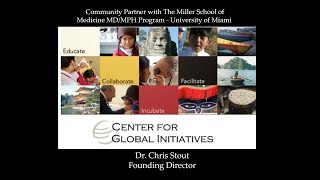
In this recorded presentation Dr. Chris Stout, the founding director of the Center for Global Initiatives (CGI), outlines the Center’s mission, operating model, and its new Community Partner program with the Miller School of Medicine’s MD/MPH program at the University of Miami. CGI’s core purpose is to create self‑sustaining, volunteer‑driven health programs that address global health inequities through an open‑source, tool‑sharing philosophy. The Center functions as an incubator, collaborator, facilitator, and educator, channeling donations directly to projects without taking salaries. Dr. Stout highlights the long‑standing partnership with Thrive in Tanzania, describing concrete outcomes such as a malaria response delivered at $0.73 per life saved and the procurement of an ambulance. He details the extensive free resources CGI provides—medical toolkits, multilingual web content, podcasts, YouTube lectures, newsletters, and downloadable card sets—along with his personal professional background (licensed clinical psychologist, Harvard postdoc, public‑health fellowship, UN service, academic appointments). The talk also mentions CGI’s recognitions (Guidestar Platinum rating, 157,000 newsletter subscribers) and avenues for further engagement (LinkedIn, ISSUU, email). The presentation serves both as an informational overview for prospective student partners and a call to action for broader collaboration.
Chapters
Hi everyone, I'm Dr. Chris Stout. I'm the founding director of the center for Global Initiatives and in this short presentation we'll be reviewing the center and our Community partner program that we're going to be initiating with the Miller School of Medicine and their MD MPH program at the University of Miami. A little bit in terms of the background of the center, it's our mission to help in the creation of self sustaining programs that improve access to health care and and underserved communities throughout the world. It's our goal to open source humanitarian intervention. Conceptually, we see problems that we address as healthcare services, sciences, systems education and research, and that these all suffer from disconnections globally and locally, biologically and behaviorally, and in training and practice. We believe that health inequities are global in scale. However, it's our philosophies, our philosophy, to successfully address these injustices through multiple smaller scale projects with coordinated focus and outcome accountability. We've been endorsed by the great nonprofits and seen as a great nonprofit since 2013. And we hold a platinum level rating from Guidestar, which we're very proud of. Generally, we serve as an incubator for new initiatives that creatively solve healthcare inequities throughout the world. We act as a collaborator with individuals and organizations in developing and launching projects that address the needs of medically impoverished populations. We function as a facilitator in directing public and private resources towards programs aimed at improving health. And we work as an educator to provide information and tools to empower others, which we'll go into in just a minute. The most unique aspects of the center all of the work done at the center is via volunteers, so all tax deductible donations go directly to the work. Myself, I don't take a salary and never have and never will. We serve as a hothouse for new projects. We help nurture and grow and launch them to be self sustaining. Not to be part of our center, but to get them going. To help them get going after a project's taken hold, we can continue to serve as pro bono consultants as long as they need us, along with fulfilling other kinds of needs. I might be providing materials or medicines or case consultations, making introductions to other organizations, what have you. The majority of our projects are the result of being invited to do the work. We don't go select projects when we're not a good fit. When someone comes to us, we recommend a more suitable organization and if we have a contact with that, we'll do an introduction as best we can. Depending on the project. We seek to blend primary care, behavioral health and public health into ultimately self sustaining outcomes, accountable culturally consonant results. So the basic idea is that really it shouldn't be so hard to do good work and helping others really shouldn't be so hard. It should not be so high friction and high difficulty and complication. So we consider this in our heads as open sourcing, humanitarian intervention, making tools available to those who need them in real time 24 7, 365 to be able to scratch the itch they have or solve the problem they have and then be able to be consultative as need be as well too. So I'm a LinkedIn top voice and I write a great deal about the Center's work. You'll see this in a few slides. But if you would like to know more about us, I'll also have a link at the end of this where you can read one of our outcomes looking at what we've been doing, what we're going to be doing and what we'll continue to be doing in this LinkedIn Top Voice article. And then also if you'd like to learn more about us in a more audio kind of way, I had the opportunity to be interviewed by public radio in Chicago, WBEZ and talked about kind of the start of the center and what we're up to. So again, links for that will be at the end. Our primary partner is in Tanzania. We've been working there the longest, since the early 90s actually and it's called Thrive, which stands for Tanzanian Health and Resilience Initiative. Valuing Education. We started off with an educational focus, helping start a kindergarten for children that were orphaned there that has grown since our early days. We're very proud of that. A lot of our funding has gone to hiring staff to helping build structures. What it looked like in the beginning did not look at all like this. And then also our primary partner, Eloise is a steward of our funding. When we provide funding in addition to consultation and sometimes we don't dictate what it is they need, they know what they need. So we provide the funding to be able to. One year there had been a shortage of food, so we helped support with providing funding for grain. Our primary collaborator, Reverend Alois Uru, is also a chaplain at two hospitals. This is one of them and we coordinate through him for provision of medical supplies, nursing, education, telehealth, what have you. One year we had a issue with or we didn't. Well, I guess we did as collaborators, but there was a very problematic malaria outbreak. You'll see an article about this coming up. But basically, of course, it's better to have bed nets, etc. To prevent the spread of malaria, but you still need to treat those that are sick with it. And we were able to do that and do it at a rate of 73 cents a life saved. And this is a shot of the medical supply that we funded. And you'll see a reference to that article to find more details. And then also tip of the hat to one of our volunteers, a very resourceful person was able to source us an ambulance for the hospitals there as well. So again, been able to do a lot with the funding that we have and the talent that we have. So it's our philosophy. This is back to the more asynchronous that it's really a lot about tools. A lot of the things that we have available are certainly fine to googleable, searchable on your own. But that takes time and it also takes vetting, like what's legitimate and what's questionable. So with my background in terms of scientific process and looking at valid measures and reliable tools, this is kind of one of the things that I've leaned into in terms of being helpful with the center. So if you come to our website, you'll find a variety of free medical tools. Most everything there that's bold or underlined is a hyperlink. So again, always free all the time. Come take a look at it. We've also got resources by a variety of different languages and whatever, worldwide. So pour yourself a cup of coffee and you can click around in there for quite, quite a long time. But it's always, it's right there, it's easy, it's one stop shopping. Also on our website we have a variety of YouTube videos, presentations and lectures. This talk that you're hearing now will be added to that catalog as well. So it's always updated, but it's also a nice archive for a variety of different kinds of skill sets. I also host a podcast. At the time of recording this, we're in our seventh season and a variety of the guests on there have a humanitarian public health bent. Professors from the School of Public Health and College of Medicine at University of Illinois, dear friends of mine that are at the Harvard Humanitarian Initiative, etc. A lot of NGOs and topical areas in this space as well. So if you're into podcasts, we're on about 65 different platforms. So probably whatever you enjoy listening on, we're probably on it there as well. So check out our catalog there as well. Back to LinkedIn. In some of the writings that I've done there, we've got a card set that's downloadable called 52 Ways to Change the World. We also have a Facebook group that is free. You're welcome to join. We post very often there on scholarships, fellowships, articles, what have you. Just a lot of tools that we see that want to push forward. And again, we even have a newsletter entitled Tools for Change. It is available via LinkedIn if you're on LinkedIn and it is monthly, comes out the first Wednesday of every month. It's archived on LinkedIn and it's again hypertext filled in a variety of different kinds of areas. As of this talk, we have over 157,000 subscribers, which we're very proud of and would very much like you to join us as well. Check it out again, back to LinkedIn. It serves as an archive of a lot of the articles that I've written and interviews that I've done from the podcast. So some are standalone articles like the Sting of Moral Clarity, for example, Effective Altruism was a podcast guest interview. And then even things like more downloadable tools like Humanitarian Emergency Medical Kit. So and again, this is a sample that I mentioned earlier of some of the articles that I've written. So if you'd like to know more or have a deeper dive, this is the one 73 cents. This is the one about the malaria outbreak that I talked about. I also edited and authored some of the chapters in a three volume set, the New Humanitarians. You can check it out on Amazon. And we also have a book also on Amazon and our website called why Global Health Matters. And we were very fortunate to have Nobel Laureate Jody Williams author the forward to that. So a lot of our work, which I know students listening to this might be interested in publishing. So I've published a great deal in a variety of areas, not just global health, not just humanitarian intervention, but a lot around psychology and conflict and whatnot. So please feel free to look at those. And look, I have a Amazon author site that has all the books there and then I also have on YouTube a seven or eight part series on how to get published from scientific journals to best sellers. So if publishing is something that you have an interest in, again, this is asynchronous and a tool available to you anytime on LinkedIn. Just Google for it to wrap up. If you want to know just a smidge about my background, who I am, where I came from, I'm a licensed clinical psychologist, pardon me, have been since 1985 I did my postdoc at Harvard Medical School in the area of developmental, neurodevelopmental, behavioral, behavioral pediatrics and when I worked clinically, primarily worked with children and families. I did a fellowship in public health at the University of Illinois. I served on the Board of health in my county for over a decade and then I've served on faculty at the Feinberg School of Medicine at Northwestern University and I also was at the College of Medicine as a full clinical professor in the Department of Psychiatry and then also help them start up their center for Global Health. I worked for a year at the United nations through the American Psychological association as a special representative. That gave me an opportunity to meet who became a dear friend and colleague, Harvey Langholz, who is also working at the un. A social psychologist, he did this book the Psychology of Peacekeeping and then he and I collaborated on the Psychology of Diplomacy after I finished my year at the un. So I tried to bring forth a lot of other information in the sense of looking at health from the lens of the Millennium Goals, from the United nations, etc. And this is what I also talk about in the context of having a variety of different seemingly divergent aspects and interests, but really that all kind of come together. And for me it really was kind of triggered by doing my first volunteer project through Flying Doctors of America and then I did a write up of that on LinkedIn. Of course I can't seem to do anything without then doing a write up on it, but my best mistake becoming an accidental humanitarian. So for all the links that I referred to, podcasts, etc etc. I have that in just go to issuu.com and then look at Dr. Period Kristout's stacks. You'll see a variety of different kinds of tools that are available again, all free to you to be able to read there, what have you and click on the links and go directly to them. So I hope that's very helpful to you. I'm really glad to be a part of this new collaboration. So thank you very much for the invitation and having me be able to do this talk. Please do keep in touch. If there's some hiccup or anything with any of the links or anything, just shoot an email to me drchristoutmail and go do great things. I'm looking forward to working together with you. Thanks.