Don’t Take Yes for an Answer: Steve Herz on How to Accomplish More, Help Others, and Do Better Work
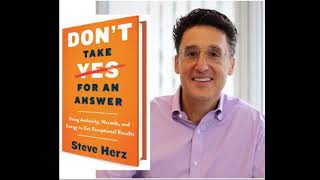
Steve Herz, a sports agent and author, was told in law school he wasn't cut out for the profession. He developed the AWE framework (Authority, Warmth, Energy) to help people communicate better, and explains how it works in person and on Zoom. His book came together after a corporate coaching gig and a chance request at an International Women's Day event.
Chapters
Living a life in full is a conversation you always wanted to have with that person who gave an amazing TED Talk or the author of one of your favorite books, or that inspirational Olympian you always wanted to know more about. It's graduate level conversations with those making a difference in the world and in the lives of others. This show brings you new ideas and approaches so that you can live a life in full. I'm your host, Dr. Chris Stout and I hope you enjoy this episode. This episode is brought to you by the new fellowship and certificate programs now being offered by the center for Global Initiatives. As you may know, the center is an all volunteer organization and the same is true for the faculty in these programs. So all the tuition goes to support the work of the Center. It has always been our ethos to open source humanitarian intervention and these programs use the same approach in that all the materials we use are freely available all the time to anyone, everywhere, even if you don't take a course. We have built a world class faculty and contracts with other universities, medical schools and partnered NGOs. There are two fellowship tracks, one for those wishing to start their own nonprofit or non governmental organization and one for those seeking mentorship for career development and advancement in humanitarian work. Our initial certificate programs include humanitarian intervention, social entrepreneurship and global health practice. Please consider taking a world class masterclass with us. Visit alifeinfull.org and click on the CourseWorks tab to learn more. Thanks. Sure welcome to another episode of Living a Life in Full. I'm your host, Dr. Chris Stout. I've been looking forward to connecting with Steve Herz ever since I first read a piece about his work in Fast Company on a very clever and scalable approach to improving your career, which is detailed in his new book, Don't Take yes for an Answer, which we'll be focusing on in this episode. In terms of background, Steve is President of the Montag Group, or tmg, a sports and entertainment talent and marketing consultancy. He's also a career advisor to CEOs, lawyers, entrepreneurs and young professionals. Prior to joining TMG, Steve was President and founding partner of IF Management, an industry leader and premier talent agency whose broadcasting division became one of the largest in the space, representing over 200 television and radio personalities like CBS, CNN, MSNBC and Fox, and represents some of the biggest names in sports news media, including NBC Sports Mike Tirico, ESPN's Scott Van Pelt and Dan Shulman, and CNN Chief International Correspondent Clarissa Rule. Easy for me to say. Clarissa Ward. Steve received his Bachelor's degree in Political Science from the University of Michigan, and his JD From Vanderbilt Law School. Steve is involved in several charities, including serving on the Leadership Council at Birthright Israel. He has also been a volunteer tutor at the Horizon School at Rikers Island Prison in New York and the Harlem Academy Charter School. Steve and his work have been featured in Entrepreneur, Business Insider, Chief Executive, Forbes, Wharton, Sirius, and a number of other podcasts. Steve is married and has two children and lives on the Upper west side of New York City. Welcome to the show, Steve.
Thanks for having me. Really looking forward to it, Chris, thanks so much.
Absolutely. Could you maybe start off with sharing your background in the context of the feedback that you received when you were in law school?
Sure. Well, I guess it's interesting because it's kind of how my book starts. When I was in law school, I worked for a law firm called Curtis Millay Prevost. It was the summer of 1990. It was my second year. And for those of you who aren't lawyers, you may not know that the way that you get a job coming out of law school is most often by virtue of the firm that you work for in your second summer. It's called the Summer Associateship Program. And most people actually get offers from the firms that they work for in that second summer. At least that's how it was back then. And when I was there, there were 29 summer associates. And it was an interesting situation that at the end of the summer, when it came time to telling us whether we would get the offer or not, I happened to be the last person picked to go into the room and talk to the managing partner. And all 28 other people had already gotten offers. And so I figured I was, you know, smooth sailing here. And the managing partner, a guy named Turner Smith, just. He looked me in the eye and he said, look, you know, we really stress out if we don't give someone an offer. We know it's a black mark on your record. And in your case, it was very easy. We're not giving you an offer. And then he kind of just let down his guard and he said, and I, and I, I guess a lot of people have read the book and said, oh, this Turner Smith, what a jerk. You know, he's so harsh with you. But it was just the opposite. He was, he was so kind to be that honest with me and, and that forthcoming. And he said, look, I like you. You're a good guy. I really enjoyed having you here this summer. You're very popular person. You have a lot of great skills and talents. People like you I don't think you're cut out to be a lawyer, and I don't think you even want to be a lawyer. I think your head and your heart aren't into it. And I just want to tell you, like, I could, I could sit here and lie to you and tell you to go get a job, another firm, or that there are all these reasons why you didn't get it that were because of us, but you just weren't very good. And I think that you have a lot of skill and ability and you should take that in another direction in your career. And I hope you come back here in 10 or 20 years and start a business and come back as a client. And so that was a very, very defining moment in my life.
Yeah, well, you know, I've had David Meltzer on the show, and he manages sports talent, but I don't really feel like I know very well about working as an agent in media. I'm guessing it's a bit different than Ballers or something. But tell us a little bit about that because maybe that was. Is that what you did instead, pursuing law?
Yeah, I mean, I, I, look, it wasn't a direct path. I mean, I still had one year left of law school and, you know, I, I come from a family of lawyers. I, I have two older brothers and a sister who are all lawyers. I have a, my father, uncles, you know, a lot of cousins that have thrived in the law. So it's kind of the family business, you know. And so I, I, I kind of went back to Vanderbilt, reeling a bit from that conversation, but, you know, also not really knowing what I wanted to do at that point, because everything was geared towards that career. And eventually, you know, I sort of had this, I tried to look into a bunch of different things. I went and interviewed for a job with a public defender with the DA's office. And that, that was different than, you know, working in a law firm. So maybe I'd be more passionate about it, but that didn't seem to be a good fit. And then eventually kind of stumbled on this idea of trying to be a sports agent because it seemed like, you know, frankly, I love sports. I went to University of Michigan. I worked for the athletic department. I worked for the sports information department. I was a sports writer for the school newspaper there. So I was very involved in sports and knew a little bit about background. But then that also just seemed like a bit of a pipe dream. I didn't realize how hard it was going to be and eventually got a job Working for a company called Athletes and Artists. And I didn't even know this existed in the world when I got the job. But there was, this was an agency that represented sports and newscasters. And so my, my kind of, my whole world changed because I like this field. I love media. I had done it, like I said, with, with, with journalism and I love sports. And this seemed to be an ability to kind of combine both of those passions.
So how does that work? Is there you get assigned to bring in talent or do you manage the. That's already there and review contracts and get them better gigs and raises or what, what is the, the kind of, the day in, day out, if there is such a thing, or week in week out of the kinds of work that an agent would do in news media and athletic media.
So it's a lot, it's a lot of different things. It's, it's, it's. First of all, you know, back then it was, my job was more like trying to find ancillary opportunities for these clients. So back in the day we represented Al Michaels who was at that point, you know, the voice of Monday Night Football on abc and Chris Berman at ESPN and a lot of hockey players. Brian Leach, who was the captain of the Rangers at the time, or not maybe not the captain, but one of their best players and a lot of other broadcasters. So I was trying to get them speaking engagements and endorsement deals and, you know, commercials and ancillary opportunities. But in terms of the, where my career has shifted since then, in terms of just being the agent for broadcast talent, it's, it's, it's finding them jobs, it's negotiating contracts for them, it's preserving their relationships with their existing bosses and helping to ferret out other relationships for them, creating leverage for them. It's now this day, everything's changed so much in the last 30 years. So we try to find them marketing opportunities on social media, digital media, commercials, endorsements, speeches. There's a lot more to do than there was back then. You know, the world has changed, I think in many ways a very positive way from a commercial standpoint.
So a lot of really kind of handling them as their brand, so to speak, and getting out into other outlets and venues and that sort of thing.
Yeah, exactly. And also one thing that is particularly of interest to me that I think is for me a very fun and rewarding part of the agent business is giving feedback to the client on their on air performance. And that kind of was the basis of the beginning of how I formulated the idea that you read about in the book, this idea about authority, warmth and energy. And it was the prism of which I looked through all these. You know, they were tapes. Back in the day, people had these three quarter inch tapes, these giant tapes you'd watch. And, you know, ultimately you could sell somebody as much as you want to try to get them from Tacoma, Washington to ESPN or from, you know, Iowa to CBS News. But ultimately it was the executive that was popping that tape into their machine and making their own judgment call on whether they thought this person had the ability to do that. And so I thought if we could build a better product by putting a better tape together, the only way we could do that is by giving the client the feedback on whether it was voice or posture or body language or writing skills or energy. Only when the tape got better and the executive saw something they liked more would they be more interested in hiring the client. So that became an integral part of the job and still is to this day.
Well, it seems like. I know that you were quoted on cnbc, you were saying that being brutally honest is kind of what you get paid to do. And part of your job is pointing out, you know, things that could, it's true, hurt your clients. It's true.
Although I would say. What's that?
No, I was just in saying that, you know, that it's kind of your. To point out things that could hurt your client's reputation or perhaps make them better in terms of, you know, how they present, similar to what you're seeing in those demo tapes.
Yeah, but you got to be careful with, with being brutally honest. You got. One thing I've learned over the years is you can't be brutally honest with someone that may not be in a mental framework to hear that, you know, and it's just important to meet somebody on their turf. It's not going to do any good for anybody to, to. To. To hear harsh feedback if they're, if they don't have the right mindset and mentality to grow from that.
Yeah, I think it probably takes a certain kind of development of the relationship that you have with that person in terms of trust and in terms of, you know, what a person's motivations are. And this probably is a good segue into your book. You've alluded to the awe, but it's also part of your subtitle of the book. So again, don't take yes for an answer. Using authority, warmth, and energy to get exceptional results. And I also, in my. I found that your book was nominated. Congratulations to The Next Big Idea Club by really kind of a who's who. Adam Grant and Susan Cain, Daniel Pink, Malcolm Gladwell. So it's really, you know, terrific and I enjoyed your book and just a couple of other little kudos that other people have said. Clarissa Ward from CNN said, with clarity, wisdom and authority, hers outlines smart and sensible ways to achieve success. Sometimes you have to take tough advice to get better. Failure is often the best teach. Hers message is one we all need to hear. And the Chancellor Emeritus and Professor of Law and Political Science at Vanderbilt, Nicholas Zeppo said Steve has written a brilliant book. It's a must read for everyone. No matter what age or stage in life or career. The characters come to life off the pages as Steve mixes humor, pathos, empathy and straight honesty that makes this book one wants to read again and again. At the end of the book, Steve has become your best friend and most honest advisor. So well deserved. Steve, I very much agree with those compliments. So what was the tipping point? It seemed like these are probably experiences that you had kind of on the receiving end back how we started talking about your experience with your law school time. But what was the tipping point to get this down into print and into a book.
So it all started about five years ago. I never really thought I'd write a book. It wasn't, you know, obviously everybody thinks they're going to write a book at some point in their life. And that was an idea I had probably 25, 30 years ago. I had these little notes for a book, but I never did anything with it. And it wasn't something that was at all top of mind. But about five years ago I was turning 50, so I'm 54. I turned 54 in July of this year and I was turning 50. And I said, you know, I don't want to think of like having a midlife crisis per se, but I want to have a midlife calling. What else can I do with my life? I had now owned my business for 20 years. I started when I was 30. It was pretty, it was established and doing well. I, you know, I have been married now for 15 years. I have two kids. My family seemed very stable. I thought, like, what else? What else can I do with my life? I didn't feel like I want to do the exact same thing for the rest of my life, you know, but I like what I was doing, so I don't want to give that up. So I decided I wanted to see if the principles that I was using to help my clients could be applicable to the everyday person, and is there something transferable in that skill set and that prism, which, you know, I was coaching and how I was seeing the world. So I just mentioned it to a friend of mine. She's a lawyer at a bank here in New York, and just mentioned it to her and casually. And she said, I love this idea. This is great. I'd love for you to come in and do some coaching at my bank. And so she introduced me to the head of human resources at this bank, and I met with her, and she said, I like this idea. I want to hire you to coach some people in our company. How much do you charge? And I said, I don't know, because I don't really actually have a business yet, and you're my first customer. And I said, how does this sound as a price? And she said, yeah, that sounds fair. Let's sign a contract. And you got to sign an NDA. And so that was it. And then I started working for this bank. And then it was about. I guess about six months later, I got hired to speak at this International Women's Day. Why they would hire me, come speak to 180 women at an event. I don't know.
There you go.
A woman. A woman heard my speech, and she got up and she. She asked a question, and she said, do you have any copies of your book? I'd like to buy two copies for my kids. It's a great message. I have a son who's 21 and a daughter who's 19. I'd love for them to get your book. I said, I don't have a book. She said, that's a real shame, because this would be a great book. And I. I came home that night. I told my wife the story. It was March 8th, and she's like, well, write a book. You've been talking about this forever. And this only in the last six months since I decided to do this teaching. And I just started typing out these notes of the presentation that I had been giving into book form and was lucky enough to find an agent. And the agent was great, and she got me four offers from different publishers. And before I knew it, we're in this, like, little bidding war. And the next thing you know, I got Harper Collins offering to buy the book. And it was really just very lucky. Like, nothing in life ever works out like that, you know, it was just really fortunate.
It so fell into place, so. So let's unpack a little bit. Great, great acronym awe. Awe. But let's talk about, you've you've mentioned it before. It's obviously the subtitle. Authority, warmth and energy. Did those sort of organically develop in the process of going through your notes and trying to organize your ideas or tell us about how that came about as a grouping and then maybe deconstruct them as what each one, how they play out.
So the truth of the matter is, is that the AWE construct started with an old boss of mine, slash partner, who is no longer alive, a guy by the name of Alfred Geller. And some people who really know the TV business might know his name. He was a legendary TV news agent in the 1970s and 80s and into the 90s. And I was working with him when, you know, it's about five years out of school. And he really taught me how to analyze on air work, really what to look for. I didn't know anything about how to deconstruct this kind of stuff. And he used to talk about someone's strength. That was his word strength. And I didn't think after leaving him and ended up starting my own business, I don't think strength was really capturing what I was looking for in terms of, you know, my word authority is what he would call strength. Right. And then he didn't, he didn't really talk about warmth in the same way, but I kind of added that. And then energy was not something he really focused on. So I just thought like, awe is just something. The whole point of learning is it's got to be easy and memorable, you know, and if someone reads my book or like, we all read a lot of books, right? If I told you to, you know, think about a book you read, what's the one thing you remembered about XYZ book six months from now, even six weeks from now, Often you can't think of anything and there's no maybe osmosis. It gets in there. And you did learn something that's, that's, you know, that's actually actionable later in life. But often it's not. You just forget it.
Right.
So I wanted this, this whole construct to be very, very easy to recall and be applicable.
I think it is. I mean, when you. That's really a nice construct and model to be able to do that of thinking about, you know, okay, well then what is that? And then how do they play out? So can you talk about some of the strategies that you have in the book and share some examples?
Sure. Well, I think for the listener and I think for people, it's just about having a mindset shift, right? It's just about a prism of which you look at the world and what's been really rewarding over these last few years is I have so many friends who've now read the book and know me and they will report back to me. Oh, did you see Biden's speech last night? Boy, he really showed a lot more warmth than he normally does, and I thought that was very compelling. Or did you see this one? Or I went to church and my pastor gave an amazing speech with tremendous energy, much more than normal. He really had awe. Or my kid has a teacher this year and she's got awe, and here's why. So it's just about seeing things through this new prism. And when you start seeing all this communication through this prism, it's very easy to really continue to apply it in your life. And then secondarily, it's easy to apply it back to yourself. Right. If you start to see things you like in other people and don't like in other people, and you're easily, easily able to characterize it, this is low W or high E or low A in the awe construct, then you could turn that back on yourself. And I think it's. If you read the book, you'll see all these categories break down into these levels of small steps and granular things that contribute to one's A authority, W warmth, or E energy. And it would be things like your voice. Do you have a commanding voice and does that connote authority which gives you a sense of competence and influence over other people? Or do people not take you seriously, even though you might have all the substance qualities in the world? If you don't have that stylistic authority about yourself, maybe your body language is weak or you're not emotionally committed to your message, for example, or you look down all the time and you show a lot of hesitation when making a point or you don't inflect. Then you could have all the authority in the world substantively, but you're not going to have it in the room. So, you know, that's. That's what it comes down to. And I can get into it for warmth and energy as well. But this is really the construct. It's just this mindset shift and seeing the world through this very simplistic prism as you approach communication going forward.
I like that. It reminds me, I saw on a CNN documentary about some of the first Ladies, and there was a clip about Mrs. Obama where she had her. Like she was making a point at some talk. I think this might have even been pre election or something and she like had fists and someone showed her, you know, like a photogr of that, you know, a still of it or someone showed it to her with the audio off and it just communicated a much different message than what, you know, her, her intonation and what she was saying were, you know, great and supportive and, you know, wonderful. But the, the visuals, the optics of it really didn't, you know, they weren't consonant with, you know, what that was. And then people could obviously, in political situations distort that to, you know, say other things or make other things about it. So it's, it really is, I would imagine, a lot of the, the talent that you work with, you have all these examples of how someone might come across or, and be able to, you know, point those kinds of things out where it would be very, you know, easy for them to, you know, to be able to understand that and then be able to work on that and tweak it a bit.
Yeah, look, it's, you know, the old saying, what you don't know can't hurt you. That's not true. What you don't know is very much going to hurt you. And this is my principle and my point. And look, I think that the bottom line is that this is true of all of us. Like, I'm no better than you or anyone else listening. I've got weaknesses. There are things I could be improving upon. Luckily, I have a wife who really embraces the principles of the book and she gives me that feedback. So I just feel like this is just, again, it's a mindset shift that hopefully people would undertake to their own benefit.
Yeah. And again, back to the structure of the book. You've kind of put that together in nice self assessment kinds of ways. And it'd be easy to this kind of a book and say, you know, take it as a, as a gospel of thou shalt. You know, to whoever, to your employees or to your co workers or to your family versus a. Let's, you know, let's shine the light on ourselves. Let's take a look at what can I do? How can I role model this? Where are my strengths? Where are my weaknesses? Where I can devote some time to be able to, you know, develop that muscle that maybe, you know, I thought was a. Okay, but now I've gotten feedback from, you know, a trusted other that I can do something with it. Now I have a structure via your book to be able to have some technique and methods rather than just kind of, you know, flail around and try and Figure out, well, what was the problem? So it's, you know, I really enjoyed that, that aspect of how you did that. And it's, it's nice to go back and forth between actionable, specific, I'm kind of a nerd for, you know, bullet points and what to dos and assessments. But then also you play it out, you know, in a full color commentary with the stories that you have as well too. So it's, I really like that, that approach. It's, it's very engaging, very enjoyable.
Right, right. No, I, I, I, I'm glad you feel that way because look, sometimes it's these little tiny things that really hold us back and it's something we're not looking at. And we might work so hard to get that really good degree in psychology in your case, you know, or in law in my case, or accounting or business or medicine. And yet we don't thrive in the field that we chose to the extent that we can because something so off our radar in terms of what we've been learning because it's all about the technical skills. And everything I'm talking about are the non technical skills.
Yeah. So your book was completed and out pre pandemic and pre Work from Home and pre Zoom Mania. Do you, how would you recommend that we adapt some of the AWE tools to more virtual situations that people may be finding themselves in these days?
Well, my book actually came out in the middle of the pandemic.
In the middle. Okay. All right.
So I would say, you know, look, at the end of the day, connection is connection. And if you can, you know, one of the big things we talk about with the warmth construct, the W and R is this idea of connecting with someone and making people trust you and like you and feel comfortable with you. And a lot of that comes down to, am I interested in you? And somebody said this in the book. I thought it was a great line. I used it. They went to go hear someone speak and they didn't like the person because they felt like he wasn't listening to the audience. There's a pretty interesting comment. You think about how can you listen to the audience while you're speaking. Yeah, but if you think about it, you can, you can, you can listen with your body, you can listen with your inflection, with your eyes, with the way you notice people and make eye contact with different people in the audience. So you can definitely pay attention to other people even while you're doing the speaking. And so I think it's just the idea is that whether it's on zoom or on a telephone or in person, you still have tools at your disposal to connect with someone and show that you're interested. Like listening, for example, asking questions, having curiosity, being interested, following up with what the person said in terms of the way they answered your question in a way that shows them that you actually listen to that question and that you ask a question that's consistent with their answer. Not to show you weren't listening and making, even like making eye contact on zoom and nodding and smiling. You can put a thumbs up if you, even if you have your camera, I mean, I'm sorry, if you're on mute. These are all tools at your disposal. It's all about the same principle, just in a different medium.
Yeah, that's good. I forget if it was on another podcast that I heard you on or via the book, but I thought those were really good points to be able to just the simple, you know, thumbs up, you know, that, hey, I'm engaged, I'm paying attention, I'm not the dog's not barking, you know, all these other kind of interstitial things that wouldn't necessarily be happening by the water cooler and in the office setting. So again, I just, I very much enjoyed the, the anecdotes and kind of your history through it. And it seems almost kind of like a full circle. I like how you talked about, you know, the, the book was always there. But it also seemed, you know, from your stories at the beginning about, you know, getting kicked under the table and those things and your experience again back with, with your law school training that to be able to, you know, sort of have this as a little bit of a highlight reel for you that, you know, you've gone, your life has been very rich and very involved with, you know, a lot of interesting people. But then it's not just a sideline kind of thing that you've been able to say, here's where I've worked in this situation, here's what I've observed in that situation and you know, back to the construct. Here's a way that we can be able to help the clients that we work with, but also, you know, better engage with each other, be it family or loved ones or friends or what have you, so.
Right.
I also want to talk a little bit about your personal character, if you don't mind. I mean, these kinds of things aren't in the book, but I really think that you're a person who we are in our offstage lives or who we are in our non professional Persona. I also just want to talk, if you don't mind, a little bit about the Gulf Coast Triathlon and what that was like and why you did it. Sure.
Well, I gotta say, I've done, like, 100 podcasts and interviews. You're the first person to ask me about it, so kudos to you. That was an interesting thing. That was. That was a long time ago now, at this point. That's almost 20 years ago. It actually, you know, emanated from a breakup with a girl, and it was a really tough breakup for me. I was really hurt by it. And I remember, like, it was yesterday. There was a restaurant that I used to go to in New York City called Citrus. It was on Amsterdam Avenue and 75th street, and it was owned by this guy named Louis Lanza, who also owned a restaurant one block south of that called Josie's on 74th in Amsterdam. They were two of my favorite places. Both closed now. And like Josie's so much that it was the last place I ever ate before we had our daughter, our oldest daughter, and her name is Josie.
Oh, wow.
I like Louis Lance's restaurant tribute.
Yeah.
But I was. Yeah. So I was eating dinner at this place, Citrus, with a old client of mine named Bill Patrick, who was, at that point, the host of the NHL on Versus Network. And I was complaining about this breakup, and I. I remember going to the bathroom and I just had this, like, gestalt, you know, this, like, something just snapped in me in a good way on the way back from the bathroom. I was very overweight at the time and feeling sorry for myself. And I said. I came back. I said, bill, I'm turning this into a positive. I'm not going to dwell on this anymore. I am going to turn this into a positive. I'm going to make something good out of all this. And the next day, I went to my gym, the same gym where I met this guy, Alfred Geller, if you read the book. And I ran to this woman named Joan Cohn, still friendly with to this day. This was 1998, and she said she was getting involved with the Leukemia Society team and training. It was a great organization and would I come to a meeting. So I went to the meeting, and they asked for people, they want to. Do you want to run a marathon? Do you want to do different kinds of, you know, bicycle races, etc? And they had this thing. Could you. Would you want to sign up for the Gulf Coast Triathlon? Which was crazy because I was, like, 30, 40 pounds overweight.
Oh, man.
Over this bad breakup And I, and I, and I was also. I didn't even know how to swim. I was a terrible swim.
Oh my gosh.
Really bad.
Gee.
And so perfect.
Just hit all the high notes.
This is great.
Meant to be.
I said, screw it. I'm gonna sign up for this triathlon.
Wow.
And, you know, it was. It was a 56 mile bike, a mile and a half swim in the Gulf of Mexico, treacherous waves, and then it was a 13.1 mile race and it was going to be like 90 degrees there in Panama City, Florida. And so, so, so at the end of this, at the end of this, the session when you sign up for it, I. They had a sports psychologist there, a guy named Bob Litwin. And he takes me aside and I tell him, like, this is crazy. I don't know how I'm gonna do this in May. This was November. I had about six months. And he said, I want you to close your eyes and I want you to visualize what it's going to feel like when you finish that swim a mile and a half in the Gulf of Mexico. And what it's going to feel like when you get off, get out of the water. Really feel it, really see it. And see yourself getting on the bike. And then I want you to see yourself getting off the bike, getting on, getting into your running shoes. And then really visualize what it's going to feel when you cross that finish line. And it's. To this day, it's the most bizarre, crazy thing ever. The exact thing I visualized came to fruition.
Wow.
And I remember I literally cried when I finished the race. And I was. Probably came in like the bottom 10 or 20% of the people and. But I finished and I thought, okay, this stuff works. And I. It changed my life. It changed my life. That was like, it was before that and then after that, everything.
Wow.
And now if, like, if I set my mind to something, whether it's writing a book or whatever, if I visualize what it's going to feel like at the end, I can do all the work to get myself there.
Wow. I'm. I'm glad we talked about that. I was curious about, you know, what the background of that, of the genesis of getting it going and how you went through that. And if my research is correct, I think you were using the, like the most inspirational member of the team in training also. I was. Yeah. See that's. Oh, Steve, that, that's. That's such a heartwarming story. I think it also, again, just kind of speaks to who you are in the, the between the lines aspect of your book. I mean, you, you know, the. On the one hand, you know, it's sort of like the having to deliver, you know, some, some news that maybe people don't want to hear about that, you know, your voice needs some tweaking or your, your gestures need some improvement or whatever, but to do it in a place where I think who you are as a person comes through with such authenticity, you know, that it's not like, you know, a mean boss or a bad professor or something like that. I think that also, you know, is a nice lesson for us to learn to try and mimic and model the approach that you have to how you deal with things. And obviously, you know, how you. How you deal with life, too. So that's very inspirational in a variety of ways. So thanks, thanks for spending time and sharing that story, too. So what. What, what didn't we cover? That still needs to be said, do you think?
I don't know. I think, you know, just thinking about that triathlon story, just to share a couple other little anecdotes with you, is that I think if you have a goal in your life, whatever it is, whether it's, you know, to do a triathlon or build a business or whatever, I think if you talk to people about it and you make it public, you hold yourself accountable to the end result, and you also find yourself with a really good accountability partner or partners. And if you have the right people in your life, a cheering section. And that was something that I also use later on in life is when I told people I wanted to write a book and I really got committed to it and I started telling people about it. I felt like I was. Now, people could care less whether I did or I didn't, of course, but that's not how you perceive it. And you want to be held to your word, so you want to finish that what you started, right? And it was the same thing with the triathlon. And when you have these accountability partners, I just also think it makes your life more fun. You know, I remember I hired this, this, this swim coach when, when I started doing. His name was Boris Talon. And to this day, I can't get in the pool without hearing Boris's voice in my head going, kick Steve in Russian. Kick Steve. You gotta kick Steve. And so I swear I swim a lot. That's kind of an exercise that I still do. And when I'm underwater, if I'm not kicking, I hear Boris. I haven't seen Boris in probably 15 years. That guy owns a piece of real estate in my head, and he always will.
Oh, that's good. I mean, it's. It's neat to have those experiences. I went through a real difficult time in a academic gig that I had, and just for a variety, like, it was just like I was, you know, just stepping on landmines. Everything could go wrong, did go wrong, but I would go back to my faculty peers and kind of, you know, tell a little war story of something that had gone a, you know, direction that I had not wanted it to go in or something that, you know, kind of hope to get an article published. And you got, you know, like a bloody scathing review of it, you know, to do a revision, that sort of a thing. And it was just sort of like, you know, this nice combination of the, you know, you know, kick, Steve, kick, you know, like, you know, come on, you can do this. This is possible. You're. These. These kinds of things happen. You know, you're not the first person to have a rejection or a bad day, and then also what to do about it. So it's sort of like the salve, you know, but then also, you know, get back on the bicycle, get back in the book pool, get back in the. In the game, and, you know, and now, you know, something a little different and that you didn't know before. And it can make all the difference in the world, too. So I. I know exactly what you mean. It's. It's sometimes hard to find those folks. I mean that, you know, nowadays with trolls and things, there's certainly, you know, haters got to hate, so to speak. But to have that, you know, that group of colleagues and friends and family that you can feel to be yourself and transform, transparent and, you know, share some anxieties and fears about, and to be able to get their, you know, heartfelt support back can, you know, get people through very difficult, stressful, stormy, dark times.
Yeah. Well, I'll say you touched on a really important point about trolls and things like that. Support. You know, I've told a lot of people this book is called Don't Take yes for an answer. It's not called Don't Give yes for an answer. So it's your job as an individual who wants to achieve whatever you want to achieve in your life. And that's not for me to decide. You know, there's no glory necessarily doing a triathlon. I mean, who cares, like, great that I did it, but it doesn't change the world. It's an individual accomplishment. Someone doesn't want to do one, that's fine, too, you know, but the thing is, is that you have to decide what you want from life and what your goals are. And it's your job to seek out that feedback. It's not the world's job to give it to you. And often they won't give it to you.
Yeah.
So if you really want to achieve more and you feel like you're not reaching your potential and there's ways to unlock more for you in a positive sense, then seek out that feedback and ask for it. And don't take yes for an answer. Keyword being take. Demand some constructive feedback from people and find people that you trust and that you really know have your best interests at heart. Don't find people to be your coaches who are just looking to tear you down. I don't think that's a very helpful way. Look, some people will tear you down in a tough love kind of way, but as long as there's love there and they really do care about you, then a little bit of harsh feedback is fine. But I wouldn't let that be the totality of the feedback you get.
That's great. That's very good. Well, let's maybe end up on that note. So if listeners want to know more about you and your work, how to get a copy of your book, what are some of the best ways to do so? Steve, you.
Well, you can obviously go to any Barnes and Noble or bookstore. They pretty much sold everywhere. But to find out more about me, I think the best way might be just to go to my website. It's www.stevenher.com S T V N hers.com H E R Z and you can. You can buy the book on Amazon or you can follow me on instagram @steveherz66, or on LinkedIn or on Facebook or all these social media platforms, or just go right to that website and you can click on there to follow me. And, you know, look, if people like what they heard today and they want to get, there's a lot of work to be done with all this. This is not. You're not going to change just by listening to this podcast. You're going to have to learn the granularity of it and figure out what your own personal strengths and weaknesses are. And then I think once you do that, then the work is fairly easy. But there is a few steps to take in between hearing this kind of a message and actually effectuating some positive change in your life. I'm not offering like junk food here. That's easy. There is some work to be done.
Yeah, absolutely. Well, I think the conversation is inspirational and the book can be sort of a toolkit in terms of seeing other examples and getting inspiration from there as well, but then also kind of breaking it down and, you know, where do I start and how do I start to apply this, you know, to myself? So thank you, Steve. You're a very generous person with your thoughts and your ideas and your experiences. And just being able to spend the time with you today was just really a treat. I really appreciate having you on. Thank you.
And thank you as well. I would right back at you. You're a really interesting guy and I really appreciate the time and effort you put into learning about me and really promoting this message. So I really appreciate it.
Thank. You. Living a Life in Full is a production of Stout Media, a subsidiary of Gordian Knot, LLC. Assistant Producer, Gracie Wong Music Dan O' Brien Executive Producer and Host, Dr. Chris Stout to learn more, stop by our website at lifeinfull for show notes and please recommend us to your friends and subscribe on your favorite platform. And as for the obligatory disclaimer, this podcast is for general information uses only and does not constitute the practice of psychology, medicine, nutrition or other professional health care services, including the giving of medical or psychological advice. No doctor patient relationship is formed. Lastly, and perhaps most importantly, I take conflicts of interest seriously. For all of my disclosures as well as show notes, please see livingalifeinfl.org podcast and my LinkedIn profile. Thanks and until next time,
More from Dr.

2025 Mercedes-Benz CLE 450 4Matic Cabrio – Owner’s Views After a Year-and-a-Half as a Daily Driver

The Complete Guide to a Successful Everest Base Camp Trek – Post-Trek Debrief

The Complete Guide to a Successful EBC Trek – Post-Trek Debrief: What I Needed (and What I Didn’t)

What Went Wrong Customizing My New 2026 Porsche Carrera T …and what I did about it!

Coming May 1 At the Intersection of High Performance and Fulfillment: A Conversation with Alisa Cohn

From High Performance to Fulfillment: Lessons in Inner Mastery with Jim Murphy

Coming March 19: From High Performance to Fulfillment: Lessons in Inner Mastery with Jim Murphy

The New Humanitarians Volumes I - III:- Inspiration, Innovation, and Blueprints for Visionaries

The New Humanitarians Volumes I - III:- Inspiration, Innovation, and Blueprints for Visionaries

The New Humanitarians Vol I - III: Inspiration, Innovation, and Blueprints for Visionaries - Forward
