Dr Chris Stout on AI in Healthcare
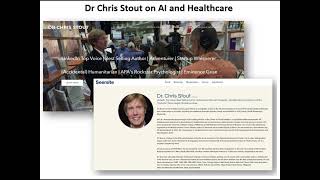
In this interview, Dr. Chris Stout, a licensed clinical psychologist with four decades of experience in healthcare, academia, nonprofit work, and AI‑focused startups, shares his nuanced view of artificial intelligence in medicine. He frames AI and large language models (LLMs) as powerful tools rather than cure‑alls, recalling an early undergraduate program he built to probabilistically suggest non‑psychiatric diagnoses. He highlights AI’s promise in accelerating drug discovery—citing the startup Sandbox that uses AI to prioritize promising compounds and revive orphan‑drug candidates—while warning about bias, sexist or racist embeddings, hallucinations, and the necessity of “adult” human supervision. Dr. Stout stresses transparency and ethical data practices for startups, recommending reliance on publicly available, peer‑reviewed sources such as Cochrane, PLOS, and his own de‑identified patient registries (over 2 million records on ClinicalTrials.gov) for training models. He discusses AI’s current role in behavioral health, from chat‑based triage tools to AI‑assisted scribing, history‑taking, and literature summarization, and envisions future early‑detection systems that integrate genetics, microbiome, lifestyle, and comorbidities. While acknowledging a niche of patients who may prefer non‑judgmental AI interaction, he maintains that most will still value human therapeutic relationships, with AI serving to reduce administrative burden and improve outcomes. Finally, he reiterates that human oversight—continuous validation, supervision, and periodic performance checks—remains essential to mitigate risks and ensure AI reliability in clinical settings.
Chapters
Foreign.
Hi, I'm from Searsight, calling about your AI powered interview. How are you doing?
I'm good, how are you?
I'm doing great, thanks for asking. To get us started, could you tell me a bit about yourself and your background?
Sure. My name is Dr. Chris Stout. I'm a licensed clinical psychologist. I have around 40 years of industry expertise in the areas of healthcare, behavioral healthcare, global healthcare, public health. I've taught at two medical schools, Northwestern and University of Illinois. I started a global health nonprofit and I work right now with a number of startups and in AI and in healthcare technologies.
Wow, that's quite a rich background. With your experience spanning psychology, academia, nonprofits and startups, how do you think this mix shapes Your view on AI's role in healthcare? How does that interdisciplinary angle help push AI's impact on global health?
Well, I think that it's really perhaps a matter of perspective. I see AI, AIs and large language models as being best conceptualized as a tool, really more so than a panacea or an easy button. Way back when, when I first started out in clinical practice, I was really concerned about misdiagnosing someone as having a psychiatric condition rather than perhaps something that was more biologically based in terms of causality or like an endocrine disorder or something like that that would also mimic and present with psychiatric symptoms. I also as an undergrad was a math and computer science major and so I took those skill sets and wrote a very, very, very basic program that would probabilistically consider symptom presentation and then make suggestions of various non psychiatric diagnoses for a clinician to consider. Should they refer them to a specialist or certain kinds of lab tests to help point to a better diagnostic direction. It's really much more of an algorithm than heuristic and it was a tool tool, not an easy button. Your question though concerns a very broad healthcare ecosystem and knowing that prediction is difficult, especially about the future. Like Niles Bohr said, what I tend to work on and write about today stands more of a fair chance of being seen as naive at best or wrong at worst. In terms of the things that I do for LinkedIn as a top voice, for example, writing in this space, so what all I think we should all take with, you know, the applications of these in healthcare is with a grain of salt. So having said that, that's my disclaimer. I think that AI will be a very helpful accelerator in drug discovery in particular. Two friends of mine are involved with a semi startup. I guess it's been around a few months now called Sandbox and they're looking at that in terms of using AI to accelerate promising compounds in the pharmacology space. There's nascent work afoot, as I've done in some of my writings about treating individuals with schizophrenia, for example. With that, there's a number of chatbots that are already being used, but they're not without their bugs. There's a GPT2 and other natural language algorithms like it that are known to actually embed had very racist, sexist and homophobic ideas. So we need to watch out for that, let alone, you know, hallucinations. More than one chatbot was led to stat the disastrously astray in this way and really found that, you know, there's a lot of risks with it, that these things need the adult supervision, I. E. A human being able to manage these things to make sure that they hold the promise that we want and don't go off the rails, for example.
That's a really thoughtful take, seeing AI as a powerful tool but not a magic fix, especially with those risks like bias and hallucinations. You mentioned Sandbox and drug discovery. How do you think startups like that can best navigate these challenges while leveraging AI effectively? Any advice for health focused startups wanting to use AI responsibly?
Yeah, I think that's a great question. I think that there are a variety of different kinds of issues that are involved with that vis a vis ethics and transparency. You know, it's now become quickly become a standard so that what data sets are predicated on some, at some level are public. But you know, I understand from a business perspective you need to kind of keep your secret sauce to yourself, so to speak, but in the context of being sure that there's not gonna be any risk to patients or risk to anyone that's receiving any kind of AI informed HealthC provision that what those things are predicated on, you know, are critical. I've also written just actually second editions of two books of mine with Wiley on treatment guidelines and practice guidelines in the behavioral health sphere. So those books, everything that we have on that are very transparently explained in terms of all the references, all the evidence based practice articles, etc. In peer reviewed journals. So I think that's really kind of a good way to go about doing that for startups that if there are published kinds of databases, again, if you're looking at evidence based practice, evidence based medicine, the Cochrane Collaborative out of the UK is really kind of a standard and anything that comes from a peer reviewed scientific journal in some level is, you know, is public knowledge. Anybody can access a journal and read it. There's in some instances paywalls. There's also public library of science plos, which doesn't have paywalls. But regardless, the data around those kinds of things, as long as the studies have been done in a good scientific method with good scientific rigor, as long as there hasn't been anything nefarious and monkeying around with the data that we can trust the studies. It's hard for peer reviewers to know that there has to be a certain level of acceptance of what's being printed and written about and statistically analyzed as based in truth. So as long as we can have trust and faith in those kinds of areas, I think it'll be very helpful for startups to be able to access those kinds of things. I should, pardon me, also note that I created two patient registries at ClinicalTrials.gov that provides de identified patient data. We had at the last time that I was involved in that project, over 2 million patients. So we had a great deal of data that I would love to see someone with a very clever AI go in there and take a look at the kinds of things that we were doing. We're looking in one, one was on sports medicine kinds of issues and the other one's on orthopedics. So I think there's a variety of data that are out there that are publicly shareable and accessible and transparent enough to know that if someone's putting something together and using it that they can still keep their proprietary kinds of. Maybe their algorithm is what's proprietary and the data is public. But I think those are really good, maybe thoughtful best practices for people in the technology, behavioral healthcare, general healthcare, AI space.
That's a solid framework balancing transparency with protecting proprietary tech while leaning on trusted peer reviewed data. Patient registries like the ones you created sound like gold mines for AI insights. How do you see AI transforming psychology and mental health specifically? Could it help beyond treatment maybe in early detection or prevention?
Yeah, absolutely. I think right now we're in the phase of looking at applications of chatbots. Those chatbots maybe are a prelude to someone getting involved with traditional one on one therapy, or let's call it traditional telehealth kinds of assistance in getting care provided. There tends to be somewhat of a waiting list and backlog in behavioral healthcare and not all people want to deal with an algorithm or deal with a chatbot, but in certain kinds of instances they may be certainly a reasonable prelude to access to regular care. I also work as chief clinical officer for a digital behavioral healthcare company. And one of the things that we do with all of our humans right now we're looking at the possibility of using AI driven chatbots is we record all of the sessions and they're reviewed by human clinical supervisors. So I think that's really kind of a tried and true way, way to test those kinds of things. But I think back to your specific around behavioral health and I would say this might also look to other kinds of health care that I have great optimism that we'll be able to start to fold in other kinds of things for early detection to the point of your question. So perhaps familial medical history, perhaps the individual's medical history, perhaps their genetic circumstance, if they've had like a 23andMe or some kind of genome taking, taking a look at, as we get more data around those kinds of things, perhaps their microbiome, perhaps their diet patterns, their exercise patterns, their sleep patterns, if they have other kinds of comorbidities, do they have endocrine disorders, do they have sleep disorders, have they had stressful kinds of circumstances, are they former combat military where there's those kinds of issues? So I think as we get more data, things will always refine and get better. But I think those are really key critical things. Back to my work with the treatment guidelines projects with Wiley, those data can be transposed into electronic medical records. They can be scrubbed then for diagnostic and symptom presentation that can then give a probabilistic informed treatment guideline that then the live human that is providing the care and supervising any other kinds of technological augmentation can be able to take a look at those kinds of things and agree or disagree to include or exclude that in their clinical notes. The things that most, 100% of almost all clinicians, no matter if they're psychiatrists, psychologists, social workers, nurse practitioners, you name it, we all love working with our patients and the time spent with our patients. We hate billing, we hate the clinical charting, things like that. As we have AI scribes to be able to do that, as we have AI informed treatments, programs and algorithms, as we have AI history takers, all of those kinds of things are going to make it easier for clinicians to spend the majority of their time directly providing care and services, not all the other kinds of behind the scenes mechanics of that. And also those behind the scenes mechanics aren't things that are reimbursable, that aren't billed for. And finally, I'm sorry for such a Long winded answer. Finally, the other aspect is it's really hard for any kind of medical professional to keep up with the literature. There is just such a, you know, deluge of good. There's a number of peer reviewed, you know, top journals out there. There's. It's very difficult for people to even just kind of be up to date in their own lane. Like for me as a clinical psychologist, because there's a variety of other things in other journals that I may not read that would be very helpful to me. I don't read a whole lot of psychiatric journals. I don't read a whole lot of social work journals. So in those auspices, you know, if I could have an algorithm that helps keep me up to d especially vis a vis whatever kind of patient load that I have at any point in time, that's also going to be a huge, huge benefit to me. Being able to provide better care, which will then provide better treatment outcomes.
That's a fantastic vision. AI easing the paperwork burden, helping clinicians stay current, and even flagging early risks by integrating all those personal and medical data points. Do you think there's a risk AI could ever replace the human connection in therapy? Or is it more about enhancing that relationship? How do you see the balance?
Well, my bias is that, you know, I'm a human, so I have, I'm going to have a human bias. I am also a technologist, so I like technology as well. My ideal world would be humans managing it, having that human relationship. There's certainly a lot of science fiction stories and movies and things like that about having relationships with your technology, relationships with your AI. We tend to use human pronouns with them as they or her or him rather than it. So I think that kind of speaks to maybe our anthropomorphizing technology like we might also do with pets and whatnot. I think there's be a certain popular, certain niche of population that would prefer perhaps the anonymity and feeling like an AI doesn't necessarily judge them, whereas a human might. So they might have more transparency and openness and honesty about answering questions that might otherwise make them feel like they're being judged if it's done by a human. So I, ideally, I think there will be a sub population of people that will just prefer the AI as long as the AI is good and under some kind of human supervision and oversight. Wonderful, that's great. And if they get good benefit, then I'm all for it. I think the majority though of people would probably still like to have that human kind of connection, be it via telehealth or traditional, you know, face to face kinds of things. But then for the improvement of treatment outcomes and benefit of the patient and for the getting rid of a lot of the mechanics and hassle of running a practice for the clinician, those are all very beneficial things that in the long run will improve outcomes, improve patient satisfaction, clinician satisfaction and efficiency of care.
I love that recognizing AI's role as a non judgmental space for some, while still valuing the human connection for most. It sounds like a real partnership rather than a replacement. Switching gears a bit, you mentioned Sandbox earlier in AI Driven Drug Discovery. What do you think the biggest potential is in that area?
Oh, gosh, I couple things. I think at one level we'll probably see if there are data that are being made available through Big Pharma that the lot of things that we might call orphan diseases will be taking will blow the dust off of certain kinds of medications that maybe were thought not to be robust enough to go through the different phases of clinical trials to get FDA approvals. Being specific to the United States with the Food and Drug Administration, I think that there's a lot of black box application or I should not black box but off label use of medications. I think if there'd be a way of tracking that with large language models and large databases and big data science, that we'd be able to start to see that there might be other applications that have good therapeutic efficacy with maybe very small populations. I don't know from a business perspective if that would give pharmaceutical companies an interest in trying to bring those kinds of things to market or just simply, you know, show that they do have drugs and compounds that might have greater utility in other areas than what was originally known. I can't help but suspect that that's the case. I know from way back when there was a drug that showed therapeutic potential in African American males for sickle cell, but it wasn't generalizable enough. It seemed like I'm fuzzy on my specifics, but there wasn't enough generalizability to bring something like that to market with the data that were available. So I suspect as more data do become available, maybe through Patient Regist, that that we'll see a lot of potentials for companies like Sandbox and whoever's going to come up in the future to perhaps be in that same space or competitors with them to see that we will have those kinds of opportunities. Circling back to the work I do with in global Health with my nonprofit, I think that'll be a huge benefit for neglected diseases. I know the Gates foundation has worked a lot in that space and area. I know that David Fagenbaum, who is a prior guest on my podcast, has done that with Kasselman's disease. So I think there's a variety of other kinds of medication utilizations for other kinds of diseases that, you know, just there's not enough scientists, there's not enough lab time, there's not enough time to wait for things to happen, to go through live human clinical trials versus digital human modeling that will kind of help sift out against negative side effects as well as greater likelihoods of successful compounds which then like if you had 10 potentials, but your AI said out of these 10, three really look like great potentials, then you don't spend time and money and effort and years on all 10. You forget about those seven and focus on those three.
That's a fascinating insight. AI helping revive overlooked drugs and speeding up trials by narrowing down the most promising candidates. You also touched on risks earlier, like iatrogenic effects. What do you think can be done to improve large language models so they minimize harm while maximizing therapeutic benefits?
Well, the easy, simple one is just human supervision, as I sometimes refer to it as adult supervision. That things that are done, like I mentioned, with the models that we use that prevail with humans, not with bots or AIs. Yet it's just been that we do provide that kind of level of clinical supervision by virtue of looking at the summaries and recordings of the interactions that are held. It's hard for people to do that at scale. It's hard to do that in a clinical practice if it's a group clinical practice. It's hard to do that if you're in a single clinical practice. Because who's supervising you? Some people do hire. Even senior level people will hire other senior level people to deal with difficult cases, but maybe not the they are challenging cases or risky cases, but they don't necessarily do that, you know, with the majority of their cases that seem to be going fine and maybe you don't need to do that. But I think, you know, as, as the technology and things get better that, you know, we will, you know, maybe need less and less human supervision and have greater faith, trust and reliability in the AI models. I mean, it's the same thing. Just think about an X ray or a blood test or anything like that. You know, they need to be vetted, periodically sampled to make sure that references slab data are correct, that you could have two radiologists look at a CAT scan and have three different opinions. So that's just kind of part and parcel of the. It's, it's the science of healthcare and medicine, but it's not a, you know, a perfect science. So there can still be a certain level of art that gets brought into it, a certain level of experience and expertise that gets brought into it. But again, maybe that's not a great example because AIs do probably an amazing job in managing, doing interpretations of images. That's probably one of their strongest suits. So I think that all of those kinds of things will start to get, or have already started to get better and better. And I see no reason to think that that's ever going to diminish. But I don't know if we'll ever reach, you know, great, you know, perfect fidelity. Maybe we will reach perfect fidelity with humans because humans aren't perfect either.
Adult supervision really does sound like the key. Keeping humans in the loop to catch errors and guide AI safely. You made a great point about medicine never being perfect. So maybe AI just adds another layer of expertise. Before we wrap up, do you have any questions for me?
No, this has really been great. You seem very informed around the topics as well. And I think these are very important things, not just in the practice and teaching of medicine and healthcare, but also in the whole investment side of things. Because any of these kinds of technologies, while holding great promise, it's important and incumbent upon investors to be able to kind of have, you know, initial abilities to separate the wheat from the chaff of where they're going to invest their dollars that is actually going to create companies that will do what they, you know, say, claim that they think they can do and have success and scalability in doing that. So thanks. Those are really well inform questions. I've appreciated this time today.
Thanks so much for sharing your insights today. It was a pleasure talking with you. Take care. Of.
More from Dr.

2025 Mercedes-Benz CLE 450 4Matic Cabrio – Owner’s Views After a Year-and-a-Half as a Daily Driver

The Complete Guide to a Successful Everest Base Camp Trek – Post-Trek Debrief

The Complete Guide to a Successful EBC Trek – Post-Trek Debrief: What I Needed (and What I Didn’t)

What Went Wrong Customizing My New 2026 Porsche Carrera T …and what I did about it!

Coming May 1 At the Intersection of High Performance and Fulfillment: A Conversation with Alisa Cohn

From High Performance to Fulfillment: Lessons in Inner Mastery with Jim Murphy

Coming March 19: From High Performance to Fulfillment: Lessons in Inner Mastery with Jim Murphy

The New Humanitarians Volumes I - III:- Inspiration, Innovation, and Blueprints for Visionaries

The New Humanitarians Volumes I - III:- Inspiration, Innovation, and Blueprints for Visionaries

The New Humanitarians Vol I - III: Inspiration, Innovation, and Blueprints for Visionaries - Forward
