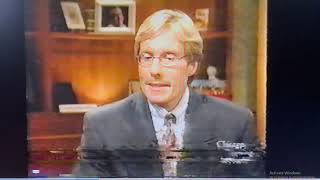
Dr. Chris Stout, a psychiatry professor at UIC, discusses a report finding major gaps in Chicago's mental health preparedness for terrorism. The core problem: mental health professionals, police, journalists, and community leaders don't talk to each other. His solution involves mapping connections, convening a conference, and shifting focus from treating pathology to building resilience and coping skills.
Chapters
Know how to deal with it emotionally. According to a new report from the University of Illinois at Chicago, there are serious gaps in Chicago's commitment to address public mental health regarding terrorism. Joining me is Dr. Chris Stout. He's a clinical professor of psychiatry and on the faculty at the center for Humanitarian Response to social catastrophe. Dr. Stout, thanks for coming in tonight.
Thanks. Pleasure to be here.
That's a mouthful. Tell me what that is. International center for Humanitarian Response to Social
Catastrophe, a center at UIC in the Department of Psychiatry that has been founded by Steven Wine, a psychiatrist there. And it was really Steven's brain power and horsepower behind that center to help deal with things that now have come up in the context of terrorism. It wasn't originally developed for terrorism. It certainly fits within that scheme.
We mentioned that there's a gap, according to this report, in the city's commitment to mental health when it comes to terrorism. What is the most serious gap?
Specifically, from our perspective, the issue is really a disconnection between a number of people that you might think already have connections together. We've certainly seen on the good side of things, fire and police and those types of disciplines working well together. But one of the things that we had found that was relatively unique through a conference that we had had back in June at the university was that mental health professionals, journalists, the media, police, Red Cross, clergy, we're not having dialogues together about how to respond to these kinds of issues.
Now you're talking about during normal times or during times of extreme trauma?
During any time, certainly, I think the extreme trauma, the threat of terrorism, the anniversary date of 9, 11, I think, certainly highlights that. But even under times of normalcy, these groups and constituencies and stakeholders within different communities typically don't have conversations with one another to develop dialogues and connections when something untoward occurs.
So how do you link them all together? What do you do?
Well, there's a variety of different kinds of things. Our initial start at this was really as in the academic model was to find out kind of what is existing out there, where are there some linkages already, what might need to be done, where are the areas of need, where are the areas of success that we can build upon? And through this two day conference that we had, we found that there were some constituency groups that had, you know, some recognition of one another or what have you. But our goal was to be able to have these people provide a venue for these people to be able to meet and discuss and wrestle with some of the difficult questions concerning Chicago in particular and Illinois at large, dealing with
the general public, as you have been quite a bit since 9 11, what do you find people are struggling with most?
It. It's been very fascinating. I've been doing a lot of talks at libraries and public venues around these kinds of things. And one of the things that's been critical is what do I do as a person? I'm worried about certain kinds of things. Am I being paranoid? Am I being overly worried? What kinds of things can I do as an individual citizen or a person within my community to kind of take a little bit of control back?
When we talk about how we've changed since 911 and how we're affected by 9 11, don't you think there's a huge difference between what's happening here in the Midwest and what's happening in New York? What's happening in Washington, D.C. what's happening in Shanksville, Pennsylvania and how people feel? What have you noticed?
Well, I think the, you know, the public recognitions and the public ceremonies are certainly in those places for obvious reasons. And I think the. Where there has not been that kind of a terrorist attack that you don't see those same kinds of things occurring, which there's, you know, positives and negatives to.
We're a bit removed.
Yeah. And I think that's part of it. I'll tell you though that on September 11th there were three facilities in the Lake county region that contacted the local Department of Mental Health, Public Health to get services provided to them because they had losses there. Morgan Stanley Dean winners. One example.
You say that we need to be better prepared for stress and to handle stress in general, both small and large stresses in our lives. Can you elaborate on that a little bit?
Sure. Typically within psychiatry and psychology, our history is always working with problems and being very problem centered, problem focused and probably to a fault, more pathologizing different kinds of things and working with those kinds of problems. With this kind of a model in this era, the idea is to look on building resilience and strength in individuals that you could be stressed by these kinds of things and have concerns and worries. But the idea is to be able to teach people different kinds of skills. People that don't have a mental illness, people like you and I that can have concerns about these things, but be able to get resources, to be able to learn how to cope, deal with things with our children better, those kinds of things.
Talking about resources now, on our website, we have posted about a dozen almost different sites where you can go for personal help.
Can you generalize what these sites are? These Websites are wide variety of different kinds of things, but they've been the kinds of things that people have been asking for. So there are issues of how to deal with things psychologically and emotionally. They're how to stop your house in case of any kind of an emergency, be it a terrorist attack or be it a power outage.
Now, are these sites that have not been widely publicized, are they being used?
They have been. Most of them have been very widely publicized. They do. I was talking earlier that there's not a Good Housekeeping seal of approval, but they're government sponsored sites at professional organization sites. So there are sites that people can go to and trust the content on them to be helpful for those.
You just go to wttw.com talk for a minute or two here about the difference between the way we are now and the way we were last year and what you see happening as the years go on from 9 11.
Yeah, it's variable. I think the world did change on 9112 years ago. Not just the United States, I think, but certainly the global world and certainly specifically here in Chicago. I think that we'll see people respond to it differently in different kinds of ways depending upon the nature of what it is that they do, how they manage their own kinds of stresses. I think people, you know, some people, it's important to recognize anniversaries and have respect for that. It's not appropriate to be in denial or to minimize those kinds of things. But it's also, I think appropriate to, you know, to not focus on them too much to the point of becoming upset or obsessed with.
And what do you say to parents of school age children as far as watching all of these observances and commemorative ceremonies?
The first thing depends, widely varies by age. But I would certainly first suggest that parents talk to their children to see if they understand what it is that they're seeing. Teenagers, you know, probably certainly do, but maybe younger children don't understand. They might not understand is this something that just recently happened or what's going on? And I think it's appropriate for parents then to perhaps use some of the resources through WTTW.com's websites to see how can I what's the most age appropriate way to approach my child to have a discussion about this? Some parents themselves may not feel very well equipped to talk about it may stimulate emotions in them as well.
Dr. Stout, thanks for coming in tonight. Appreciate hearing what you have to say about all this.
Great to be here. Thank you.
And we will go next to the sports page on Chicago tonight.