Helping Different Brains Around the World Dr. Chris Stout Interview
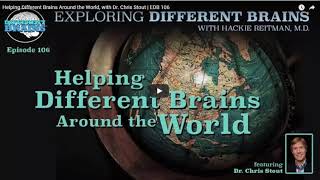
Clinical psychologist and humanitarian Dr. Chris Stout discusses how gut health, diet, and exercise reshape the brain, and why mental health is foundational to ending poverty and building peace. He shares his work with the UN and a kindergarten he started in Tanzania, arguing that we need to act now rather than wait.
Chapters
The following is a production of Different Brains. Visit us@differentbrains.org.
Hi, I'm Dr. Hackie Reitman. Welcome to another episode of Exploring Different Brains. And this guy today I want you to meet. I was so excited when I started reading about him and I contacted him and I said, wow, a modern day renaissance man. So I'm going to have to read this because Dr. Chris Stout was deemed an international rock star by the American Psychological Association. I can't wait to ask him what the hell that means. That's great. He's a clinical psychologist, he's a philanthropist, he's the founder of the center for Global Initiatives. He's the vice president of research and data analytics for atr. From helping organizations succeed to being a best selling author speaker to founding a kindergarten for orphaned children in Tanzania, what am I going to do today? I think I'm going to open an orphanage in Tanzania. Chris, welcome to Exploring Different Brains.
Thank you very much Dr. Hacke. It's great to be here.
Let me tell you, this is a big honor for me. It's not often I even hear of people like you. It's like amazing, all this stuff.
Well, you're very kind. I mean it takes one to know one, my friend.
You're too kind. Now why don't you introduce yourself to our audience the way you would.
Well, thank you. It's good to be on your show. I'm a clinical psychologist by training 30 some odd years ago. Prior to that, also have a undergrad degree in architecture and kind of came from very humble up. Undergrad degree in architecture and kind of came from very humble upbringing. Divorced folks. Lived with my mom first part of my childhood in urban Dallas and lived with my dad second half of my childhood and adolescence on a rural farm. And I think sort of all those things maybe kind of came together to teach me a lot of different kinds of things, but certainly gave me an interest in winding up in psychology and then looking to see how I can apply psychology from the clinical side, the humanitarian side and the research side to various and sundry kinds of problems.
So at what point did you realize that it's all about the brain?
Gosh, probably in undergrad the classes that I took had a, you know, like the traditional kinds of things. You'd learn Freudian, you'd learn Jungian, you'd learn behavioral, you'd learn this and that, Skinner and whatnot. But I took a comparative psychology course where parts of rats brains and saw what kinds of impacts that that had. And then I really sort of had this appreciation of the mind, body, interconnection. And looking at how I remember this wonderful cartoon that said nature, nurture or anybody's gifts. And I always felt it was sort of a combination of those kinds of things because regardless of upbring, regardless of conditioning, there's still always going to be the impact of systems and the brain, obviously in that instance, upon how people process information, upon how people emotionally experience things and how they develop their relationships.
Tell me your impression based on what you just said of the gut brain connection.
Well, I, I am feeling like I'm kind of on a trajectory of getting education about that a lot more than I used to. I was at a conference last year and learned for the first time, I'm embarrassed to say I never heard this in percent of serotonin is produced in the gut. You know, I always sort of presumed it was not in the gut, if anywhere. So. And I've been reading a variety of things, just as recently as yesterday about the impact of the microbiome and impact of diet and impact of probiotics and things like that on managing not just things that people would think like IBD or something, but also psychological and emotional kinds of issues. Anxiety. Yeah.
I was amazed when I started learning. I interviewed Derek McFabe from up in Canada, who's one of the world's pioneers in gut brain. And it was an amazing journey to start learning about that. How the. I think a New York Times article, they quoted my old classmate Tom Insel, who used to be director of the National Institute of Mental Health, as saying, the flora in your gut says more about the wiring of your brain than your genes, than your genes. You know, it's like fecal transplants. It was a whole amazing thing. And then a light went on in my brain that, you know what, it's all, all of these factors that many of which you can control really affect the neuroplasticity and your ability to rewire. And it's become my opinion, which is why I started differentbrains.org that all of these different entities, whether you call mental health issues or neurological issues or developmental issues, from Alzheimer's to autism and everything in between, all the same tools seem to have a profound effect. Whether it's exercise, a good plant based kind of diet, socialization, the most underrated thing, you know, good relationships and diet, nutrition, activity socialization, it's not brain surgery, but diet, nutrition, activity socialization. It's not brain surgery, but it does affect your brain.
Yeah, yeah, I think it's. You raise an interesting point because I think oftentimes in graduate programs or medical school that people become very reductionistic and we like to have real simple, you know, black, white, ab kinds of relationships. And it's sort of like the more the proverbial cliche of the more we learn, the more we realize we don't know. But I feel more hopeful to the points that you just made in terms of a more interdisciplinary, cross collaborative kind of perspective of looking at all these kinds of body systems. Before there used to be sort of this dichotomy with psychology was the non medical version of psychiatry and vice versa. And now I think, you know, when you look at pediatrics, we look at oncology, you look at gastroenterology, all these kinds of things, we see the combined effect.
I can tell you I got zero training in that. And I hope the worm is turning now. Now I'm going to segue here a little bit because on the site for the center for Global Initiatives, I just want to read this. This caught my eye because the last guy I heard talk like this was a way back, I took a two week course in Washington D.C. in orthopedic pathology when I was still in medical school by a guy named Lent Johnson, who was an iconoclast and he was head of the Armed Force Institute of Pathology. And he saw the whole prism of the world like this. I'm quoting from, on the site for the center a quote. Health is perhaps the most common denominator in a region's potential for success as it is so intertwined with economic sustainability, poverty, preventing war, mitigating violence and fostering social prosperity. Can you expound upon that in terms of acceptance of mental health and everything we're talking about here?
There is a fellow, Jordan Kaslow, who is a ophthalmologist, and he was really sort of the inspiration of that perspective on my part. And one of the things that he talked about was looking at this. This is sort of really, again, being holistic in a different way. We talked about just now being holistic and looking at a person as a system. But when you look at cultures and you look at regions and you look at places in the world that are hot spots, there are systems as well too. And oftentimes the socially disenfranchised, the marginalized, the abused, the stigmatized are those that have mental health kinds of issues. Oftentimes there's very little empathy. And this isn't just a developing place, unfortunately, it's a global issue. Some places are more accepting and more open than others. Some people are more accepting and open than others. But I had worked at the United Nations 1998, 1999, and one of the things that I worked on was, was the aspect of looking at mental health and substance abuse vis a vis sustainable development. And sort of the argument or the thesis that I had in that, which relates back to the quote that you very generously used, was that without mental health, there is no health, so to speak, that issues of you can be needing this kind of assistance regardless of whatever kind of circumstance you're in. And if you're not getting that, it's going to be hard to be a good parent, it's going to be hard to be a good worker, to be a good parent, it's going to be hard to be a good worker, it's going to be hard to be a good contributor to your community or to your tribe or whatever. And it makes it really, ironically, I think, a fundamental aspect of being successful in every other aspect of one's life, Even if you're, you know, biologically, so to speak, or physically fit or healthy, if you, you know, are suffering with debilitating chronic clinical depression, you're not going to be able to go work, you're not going to be able to support a family, things like that. So that's the kind of aspect of what that point was trying to get to.
What was your inspiration in getting into this whole arena of psychology and brain? And also, I don't know if it's related to this, but I suspect it is. In your case, how did you expand your circles of concern to include the whole world?
Oh, gosh, you have good questions, I guess for me, curiosity, wondering how, how things tick, what makes, you know, if you look at the positive psychology kind of thing, you know, what helps people to be happy and productive and energetic and good partners and good parents, etc. And the pathology side of it, what, you know, what goes haywire, you know, what are the kinds of things that could be avoided and prevented? What are the kinds and prevented. What are the kinds of things that could be mitigated? What. The kinds of things that have opportunity to have clinical impact and improvement on. So in my line of thought, I really can't separate, you know, the behavioral from the biological, the emotional from the brain, so to speak. So again, I just saw that as being very synthetic, very interwoven, very part and parcel of one another for the global part of it. I've written in places that I kind of refer to myself as being an accidental, humanitarian, kind of a Mr. Magoo if you will. You know, sort of walking off of one I beam and fortunately landing on another one. Because I would love to sit here and tell you, you know, I had this great plan, this great trajectory. It was very linear. I was going to do A and then B and then C and then D, and it wasn't that way at all. When I started off as a first year graduate student, I imagined myself as working with adults, as outpatients, and by the time I finished, I was working with children. And it was good to have a plan in a trajectory, but I found other things that I found more satisfying and enjoyable and good work. The same with the humanitarian sphere. I through the World Economic Forum and through flying doctors, going on a mission and doing other kinds of things with other people who became friends, it just sort of pulled me into that area. I mean, the. Honestly, the genesis of starting the center was based upon a climb that I had done 15 years earlier in Tanzania with a fellow that I met that was working his way through seminary as a porter. And he and I kept in touch and one thing led to another. He was a friend. I wanted to help him out. And one of the results of helping him out was helping to form the kindergarten that you mentioned in the intro. So I didn't plan that. I didn't, you know, it wasn't on my goals and bucket list. It just organically evolved by virtue of having a friend in need and me having some other friends. On this side, state side, they're able to be of help. On this state side, they're able to be of help.
So you have global ADHD. And you're a doctor.
It's a dose of OCD probably too.
Yeah, but you're a dot connector. You connect all the dots and when you meet somebody new, you connect that dot to your already existing universe. That's tremendous. You know, I was very hearing what you said. There used to be this dichotomy between the medical field and the psychological field that the psychologists don't have to know the anatomy and everything. Now my daughter Rebecca, who's my hero, who's inspired the movies and books and everything, who's 35, she, to go along with her discrete math degree from Georgia Tech, she's about halfway or two thirds of the way through her master's in applied psychology and one of her favorite courses I don't think existed way back then, which was biopsychology, where you. And now with the modern scans, you can see them light up and everything. So that gulf has been crossed now. And Now I think there's better communication between a psychologist such as yourself and the organizations and what I hope is going on between them and the MD community and psychiatrists and neuroscientists.
Yeah, I think you're right. You're spot on. I mean, there's, I think, a much more appreciation with programs and things that are looking at the impact of neuroscience. There's a. I'm not conversant in it at all. I'm just aware of it that looking at neuroscience support for psychoanalysis, analytic theory, which I think was, you know, sort of revolutionary, and I think your point about, you know, kind of make building bridges, you know, if you think about the biopsychosocial aspects, I think it gets to your earlier point of the whole of culture and social aspect to it as well. And we see psychologists working in medical settings, you know, elbow to elbow with different kinds of specialists and nurses and whatnot around treating oncology patients, etc. I just saw a headline in Medscape yesterday that talked about brain imaging determining who's going to be a good surgeon. I thought, wow, that's an amazing application of that. So I think again, just the more that we start to learn, the more we see maybe creative applications of diagnostic tools and things, the more we're going to make better decisions and be more informed about how to create change.
Well, Dr. Chris Stout, you're pretty amazing. Now, you're one of the few people I've met who actually worked in the un. What's the biggest thing somebody like me has no clue about the un?
I, with the un I had, I work with a colleague, Harvey Langholz, who's a social psychologist at the College of William and Mary. And he had a very in depth relationship with the United Nations. This was back when Madeleine Albright was Secretary of State and she was kind of his boss while he was there. And there's a, to my, I did not know this. To my surprise, there is a perpetual position at the United nations for someone in the military, which almost seems a little oxymoronic. But he was from what I think is sort of like the Kindler kinder and gentler military, which was the Coast Guard. So it seemed very fitting for that. So he and I got together. He had written a book called the Psychology of Peacekeeping. We got together and wrote a book called the Psychology of Diplomacy. And again, the work that I had done was looking at, in the diplomatic scenario of looking at sustainability. And now this was, and now this was late 90s, so there weren't Millennium Goals Yet. But now, what we see in the Millennium Goals of the kinds of things where psychology and behavioral kinds of issues and mental health kinds of issues can have a seat at the table and have an impact. So those are the positive kinds of things. That's my love side of that equation. Hate's too strong a word. But the frustrations is that the United nations, like a lot of other large bureaucratic, complex systems, are very slow to move. There's a lot of politics there, as you can imagine, as there is in any other kind of large institutional circumstance. And it makes it very frustrating for people like myself and the colleagues I was working with to feel like you're, you know, getting. You felt like you're making very incremental change. It was going in the right direction, but it was, you know, you. You become very impatient after a while to try and see the kinds of things that seem so obvious and have great agreement. But the application in terms of being able to make. Make significant change and change was a. Like a Sisyphusian, if that's a word, kind of challenge. It's just two steps forward, three steps back.
Sisyphus. The myth of Sisyphus. That's a good analogy. You know, the analogies to the aircraft carrier taking three months to turn 10 degrees. I used to make that analogy when, you know, I was an orthopedic surgeon and then started recruiting the best people I could find from around the country. And we ultimately ended up with like, five offices in three counties. And we were acquired by a publicly traded company. And I stayed on as CEO for a couple of years. But it was amazing that the stuff you could get done as like a PT boat, you know, throw it in reverse, shoot a torpedo. But, man, when you get in those big bureaucratic things, it's just going to have to turn and drive you crazy. And meanwhile, people are suffering and injustices go on and on.
Our website is one of my most inspirational books by a economist, William Easterly. And he's kind of one of my heroes. And he wrote a book kind of playing off the title of White Man's Burden. And in that book, he talks about the problems of large bureaucratic systems, whatever they might be, to affect change in a quick kind of way. And really supported and fostered the idea of smaller, more agile, more guerrilla, if you will, kinds of whatever, NGOs, non profits, people working as individuals, people working together in groups to be able to create change in the proverbial, you know, saving that starfish on the beach, you know, as opposed to maybe you can't save all of them, but you made a difference in the impacting the one that you did save.
Care to tell us more about your family and children and.
Sure, I'd love to. My wife Karen and I just celebrated
your family and children.
Sure, I'd love to. My wife Karen and I just celebrated our 32nd anniversary. So that's wonderful and great fun. She's also a clinical psychologist. We met in graduate school. I have two children. My son is 22 years old and finishing up his undergrad in statistics at University of Illinois, and my daughter is 19 and finishing up her sophomore year at the Business Honors Program at University of Illinois.
Why don't you tell our audience how they learn more about you? How do you get in touch with you? What are some of the places they can go?
I would be happy to be of help. Probably the easiest portal to a variety of other kinds of links is my website, which is simply Dr. Chris Stout. No punctuation, so just DrChris Stout.com and there's a way to put in a thing in there to be able to email me. You'll see links to LinkedIn and people can read about some of the things I do there. I curate a lot of information on LinkedIn, so the kinds of things I was just now talking about, I mean, I did a piece probably about a month and a half ago on biohacking where I talk a lot about biome and whatnot. So that would probably be the easiest. But once you get in there, then it's kind of a person's choice. I've got a channel on YouTube, I'm on Twitter, I'm on Instagram. Our center is centerforglobalinitiatives.org we have a lot of free tools and resources and downloadable books and chapters there. And I just launched about two months ago a podcast myself. So it's called Living a Life in Full and it's on itunes and we have a website for that too that you can link in through the drchhrisstout.com site.
What is that podcast about?
It's about every kind of like a podcast magazine. So it's things that right now, as I guess some number of podcasts start off with, I'm interviewing colleagues of mine, friends of mine that I think have done some amazing kinds of things. So I'm a runner. So the very first show is on two physical therapists who one's a marathoner, the other's an ultra marathoner and talking about avoiding injury and coming back from injury. And how do you even start a mile run if you've Never run before, etc. Most recently, this show's not up yet, it's in post production. But it's a wonderful young man named Colin O'. Brady. And Colin is known for doing something called Project 7 2. And that means that he has climbed the Seven Summits, the tallest mountain on each continent. I've done three, he's done seven. I did the easy ones and he's done the all of them, the major ones. And then he went, because that wasn't enough, to the normal in 139 days. So I encourage people to listen. Not everybody. Every episode might not be someone's cup of tea, but I guarantee you that there's going to be something interesting and definitely inspirational in every episode.
Is there anything, Chris, that we did not cover that you'd like to cover or talk about or get information out about to our audience?
I think you've done a good covering of the Waterfront. The only thing I would add is just I would encourage people that, you know, if you have that, that itch that you want to scratch of being helpful or contributing or doing something in the world. There's a lot of need out there and I would encourage people to not put that off. I used to talk about what I called the pox of the untils. Oftentimes people will wait until they lose five pounds, or until they graduate school, or until they get divorced, or until they get married or until they retire. Then all of a sudden they've squandered what could be a wonderful enriched till they get divorced or until they get married or until they retire. Then all of a sudden they've squandered what could be a wonderful, enriched life by virtue of just putting things off. So I would just encourage people to get out there, take a first step, try something out. If it works, terrific, congratulations. If it doesn't, try something different and look to resources that are out there to be able to help do it. I part of the reason for our center is to say it shouldn't be so hard to do good work in the world. So part of what we do is to try to take some of that pain in the neck stuff out of it and provide a lot of free resources and tools for people to be
able to use well. Dr. Chris Stout, humanitarian, psychologist, rock star of international psychology, global leader, we thank you so much for spending time here at Different Brains with us.
It has been a distinct pleasure and it's my honor. Thanks so much for having me. Exploring Different Brains is a production of Different Brains. Exploring Different Brains is a production of Different Brains, Inc. For more information, Visit us at differentbrains.org for more information, visit us at differentbrains.org.
More from Dr.

2025 Mercedes-Benz CLE 450 4Matic Cabrio – Owner’s Views After a Year-and-a-Half as a Daily Driver

The Complete Guide to a Successful Everest Base Camp Trek – Post-Trek Debrief

The Complete Guide to a Successful EBC Trek – Post-Trek Debrief: What I Needed (and What I Didn’t)

What Went Wrong Customizing My New 2026 Porsche Carrera T …and what I did about it!

Coming May 1 At the Intersection of High Performance and Fulfillment: A Conversation with Alisa Cohn

From High Performance to Fulfillment: Lessons in Inner Mastery with Jim Murphy

Coming March 19: From High Performance to Fulfillment: Lessons in Inner Mastery with Jim Murphy

The New Humanitarians Volumes I - III:- Inspiration, Innovation, and Blueprints for Visionaries

The New Humanitarians Volumes I - III:- Inspiration, Innovation, and Blueprints for Visionaries

The New Humanitarians Vol I - III: Inspiration, Innovation, and Blueprints for Visionaries - Forward
