How has the Pandemic affected the Mental Well-being?
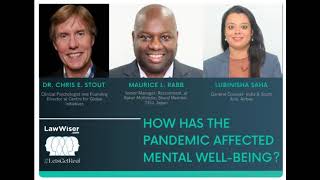
Maurice Raab moderates a panel with clinical psychologist Dr Chris E. Stout and Airbus General Counsel Lubinisha Saha on how COVID-19 changed mental health in law and aviation. Airbus set up hospital-bed databases and on-site counseling; both panelists say stigma around mental-health days has dropped and leaders are more empathetic. Dr Stout notes U.S. schools now widely accept mental-health days and tele-health has broader acceptance.
Chapters
Mental health is a subject that has long been pushed under the carpet, especially where the legal industry is concerned. Lawyers are expected to manage tremendous amounts of workload and stress at the same time make it look like they're in control and on top of their game at all times. Any signs of vulnerability could be viewed as a deterrent to performance, client confidence and career growth. In the run up to World Mental health day on October 10th, Lawweiser is curating a campaign called LetsGetReal. They're bringing together speakers from across the globe to speak on mental health in the context of the legal industry. This panel discussion is a part of that campaign. For those of you unfamiliar with lawweiser.com, they are India's first video only knowledge sharing platform for the legal community. They connect all stakeholders of the industry including practicing lawyers, GCs, legal tech innovators and other professionals. Law Wiser aim is to transform the creation and consumption of legal context through engaging and impactful videos. Thank you Law Wiser for putting together the hashtag let'sget Real campaign. My name is Maurice Raab and I'm the moderator for today's panel. In my day job I am a Senior Manager for Recruitment in asia for Baker McKenzie, but I wear another hat. My other hat is I'm a board member for TEL Japan which is a mental health based MPO based in Tokyo, Japan. TEO has an English language suicide lifeline and also has a clinic. Joining me today on this panel are Dr. Chris E. Stout, clinical psychologist and founding Director of the center for Global Initiatives and Lubinisha Saha, General Counsel in India and South Asia for Airbus. This panel discussion is on how has the pandemic affected mental well being? During this discussion we will explore several topics such as the impact of the pandemic on mental health and strategies for coping with mental health generally. I'd like to start today's panel by sharing my pandemic story. Every listener here, every one of you listening right now, I know you have your pandemic story as well. I'll start with my pandemic story. As for me, last year my mother passed away due to complications from COVID 19 when she first took ill. I had recently relocated from Tokyo to Hong Kong and at that time due to the uncertainty with regarding travel with regarding spread of the pandemic or the virus, I was not able to return to the United States to see her before she passed and I was also not able to return to the United States for her funeral. Needless to say, that is a very stressful Very, very stressful time. However, given the work that I'd done with Tell Japan, given various mental health initiatives that I'd done before, and the community and support that I have, I was able to reach out to friends, family, other professionals to help me through that situation. Additionally, I took advantage of Baker McKenzie's employee assistant program for counseling and for guidance on how I could grieve. Of course, today I'm still grieving. I'm still getting over the passing of my mother. However, I know that I'm not alone. And one thing that I hope that you understand and learn through this panel today is that you are not alone, that we are not alone, and that there is someone to listen to you and to help you through the mental health or through any mental issues that you may be experiencing. And with that, I would like to turn it over to our first panelist, Lebanesha, to hear a bit about her story and why this topic is so important to her.
Super. Thank you, Maurice. That was, I mean, my condolences. And I can't even begin to imagine how difficult that must have been for you. I mean, we hear of this, but to actually experience this is quite something. So I'm glad you're fine. I'm glad things are better now. So thank you for the introduction. My name is Lubinisha Saha, a lawyer by profession. I am the general counsel for India and South Airbus. I'm based in Delhi. You know, being a lawyer comes with it. Multifaceted hats we need to wear in house plus otherwise, right? So I always, in my introduction say I'm a slash person. So I'm a mother of two boys. I'm a lawyer. I also have my own pursuits of, you know, doing things, whether it's creative paintings or writings or whatever. So it's. It's multifaceted and slash. So all of that helps me keep sane or insane, whatever it may be, to get through my day. My pandemic story is again of loss of not very close ones, but people who we knew, people who we could personally connect with, friends, family. India was really badly hit, especially in wave two, and it was at one point in time, every day in the morning, we were looking for hospital beds and looking to see how we could help both professionally and personally. So it's been a nightmare in terms of getting through those times on a personal space. I myself had to underwent a separation, went out to live with my boy, set up a home on my own, and all of this happened during the pandemic. So it was all of that coupled with work, coupled with staying afloat, coupled with trying to, you know, sort of be positive about most things. So it's been a journey and I'm glad we're on the better side of yesterday and hopefully things will only get better from now. So thank you. And over to you again.
Thank you. Thank you, Luminesha, for that introduction and thank you for the condolences and for sharing your story. Going through the challenges, particularly of a separation and dealing with that during this very challenging time is off the charts. Off the charts stressful. Thank you. Next, I would really like to turn it over to Chris. Chris Stout, Dr. Chris Stout, for why this topic is so important to you.
Yeah, thank you. Thank you for the introduction and again, also my condolences and sympathy for your circumstance and situation. I know that it's a very trying kind of thing to lose a loved one as close as a parent and then have it be exacerbated by the pandemic is just something that we would have never, ever thought to have to go through. So my heart goes out to you. Background for me, as you mentioned in the intro, I'm a licensed clinical psychologist and started off working in psychology and that tended to migrate. I worked in hospital settings a great deal, started to I've taught in a variety of graduate programs, but most recently at the College of Medicine at the University of Illinois and got to work there in the areas of global health and emergency medicine. I recently did a talk and a presentation on moral injury and looking at the F aspects of COVID and what a lot of people in emergency rooms and emergency departments were having to deal with. Also, about 12 years ago, I founded a nonprofit called center for Global Initiatives, and in that process we do a variety of global health work and information sharing and education and training. And with the pandemic that really kind of became front and center. We've developed a variety of different kinds of on our website, downloadable tools and materials, books, chapters, podcasts, videos, et cetera that deal with global health in general. But also now some specificity with regard to Covid and the pandemic, how to deal with it, everything from epidemiology to treatment to management. More specific in my background, how I came to that was that I was always involved in public health and general medicine and health. I was a public health fellow. I served on a board of health for about 10 years. So a lot of the aspects of understanding mental health issues and issues of stress and loss and grieving and depression, as well as anxiety in these kinds of times when people really don't have an experience to go back to has been really kind of critical. We've also developed a newsletter that's weekly on LinkedIn. We have a wonderful readership of that. We've got over, I think 125,000 free subscribers to that. And it's become very pandemic focused again with tools and latest news from vetted reliable kinds of resources, which is one of the other problems. I'm sure we'll mention today that there's a lot of misinformation out there and a lot of information that can create greater anxieties unnecessarily and mental health kinds of issues. So I'm happy to be a part of this panel and looking forward to our conversation.
Thank you for that. I took a lot of notes. There's some, definitely some follow up questions that I do want to ask you a little bit later, you know, maybe go a little bit off script. But thank you for sharing that. To really start kind of a general question in a little bit of a positivity in this time, I would like to hear from each of you some preventive measures or some initiatives that you've seen organizations take, whether it's your organization or some of the organizations that are, that are noteworthy that they've taken to really deal with the mental well being of the professionals in their specific organization. So perhaps start. Get one from the legal industry. From Lubonisha. We can start with you. Sure.
So, you know, I come from aviation and it's one of the sectors which got hit like really on the face. Right. Because it completely. We weren't prepared because I mean aviation was always there to stay. So it really, really hit us. So we, you know, we had a crisis management team, much like many organizations do. It was a working group and in, in the multiple parameters we had to look or look after, one was obviously protecting our people. Right. And then of course our supply chain and focusing on the customers and giving them some business continuity because there were still flights on rescue on operations, medical relief, etc. And then there was the bit about doing Covid relief for the nation as well.
Right.
So I think all of these things were happening together. So in terms of the organization, what they've done, I think it was really very well received by the employees overall because everybody was running across Facebook and WhatsApp and getting misguided by multiple layers of information. So the first thing we did was we put a repository of all the data which means you could actually search for a hospital, hospital bed, availability of medicines, etcetera we also had like the pre screening piece, which means Covid tests at home. You could have someone come in and help you if there is no hospital beds. We even had ICU at home facilities wherein somebody would come and create ICU set up at home because hospital beds were scarce in India and it was a nightmare to even get one. So, you know, it was this entire cycle of pre screening during COVID critical care and not just for the employees, but for the overall family, including insurance coverage, etc. So all of that really helped. From an organization perspective, we did a lot with regard to Covid relief for the country. I think we tried and sourced a lot of oxygen generators, concentrators and one unique thing I think from the industry perspective was we used our ferry flights, the flights which actually come for delivery as sale to customers, filled with medical relief equipment and oxygen generators and really helped. So I think a summation of all of that kind of gave people the confidence that it was okay. We did have a lot of cases between our various sites, but it was still manageable. We managed to get space for everybody looking after them, etc. So it really helped. And during that time we also set up something called a well being week. We had a counselor available where people could reach out to and different sets of conversations and panels to be able to reach out and make yourself accessible. So yeah, I think a multitude of all of these kind of helped the organization and helped employees and the overall ecosystem in that regard.
Yeah. As a follow up question, I'm curious if you have you seen any sort of change in attitudes toward well being or being able to talk about mental health issues pre Covid and now particularly in your organization?
Yeah, no, I agree. I think the overall eq, the emotional sense of thing has gone up. I see managers much more empathetic to most questions. I see flexibility very open now as a topic, you can work from anywhere and it's fine. Right. And just the availability to take a day off it. For example, my team would say I just can't work right now. I mean there's no reason. It's wave two. Everything is fine. But I just, my brain is clogged and that's fine. Take a day off. Right. So those conversations didn't exist earlier. The fact that you have, you can make space for your own mental well being is something which is, you know, it's well regarded today in an organization. And that to me is pretty much a change from what was, you know, a passe as a conversation going forward.
And Dr. Stout is this something that you've also seen from other organizations, you know, not only in the US but perhaps globally?
Yes, absolutely. To start with the local in Chicago, there's just been, you know, schools are starting back in the US and there's now been a number of school districts that have sort of quote unquote, allowed for what they call mental health days for the students. And I think that's, you know, kind of speaks to, you know, what Airbus is managing. And I think globally and internationally, we're starting to see that as well, too. It used to be, at least in stateside, kind of a cliche or a joke to say, you know, I just, you know, whatever stress is going on in my life or I'm not feeling so great or whatever emotionally, I don't have a fever. I'm not, you know, sick or anything like that in a physical way, but I need a mental health day. I think that's now become much more open, much more appreciated. I think perhaps there is, to your question, the first thing that popped into my head, that one of the benefits of the pandemic, if you want to call it that, is that there's such a decrease stigma or an increased empathy around mental health kinds of issues. Everybody in the world deals with stress and anxiety and depression at some point in their life. And at some point it becomes not very manageable where we need to reach out and go to an EAP or go to a trusted colleague or go to some kind of professional. And those kinds of things that we took for granted before the pandemic, where you can't just easily make an appointment or you can't just go home and visit someone, as we've heard in the stories already today, that being able to have not just working from home, but being able to take advantage of telehealth, teletherapy kinds of services, I think has also become much more widespread globally, certainly in North America. But then also not just the technological accessibility of it, or the insurance coverage of it, or the employer provision of that, but just also the acceptance of that. Because the other side of stigma is not just not reaching out, but then when you do that, to see that it isn't going to be something that you're going to be embarrassed about to talk with your human resources folks about, well, do I have this as coverage or do I have telehealth, or do I have these other kinds of things that people, I would speculate pre pandemic, even if they were dealing with those issues just on whatever other personal basis would have been too inhibited to go out and do. And so I think there's much greater acceptance, much more widespread appreciation that these are part of the human condition pandemics exacerbated. And it's nothing to be ashamed of.
Yes. And I've really found interesting your point about the mental health day, because definitely being from the US myself, I've always said, oh, today I have to take a mental day, health day.
Right.
And sometimes in Japan, they don't. Like, my Japan colleagues are like, I don't get it. What is a mental health day? Why are you taking it? And I'm like, well, you need to recharge. Right. Some of the best athletes, sometimes they have to sit out a game. Right, Right. Because, you know, it's a marathon. And to have that peak performance, sometimes you have to recharge. You have to, you have to detach and really recharge yourself. Well, Maurice, just go ahead.
I'm sorry. Just to say, you know, the other aspect of that is the cultural differences. We have cultures, you know, in Japan in particular, that focus very much on working yourself to death, literally. I forget what the word is. There's a word in Japanese for that. And then also the culture of our companies, you could be in, you know, in the most accepting, greatest benefits. You know, there's a lot of places stateside that offer unlimited vacations. And the studies that look at those places, people rarely take them, you know, because there's a corporate culture of, well, you don't do that, you know, and that we're always on, we're always on our phones, we're always checking. There's an article in the Wall Street Journal over the weekend here that talked about the always on culture of always checking our emails. And even if it's 11 o' clock at night, I gotta check it one more time. So I think, I hope that we'll continue the positive aspects of corporate cultures to be able to say we do need a time off. We do need to take a break from our screens, from our emails, from our responsibilities in a sense. Not that we're not coming back, but just we need to, as you said, like an athlete, you know, need to have a recovery period so you can come back into the game and be able to perform well.
Right. And what you were saying about the culture really, really resonates with me, particularly as a lawyer and as a person working in the legal industry, because it pretty much is a whole industry that has that culture. Right. And because legal is very competitive, a lot of partners, a lot of lawyers are afraid if I don't respond now, if I don't talk to the client now, the next person will, right? And the next lawyer, the next person will go and take that deal. So I do think that there definitely needs to be a lot more conversation in the legal industry, especially about when is it an emergency deal, when is it not, when is it a bet the company kind of deals with. And I do know that some in house counsel, and I would like to hear from Lubanisha there, I do know that some in house counsel are being explicit with their attorneys, their outside counsel, and saying this is not a stay all night task or this is not a have your junior associates spend the weekend doing this. I know you want to provide good service. This is something that you can provide to us on Monday or Tuesday. Really realize that this is not an urgent math, an urgent matter. And then that gives the attorneys at least some permission, hopefully they take it to not burn them in that oil or not take all weekend to do that task. Is that something that you're seeing in India or that you advocate as well as a gc?
Yeah. So, Maurice, I think culturally, the way law firms work and the way you've been used to is everybody builds a buffer. So if your boss has given you a day, you add another day, and then by the time it gets to the person doing the work, he has to deliver it yesterday. Right. And it's just bizarre because nobody really wants it till day after. Right. And it's this mad chain of working and especially service providers. I would go beyond law firms and even law firms, they just, they have this pressure, right, to serve the client, to retain the client, to ensure that they don't go anywhere, to show that they're doing all the work, they're burning the midnight or it's. And frankly, you don't need to. Right. So when I sort of talk to my, you know, panel law firms, I'll say, I need this really urgently. I don't need these two things, but I need something substantive at this point in time. And maybe if you want to talk to me, whatever, it's fine. But though the ball has moved, but the overall pressure still remain to be able to show that they are working and show that delivery is happening on time. And even though they have sort of moved to a work from home, flexible environment, but I guess the pressure, there's a long way to go for it to be really realistic. I think it's. That's still a journey we need to undertake, especially in talking about Asia Overall, Right, right.
And I wonder with that, you know, Dr. Stout, looking at, we did talk about some of the things that are, that are happening, like the mental health days and some people using the employee assistant programs. But what are some of the. Because we're still in the midst of it. But what are some of the kind of short term and long term aspects of the pandemic that you will have that you think will happen on the mental health meaning, like right now we're still in the midst of it. And what's going to happen a year or two from now? What are some things that we can look out for or be ready for so that we can start to prepare for that?
Yeah, that's a great question. I don't know if I have as great an answer as challenging a question. I think that it's important and incumbent upon all of us as leaders, as followers, whatever roles we play, to be able to say these are some of the beneficial things that we've been able to bring forth from the pandemic. We can think about it in the context of a public health way, general healthcare kinds of things. What have we learned from this? If you're a hospital, if you're an emergency room, et cetera, from the medical side, but then also from the corporate side, from working at a legal firm, if you're in the leadership there, what are some of the things that we can now say we've learned from this? This is time limited. We've gone through it and we've been there, we've done that, that's that. But I suspect there's a variety of other kinds of things that may be systemic to the leadership. To say these are better models. As Lubnisha talked about, it's okay to work from home. I mean, some people, you know, depending upon what your industry was, if you're wr, that was no big deal to work from anywhere. But if you're an attorney, it may be, well, I need to show up at the office, I need to have face time. I need to be the last person out of the office, otherwise I'm not going to make partner, et cetera. So those kinds of things I think have started to have a little bit of a seismic shift across most all industries, law certainly included. And it becomes then important that those that are not in leadership positions don't start to slide back to that, you know, because that's going to be a very slippery slope and a very tempting kind of thing. I want to make partner, I want to get a promotion. I want to, you Know, do get, you know, get a raise, whatever. I want to be, you know, the star here because everybody in law, you know, everybody's an overachiever. You know, you work really hard to get through school, to get your job and to be successful there and do good work. Typically we associate that with FaceTime, with being there, with showing up. I think that if we find that we can be just as productive, if not better. Like to your point about having that recovery time, I think that's important. I think the other aspect then on the leadership side is to say we need to have open door policies about whatever it takes, pandemic be damned. No matter just day in, day out of, how can we better support our employees? A lot of leadership, I'll tell you, not everyone, but a lot of leaders felt like when someone had a mental health issue, it was that, that was a weakness. They just needed to buckle down, work harder, pull themselves up by their bootstraps. There's a ton of cliches around that. And I hope that stigma, that bias, that error in thinking has now been kind of put away, but we'll continue to need to work on that. So if we frame it perhaps to leadership to say what increases productivity, what decreases absenteeism, presenteeism, what decreases turnover, we're seeing that that's going to be our next dilemma of people leaving their jobs because they, for whatever reasons, I would say that mental health is probably one of the critical factors of that. What can we be helpful with, with, you know, Maurice, you would know this vis a vis recruiting and retaining people as leaders. And I would say, at least in the top three, and I'm biased, I'm a psychologist, it's going to be mental health and wellness issues.
Yes. And I am very curious because you did say one of the things that really stuck out is the leadership and leadership's my attitude and how they deal with it. I am very curious, Luminisha, how you as a leader sort of model mental wellness and for your team. So that's a two part and then two, what are some recommendations or strategies you could provide to other leaders in the legal industry, particularly in house or law firm and particularly in India?
Sure, no thanks for that. I think, you know what Dr. Stout also said about the open door policy resonates. Right. So what I've done for my team is I've not just for my team for, you know, mostly for women because in the organization diversity is a challenge for my industry. Point number one. Point number two, given the pandemic, the merging of the Roles have happened. And for most cultures where women take a lot of stress with regard to home, the lines have merged, even for me. I mean, there is the boys, there's home, there's work, and it's kind of all the time, every time, all over, right. The stresses have changed in a good way, bad way. That's debatable. So I think conversations have to keep happening. So I've opened up my calendar for conversations where any woman or anyone actually in the organization who wants to speak can just reserve a slot and come and talk. It can be as innocuous as, you know, I had a bad day and nothing really went right. It can be something about your career. So opening conversations, I think is number one. Number two is overall empathy. Right. So when we have the CEO or someone addressing all hands or all legal fraternity, the empathetic tone, even if it's returned to office, right. The fact that we are open to, you know, creative solutions, we are open to the fact that not everyone needs to come to office. If it's IT engineer who's doing coding, maybe he can do it from somewhere else. Or if it's like an engineer who has to work on the aircraft, maybe he has to come.
Right.
So the tone of empathy is very important across, across the organizations as well. And then just keeping the conversation alive, right. Taking a day off if you need to, some wellness conversations. And we even try to weave in some of these in our day to day. So for example, if you're having an off site, we had someone talk about mental health issues, in fact, a couple of days ago, just talk about this and making it very normal, making it very open. And if we are talking about it, so can the teams and so can everybody else. And so can everybody else. And kind of has a cascading effect within the organization and to all your external stakeholders as well, be it law firms, be it otherwise. So I see, I see the ball moving, I see the conversations happening. And organizations are increasingly absorbing this change and trying to do things which is going to benefit overall, well being of a person. So I see that and I think it's a good thing,
kind of. Do you think it would be helpful for some leaders to, I won't say necessarily mandate, but strongly encourage some of their team members to take that day off. Right. Like sometimes I know someone may feel like it, but if you are engaging in those conversations and you can maybe feel the energy isn't quite there, you think it would be okay, the leader say, hey, your energy doesn't seem quite there. Maybe Take a half day off or maybe take off Friday or something like that.
Yeah, we need to get there. I think the right thing.
Okay.
Need to get there.
Whether everybody will react in that way is yet, is yet a journey. But people are saying, let's go have a coffee, right? I think you need to take some fresh air. Let's go, like just take a walk and do something or, you know, whatever. I think the right conversations are happening. But are we mature enough to say take the day off or take the week off? Maybe not just yet.
Yeah, well, hopefully. I really hope we get to that level someday. And I do want to sort of go back and dig into some of the initiatives that you're working on. Dr. Stout, with the MPO, obviously, being an NPO board member, I have a heart for MPOs and anything that is mental health related NPO, I'm all in. But if you could share one or two things that you think have been really impactful during the pandemic. You listed a lot of stuff before, but I'm just curious, is it the newsletter or some other initiatives that you have been really impactful during this time?
I think probably the newsletter is probably one of the key things. It's global. It's very much, you know, when people do want to seek out information, people want answers quickly. You know, how many, you know, think of yourself. When I'm on Google, you know, I don't want to go to that second page. You know, I want that first page. I want, you know, maybe two or three things. I don't drill down, you know, very far, whatever. And if it's something that's healthcare related or mental health care related, or because of our family or because of our work or because of our colleagues, we don't want to make decisions. Had a family member, a cousin who have two young girls, and we had a lot of conversations as family members about should their daughters get vaccinated and is that really safe and when is it right? And the hard part, as both of you know, and probably a number of people in the audience, is that with these new kinds of diseases and the epidemiological data takes a while, there's a lag to be able to catch up. And we've seen, you know, with the CDC in the United States and the World Health Organization globally pivot and change because the data change, the numbers change. You think, you know, there's, there's all these different kinds of questions. And the, the problem is, is there's some nefarious people out there that take that Take advantage of that and then, you know, bolster, you know, false information or they, for whatever. Again, bizarre reasons to me. But, you know, maybe there's a political agenda, maybe there's, you know, they're trying to sell something or whatever. So to be able to get data to people on a fresh way. We publish every Wednesday and I would encourage, if people are on LinkedIn, you know, please do seek it out, you know, if you can put links or something like that. But just it's called Tools for Change and it's very much an emphasis on tools. And the idea is that anything that's in there has been vetted. There are some things that are in there that are evergreen. In this upcoming issue that's going to come out this week, I've put in probably, oh my Gosh, I bet 65, 70 different hypertext links of resources that are particular to law firms and legal agencies globally. They're based out of the American Bar association, but then they're also subsequently vetted. So for your readership or the, the people as part of this and law wiser that you know that those would probably be the easiest, quickest, most reliable ways to be able to kind of keep in touch and keep a thumb on the pulse of what's going on on a weekly basis.
Thank you. It seems like I have some extra reading to do following this. So it was that Tools for Change.
Yes, Tools for Change.
Tools for Change. So, yeah, I will have some reading and, and maybe some information to share with my colleagues at the firm and in the industry.
And I'll just say one last plug for that is that it's not like reading a scientific journal. So that might intimidate some people or feel like, oh my gosh, I'm not gonna understand the biochemistry of COVID or whatever. And you don't have to. These are things that are very actionable. Everything in there is actionable. And then if you scratch your head as attorneys will and say, well, what's this? How do they, what are they basing this conclusion on? We put hypertext links in everything so you can original source everything that's in there as well. And then those are because of some people, in some circumstances you may want to have that extra little bit of information. Well, what about my girls? What about my children? What about my parents? What about my colleagues? What can I do differently? I'm reading all these different things in the media about masks or about this or thats. We try and distill all that down to its, to an abstract, to an essence on each, each topic and then have the links if you want to go deeper.
Thank you. Thank you for that. So, audience, please take a look. As it seems I would like to really continue this conversation much longer, but I was giving a time mandate. So we're coming over sort of to our last question or last topic. And, and in this last topic, I'd really like to hear from each of you something today that you've heard that's sort of resonated or impacted you and. Or some advice that you would really like the audience to take to consider dealing with this during the pandemic. I'll start with you, Libanisha. Sure.
So great conversation. Thank you, Maurice. Thank you, Chris. I think lots of notes I have, right. Tools for Change, well being day, Mental health day, all of that. Right. And I think that's all ticket to use as we go along. But what I want to talk about is something a little bit more positive on an ending note is that, you know, the fact that stress is very relative, right. And each of us had our own personal journeys, but at the given point in time, it seems like we'll never make it. And this is it, and this is doom and glooms day. But in hindsight, it all looks good and then we move on and we move on and we move on. So in hindsight, stress is very manageable. So I would like to talk about the fact that you don't need to manage stress at all. I think it's not something we should ever talk about, but just manage ourselves right, and manage the way we are with ourselves in the organization, with others, and just focus on reacting to things in a way that it is going to add to us and our mental capacities. Once we do that, the stress is just a non issue. And I think we just have to get there by just focusing on this machine and getting this one right. So that's my $0.02 on this day.
Thank you. Very, very, very positive and uplifting as well. And from you, Dr. Stone.
Well, I really like that. I really do like that. And I think that that's a good point because it kind of brings back perspective and level setting. I think we, you know, you go to, you get through school, you get through undergraduates, you get through law school, you get through your first job, et cetera. And all those are, you know, those are, I don't want to use stress now, but those are challenging kinds of things. So, so we get through those challenges. These are challenges that we get through. We have our wins, we have our losses. And Maurice, one of the things you said, that also resonated with me in the aspect of looking at athletics is the concept of being able to look at performance. And maybe that's a nice reframe to think about as well too. What can we do for ourselves to perform at our best? And that's stress. I'm going to just borrow just for a second, stress a muscle and then relax the muscle, let the muscle recover, et cetera. Do what we need do to use a physiological sports metaphor for our emotional well being as well, because that's kind of how humans work. So I think looking at those things in the context of how can I better perform in a positive kind of way as opposed to how do I get through this. There's great writings out there also on resilience and what Nassim Taleb talks about of anti fragileness. And I think those are all good things to consider in the more positive psychology kind of perspective with this. So I would just double emphasize and double underline that. I think that's. Those are really good points that you both have brought up today. Thank you,
thank you. Thank you for that as well. And for me, in closing, what I would say one to the audience, good thing this is recorded because I'm sure the first time through you didn't have your pencil ready. So and you've probably gone back and now you have your pencil ready and you knew that you should have had it ready because there are lots of things to capture here. I should have said that at the beginning, you know, I should have warned you. But now I know for next time. But some of the themes that I really heard and that I sort of took down is one is leadership, particularly in the organizational sense, really having the right leadership and leadership being a model and providing the space and having that empathy not only for the other leaders, but also for other people in the organization and in the community. So leadership is key. So to the extent you are not in a leadership position, please share this video with leaders in your organization so that they can take a look. And to the extent you are a leader, really take the heart, you know, some of the things and messages that you've heard here. Another thing was communication and conversation, right? And just how this is, you know, a pretty short conversation and I think an impactful conversation. We do need to keep to have that conversation going. And as Lubinisha said, you normalize the conversation about talking about mental health. And again, I always borrow from sports, not necessarily because I'm an athlete, but because I do think, I think A lot of sports athletes right now are taking a lead on mental health. You know, not only like Naomi Osaka recently and what she's doing and Simo Bao's in the Olympics. They, you know, they're taking. These are people that perform at the top level. They are the best at what they do. And you see that they need recovery, they need coaching, they need mental health coaches and some of the others, they have people that help them on their team. Now, you may not be able to afford it, but there are resources like, you know, for example, tools for Change or TEL in Japan or there may be some local nonprofit organizations that are free or very subsidized. So you don't necessarily have to be really paid athlete to get those services. There are some services out there that can help out or if your organization has an employee assistant program that's usually paid for, that's also a resource. So that that sort of performance and normalizing the mental health conversation is something that is there. And then I would say a last one is information really. I know it is stressful and it's hard to find the right information, but we do need to be a bit careful on what data we're looking at and how much data we're looking at. And unfortunately, in this particular panel, we didn't get to go very, very deep and like how to look for misinformation or how to vet it. But that's something that you may want to add as a further conversation to this. So those are some of the things that I've sort of taken away from today's conversation. Again, in closing, I would really like to thank Lawweiser for putting together this campaign. And hopefully through these conversations that you heard today, you really felt that it was. Was bereal, like we were real and that you felt that we were authentic. And obviously and clearly. And I would be remiss if I didn't thank my panelists or my fellow panelists. Lubinisha, thank you very much. And Dr. Stout, thank you as well for your time today.
More from Dr.

2025 Mercedes-Benz CLE 450 4Matic Cabrio – Owner’s Views After a Year-and-a-Half as a Daily Driver

The Complete Guide to a Successful Everest Base Camp Trek – Post-Trek Debrief

The Complete Guide to a Successful EBC Trek – Post-Trek Debrief: What I Needed (and What I Didn’t)

What Went Wrong Customizing My New 2026 Porsche Carrera T …and what I did about it!

Coming May 1 At the Intersection of High Performance and Fulfillment: A Conversation with Alisa Cohn

From High Performance to Fulfillment: Lessons in Inner Mastery with Jim Murphy

Coming March 19: From High Performance to Fulfillment: Lessons in Inner Mastery with Jim Murphy

The New Humanitarians Volumes I - III:- Inspiration, Innovation, and Blueprints for Visionaries

The New Humanitarians Volumes I - III:- Inspiration, Innovation, and Blueprints for Visionaries

The New Humanitarians Vol I - III: Inspiration, Innovation, and Blueprints for Visionaries - Forward
