Humanitarian Leadership: One Meaningful Conversation At A Time
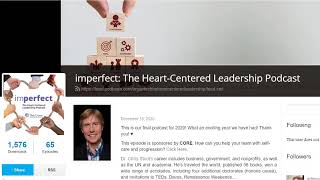
In this episode of the Imperfect, the Heart‑Centered Leadership Podcast, host Deb Crow interviews Dr. Chris Stout, a clinical psychologist turned humanitarian entrepreneur. The conversation traces Dr. Stout’s evolution from a shy undergraduate who discovered service through a fraternity, to an “accidental humanitarian” who founded the Center for Global Initiatives (CGI). Dr. Stout describes the grassroots creation of a kindergarten and hospital support projects in Tanzania, the logistical and legal hurdles of establishing a 501(c)(3) nonprofit, and the role of mentorship in navigating those challenges. He reflects on the imperfections of his leadership—naïveté about fundraising, the difficulty of scaling volunteer‑driven work, and the need to “open‑source” humanitarian tools to lower friction for others. The dialogue also explores his personal motivations, favorite memories, the desire to meet Buckminster Fuller, and his vision for a legacy defined not by fame but by the modest, lasting impact on individuals. Throughout, both speakers emphasize servant/heart‑centered leadership, the value of failing forward, and the importance of nurturing future leaders.
Chapters
Hi and welcome to the Imperfect podcast. My name is Deb Crow and I will be your host. Join me on this journey as we meet heart centered leaders from all over the globe. Lots of interesting questions, interesting conversation, and find out what makes a leader. How do they handle uncertainty and complexity? How do they lead in a time that is volatile? Join us. Welcome back to Imperfect, the Heart Centered Leadership Podcast. And let me tell you, for the last 48 hours I have been reading and researching my guest today, and most of you have probably seen him on LinkedIn because he is one of the top influencers. My favorite description of him is international psychology rock star Dr. Chris Stout has brought health and psychological assistance to so many areas across the globe. He's enhanced the lives of children and families. It's very rare that a psychologist will get to trade comments and going to say witty comments with international luminaries, but that's what Chris is all about. He's had conversations with Bono, Al Gore, the Clintons, Steve Jobs, and if you ask him what he likes to do, he says he likes to run stuff. So I can tell you that this is going to be a fun interview because Chris has an amazing sense of humor. So, Dr. Chris, welcome to the show.
Hey, Deb. Thanks. It's an honor to be on.
It's nice to have a fellow podcaster. It makes my job easy.
Likewise. I don't have the volume that you do, so I'm very impressed. So this is a treat to be on.
Well, I am just honored that you had the time to be on my little podcast here. So I'm ready to jump in and ask you some really great leadership questions. So if you're ready, let's go.
Sounds great.
I have done a lot of reading. I have watched your post on LinkedIn. I love reading what you post. You truly are an influencer. And I love that you say I seem to run a lot of stuff. So my first leadership question is, at what age did you notice or have an inclination that you had a leadership skill and did you think you'd land up in leading within social responsibility?
Great question. Thank you. I guess it was probably undergraduate. I got involved in a service fraternity and part of the obligation of that was to do service oriented kinds of things. And I found that it was just really enjoyable. I was always pretty quiet and bookish in high school and kind of did stuff, but it was always behind the scenes. And I think that helped get me out of my, you know, shyness, so to speak. And then I had my first boss as a pre Doctoral intern, was a kind of a flamboyant fellow. And he was really kind of always pushing me and pushing, pushing my buttons and trying to have me push my limits. And while that was not a very comfortable experience for me, I think it was nevertheless formative to, you know, to be, you know, to be the presenter. You know, I always. I would much have preferred to write an article or, you know, do the. Do the research, do the work behind something, but the thought of presenting, presenting or going in front of an audience initially was just terrifying. And that kind of built upon itself and that got connections. It became more and more comfortable. And then when you do that in the auspices of starting to build things like a nonprofit or a business or a startup or a department, those kinds of leadership skills, I think start to get honed a little bit more and to, you know, you can't be like the wizard of Oz and sort of manage things from behind the curtain. You really kind of have to be out there and out front and kind of covian perspective of, you know, steward leadership, of being out there to serve others and to do that not just in the work that you do, but also with the staff that you have.
Oh, it's music to my ears. Servant. Servant leadership. I love that. And that's the premise and the foundation of this podcast. Finding heart centered leaders all over the globe, and not just within your chosen career or vocation, but being that steward, that servant leader 24 7. So I'm so thrilled to hear you say that. Now my second question I ask all of my guests, Chris, what imperfections do you bring to your heart centered leadership?
Well, I think. I don't know that we have enough hours in the day for me to go into the rabbit hole of all my imperfections, but I guess maybe we have an odd highlight reel of them. I think part of, I joke about this, I've written about this, that I kind of refer to myself as being an accidental humanitarian. I very much wish I could tell people that, you know, this is something that, you know, it was a passion of mine forever that, you know, springing from the womb and then wanting to, you know, do all this work and all this, which was definitely not the case. I had very different kinds of career aspirations that evolved and changed over time, thank goodness. And then I just, by virtue of a story that's too long for our conversation today, but I had an experience that happened to me that really sort of, I don't know, changed me and turned a light bulb on for me and sort of helped me Take the foot off a certain kind of direction of the gas pedal of my career and then shifting into maybe a more scenic route, so to speak, to keep my car metaphor going. Of finding that there was great joy and pleasure in helping others in a way that wasn't just, you know, I was trained as a clinical psychologist and worked in practice and did a lot of things. It was obviously in the healthcare and helping oriented sphere, but I found that to be very different, almost still kind of, you know, you did it as your job, as your career, which is great and fine for people, but, you know, you still needed to have an income with that and have, you know, do it, do it as a fee for service kind of circumstance. And the humanitarian work pulled me away from that. And I felt that the leadership aspects of how I did that and then trying to, you know, we're an all volunteer organization, none of us are paid. And being able to have people donate their time to be able to help build things and help do things that aren't right off the bat are not easy to do, I think are some of the things that I was very naive about that I joke with some of my founders that if I would have known as hard as this would have been, I probably wouldn't have done it. So I feel like there's a lot of things that I've been very naive about that has reared their heads in, in for profit startup businesses that I've been a part of, as well as in the not for profit, humanitarian space. So just really being sort of like a Mr. Magoo and not knowing what I'm getting myself into, but generally, And I hope 51% of the time having
a good outcome, well, it doesn't get any better than that. And I'm old enough to know who Mr. Magoo is, by the way.
Okay, well then you know what I'm talking about.
I know exactly what you're talking about. But don't. You know, all joking aside, aren't some of the best outcomes derived from just jumping in without an anticipated outcome or fully having a vision? I think some of the great minds, some of the great things that have happened and that I have viewed in my lifetime and it's going to segue nice into my next question for you. I know that you founded the center for Global Initiatives, which is a top rated nonprofit. I want to congratulate you on that.
Thanks.
Going back to where I was framing that question, was that something that you long to do, that you fell into and share with us a little bit about the Change that you imparted on the children in Tanzania. Right?
Yeah, yeah. Well, I. I had done a lot of work with the World Economic Forum some years back, and you and I were talking before the show about Mahmet Oz, and that's actually how he and I first got together. And we had done a couple of projects together and there's sort of parallel tracks and multiple things going on simultaneously that then came together to do the work in Tanzania and do the creation of the center. And just real quick, the specifics of that is that I. Again, back to being naive. I had no idea, idea how to put together a nonprofit. I had no idea what a 501C3 was in the United States. I had no idea constructing a board or any of the kind of nuts and bolts that go into that. And I was fortunate to have a mentor who I'm still so close with and so appreciative of, who is an attorney, Harvard trained, Harvard law guy, really sharp, sharp guy. And he said, you know, you're funding all the work that you're doing. You've been supporting this project in Tanzania that you referenced. And he said, you know, unless you have like an oil well in your backyard or a trust fund or something that I didn't know about, you can't sustain that. You can't just keep doing this yourself all the time. So he was right. And I said, yeah, absolutely. So what do I do? And he said, you contact my wife, meaning his wife, who's also a very sharp attorney. And he said, she'll help you put together all the documentation and the incorporation and the submission to become a 501. So the mechanics of that got started to the part of putting together a board and the work in Tanzania. I had met a fellow some years back when I was on a climb doing Kilimanjaro. And he and I had kept in touch over the years and periodically there would be different kinds of problems that we were like physical pen pals. There was pre Internet and email and all that. And we would send over materials for children, for education. And then that became problematic and too expensive. So then we started. Created an account and started sending over funds that they could then do what they needed to do. He also, he became a chaplain. He's a chaplain at two hospitals. So we helped support some of their medication. We helped support some of their nurses training. And then we also had. He worked at an orphanage. And the orphanage, you know, again, back to Mr. Magoo. I had no idea what the orphanage did. I had no idea what you know, the nuts and bolts about what the orphanage needed. And I. That's not my job. That was. He would explain to me kind of what was what. And my job became, how can we support this? How can we do something to be able to make a difference there and to help these children? So I went to my collection who were principals at schools, who were early childhood development specialists, who were teachers, who were educators, and said, you know, here's our project. We need to kind of put together a school for children, kindergarten for children. And we put everything together in a packet and sent it over. And he then took it, took it to the Ministry of Education. They accepted it, and we were able to form a kindergarten and build it physically with, you know, the brick and mortar part of it, staff it with faculty and teachers, and then also be able to equip it with materials and desks and things like that. And that's been kind of our sweet spot of support that in the two hospitals for the last 17 years or so. Parallel to that, again, back me not knowing what the heck's going on with any of these things. I had worked with a lot of friends and colleagues at the World Economic Forum who had started successful, amazing nonprofits. So I went to them, being kind of this bookish academic, and said, you know, hey, we'd like to do interviews. So we created a three book volume book set that was published by Prager called the New Humanitarians. And each chapter was a chapter from a big deal nonprofit and some very new startup nonprofits, Doctors Without Borders, Amnesty International, etc. And part of it was to kind of, you know, help me understand how did this, you know, how did Doctors Without Borders even start? And I got to learn because we did interviews with the founders of it, and we, you know, made a book chapter out of it, and we did the next. And, you know, each chapter was a standalone for these organizations. But it was really mercenary on my part because I wanted to learn myself. How did they do this, and how can I learn from them to be able to build ours? And Mamet was kind enough to write the forward for those three books as well, too. So all these parallel things were kind of going on, and then the result was kindergarten. As the result was the center for Global Initiatives and the different projects that we've been fortunate to partner with others in different countries to be able to do. But Tanzania has really been kind of our longest and our near and dear partner.
Well, and what a special memory for you. And I can't even imagine how heartfelt that was to see it come from the idea to fruition and just changing the lives of those children. So I know it's brought you a lot of joy. And do you think it's had its biggest impact on being a humanitarian and really bringing that integration of psychology and public health together?
Yeah, it has. And it's also taught me that, you know, my gosh, Deb, the amount the, you know, you hear about in the business world all the time about, you know, people scaling and people wanting to give, you know, 10x this or 100x unicorns and startups and things like that and our experience with how little a US dollar can make a transition to a Tanzanian shilling and how much that can, you know, how far that can go and what can be bought with that. We had a, there was a, we, we are partners. They had a malaria outbreak some years ago and we got funds over there to have them use those shillings to be able to purchase what they needed, you know, if they needed medications or if they needed, you know, whatever it was. And we were able to they there. I'm, you know, my background in psychology, so I'm very much into outcomes and looking at evaluating things. And we kind of did the math and the number of people that they treated for the amount of funds that we provided calculated back out to around $0.73 a life for an entire treatment protocol. So when you talk about scaling and 10xing something to think about that for less than a buck you could be able to treat an individual in their hospital successfully that was suffering from malaria was just, just mind boggling. You know, I never, I had no idea, you know, how that would, what the math would be or what kind of impact we could have. So it's those kinds of things where I feel like I'm, you know, I get such satisfaction out of those kinds of things. Being able to play a small supporting role in the yeoman's work that they do, you know, working with patients day in, day out, that we can at least provide them, help support them with some of the tools that they need to be able to do what they need to do.
Well, it's. You're a hero in my eyes for what you've done. And like I said to you before we recorded, it's not about the outcome for you. It's not about the stature, it's not about the degrees, it's not about the awards. And you, I mean, you have a laugh when you write anything about yourself. From anything that I've read, you instill a lot of humor. And for me, what I interpret from your writing and getting to talk to you a little bit is you just want to do and be for the greater good.
Well, thank you. That if you could say, I would be blushing right now, or I am blushing right now. So I'm glad this is an audio podcast, but that's very kind of you to say. It's a very humbling opportunity to be able to do something like this for others. And, you know, if anything, you know, people can help support what we're doing or just to say, you know, my gosh, you know, if Chris can do this, then, you know, imagine what other skilled people can do. People have way more of a toolkit than what I have. So I always try and have that be an encouragement in the sense of, you know, it's not necessarily easy, but it's not impossible. And that's kind of what we did too. We had a pivot with our center to be able to say, you know, hey, we've learned a lot. And not everybody that comes to us wants to like, we help people start 501C3s if they want to here in the US and if some people don't want to do that, they say, you know, I went, for whatever reason, I volunteered or I went on vacation or whatever, and I fell in love with these people in this country or whatever. And all they need is a well, all they need is a bridge, all they need is a surfaced road, whatever. I don't want to create an entire, you know, non profit entity, company, business, etc. I just want to help them get a well so they can get water. So we help people do that too. And that's kind of the resourcing that we do is to be able to help, you know, make those connections, provide the tools to just make humanitarian work. Less friction, less difficult. That, you know, where people like, you know, if you look at the IRS rules to become a 501c3, they're a little daunting and they are not easy to do. So some people get turned away before they ever get much further than an idea or a desire. So our goal is to what we call open sourcing, humanitarian intervention, so that we take that, we reduce that friction, we lower those speed bumps and help other people do stuff. Because the more people that are doing these kinds of things, the less that we have to do them. So we'd much rather help provide the picks and shovels rather than. Than do all the mining ourselves.
When you're speaking, it's making me Think of a comment that I often get from people and I have to ask you if you get it. Have you ever been asked, Chris, is there anything you don't do?
Oh my goodness, yeah. I mean, that's very nice. I tend to have probably too many interests in things and a lot of times when I kind of in my for profit side with, working with startups, I get so broad based and it's sort of like, hey, we could do this and hey, we could do this and hey, let's start a band and hey, you know, let's do all these kinds of things because it's just all so exciting and you know, the bright sparkly thing, you know, catches my attention. So, you know, there, there are a variety of things that I have very little experience with and very minimal skill sets in. But you know, those are the goals that I have. Those certain kinds of things I have a curiosity about or whatever, then that gets put on a list and maybe not for tomorrow or next year, but at some point in the future that might be something that I can learn a little bit more about. I'm like, you know, I'm always interested in learning more and trying to see how maybe things that seem a little tangential and oblique to what I'm doing are perhaps additive. And maybe they're not going to be additive today, but they might be additive in the future in some new, new approach or new skill set or new technology to be able to use.
Well, I always laugh when I get asked that question because, you know, I was brought up at a time where you were supposed to finish grade 13 because 100 years ago there was grade 13 and go to university and get a job and stay there until you retire and you get the gold watch. And I remember saying to my parents, I am not doing that. That is not my trajectory. And I had a dad who was an entrepreneur, so I lost my dad in second year of university. But you brought up a really good point that I want to just add a bit to. You're paving the future for future leaders, heart centered leaders. And I spend as much time as possible educating youth, mentoring youth, because they are our future. And I'm always asked, Deb, what's the difference between a leader and a manager? A leader has people follow them and a manager has people who work for them. So what you've done with all the work that you've done in Tanzania and you didn't have all the answers and the hardest part is grabbing the vision and starting. And I'm like you, Chris, it's like, like, let's just try it. Whatever doesn't work, we can pivot, we can transition. I'll find somebody else who knows how to do it. It's very entrepreneurial mindset. But, you know, I had an Irish nana who said to me, you get one trip around the sun, so make sure you live it to your fullest.
I like what, I like her point. That's, that's very great.
Well. And do we ever want to look back and say, I wish I coulda, woulda, should. I don't think he'll do that. I won't do that. So I just, I feel like a kindred spirit because you've done so many different things and I, I feel the same kind of trajectory aligned with you. And just because we don't know all the answers doesn't mean we can't pursue it.
Yeah, well, here, here. Yeah. I think what I know of your background as well and your work and the kinds of things that we've had, you know, off mic conversations about too, I think very much, you know, we do share that kind of ethos about that. So it's, it's a good fit, you know, for have, share those kinds of feelings. It just is a kind of a way to be well.
And you know what? I'm a big proponent about failing forward because every time we fail, it is an experience. It is something else that we have learned to put in our arsenal to keep that toolkit growing and developing and being, you know, a better version of ourself from even yesterday. And I am the first one to say I had no idea, or how do you, you do that? Or like, I'm just very curious, you know, So I think it's a fun way to be. And the more leaders that I've interviewed around the globe on this little podcast, it's a very common trait that I think a lot of leaders have. And it makes me think of the cliche that we heard growing up, if at first you don't succeed, try, try again. That's exactly what we should do.
Yeah, yeah, good point. It's, it reminds me too of sort of the, the joke cliche of a good scare is worth more than good advice. I mean, it's, it's those kinds of the failures, the scary parts of those kinds of things you, you very much learn from. So not that advice isn't helpful. It certainly is as well, but I think it's those kinds of things that sometimes if people, I think, you know, it's almost like an opportunity cost if people feel like, oh, my gosh, I can't do this because I might not, you know, be super stellar at it, so I'm not going to do it at all. You lose in that you lose the opportunities that come along with that. Even if you do, you know, fall in your face. The idea, like you said, is to fail forward, where you can then take that and learn from it and tweak, iterate, rinse, repeat, and try it again.
Well, perfection will never be a tangible reality, and a lot of people haven't figured that out yet. So maybe we've put a little down. I'm going to switch gears, and I'm going to ask you my Fab four. And these are just four fun questions, and we want to know what's sitting on the top of Kris's mind. All right, first question. What is a favorite memory that you have?
Oh, my gosh. Yikes. You know, there's a thing in psychology called primacy and recency effect, and it's sort of like, you know, whatever's happened recently is probably what first comes to mind or whatever a big deal happens that probably also has a chance of coming to mind. Golly. I guess it's just, you know, there have been some very. They probably kind of blended themselves together, but there's been some very memorable family vacations that my wife and our two children have had over the years that have just been, you know, kind of fun adventures and neat things to kind of, you know, get away from the day in, day out and maybe have a little, you know, adventuresome kind of thing. I think I had always. My folks had divorced. I'm an only child. I never went on a vacation or anything until, you know, I was in college and went with some friends. So I had always sort of had these fantasies as a boy and teenager, like, oh, it would be so fun to go on a family vacation. Oh, it'd be so fun to be like Johnny Quest or something and go someplace and do fun, cool, interesting things. But with my family, and so we were able to. My wife, who was also pretty adventuresome, we were able to do those kinds of things, she and I, before kids, and then continuing once our kids got old enough to do that. So I would say fun family vacations that I can periodically, I'll come across a photo or something from some years back of one of those. It's just like, you know, it just transports you back in time to that. That era. And then to be able to bring it up, you know, with one of our children or to talk about it with my wife. Say, hey, you know, I'll probably do it today. Say, hey. Deb and I were talking about this one day, you know. What was this? It made me think about this vacation when we went to wherever. So I'd probably say it's a little bit of a memory mashup. But that would probably be my best answer off the top of my head.
I like that. Memory mashup. I talk a lot about memory. I have heard that one. I like that.
Well, it's. There you go. It's all yours.
All right, second question. Who is someone that you would really like to meet and why?
Oh, golly, Molly. I kind of did it in a pen pal ish kind of way. I started off years and years and years ago. I stumbled upon a book at an old used bookstore. That was done by a fellow named R. Buckminster Fuller. Fuller. It's called Nine Chains to the Moon. And it was kind of above my pay grade and reading level. But for some reason, I was just sort of enamored by it. And for folks that may not know who Buckminster Fuller was, he was just really an amazing polymath. He was known as, you know, he's a designer and an architect and a mathematician and a visionary and all this. And I took a undergrad kind of thesis course and kind of got the gumption up. I had started off as an architecture major, so I studied him a lot in geodesic domes and his Dynamaxian houses and all this kinds of stuff that I just was just nuts about. And I probably, to this day, I bet I have almost every book that he's ever written. And believe me, I poured through them. And he. In this class, I thought, you know, I had some ideas and some concepts that were kind of along the lines of psychology. But I thought had a lot of perspective from what I had learned from his book. So my professor said, well, why don't you write him a letter? And it's like a Wayne's World. I'm not worthy. It's like, no, I can't write him a letter. You know, this is. Again, this is like 78 or something, you know. So I thought, well, okay. My professor said I should write him a letter. So write him a letter. So I wrote him a letter. And to my wonderful surprise, he wrote me back. And I can also tell you, to this day, I have that letter. I have the envelope, you know. And it was about two years before he passed away. And that, you know, just made it all the more treasured to me that he would, you know, here I am, this goofball undergrad, you know, 19 year old, 20 year old that, you know, knows zero about the world, having the, the audacity, you know, to write this elder statesman of innovation and technology way before his head, his time. And, you know, he takes the time to write me back. You know, I was just like, oh my gosh. So I wish I could have had a conversation with him. I, you know, I probably would have passed out, you know, if that opportunity was. Have ever arose. But he just really was someone that I have valued and thought about as a virtual mentor to me. But his letter and his words and his work and his writings and watching lectures, there's videos available online. So I just wish that I would have had an opportunity to sit down and break bread with him and have a conversation.
Okay, so transparent goosebumps moment for me.
Okay.
I started my schooling in architecture design, so there's another thing.
We have identical cousins here.
There you go. And I sent a handwritten note myself to not the same author, but to Dr. Patch Adams.
Oh, really? Okay.
Yeah, in August of this year. And I got a beautiful handwritten letter back in October. And it's sitting literally on the corner of my desk as you're talking. And I'm just like, okay, this is, this is goosebumpy. This is memory mash up going on right here.
Yeah, people need to reach out to their heroes. They might reach out to.
He's my hero. He's such a heart centered leader and I would love for him to get more funding and exposure for his Gesundheit Institute in Illinois. And it's. But the whole point of it is you wrote somebody who, you probably made his day with your letter because he, he was a leader. He inspired something in you. What 19 year old sits down and writes a letter to someone in that capacity?
Yep, just. Just a goofball.
Like such a cool story, Chris. I love that.
Thanks. Well, I like love the parallel too. How about that?
I know, I know. I'm telling you, podcast cousins going on here, here. My third question is if I could give you a wish today. I'm waving my magic wand right now. What would your wish be as a global humanitarian?
Oh, my goodness. Gosh. I guess, you know, it's like one of those things when you have three wishes, you want to like wish for more wishes kind of a thing. But in some ways, like the work of our center, I guess to frame it this way, I am one of my weaknesses. So maybe to go Back to. Referring back to your earlier question, one of my weaknesses is I hate, hate, hate fundraising. I'm really bad at it. So I don't know which comes first. I hate it, and therefore I'm bad at it, or I'm bad at it and therefore I hate it. But regardless, I'm really not good at it. So I try to come up with all these other kinds of ways to be able to do fundraising for our center. And it's been sponsoring climbs because that's how the center started, kind of, in a sense, with Tequilimanjaro and Tanzania. I've done a couple of the last books that I've written. The royalties go to funding the center. We're just now starting a fellowship and certificate program that all the materials are free, but the tuition is going to fund the program's work. But all the faculty, myself included, that are teaching any of the courses are doing it for free. So, you know, it'd be great to get like a magical funding, you know, source or something, a little magic, you know, pot of money at the end of the rainbow or something to be able to do these kinds of things. It creates an opportunity for us to be creative, to try and figure out ways to do the funding. But that's just always kind of like the difficult side, the putting, you know, the fuel in the machine kind of thing to help it keep running so that we can do what we can do. I feel like we've been super creative and very, very, you know, benefited by and very much feel very strong feelings to all those people that have been donors and supporters of us in whatever way they can, volunteering or writing checks or what have you. But, you know, I just. It's sort of like, you know, I can't ask friends for money. And that just feels weird. So I guess a funding source and. Or, you know, part of that could be, you know, if our new fellowship and certificate programs would take off, I would like you to wiggle your wand in that direction as well, too. We're going to be launching that in 2021. So people are interested in that. They can reach out. We can give them some more information about what to expect with that. I think that will also help our ethos of open sourcing, humanitarian intervention, and again, helping people get the resources they need and the tools they need. Even if someone is not a student in our program, all of our materials are free to everybody. So that would be one of the things that. Helping people know that that exists and that we're not, you know, invisible or, you know, hidden behind something that people don't know about.
Well, I'm going to wave my magic wand and now that you've met me, you're stuck with me. I'm going to become part of your memory mashup.
Okay. It's a deal, Deb.
It's a relationship that will continue. And I know there's more conversations to come. And my last question, Chris, is what do you want your legacy to be?
Oh, my gosh. I guess, you know, I probably have a weird answer for that. It's sort of like I don't necessarily care if people remember me, but maybe that there's some aspect of something that, you know, the work that we've done or the some. Something that we created or generated needed has somehow helped spark somebody. Like, I think about it in the context of a book that really spoke to you or of a teacher who really changed your life, or a coach, or a parent, or a friend or a partner, whatever parent, that you don't necessarily need to remember who they were. Like, I often tell people in talks that, do you know who your, you probably know your great grand, your grandparents names and do you know their middle names? You know, your great great grandparents middle names? Do you know what their eye color was? Do you know, it doesn't take many generations back for any of us to have no fricking idea much about our great, great great grandparents. You know, unless there's something really notable about it, you know, they came across on the Mayflower or they were at Ellis island or something that has been kind of historically unusual. But regardless, whatever they did in their lives that had an impact on their children, that had an impact on their children, that had an impact on your, your parents, that had an impact, therefore on you. And it's not limited to families. I mean, it can be whoever else is in the sphere of our lives. So I would have liked my legacy to be that, you know, somewhere along the lines that some little, you know, someone heard of a podcast today with Chris and Deb or someone, you know, read, you know, read a book or someone, you know, read a LinkedIn post, or someone volunteered with the center or someone was a fellow in our program or whatever, someone was a student in my class two years ago or 20 years ago that, you know, somehow that turned them on to some. Something that then took them down a route in their life that, you know, it doesn't have to be forever, but maybe even just short lived that got them into doing something that they, you know, very much enjoyed and made a difference in their life and, you know, was a contributing part to their life. So I just, I guess my legacy doesn't need to be with a brand label of me or the center, but just has to somehow have made some kind of difference to someone. It can certainly be anonymous, certainly be forgotten as to who, but that it's, you know, made some kind of, you know, modest improvement in someone's well being.
Well, that's beautiful. And it right away makes me think of that beautiful quote from Maya Angelou where she said people will forget what you said, people will forget what you did, but people will never forget how you made them feel. And to me, Chris, that's a heart centered leader right there. So you are episode 61. You are the last podcast for me for the year of 2020 and I couldn't think of a better person to end 2020 with. Excited for all the initiatives and things that you spoke of for 2021 and just know I'm grateful for your time and expertise today on being on the show.
Oh, Deb, it's been just an enjoyable part of my day and it's just honestly, I feel like we're very kindred spirits. So I look forward to this. As they say in Casablanca, the beginning of a wonderful relationship. So looking forward to what comes next from you. Big fan of your show and can't wait to see your guest lineup for 2021 as well. Thank you for the honor of being able to be a guest and wrap things up for 2020.
Thank you so much. And I always leave the listeners with my list of five things that I really help, feel, help really help us lead a purposeful life, follow your heart, have passion, do your best, know your truth, and always be in love with the journey. And I am going to add number six because it is the last podcast of 2020. Embrace youe Imperfections this is Deb Crow. Thanks again for joining me on this journey from the end of May for the end of 2020. And I look forward to being back here In January of 2021 on Imperfect, the heart Centered Leadership Podcast.
More from Dr.

2025 Mercedes-Benz CLE 450 4Matic Cabrio – Owner’s Views After a Year-and-a-Half as a Daily Driver

The Complete Guide to a Successful Everest Base Camp Trek – Post-Trek Debrief

The Complete Guide to a Successful EBC Trek – Post-Trek Debrief: What I Needed (and What I Didn’t)

What Went Wrong Customizing My New 2026 Porsche Carrera T …and what I did about it!

Coming May 1 At the Intersection of High Performance and Fulfillment: A Conversation with Alisa Cohn

From High Performance to Fulfillment: Lessons in Inner Mastery with Jim Murphy

Coming March 19: From High Performance to Fulfillment: Lessons in Inner Mastery with Jim Murphy

The New Humanitarians Volumes I - III:- Inspiration, Innovation, and Blueprints for Visionaries

The New Humanitarians Volumes I - III:- Inspiration, Innovation, and Blueprints for Visionaries

The New Humanitarians Vol I - III: Inspiration, Innovation, and Blueprints for Visionaries - Forward
