Life, Work, and New Perspectives on Legacy - on Direct Shift
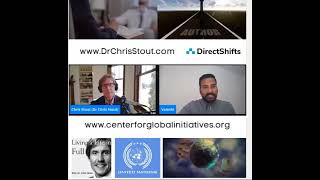
In this hour‑long interview, host Vamshi and co‑host Raj sit down with Dr. Chris Stout, a clinical psychologist, author, podcaster, UN ambassador, and founder of the Center for Global Initiatives (CGI). Dr. Stout walks through his career trajectory—from private practice and academic appointments to humanitarian field work in Tanzania, Ghana, Bolivia, Cambodia, India, and Ukraine—explaining how an accidental entry into global health led to the creation of a 501(c)(3) nonprofit focused on “open‑source humanitarian intervention.” He describes the pivot from trying to execute every project himself to teaching others how to launch and manage their own initiatives, culminating in a 10‑week fellowship‑certificate program whose curriculum is freely available. The conversation then shifts to broader health‑system insights: the importance of equitable partnerships (avoiding a colonial “we‑know‑best” mindset), the role of tele‑health and digital therapeutics in expanding access, and the challenges of payer‑provider variability across U.S. states. Dr. Stout critiques the hype around health‑tech startups, emphasizing the need for clinical efficacy, rigorous validation (RCT‑style studies), and realistic business models that align with payer incentives and employer‑based care. He also discusses mental‑health stigma across cultures, the rise of CBT‑based digital platforms, and the difficulty patients face in vetting providers. The interview concludes with practical advice for clinicians battling burnout—streamlining workflows, leveraging technology for documentation, and fostering supportive leadership—and personal productivity hacks for multi‑role professionals, such as leveraging overlapping work (writing, podcasting, teaching, publishing) to create synergistic impact. Throughout, Dr. Stout stresses mentorship, open‑source sharing, and a responsibility to give back, framing his legacy as a network of collaborative, sustainable solutions for global and domestic health challenges.
Chapters
Doctor Stout, privilege to have you here. I'm going to use that word multiple times today because our platform is exactly designed for us to have people like you come and help us enlighten our audience as well as all the people that we are trying to reach out to. Once again, thank you for being here. For those of you who, you know may not know a lot about Dr. Stout, Dr. Stout is a clinical psychologist, well published author, and living the podcast of Living a Life In Full, is the producer as well as the host of that, as well as being an ambassador to UN I can go on and on of the impact that Dr. Stout has created to make this world a better place. And like Raj said, somebody that has had a tough journey and for him to share how the journey has been, has progressed and how the journey has transformed into creating impacts in millions of the lives of others is what we want to kind of share with you today. So without much further ado, I would like to present to you all Dr. Stout. And to begin with Dr. Stoud, I'm apologetic. I may not have done a lot of justice to your profile. I could go for the next 45 minutes just talking about your profile. I love all the things that you've done. But please enlighten our audience on a summary of your journey, what has got you till here, and what you wish to do in the next fulfilling years of your life. Please give us that background and then I have a bunch of things that I want to share with you and talk to you about and then we'll move on.
Okay, well, thank you. Thanks. First of all, it's. It's an honor and a pleasure to share this time with you and your audience today. Thank you for having me on. You did a very nice job of kind of describing my background. A lot of challenges and we'll probably get into that and some of the questions. But basically started off as a clinical psychologist, went to graduate school for that and started off in kind of the traditional start a private practice, work at a private practice and be treat families and kids. Parallel to that, I also had teaching opportunities and some administrative work in a hospital setting and just kind of over time and over the years continued to grow that and expand that. Taught at a number of places and most recently at the College of Medicine at University of Illinois. I was in the Department of Psychiatry there, but actually did more work with their back in the day, starting with their center for Global Health. And through that work and through some volunteer work, really got involved in the humanitarian space and through the great Help with some mentors and through some great role models, developed a non profit center, the center for Global Initiatives. And now I've kind of shifted my work to being primarily focused on that activity and that work and our new fellowship program and then also serving as an advisor to startups and to some established companies that I've been an advisor for. So varied patchwork kind of history, but happy to answer questions or go down some rabbit holes if you'd care to in our time today.
Totally. I would love to go down all of those paths. Dr. Stork, thanks for sharing that. So the center for Global Initiatives definitely sounds interesting. Is it specifically focused on one area or is it looking at multiple areas across the globe?
That's a great question. And it's been an evolution that might be of interest to your audience. We first started off, I just started off very organically. I had done some climbs, I had done some travel, and some people that I was working with said, you know, could you help us out with this project? Could you, you know, put us together with, we need to get some medications, we need to get some surgical help, we need to get this or that. And I really didn't start off with, you know, I'm a psycholog that global health really kind of wasn't my area of expertise. And I started talking to some other friends and some other colleagues and put one thing together and another thing together. I went on a climbing trip in Tanzania and met a fellow that we've since become partners and worked with orphans and worked in two hospitals that he's a part of and just kind of did it, you know, kind of what I kind of refer to myself. I've written about being called an accidental humanitarian. I didn't really plan it, I didn't take courses in it or anything like that. And everything was great. One of my mentors said, you know, you need to make this a legitimate 501C3. I said, oh, that sounds great. How do I do that? And he said, well, you need to talk to my wife who is an attorney. He was also a Harvard jd. So we did that. And they helped me kind of navigate all the tax issues and application issues to the irs. And we were able to get incorporated in Illinois and become a legitimate 501C3. And that was all exciting. And I was again, very naive to things. I didn't know that, you know, there's a different set of tax forms that you fill out being a 501C3, and all these kind of surprises. They weren't, you know, insurmountable, but they're just sort of not things that you necessarily would experience or expect being, you know, kind of accidentally getting into that. What I basically wanted to do was the work and to, you know, collaborate with other people in that space. And everything was going along swimmingly. We had some colleagues and we had some collaborations. We were working in, let's see, Benin, Bolivia, Cambodia, Africa. And in Africa, we were working in Tanzania and Ghana and also in India. And that. That was great. And someone came to us from Ukraine and they said, we would like to partner with you all about a project with going for a grant with usaid. And we said, terrific. So we had meetings, and we learned that what they to do and how we'd have to fulfill the grant was that it would be this commitment of three years for the first phase of the grant, and it would require probably me, because I was the only psychologist on our board, to go to Kiev about four times a year, once a quarter for a week to 10 days, and to do these assessments. And it was like, oh, my gosh, I don't have. I have a day job. Everybody at the center, myself included, we don't get paid. This is all volunteer. And I thought, you know, I can't take off. I don't have that much vacation time. Even if I did, my family would, you know, would not be happy with me saying, you know, I'll see you guys, you know, have a fun spring break. I'm going to be in Kiev. So we. We quickly realized that we, you know, could not scale beyond the projects that we were a part of. So I was kind of crestfallen with that and not knowing exactly, you know, well, great. You know, this is kind of, you know, tripping right out of the gate and not being able to, you know, continue on. And to close that story, the grant did not get funding, so that was not a problem that we needed to solve. And sadly, with working with those potential partners. But what it did cause us to do was to realize that we could pivot. And that pivot was then to say we had done a lot of work in terms of putting together our center. We had learned a lot of what to do and also what not to do. And then that had value to people. So we sort of, with our pivot, kind of said, well, rather than us trying to do all the projects that people invite us to be a part of, why don't we help teach people how they can do their own projects? The proverbial teach a person to fish or being Johnny Appleseed. So in that process, and then just as recently as launching this January 2021 as a certificate in a fellowship training program. But we really, our ethos is to what we call open source humanitarian intervention. And that means that we felt like it shouldn't be so difficult for people to do good in the world. That if someone wants to, if they want to join a project, there's plenty of projects out there and people find those on their own. But sometimes people through whatever friendships and travel or whatever circumstances, find someone or find a circumstance that they feel like, you know, they really take it to heart. I have a friend that's doing great work in Guatemala just on a kind of a random way and now he's living there. So these things happen. And sometimes people say, I want to build a 501C3, but I don't know where to start. I want to, you know, put all this stuff together and thank you. I see the screenshots, I want to build a website, I want to have a board. I want to do the taxes, I want to submit to the IRS. I want to become a 501c3 and all the benefits and the good things that come from that. And other people come to us and say, you know, that's, that's great, but that's really not what I want to do. I want to really help these people to get a well drilled. I want to help these people to have a paved road. I want these people to be able to have a bridge. These are the specific kinds of things. I don't want to develop a board. I don't want to go through all the rigmarole and wait a year and submit fees and all this sort of thing to become incorporated. I just want to work on a project. So both those kinds of groups of folks are kind of the sweet spot of what our center does to help with now. And we also, then some people maybe don't necessarily even have projects and things, but they want to be able to do a, to learn more about these kinds of things. So we have a certificate program for those individuals that is about a 10 week long project. And that that program is also all the materials that we have for that are freely available. So if anybody wants to see what that's like, then they can just contact me. And we give them our syllabus and our curriculum. There is a tuition for it, but all the faculty that teach in the program do it for free. So it's a fundraising effort for the work of our center.
Got it? Got it. Thank you. For all the details, Dr. Stout, I definitely underlined one portion of it and will fondly remember it. You mentioned it should not be so hard to do good in the world. And then you've tried to act as a channel, as a medium, as a facilitator of people that are trying to do good, but really do not know where to start, how to do, how to propagate all of that. Now, through this work, you mentioned you'd been to all of these various parts of the world and you must have seen as a part of this, because it potentially started as, let's say, Global Health Initiative, but you must have seen the status of healthcare in all of these countries. As you very well know, as a lot of our audience know, there's so much variability, and the pandemic has exposed that variability as much. It has not only impacted health of people, but the economy, economic situations of people. So as you traverse the world trying to help on a humanitarian grounds, what are some of the key takeaways that you have seen from a global health perspective on how these various parts of the country should be adopting newer health care plans or what else should they be doing? What us as the leader of the world needs to be doing more in terms of bringing more global health partners together so that the variability is reduced and access to care probably is improved. What have you seen? What are some of the key learnings that you've had from this work?
That's a great and complicated question. I think maybe first of all, partnerships are key and critical. There oftentimes has been a colonial perspective or a West Knows Best hubris about we know how to do everything right and all we need to do is teach everybody to do what we do. And there's a faith famous individual, Paul Farmer, with Partners in Health, and he did a, just as a quick little story, he did a lot of work in Haiti. And Haiti, you know, historically has been very resource poor. They've had all sorts, you know, a couple of earthquakes hit. There's just been all sorts of things that have been very challenging. And in spite of all that, and in spite of not having lots of funding and lots of whatever kinds of resources available, he was able to institute a variety of different kinds of, you know, amazing public health interventions that were sustainable and that were really sort of, you know, hot housed there. They started there. And some of the individuals, this is some years ago from Public Health in Boston asked him if he could come teach them some of the things that he had done in Haiti to teach Boston how to do A better job of managing public health resources. And I just. I really love that story because I feel like it talks about. On all the trips that I've been to, I haven't gone because I came as being like, Mr. Know It all about, you know, here's all the ways, you know, that there's problems or whatever. People already know what the problems are. They already know what they think might be helpful solutions. And my job is to come in and help them realize those helpful solutions. So it might be an issue of resources, it might be an issue of training, it might be an issue. It's always an issue of funding, but those kinds of things and coming in with a way to help, using them as partners to make assessments so that we can then have an evaluation to see what. When there is an intervention, to see if that intervention has created the success that we want it to, and then to work with them to be sustainable about it. We have a partnership that's been long standing, really kind of since 1992 in Tanzania. And it's just grown and grown and grown. And all the things that we've done with them have always come with them asking us, telling us what the problem is and asking us, could we noodle with them to help have a, you know, create a solution to that issue. And we do that and then we help link other partners. So it's not just us and them, it's us and them and somebody else and somebody else and somebody else. Because there's always going to be sort of a. A variability of when you have success with a certain level. Like we, we helped consult with training nurses. Well, that they got nurses way before they ask us to help consult with training the nurses. And we had nothing to do with getting the nurses, which was, in some sense kind of cool. So in those aspects and being able to do those kind things, it's really taught me to say, first take a look at, you know, what they're already doing. Well, because there's chances are a lot of things that are already, you know, good and positive. What can I learn from an aspect of a project I was involved in Bolivia that might be generalizable to a piece of something going on in Tanzania? Oh, I love this shot. This is great. This is some of the kids in our kindergarten. So those kinds of things are always, again, kind of keeping this respect for what is going on and what are the needs and to have them define what those needs are. When we've done fundraising, we just. We do the fundraising. That's our job. That's our skill set. That's a sweet spot and I'm not good at it, but that's something that we can do. And when funds go over, I don't say you need to give this many Tanzanian shillings to fund this project and this many Tanzanian shillings to fund this other project. I don't. And they, because I don't know, they're, they're the ones that know they are boots on the ground, that this is where they live day in, day out and they know what their needs are and then they let us know what that is and we try to do our best to satisfy that and then, you know, on to the next thing. What can we, you know, help with next, next year or whatever We've had, we've worked with training, we've worked with education, we've worked with access to medications, you know, kind of whatever those things are. I didn't come up with, with any of those ideas. That's all been responsive to our friendships and our partners with those individuals. And that's what we did in our other shorter projects that were kind of one and done, so to speak, which I also want to caution very quickly. There's a very bad habit oftentimes of well intended individuals to kind of come in, parachute in, put a band aid on something and then say best of luck and see you later. Any of the projects that we've exited from have been because they've been short term projects and those projects were done our partners in Tanzania because we're just kind of the closest with them and longest lived we'll continue to work with and then our other aspect is to help others do projects that they want to do.
Yeah, yeah, no, great point. I think partnership and sharing of best practices and learning from best practices wherever they are. Again, great points coming to coming to the domestic status of healthcare. You know, we from a direct shift perspective and having spent the last 15 years in the US healthcare space, I've also observed a lot of variabilities even in hospital operations. What we do is we help hospitals and clinics and others connect to clinicians directly and procure staffing or hire them faster so as to be able to provide more access to care. Otherwise without clinicians, the care access gets so much difficult and we have seen so much variability even internally. Right. I mean state to state, even within state policies, procedures, licensures, there is so much variability. Some form of variability is good because you need that to be customized to the state. But some variability quickly becomes hurdles and access to the care. But what We've learned is again, pandemic grayed out all those lines. One of the, let's say advantages of going through tough situations is you gray out the borders. You are able to now, as you very well know, as you are able to see what are the possibilities if it did not have these limits or the borders. I think from being able to share clinicians expertise across the boundaries of state lines has been a big win over the last eight to ten months, et cetera. So we have kind of experienced that and have always thought what should be some of these policies that the government should be taking up as a priority that would ease access to care. Right. I mean access is the first portion. Any thoughts on that Dr. Stout, on what you have seen as what should be the key priorities, the trends with respect to access to care that could potentially be improved. And have you seen some improvements in the last few months?
Sure. Scaling down. I had done work at the United nations and then obviously the work with the center and World Economic Forum around health care issues on the, on a global scale. And you see different kinds of payer models. You know, certainly just to the north of us in Canada is different than what we have here. Certainly going to, you know, the UK and national health system and health services are very different. But I think one of the things I heard someone talk about that they were saying that this is in an academic setting that they had tried, you know, they had committee after committee and they had tried for like decades to try and get more technology to be able to do education and then all it took was this pandemic and within like a month, you know, everything, all, you know, classes were all digital, etc. And I think a lesson for healthcare from that to your point about access is that the, and I've also, I should also say that I worked for the state of Illinois for the Department of Mental Health in our psychiatric private or public psychiatric systems. I've worked in private psychiatric systems and access to care is always kind of a stumbling block and it can be sometimes just because people don't have the physical ability to get to a clinician. I think telehealth is huge with being able to help with that. And I think a lot of state as well as licensing entities, which I'll talk about more in just a second, have now become much more open minded about these kinds of things and even if not everybody, you know, can afford a smartphone. But I know that there's been a lot of projects, kind of one off projects to see, well, what if we gave People smartphones and they could manage their healthcare with it or manage their income with it from people that are on welfare, et cetera. And those have been very promising. But some of the problems were there was that I think is very much in the sweet spot of what your work is, is access on the clinical side of it, on the healthcare side of it, to clinicians. I mean, people can have all the tech in their hand and broadband and everything else, but if there's no one, so to speak, to answer at the other end, then what are you going to do? I think from my, you know, point of view, starting off as a psychologist, things like telehealth services with psychology is like one of the easiest things in the world to do. I mean, I've seen wonderful tech with dermatology, with pediatrics, with women's health, with, with primary care. And those are to me a lot more complicated than psychotherapy is. And especially when you can have like our forum like this, with visual, you know, eye to eye, not just, you know, telephonic things that have been around for, for a long time. So I think in particular in the Midwest there have now been changes in statutes and laws to allow better telehealth practice. So I'm licensed in the state of Illinois. Well, if I have a patient that is now sheltering in place, that's moved to Wisconsin, there's a question, it's a gray area. Can I treat that patient? Even though I started off with that patient, let's say in Chicago, I'm still in Chicago, the patient stepped 2 inches across the border to Wisconsin. Am I now practicing outside of my statutes because my license is Illinois, not 2 inches outside of Illinois into Wisconsin or Indiana or Iowa or wherever else and those now there's interstate pacts that are allowing that to happen. There's a lot more platforms now available in the last, certainly within the last two years and probably even more within the last six months to have people feel more comfortable about being able to do those kinds of things. So I think having those opportunities and having even clinicians, because not all clinicians are super sophisticated with the technologies either. So I think being able to have the supply side of therapists, whatever, or providers, healthcare providers of any kind of specialty, be able to then have the tools to then meet the demand side of now individuals that might have technology or more comfort with that to be able to access them, that maybe don't have a car or don't have access to public transportation or don't feel comfortable going to a waiting room, these days. Those are the kinds of things that I think we're all kind of sorting it out right now and kind of being able to figure it out. And the final thing that I was kind of disappointed about, I wrote with great optimism a LinkedIn influencer piece a while back, probably 1998 or so. I was very optimistic coming. They want you to make these predictions for the upcoming year. And I am horrible at predictions. So every year I follow up with how many predictions I got wrong and then here I'm going to make some more wrong predictions about the upcoming year. And one of the things that I now am sad about is that I had great optimism and falsely so about Haven. I had thought that if you got Amazon and Berkshire Hathaway and JP Morgan together, lots of funding, lots of smart folks. The original, I don't know if he was going to be CEO or cmo. Atul Gawande, who is just an amazing physician, wrote the Checklist Manifesto and a number of other amazing works, was going to be heading that up. I thought you've got an amazing brain trust. You've got three big checkbooks, you've got all this, you know, potential to do amazing kinds of things. And even with that, it still kind of crumbled and collapsed. I advise a number of startups, some are doing very well and some have, you know, gone, gone by the wayside over the years. But one of the things that I've seen is that the ones that tend to go by the wayside, be it the behemoths with great potential, like havens or much smaller models, startups are that it's folks that may come from a background that is not healthcare and they don't realize all the things that you know, which is, you know, getting a license in one state doesn't mean that you're licensed in every state. Being a provider in this network doesn't mean you're a provider in every network. I mean, there's so many little interstitial variables that create all these burdens for the providers. And the providers oftentimes, you know, have to wait and wait and wait and wait. When I worked with the state, the state had a financial budget crunch. Community mental health centers weren't getting paid. They went out of business. By the time that funding came, there was no funding to go to all the centers because not all of them still existed anymore. So those are the complications that when you're doing a startup for a cool app or you're Elon Musk, you know, shooting rockets into space and creating really Cool cars you don't have. Yes, you obviously have regulations and you've got, you know, astrophysics working against you, but you still, it's, it's. Those are obvious kinds of things and those are science. The politics and the complications that come along with payer systems and the variability around that are some of the problems that founders that don't come from healthcare originally have no idea and are sadly surprised now.
Those are all great points. I think you hit upon something really well, which is the understanding of the assumption that tech can help healthcare get better is a very safe assumption, a good one to make. But infusing it with tech that is ill informed by how actual healthcare works from a patient side, from a payer side, from a provider side, with so much variability across all these three sectors that is not correctly informed. Any amount of tech cannot solve the problem. I think you said it very right. During the early days of our company, if we work with clinician staffing, some of the intricacies involved in healthcare are embedded in the work, in the areas that we operate in. We found the need to bring in clinical advisors. So in fact we had clinicians that were on our platform registering to actually get connected with employers to find staffing and jobs. We had some of them work as advisors to us to give.
That's good.
What should the platform look like, what should the services look like? Where should we be focusing? That's a great point. I think irrespective of how big the company is, how much funded it is, if it doesn't have, it's like I remember a poem that I read as a kid which is no matter how great of a curry you make, how many ingredients or other stuff that you put in it, it, if you do not have a pinch of salt in it, you know, your curry is of no use.
I like that. That's good, that's good. And I like, I totally, I agree with your point and want to underline it. I mean it's, it's, you know, I'm a geek, I love technology and just, you know, it's, you know, I'm an early adopter and you know, et cetera, et cetera. Just into all that. And the flip side of it is that, you know, technology applied to things without some forethought just causes you to create problem, you know, that much more faster and efficiently, you're not solving them just because you've thrown a cool app in the app store or something that you really need to know what it is that you're looking at. And as best you can, it's hard to know what your blind spot is by definition, but what you did by virtue of going to your customers, seeing about customer experience and then also learning from them, how can we fix the problems that you're suffering from? That's critical. That's a very smart, wise way to do what you've done.
No, great, great. Thanks Dr. Staub, for that. So you advise a lot of companies, established one startups, et cetera, from a health tech perspective. The last, let's say two years has seen a big explosion in terms of the health tech growth and more and more companies venturing into infusing technology into healthcare. Having the actual healthcare operations knowledge and deeper knowledge of the problems that healthcare faces is an important aspect. What other things would be your advices to some of these healthcare techs that are coming up? And now patients are infused with more apps and more technology options. Hospitals are now looking at multiple different softwares to run their operations. There's a lot of those things coming up, as you very well know. And then CMS is constantly coming up with, oh, if this is an enabler, we will help get extra reimbursements for those enablers. So those policies are changing. So it has become like a cyclical work. You change the policies, you have to incorporate that back into your process flow, your workflow and all of that. So based on that, what are some of the other key recommendations, advices to these health techs that they should definitely keep in mind as they think of solving some of these problems?
Great question. I think sometimes there's a risk in early on startups to kind of fall in love with their tech and it gets back circles back to that same point that we've already made about make sure that your technology is solving a true problem that is actually out there. I had referenced and given a LinkedIn article a while back about looking and again making bad predictions about the number of healthcare wellness startups there were in the app space. And one of the companies I actually consult with said, well, you know, here's all these other companies and they're in the App Store. So that's sort of this tacit approval. I said, well, being in the App Store doesn't mean that FDA has approved this and technically you don't need FDA approval. There are these, there's a new area, relatively new area a couple years, I guess now of digital therapeutics which actually do require an FDA approval, which is a whole nother, you know, set of issues and good and bad kinds of things. But for generally for other startups, really take a look at the fact of does your product work? Which sounds so ridiculous, but there are so many people say, well, yeah, it works because the code works or because if you click on this, it does that and it does these other things. They're looking at the algorithms, they're looking at the functionality of it. And I say, no, no, no, take a step back. Does it clinically work? Do you know, I mean, you know, in your heart of hearts, or you feel like, you know, it's got face validity? Well, if the person does this, this and this, then this should be the outcome. It's like, well, have you tested that? Does it work on someone that's 20 as well as it works on someone that's 60? Does it work on men as well as it works on women? Does it work on people that are generally healthy in other areas, you know, or is it only a very specific niche kinds of thing that is only dealing with this kind of problem as long as they have no other comorbidities and no other kinds of problems? And they say, well, we don't know. Well, then I say, well, we need to study that. That needs to be looked at. And even though I mimic I model from our friends in the drug development area in pharmacology to say you need to do a randomized control trial and you need to have a either a control where it's treatment as usual and then you're the experimental drug being whatever your tech is, your app, your algorithm, your whatever. And let's match cohorts, let's get large sample sizes, let's be able to deduce does it work? Does it work across all groups of people? Does it work across all circumstances, etc. Etc. What is the sweet spot? If it is generalizable, great. If it's niche, that's fine. Then let's, let's focus our marketing on that niche. Not everybody who's gonna pay for it. I can't tell you how many companies that have come to me and they say, well, this is so great. It's so whiz bang, people will pay for this out of pocket. Well, you know, go to the app store. Most apps are free. People hate to spend $1.99 for an app, which is kind of ridiculous. But then also they say, hey, I got health care insurance. If I'm paying a premium on my healthcare insurance, why do I need to pay for this extra? You know, what's the benefit of that? So if that's your value prop to say I have to be in my company or my company's product so great that they are willing to pay, you know, let's say your healthcare insurance is, you know, $300 a month or something, that they're not going to pay even $5 more a month to be using your app and your system. That may still be too high of a hurdle. They may want it for free. So then you have to say, well who else? Maybe there have been so many companies that have pivoted to say it's not user the patient because there's such a disconnect between payment and provider and patient that then you say maybe if we went to the employer and sold it to them and showed that we could increase productivity, decrease absenteeism, decrease presenteeism, have workers be more comfortable with managing stress and better wellness kinds of things, which are always squishy metrics to try and take a look at. Or maybe we go to the third party payers to say, hey, you guys are in the business. Two businesses. One business is to provide care to your members. The other business is to manage the dollars spent for that care to the employer who is ultimately paying for the lion's share of that care. So if we go to a payer and say, you know what, if you pay us making this up in a per member per month, but if you pay us a dollar per member per month, we can show you a return on that dollar of a, of a nickel or a quarter or whatever. So you pay for us and you get a benefit. Those are the kinds of metrics that then whoever's writing checks are going to want to pay attention to that company.
Yep, all great points. Exactly. I think, you know, you hit upon something really nice which is from a payer side. Most of the apps like you mentioned, oh, we created an app and you know, you price pointed and then you release it thinking, you know, patients will come use the app. First of all, is it connected to all the things that the patient wants it to be connected? There are now so many information sources and secondly the pairs are always the patients, the customers, consumers of healthcare, always comparing all of this against their own respective health insurance, which has been a hot topic. So those are great points. Absolutely. That brings me to you touched upon that a little bit from a mental health perspective as well. There has been such a changing trend in the mental health space, so many new solutions coming forward with promise of creating better access and quality of mental health care. Especially because as many of our audience, and as you all know, mental health in Many parts of the world, as well as many parts of the country sometimes is not correctly recognized as a need or is it not recognized at the right time as a need. So having said that, do you see a lot of these newer solutions, technology infusions and all of these things coming and helping in the mental health space as well, Dr. Stout? If not, have you seen anything as you traverse the world? Have you seen best practices with respect to mental health in specific parts of the world that potentially we could just import or imbibe and absorb and start to implement?
There are certain cultures I think are a bit more open minded to getting involved in, let's call psychotherapy in the aspect of mental health, the aspect of psychotherapy therapy as opposed to medication pharmacology for a second. So in that context, for example, in Argentina, it's not uncommon at all to sort of, you know, have your own therapist. And oftentimes, you know, that's something that people will have great pride in and, you know, talk about, well, my therapist is better than your therapist kind of a thing. And, and the traditional, what I think is, you know, kind of historic of psychoanalysis is kind of where, you know, from whence a lot of psychotherapy has come as being very much in vogue and popular and zero stigma and if anything, almost the opposite of that, that people, you know, are proud about it and share it with, with others. There are many, many, many other countries and somewhat the United States, I think included, which there's still a remarkable amount of stigma around that. I certainly saw it early on in my career. You would hear that from a variety of people. Stuff really had to get bad before they would go, you know, try and seek help from a third party, a licensed psychologist or social worker or what have you. And I think it has become. So I would like to think again, maybe I'm fooling myself, but the news feeds and the things that I see, from the Wall Street Journal to the publications from the American Psychological association, it seems like people are much more open minded about this now, somewhat because of the pandemic, I think, and somewhat the side effect of the pandemic of people working and going to school from home now has increased a variety of different kinds of stresses. There's still workplace stress, but that place is now at home as opposed to an office setting. And I think the fact that people can access more legitimate, good, empirically supported psychotherapeutic services like cognitive behavioral therapy in particular, through whatever kinds of technology platforms, which there's a variety that provide cognitive behavioral therapy that the stigma is reduced that there's just now so such a greater abundance, let's say relatively speaking, that it's not something that people have to go looking for. They can, you know, it'll be in their news feeds on, you know, newspapers or television, whatever. But then there's a lot of the supply side to kind of meet that demand. And there's a variety of variation. The problem then becomes back to what we were first talking about. Not so much about access, but how do you choose? How do you know? And that's always been the case. You know, how do you know if you want to go see a psychotherapist 5 years ago, pre Covid and all this, you would see what your insurance was. You would see who's in your provider network if you have a ppo and then you would, you know, get the phone numbers of, you know, three or four therapists and chat on the phone, etc, etc. And I think there's also, you know, people therapists now do more marketing but still it's hard for people to properly judge and vet, you know, what's the proper credential. People don't know, you know, they see a lot of folks with Alphabet soup behind their names and you know, well, what's the difference between a counselor and a psychologist and a therapist and a social worker and a psychiatrist? And can't I just see my physician and get a pill prescribed and those kinds of things? There's, there are now again the, there's an abundance online of being able to try and learn about that. But I'd highly recommend to listeners that might have an interest in this, go to legitimate sources. There's a lot of fake news out there, as we certainly all know, but go to sources that are like the American Psychological association or the American Psychiatric Association's websites. Those are vetted websites that aren't scams or anything like that. They're not going to sell you anything but that you can then learn about. Well, what are these kinds of differences? You can go to the nimh, there's a lot of dot gov resources as well too that you can see. So back to those kinds of points that there, there's a much greater abundance, there's much lower stigma. But you know, is it something that insurance will pay for? Probably a little bit more likely. Now there's been even the blues in the Chicago area and Midwest, you know, have opened up to telehealth services being paid on, on par with what traditional in office face to face was because that was the other problem. For providers to say, I'm providing just as much work and just as much, you know, good clinical outcome, but now I'm getting paid, you know, 80% on the dollar or something. Well, that's, you know, that's, that's not good for sustainability of providers, which goes back to the company, you know, your company and the work you do. If you don't have providers that can afford to be provided, providing services, then you're still going to have a deficit in people not being able to get the help they need with or without technology.
Oh yeah, no, that's a great point, especially the last one that you just made, Dr. Stout, which is having enough of those providers. Because now the problem is how do you choose? How do you make the right selection of who to go to? We are working with a few mental health companies that have contracted with us to help them source more mental health workers, more mental health clinicians, therapists, social workers, psychologists, etc. That can become a part of their ecosystem so that they can provide more care and better care. And some of the learnings that we have had is some therapists out there, et cetera, have, you know, have issues with what they're getting paid that they do not want to become a part of an ecosystem that really does not appreciate their work as much as they want it to be done. So payment is still a big issue and a lot of technology companies have said that we make access to care better, so volumes will take care of the payment. But I think still providers are looking for better payment solutions like you rightly said, and hopefully that will continue to evolve. Now that that brings me to one part that I've always been thinking. As we were working with these mental health companies, newer models of primary care have evolved, as you probably very well know, like direct to employer primary care, where primary care providers are contracting, collaborating directly with employers so that they get the whole cohort of those employees as their patient population and they start providing concierge level primary care to all those employees is win, win for everybody. Employees get better access, employer is satisfied because the patient, employers are more healthier, brings down the premiums. We have always been thinking as we started working with mental health companies, providing staffing to them. Are there such models evolving in the mental health space as well? Like direct to employer mental health care providers, not just primary care, because again, I want to hear your thoughts on potentially the contribution of the employer work environments to mental health or the lack thereof. How can some of those direct to employer, direct to employees mental health models evolving what kind of work should be done in that space?
That's a great question. I think it's an interesting historic kind of perspective. Back in the late 1980s, I worked in an integrated behavioral healthcare system system that had inpatient and outpatient and residential, et cetera. And this was an era where there's a. The Joint Commission on the Accreditation of Healthcare Organizations, jcaho said, we're going to start looking at outcomes. So we took a look at measuring outcomes, clinical outcomes. How quickly did people get well with whatever kind of problem they had, with however many visits or what types of psychotherapy or pharmacology or combinations thereof. And we took that and developed it into a process product and did direct contracting in the late 1980s. So historically that existed, and I think now the sophistication of it could be to then look at, you know, two sources, direct to employer and then offer to them, you know, the. You can, again, depending upon what state and laws and things like that, you can offer capitated plans where there's shared risk between the provider group and with the employer. You can do case rating. There's a variety of different kind of payment models and structures that are very much applicable, I think, to behavioral health just as well as, you know, primary care and some other specialty care, perhaps pediatrics and derm and things like that. I've also seen it in the orthopedic space doing some work with that, with capitation. But the most or least common denominator in it is being able to demonstrate clinical outcomes. Outcomes, people. The risk for providers is to say, if I'm working on a per member per month, my job is to not see patients. I actually will make more money, you know, if I'm getting paid and doing less work. That's, you know, that's kind of a. Almost a perverse incentive. So the way to balance that and push back against that is to say that, you know, we have the proper dosing of whatever our care is and whatever that type of care is so that we can demonstrate our clinical outcomes, and then we go at risk. I did a talk a while back on should healthcare come with a price guarantee? So, you know, after, you know, after six months post discharge from being an outpatient in psychotherapy, if there's still problems, do I get to come back for free for, you know, five visits or something? Or do I, you know, how does all that stuff work? So there's more details than what our time allows, but there's a variety of people that have written about that and experimented with that in terms of ways to do it, not just in behavioral health, but orthopedics and other areas as well. And I think that's exciting because it also puts the onus where a provider should be responsible for the work that they're doing. Psychotherapy is a little difficult because new stresses can happen the day after a person in psychotherapy that weren't there before. But nevertheless, I think there's ways through different risk management tools to be able to do that, make it affordable, make it sustainable, even if you have, you know, one or two black swan unpredicted events to still stay viable as a practice.
Oh, yep, yep, great point, great points. I did wanted to kind of talk about this earlier, but I think, you know, I'll try to touch upon this a little bit because what I want to get your thoughts thoughts and want to brainstorm this with you, Dr. Stout, especially with respect to burnout. And you know, whenever I think of your your podcast Living a Life in Full, now I know exactly why you named it that way. I think you are living a life in full. Again, thank you for all the work that you do, you know, all the aspects of human life that you have touched across the globe. So that itself is a great example of leading a life in full. Having said that, a lot of people in our network are clinicians because we are ultimate. Our mission is to connect these clinicians to where the care opportunities are. As we all know, there's been a lot of talk about clinician healthcare workers burnout over the last 10 months, a lot more than ever before.
Right.
So and we could easily anticipate what could have caused it, what are the things that are causing it, you know, how that continues to be exacerbated. And now that is intimately tied to mental health and wellness of clinicians, which you know automatically is tied to wellness of the larger population if your clinicians are, well, population as well. So we have had a lot of discussion with, you know, some of our clinicians on what are they seeing out there as avenues for them to minimize their burnout, to optimize their mental health. What should a clinician, especially with COVID or pandemic, changing the landscape of care going forward. And potentially clinicians work is going to get more challenging than what it was before. Now they have to manage through multiple apps, multiple care settings, et cetera, multiple acute of patients. And I think viruses like Covid are mitigated but probably are not going away as much as we want them to be. So there are a lot of situations that could cause the clinicians to continue to feel frustrated, angry, burnt out and all of those things. So are there enough avenues that you have seen that are helping our healthcare workers and you know, what are your thoughts on especially you know, our audience is a large clinician network. What would you suggest to them on how to monitor mental health and burnout as they produce their clinical work and how to seek avenues of help?
It's a very challenging circumstance. I think that oftentimes clinicians feel like they have to grin and bear it. Oftentimes physicians in particular have just rigorous trainings and residencies and sleep deprivation, etc. A lot of first line healthcare providers in emergency rooms and people working with challenging cases in ICUs which have just been are difficult on a good day, let alone during a pandemic. And people being understaffed and now people healthcare providers concern themselves about becoming ill. Those are things that don't necessarily happen to behavioral healthcare providers like they might with, you know, some of their colleagues in non behavioral health specific fields. I think part of the thing, it's so idiosyncratic from, you know, person to person. But the systemic kinds of things might be looking at issues of how can we help workflow, how can we we as, let's say, and when I'm saying we as like a clinic director or a hospital administrator, someone in a leadership, clinical leadership role, what can be done to minimize the kinds of things that are really the grain and the gears that really cause people to, you know, people love the work they do. People, you know, therapists and healthcare providers of whatever structure, stripe, love the patient contact, love the patient interaction, but they hate the paperwork. They hate, you know, in the back of their mind feeling like, okay, I'm doing this and I know it's going to take me three months to get paid for, you know, for this bill because the insurance company drives me crazy or because, you know, whatever. Gosh. Now I'm on three different, you know, platforms now to do my medical records because I've got three different payer sources and none of them crosswalk amongst one another or now I need to talk to this person's primary care physician and that person's never available and I don't have time to do that until like 8 o' clock at night and at 8 o' clock at night I'd like to be in bed at home. Those kinds of things. So if there's ways and those are challenges for leaders, I mean if those were easy solutions, they wouldn't be problems. So those are the kinds of things that I feel like are a shared burden across, you know, hospitals, clinics, private practices, etc. That if there can be integrative technology solutions. I mean, we heard years and years ago that electronic medical records are going to be this wonderful benefit for everybody. And they've just become sort of a joke and a meme for most people. And most people are frustrated and patients complain. You spend more time with the computer than you spend with me. So we still need to tweak. Those are great challenges for startups to take a look at of how can we make a synthetic positive patient interaction, patient provider interaction, with support of technology, to do the stuff that technology is better at, like taking notes or whatever, that then make the life and the lifestyle of that provider, you know, all that much easier. Not drudgery and not yet another thing that's going to suck up time from them.
Yep, yep, Very well said. I think, I think how can enablers be true enablers? I think that's a simple question for our clinicians. Dr. Stow, you have been multifaceted and you have seen success in multiple areas. You're a doctor, clinical psychologist, you're an influencer, you're a humanitarian, you've been an ambassador, you're an advisor to companies created impact in multiple areas across multiple many millions of lives. How do you manage, you know, your energy? How do you manage your time? And how. What is your advice to people like us and everybody hearing us and listening to us on if they were to target accomplishing so many things in such short span of time, with such limited time and energy, how do we do it? How have you done it?
Well, thank you for saying that it hasn't happened quickly. It's been quite a few decades in the middle making. So not, not all of this, you know, just happened overnight. So it's just kind of stay, you know, staying alive long enough and keeping at it. One thing that I would say, and I hate to call it a hack, but it's kind of like that, is to think about the work that you do, if there might be other benefits that might be able to simultaneously be done from it. If you think about the, you know, the cliche of two birds with one stone, or if you think of the, the image of a, of a Venn diagram and overlapping circles and that collective dark spot where they all start to overlap. Like, for example, when I probably, like if I write for LinkedIn, I'll write an idea and I'll put it together and I'll put it out to the world and then I'LL get comments and critique and criticism back on that. That might help me further develop that idea. And as I further develop that idea, then that might turn into something that's journal paper. And then I submit that for journal review and peer review, and then I get their critique and feedback. And then I think, this is good. There's a couple other people that I've referenced in the work that I've done in a scientific paper, and maybe I know them or maybe I don't. I reach out to them and say, hey, this is something that's really, you know, an itch I need to scratch. I'm really curious about this. Would you be interested in collaborating with me and talking about, you know, I have some questions for you, which is kind of like what, what I do with podcasts, but put it in more of an academic kind of perspective. And then if I can start to stitch together 5, 8, 10, 12 of those colleagues, I then pitch it to a publisher and say, here's my idea, here's my concept, here's a sample chapter, here's a sample table of contents. Here's all the other people that would write around these areas and they're experts in these fields. Would you be interested in it if we put together an edited book on topic xyz and you farm that out, you get a publisher that says yes to it, Then you put together that book. Over the course of 12 to 18 months, that book comes out, which is terrific. Then you adopt, well, you don't necessarily adopt it for a class, but then you use that and you teach students about some of the things that you learned from that. And then they go out and they propagate those ideas, and they then have their own ideas, and then they write paper and then they write book chapters, and then they publish books, or they then apply it to their clinical practice, or they apply it to doing a startup. And then you people liked your book and they want to know more about it. And then you go out and you give a lecture or two on that, and then you meet people in that audience that have a similar ilk and interest. So that just using sort of a. The scientific academic model in that one aspect, the meta aspect of that hack, is to say, whatever work you're going to do, do, if it's, if it's worth doing, then do it really well. Do it really, you know, with, with, with external critique and criticism to make it better, which isn't fun, but is certainly helpful. And then see how you can build from that. And then over the Course of, you know, of a 35 year career, then those things kind of start to add up and you have this nice network of people. You share as much as you can. I feel very blessed and grateful for all the people that helped me out now. It's kind of, I've always tried to help people, but especially now at this point in my life that it's kind of my turn to really kind of be that mentor and help people out and open doors and write book endorsements. I had a wonderful email from a colleague of mine that we had worked together 20 years ago and she said, I've got a new book coming out. Here's a PDF of the manuscript. Would you mind doing an endorsement for the back cover? And I was like, of course I would. And plus, I'm just tickled to be able to read your new book. So. So all of those kinds of things, just being open to helping others. And if you think about it in a business context of startups and things like that, certainly you want to help people, but I can't. I'm not great for every single startup that comes my way because I don't have expertise in it. So I tell those folks right off the bat, once I kind of learn who they are, what they're up to, if I can add value, then I'd be happy to see if I could be of help. Test me out, you know, for two quarters and if I'm helpful, you know, let's keep doing it. If I'm not, not, no harm, no foul, I'll be happy to see if I could refer you to somebody that could do a better job than I could because I just sort of feel like now in this phase and kind of what's coming next is really trying to give back kind of way. And the center gives back in a variety of ways and has for a decade. But me personally doing it in other kinds of ways to kind of expand that. There's sort of a biblical thing in Romans about he who has given much, has much responsibility to give back and give to others. And that's kind of where, you know, that's my ethos these days.
Now that's, that's so well said, Dr. Stock. Thank you so much for saying that. And that's, I think, you know, a perfect, perfect, you know, ending to this great episode of this podcast. You know, I'm going to remember, do what you're doing really well. Always be cognizant of that overlap where you can do multiple things and, you know, look at what the Overlap is and then help people. If you continuously take more responsibilities of helping people, that automatically means you're growing. Thank you for those learnings, Dr. Stout, and thank you for giving us all the information and learnings from your work and your life and enriching all of our audience today. Again, like I said, it has been a privilege to have you on our platform and bring to the wider audience your story. And hopefully we have done a little bit of our part today in bringing you out to our network.
Well, thank you. I appreciate that. And right back at you. I've been a consumer of your content and your shows. They're very, very well done. And I appreciate, you know, the fact that the work that you go to putting this together and the work that you do, you know, day in, day out in the day job is just fantastic. And I applaud you and your colleagues for what you've been able to accomplish.
Thank you so much. Dr. Stau, Raj, over to you.
Okay, thank you all. So, only thing I would say is if you love rock and roll, listen to the rockstar international rock star,
as
American Psychology association had coined the term international rockstar in psychology. Thank you so much for all the listeners. If you're watching this or if you have, if you're going to hit the replay, we would recommend you to share your reviews or drop in your comments and do like, comment and share this live on YouTube or on Facebook. Thank you so much for listening to the this episode of Directive Stone. Thank you so much, Dr. Stout. I hate paperwork again, right?
Yes.
I'm waiting for the AI to take over the voiceover and probably transcribe everything as the healthcare clinicians dictate.
There you go.
In fact, thank you so much for joining in for this live. Or if you're hitting the replay, we'll see you in the next episode of Directive Stories. And you'll also see lots of short stories of whatever doctor Dr. Christaud had shared with us. Thank you so much, Vamshi, for your valuable time. Thank you all. See you in the next episode. Bye bye. Take care.
Thank you.
More from Dr.

2025 Mercedes-Benz CLE 450 4Matic Cabrio – Owner’s Views After a Year-and-a-Half as a Daily Driver

The Complete Guide to a Successful Everest Base Camp Trek – Post-Trek Debrief

The Complete Guide to a Successful EBC Trek – Post-Trek Debrief: What I Needed (and What I Didn’t)

What Went Wrong Customizing My New 2026 Porsche Carrera T …and what I did about it!

Coming May 1 At the Intersection of High Performance and Fulfillment: A Conversation with Alisa Cohn

From High Performance to Fulfillment: Lessons in Inner Mastery with Jim Murphy

Coming March 19: From High Performance to Fulfillment: Lessons in Inner Mastery with Jim Murphy

The New Humanitarians Volumes I - III:- Inspiration, Innovation, and Blueprints for Visionaries

The New Humanitarians Volumes I - III:- Inspiration, Innovation, and Blueprints for Visionaries

The New Humanitarians Vol I - III: Inspiration, Innovation, and Blueprints for Visionaries - Forward
