The Master Class in Getting Published | Lesson 3 - Contracts
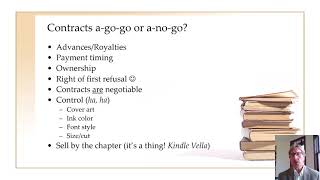
Dr. Chris Stout breaks down book contracts: how advances work as recoupable against royalties, the different royalty streams (domestic, international, digital, audiobook), and why you need a publishing attorney to negotiate. Publishers vary wildly on payment schedules and detail. You have little say over cover design but can often repurpose excerpts.
Chapters
Greetings and welcome back to how to Publish in the New Millennium. I'm Dr. Chris Stout. In today's lecture, we're going to be talking about contracts for professional book contracts. Contracts 101. Are contracts a go go or a no go? First things to think about is advances and royalties. Here's some of the, I hate to call them, like, you know, the backgrounds or the secrets, but a lot of stuff that you really don't hear about from author in academic settings. Advances once you've gotten a contract. Typically my experience has been with a number of different publishers is that there's two payments to your advance. Let's say you've got a book royalty contract for $5,000. When you sign the contract, when you've done your pitch, they've accepted everything. And when you signed your contract at the signing, you'll get half of that $2,500. Then you go through the work of producing the manuscript. It gets to the publisher and you submit it. Once they've accepted that submission, then you get the other $2,500. So that's your advance. So just submitting it doesn't mean that you get paid. It means that it's been submitted and that they've accepted it. They've reviewed it. They feel it's like a good enough caliber to now start the editorial process of it, the proofing, the all, all the tweaks and tightening of the bolts and things like that. So that's when you get the second part of it. Now, when you've gotten that example in our hypothetical $5,000 advance, that's an advance, what's called an advance against royalties. The royalties then are that once your book has sold over enough for you to get your $5,000 covered, that's not $5,000 worth of books. That means that let's say if we do the math and let's say for every that sells for $29.95 retail, that you get a dollar out of that. And that's generally how the math works in this circumstance, this kind of situation. Then once you have sold enough of those books, I guess 5,000 in my current hypothetical, that there have been 5,000 of your books sold, then that at a dollar a book for you, then your royalty has been your. Pardon me, your advance has been paid off by those royalties. If you don't, if you sell $4,999 worth, your advance has not been paid off yet and you won't make any more money than that. You have not paid off your Royalty or paid off your advance. And so it can be kind of confusing. Once you have sold enough books that it's covered your advance, then every book after that is what goes into paying you your royalty. And that can take a while. It depends upon the book. It depends. And we've talked earlier in the prior lecture about has it been accepted by or adopted by a course, how popular is it, et cetera, et cetera? Some people and I had a bad experience with Wiley. I had one book that was really kind of a stinker and it didn't sell well and I didn't meet sell enough of the books to pay off my advance. And they actually took this is a lesson that I was not happy about. But then in subsequent books I published with Wiley, those books were the amount that those books made had to first pay off my advance for the stinker book and then were able to catch up. So it worked out okay. But I had never had an experience like that. Typically historically that was the risk that publishers took on authors. It wasn't something that was shouldered by the authors. So that's something very much since we're talking about contracts to take a specific look at in terms of what the bad lesson that I learned that hopefully by taking this course that you'll take a look at your contract and see if you have a book that does not pay off in terms of covering its advance. If you subsequently write another book with that publisher, does that subsequent book have to go to service the advance of the book that did not sell well? So if you don't, if this is still kind of confusing for you, make sure that you have an attorney take a look over your contracts that has a familiarity with publishing and with authors rights. But that's something really to take a look for. I never had that with any of the other publishing houses. You might logically say, well, why publish again with Wiley? Well, I wouldn't have to. We'll talk about that in write of first refusal. But I don't have to and you know, I guess once bit, twice shy. But believe you me, after I saw that I read every other contract with a fine tooth with a magnifying glass and went through it with a fine tooth comb to be able to look for those kinds of clauses because that was quite a bad surprise. Let's talk more about royalties though, the good side of it. So let's say you've gotten your advance, your book is doing well, it's kind of an evergreen thing. You will get royalties in a variety of different kinds of areas that your publisher uses it, you'll have domestic royalties for books, let's say we're US based. So for books published in the United States and then international royalties, your book may get translated. I've had things translated into a total now of eight languages. It's kind of cool. You get a copy of the book in Arabic or a copy of the book in Korean or other languages, which is kind of fun to see. And then those rights oftentimes are a little bit better by the fact that it gets adopted in another country and goes through the translation process means that the publisher feels very strongly about it or there's a good market for it. And that's all some of the behind the scenes work that going with a professional publisher will do for you that you don't have to worry about. So those are all wonderful kinds of things. When it gets put into a digital format, digital downloads, Kindle, etc. Etc. Etc. The royalties tend to be a little bit better. You may make a little better than that presumable dollar a book. There also can be stairstep ratcheting. So let's say I'm just making this up hypothetically. After you sell your first 5,000 books, you make a dollar a book, then every 5,001 through 10,000 maybe you make a dollar and a quarter a book and every 10,001 to 15,000 you make $1,50, etc. So there can be those different kinds of ratcheting. Pardon me. So those are all nice things to think about if you've got a book that tends to have some shelf life and some longevity to it and is a bit evergreen in the nature of it. So those are all good things about royalties. I have been publishing with Wiley a number of years and I can say that, you know, it tallies up and each each year it's a kind of a nice thing. Some dwindle off. I'll talk about that in just a second. But with Wiley it's been very, very good payment timing. So here's a good way to talk about these payments. Wiley pays twice a year in April and October. So six months apart, they give you a very. Depending on how many books you've sold with them and all the different formats, you get a very itemized downloadable PDF or Excel spreadsheet of that. If you get nerdy about it and want to see how what book is sold, how much and how many copies and when and what kinds of formats. Prager, which and Greenwood, which is now owned by ABC Sileo, don't give you that level of detail, at least they don't give it to you automatically. And a lot of the books that I've sold with them, I've kind of, pardon me, run their course. I get very little residual royalties with, with those books. And that's just kind of how that whole process goes. So. ANN Prager, ABC Sileo pays once a year. They pay in the, the fall. And it's almost kind of at a point now with some of those books. I've kind of forgotten about them. And if there is something that does get paid, you know, it's sort of like, oh, that's, that's kind of a nice surprise. So that's nice. As you write your books and as you take a look at your contracts, do consider ownership of it? Do you maintain copyright of it? Generally that will be the case. There can be some exceptions here and there, but that's nice. You may want to take excerpts of your books and blog about them. You may want to use them for other kinds of publicity purposes. Some magazine, which is great, if they want to take an excerpt of your book, that, that's typically, you can give a green light to that. And your publisher will work with book publisher, will work with the publisher of that magazine to be able to use something and, you know, give an attribution to it. And then people go, oh, they like that article. Then they say, oh, there's a whole book about this. Then they may want to go out and get a copy of your book too. So those are all good things vis a vis ownership and what you want to do with it or repurpose it. I know some people will also take that copyright if the publisher doesn't do audiobooks and will work collaboratively with their original book publisher within an audio version publisher, and get it out there as well too. So that's terrific. Right of first refusal. This is kind of a nice thing. I don't have this with all my publishing contracts, but if what this means is that once you've published with somebody and you've delivered the book and you've got the contract, they will oftentimes have a clause in there called right of first refusal. And that might sound a little restrictive, but actually I found it to be just the opposite. A right of first refusal means that if you have an idea for your next book, the publisher has the first right to refuse publishing that book. So that sounds a little harsh, but basically it means that you can pitch to them. You've already got a track record, you've already published with them, hopefully everything's gone well and they probably will have a greater likelihood of wanting to publish with you again. That saves you a lot of steps of having to pitch blindly to new publishers. You already know what that publisher likes, you've already got a track record with them that you can reference, etc. Etc. So it makes things wonderful. If you pitch it and they say, no, that's fine, then you're released to then pitch it elsewhere. So that's kind of cool as well. The other thing is it gives you maybe a little bit of leverage that since you have that momentum behind you with that first publisher and you've got your next book idea with them to negotiate your contract and to say, well, thanks, I appreciate what you did the first time. I would like to get a bigger advance this time or I would like to make more on the back end and instead of getting a dollar a book, I'd like to get a dollar and a quarter a book to start off rather than ratcheting up to that dollar and a quarter. So those are all negotiable kinds of things. Oftentimes when it's your first contract and it's your first, you know, you're excited, oh my gosh, I got it. That's wonderful. It's heady. Congratulations. Those are things to take a victory lap about and to be happy about. But do consider pushing back and to say, you know, I would like a bigger advance or I would like better back end on the royalties and here are the reasons why. Not because I'm greedy or because I think I'm great or whatever, but here are some of the rationales why I've already published you with you before. That book did really well, you know, whatever. But don't just do it out of a sense of narcissism. Do it out of a place of being able to articulate the reasons why. Be reasonable about it. If the publisher hopefully will be reasonable about it right back with you and that will work out well. If not, then you do have the choice of saying, well, we can't come to an agreement and therefore that means that's a tacit denial of this contract. You are refusing this contract and I'll take my book elsewhere. And of course you have the right to do that. Not in a manipulative way or divisive way, but just in a reasonable, fair handed kind of way. Control. When you see your contract, you will see a lot of things in there that may come as a surprise to you. Again, these are all lessons learned by experience. On my part. And that is controlled. You have very little control. Once you've gotten that contract again, it's negotiable, so do keep that in mind. But there are certain things that they, you can push back and they'll push back. And, you know, your only consolation is that you can say, no, I don't want to do this contract with you. And that's that they can always say, no, we're not going to do the contract if you have to have your, you know, five year old's art on the COVID what have you. So I have not had, I had one experience with one publisher, I'll keep it all kind of confidential or anonymous where I thought the book covers were just awful and borderline being sort of biased or racist and made that argument to them. And my publisher said, you know, I'm happy to talk to your art department. They said, oh no, no, no, we just showed you this because, you know, we like working with you and we thought it was exciting, but we weren't even supposed to show it to you. So this is kind of how I found out about that. But I made my arguments and then my publisher took it back to their art department and we were able to get it fixed, which was a big relief. But chances are when you see the COVID art for your book, it's so far down the line that you know, you have very little say so over of it at any point in time, even sometimes I found that they stipulate what the color of the ink of the book will be. Again, not to pick on Wiley, but Wiley had a series of books that came out, I kid you not, had one book had blue ink on the interior, another book had green ink on the interiors. I don't know what they were thinking, if they were channeling their inner Peter Max or what. But it was a series of books, as you know, Wiley like series. And one of the distinguishing factors that they had was they had various colors of ink in the internal content of the book, which was something I'd never seen before. Font style or line spacing? Is it single point or single line? Is it a line and a half spacing, Is it a point or, pardon me, a 12 point font? Is it Times Roman? Is it Calibri? Who knows what. You'll find out what it is probably when you get the page proofs of your book, but you won't see it, you know, until then. And it'll probably may be something in the contract, but it's not something that you have very much of a Choice in pardon me you may have. When you pitch your book, some publishers will ask you what are the dimensions of the book? Not the size in the sense of how many. It could be pages. But typically size is judged by word count. 100,000 on average. But what they call size and cut and this means like the dimensionality of it. Is it a. Is it like a workbook? Is it going to be something that's almost like the size of a page 8 and a half by 11? Is it a paperback? Size is what's called quality paper bound, which is probably, I don't know the mentions off the top of my head, but probably something along the size of ten by seven, ten by seven and a half or eight, something like that. So in those sizes and dimensions that are very common, very popular in academic publishing of quality paper bound, cheaper to have a paper bound book for them to produce. That can help in terms of price point vis a vis your sales and royalty. But again, you'll have very little choice in terms of will this be hardbound or paper bound, etc. Digital obviously doesn't matter to you. And then in some cases this isn't so much for us, but just to be aware of, to sell by the chapter. This is a thing. Stephen King experimented with this with Amazon and Kindle Vella. It makes much more sense to be able to sell a book if you're writing a novel because someone reads the first chapter and goes, oh, this is not engaging, this is boring. I don't care about buying the rest of the book. It's almost like buying a track off an album rather than the whole album. So it's an experiment. Some people have done this in academic publishing. Maybe there's an edited work or certain kinds of things in a book that someone just wants to pay a buck or two for a chapter or two because the other chapters aren't of interest to them right now. It's evolved to a level that, you know, you can get a Kindle download for free sometimes or you know, not much ever more than $5. So it's just as worth, just as easy to buy the entire book rather than chapter by chapter, but just something to think about and know that it's out there. And then if you want to see, excuse me, examples of real pitches that I've done for the books that I've gotten contracts for and books that have pitches that have resulted in published books, how I've marketed them and how I put together those marketing plans, actual contracts, some of the dollars and a few things have been redacted out of them. All of the links for those contracts are available in an inexpensive book that I have available on Amazon called the Little Blue Book on Writing well and Getting Published. So feel free to check that out if that might be something of interest to you. We'll talk more about that into as well. So that's a primer on contracting. Next up will be book publishing in the non traditional realm. Looking forward to talking to you then. Thanks.
More from Dr.

2025 Mercedes-Benz CLE 450 4Matic Cabrio – Owner’s Views After a Year-and-a-Half as a Daily Driver

The Complete Guide to a Successful Everest Base Camp Trek – Post-Trek Debrief

The Complete Guide to a Successful EBC Trek – Post-Trek Debrief: What I Needed (and What I Didn’t)

What Went Wrong Customizing My New 2026 Porsche Carrera T …and what I did about it!

Coming May 1 At the Intersection of High Performance and Fulfillment: A Conversation with Alisa Cohn

From High Performance to Fulfillment: Lessons in Inner Mastery with Jim Murphy

Coming March 19: From High Performance to Fulfillment: Lessons in Inner Mastery with Jim Murphy

The New Humanitarians Volumes I - III:- Inspiration, Innovation, and Blueprints for Visionaries

The New Humanitarians Volumes I - III:- Inspiration, Innovation, and Blueprints for Visionaries

The New Humanitarians Vol I - III: Inspiration, Innovation, and Blueprints for Visionaries - Forward
