Dr. Chris Stout teaches authors how to test titles, covers, and premises before publishing. He walks through a word-column brainstorming exercise, an AI tool that scores titles against Amazon bestsellers, and design platforms like Canva. Peter Diamandis and Stephen Kotler A/B-tested cover concepts with their mailing list using SurveyMonkey to get real feedback fast.
Chapters
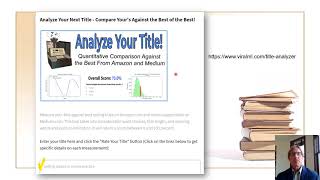
Hi, welcome back to how to Publish in the New Millennium. I'm Dr. Chris Stout. This lecture is on tools. There'll be a variety of different kinds of areas that we'll talk about with putting together your book and different kinds of tools that are available to you, be it traditional or self published. So let's start with a little bit of an exercise. I just, I thought this was really kind of a fun approach. So what's the big idea? And this was actually taken from Fast Company. So if you look into the areas of popular books, popular nonfiction books, a lot of them will be in the self help or business areas, etc. This one tends to be focused a little bit more in the business area. So again, this is kind of a little tongue in cheek, but Paradoxonomics, your name here. And this is kind of actually what a lot of these covers tend to look like. So this is create a title as theory. So you're coming up with your own new clever idea. So pick one from column A. This column optional is optional, and then one from column B. So Paradox Storm, if you chose not to have the options, or Paradox and circuits or what have you. So you start to stitch some of these together and then there's kind of a joke in the genre of having a subtitle. So in this context, since your big idea is an entirely new concept, you'll need a subtitle to do more of the heavy lifting and explaining, especially if it's kind of a. And a lot of people do like Freakonomics. Well, what was Freakonomics all about? Or Thinking Fast and Slow or those kinds of things. Very popular books, very well done books, very successful books, but done by very smart people. But they tend to be kind of a little kitschy and similar to this. So then your subtitles. So pick one from column C and one from column D. A transformative measurement of dynamic change in unbalanced wealth or. Or the power of humanity or what have you. So now you've constructed those, your title and your subtitle. And then you need to pick a premise. So then you add Ed, pardon me, E, F, G and H. And so then this needs the premise. So organizations that harness the forces of unproven instruments and products will cause previously hidden miracles to, pardon me, miracles might be good too. Marketplaces to emerge. So these are all. This is just kind of a fun way to think about, you know, how might you structure your chapters more? So just done as a creative exercise and to have a little bit of fun. So speaking of titles, there actually is a title. There used to be, gosh, one that Lulu, the self publishing website had that could help you. Like if you had a title, it would compare through an AI algorithm what your title look like as compared to other bestsellers that sadly doesn't exist anymore. But there is this one out there. If you go to click on this URL, it'll take you to this kind of a rinky dink, to be honest looking kind of site, but it is nevertheless kind of fun with what it does. So you can analyze your title. And what it does is look at a quantitative comparison of what your proposed book title is with Amazon best sellers and blog posts titles on medium. So I thought, well, what the heck, I'll take mine. So I put in mine. And this, I typed this in myself. Getting started in private practice, if you go to this link and type in whatever drafts that you're thinking of of what your title might be, you just type it in right here and click Enter. And for mine, you'll get a different graph. But for what I put in getting started in private practice, you'll get a score. And this one scored highly. I didn't spend a whole lot of time checking out bad ones and my ego couldn't take it. So this is what's called a smiling title skew. So this is sort of like the ideal smiling title is in the last or pardon me, in the light blue. And then for I don't know why, mine dipped to 1 and then skyrocketed 0.45. But anyway, mine's kind of, maybe more of a grimace or something, I'm not quite sure, a grin, maybe crooked smile with mine for the word title, word distance, skew and the word vector distance. So anyway, this is what we want to try and get to. And this is what mine was. And that was a good skew. So my overall score again was 100. And was it good, bad or crappy Skew? I scored a good skew. And then if you want to get nerdy about it, which I didn't in this slide, but how is the skew difference measured? And they will explain what goes into their algorithm. You can also then take a look at how long is it? Is it little goldilocks, too long, too short, too wordy, not wordy enough, etc. And this one, again, just a victory lap here, was perfectly sized. So this is the title length sweet spot for top medium posts versus mine and total posts. So mine, with the number of words, etc. Scored this way, if you get too wordy I guess it tends to dwindle off if it's not wordy enough. So this is kind of maybe the sweet spot of proper number of words. And then another way to be able to look at it in top medium spots for what's the actual absolute best. You can then go from there to found single positional matching words. So getting started in private, that was four, I guess practice maybe wasn't so great. And then found in composed positional matching words there were two getting started and getting started in. So these sets of matching words I guess were also good. So consider that in terms of perhaps your book titles, be it maybe if you're doing something popular or doing something academic or something like mine that maybe kind of crosses both. And then where do these matches come from? So you can take a look at these areas and see, well, maybe I should say something more like how to build or how to create or how to make or how to be or how to use, et cetera. And then this is what it looks like in terms of quadruples. So good single words, good pairs, good triples and good quadruples. And see if any of those might give you some ideas, some stimulate some creativity on your part in terms of some other chapter titles. And again, remember, if you're pitching to a traditional publisher, you can have half dozen if you want half dozen titles and different subtitles or similar titles and varying subtitles, et cetera. So publishers appreciate that, they like that. That helps get thinking creatively too, but also to get an idea of where your head's at with things. And it's, it's honestly, it's just kind of fun for back when I was using CreateSpace, which has now become KDP with Amazon, there is a system that was called Cover Lover, which is kind of a provocative name. I don't think it exists anymore. But there are a variety of other kinds of websites and services out there that can help you design your book covers. So there'll be royalty free images that your able to use the canvas, very popular, even more so these days than what it used to be. And you can have a choice of fonts and just have a lot of creativity with it. Most of these are freemium models, which means that you have a certain level of being able to get a free use of things. But if you want certain other maybe fonts or other maybe more selection of images or what have you, then that might come with a cost. I've not used any of these, so I can't tell you if they're you know good values or what the price ranges are. But all I can say is that, you know, take a look at a few of them, price them out, see if it's something that you're looking for. If you're going down the route of a self published kind of book with whatever service. We talked also about titles and this is another kind of way to test it. Peter Diamandis, who I had a chance to meet at a Medicine X conference a while back, great writer, interesting guy, Stephen Kotler, is also very much out there in terms of productivity and books and does, you know, very good work. They sent a survey out a while back. I'm on one or both of their mailing lists and stuff and they were, this is a while back when they were trying to test out some book covers and the titles were, I think, pretty much, you know, set. So they'd already maybe done some testing on that. So the book was going to be called or is called it subsequently come out Bold. How to Go Big, Create wealth and Impact the World, which I'm sure they also tested. But then they got to this point to say, well, you know, if we send this out to people that are also kind of interested in our stuff, what might be the better eye candy? What might be more eye catching to them? For these kinds of books, we've gotten at least these three different ideas of what, you know, presents the concept, the feeling of Bold. So here they are. And then basically all you would do is, is have to click on which. Well, subtitle, I guess they do have different ones. So you could click on which one that you like the most and then you could click on which one of these and send it back. Takes all of you can spend time on it and think about it or just be quick and say what caught your eye, caught your attention, caught your imagination the most quickly and send that back. So these are certainly things you can do through Mailchimp, SurveyMonkey, et cetera, those kinds of tools to any kind of mailing list or trusted friends, whoever else it is, that you might want to test images with or titles or subtitles, et cetera. So fun kinds of ways to do that. Coming up next, we'll take all these different kinds of things that we've learned thus far and apply them to marketing and sales and getting your ideas and your books out there to the world. Thanks.