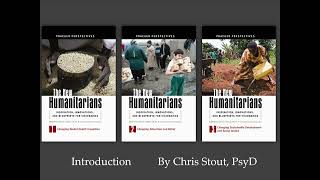
In this introductory narration, Dr. Chris Stout presents the concept, scope, and ambition of the three‑volume book and accompanying docuseries titled The New Humanitarians. He frames the work as a global tour of more than forty innovative humanitarian organizations operating across six continents, each tackling poverty, conflict, disease, human trafficking, education, environmental justice, and other systemic injustices. Stout explains that the project is meant to counter the superficiality of mainstream media by offering deep, behind‑the‑scenes stories that reveal the founders’ motivations, the moment of “tipping points,” and the practical, often guerrilla‑style solutions they devised. He describes his subjective, relationship‑based selection process—meeting leaders at venues such as Davos, TED, and Fast Company—while acknowledging the bias and lack of algorithmic rigor. The introduction highlights the diversity of the featured groups (from Braille Without Borders to for‑profit social enterprises) and outlines common traits: novel approaches, on‑the‑ground action, willingness to risk personal safety, and a drive to create sustainable, scalable models. Stout details the book’s structure: chapters authored or co‑authored by founders, guided by a flexible set of standardized interview questions, allowing each voice to shine while maintaining thematic consistency (origin story, model description, metrics, funding, lessons learned). He emphasizes that the volumes aim to inspire readers and provide actionable insights—how to secure funding, navigate failures, innovate under constraints, and measure impact—so that others may replicate or adapt these blueprints. The narrative concludes with a call to the audience to travel not as tourists but as activists, to learn from these “new humanitarians,” and to be moved to take their own courageous steps toward global change.
Chapters
Introduction by Dr. Chris Stout. Read by the author. Welcome to a trip around the world. You will travel to 6 continents, led by men and women of various ages and backgrounds. Be warned, you may go to some fairly desperate places, but they all have a seed of hope. You will not be traveling as a tourist, but rather as an activist with more than 3 dozen organizations, each one incredible. Each chapter is a story, a story of need, of response, and of accomplishment. They are all at once different, yet the same as being an inspirational account demonstrating the power of the individual triumphant over the challenges of poverty, illness, conflict, or a litany of injustices. My friend Jonathan Granoff, president of the Global Security Institute, said of the project that it is a counter to the pervasive pornography of the trivial that infects much of what is in the media today. I suspect he's correct. As a sad postscript but powerful testament to the seriousness of the work done by those profiled herein, a few days prior to this manuscript being sent in to the publisher, I was speaking with a representative with Médecins Sans Frontières who told me that that 3 of their staff had been killed in a conflict zone in Northwest Africa. My heart sunk on the news. Although I know such things happen, and with much more frequency than I usually let myself believe, I was more honored to get the stories of these heroic organizations out to a broader audience. In these 3 volumes, readers will learn about individuals who have created organizations that Break up human trafficking rings and teach citizens how to intervene in other injustices. Go to conflict areas and put themselves at risk to end the conflict. Help to ensure elections are just. Go to active war zones to administer emergency medical care. Provide training and loans in order to empower people out of poverty. Create a new language and put it to use in developing education and job training programs. Work to stop nuclear war and curb the development of weapons of mass destruction. Create an ingenious for-profit organization that supports the not-for-profit work. Solve a problem of medical supply shortages in the developing world while also alleviating medical waste problems in the developed world. Export social services training to self-sustaining programs. Create project-based trainings in order to increase capacity for global projects. Treat immigrant and refugee survivors of torture in a culturally competent manner that encompasses a holistic and healing support. Help boys conscripted into being child soldiers adapt to a normal life. Create the first not-for-profit pharmaceutical company to help in the battle of neglected diseases. Advance education for girls where it is almost unheard of. Integrate urban environmental design with democracy, civic participation, and social justice. Bring the philosophy of "it takes a village to raise a child" to formative elementary school years. Blend cultural heritage and inspire students by mobilizing parents, teachers, and young adults. Connect experts from a range of fields to work together on problems such as curing and preventing infectious and epidemic diseases, analyzing the risks of science and technology breakthroughs, and designing enforceable global health and environmental policies. Context for the project. In developing my own nascent organization, the Center for Global Initiatives, also profiled herein, I came to realize that there are many successful groundbreaking models that already exist worldwide, but there really isn't a blueprint or a how-to on the subject. Although this is most likely due to the uniqueness of the organizations and their leadership examined herein, as well as their idiosyncratic approach to conducting their work, it is my hope that these volumes will provide readers with a unique behind-the-scenes glimpse of the organizations and offer incredibly valuable insights present insider experiences, and give advice that few would ever have access to from one organization, let alone from more than 40 of the best of the best. I went about the selection process via the people I know. I met some in Davos at annual meetings of the World Economic Forum, or perhaps at a TED conference back when Richard Saul Wurman was still orchestrating them, or at a Renaissance Weekend or by being a co-nominee in the Fast Company Fast 50, or goodness knows where. I did not apply any scientific methods or algorithms to seek the most cost-efficient organizations, or those with the most stars on Charity Navigator, or those listed in a Forbes table. I was totally subjective and biased. I left my scientific method and lab coat at the door because I have been fortunate to have worked with some of the most innovative humanitarian organizations in the world, or to have collaborated with their incredibly talented founders and directors. In fact, it's my experiences with these extraordinary people that led to my idea for this book project. There are many wonderful, long-standing organizations that do important work, but I found that many of the organizations I was working with were newer and honestly a bit more edgy. Many have more skin in the game, These founders were on the ground and doing the work themselves, not remotely administrating from a comfortable office miles or a continent away. But don't let my capricious favoritism prevent you from researching the many, many other fantastic organizations that exist throughout the world. In fact, I hope this book and book set may cause you to do exactly that. I suppose I should have tried to get a book deal to to compile the complete encyclopedia of New Humanitarians, but I will leave that to someone with way more spunk than I. Though many of us are content in helping various causes by writing checks of support or even perhaps volunteering, the individuals profiled herein preferred to actually start their own organizations to enact their passionate interests. So herein was the idea that crystallized the concept for this New Humanitarians project. I wanted to find out what makes these new humanitarians tick and how their brainchildren worked. Now, through this 3-volume set and this docuseries, readers and listeners can too. From Braille Without Borders to Witness to Geek Corps en Action, humanitarian groups are working worldwide, largely in undeveloped countries, to better people's lives. Whether they are empowering people with schools for the blind, intervening in human trafficking, giving the underserved access to technology, or helping individuals work out of poverty, the men and women of these innovative organizations offer their tremendous talent to their causes, along with dedication and sometimes even personal risk to complete their missions. The work of these groups is remarkable. And so too are their stories of how they developed, including the defining moments when their founders felt that they had to take action. This project features a sampling of humanitarian groups across various areas: medicine, educational development, sustainable development, and social justice. These new humanitarians have been very successful with on-the-ground guerrilla innovations without a lot of bureaucracy, or baloney. They are rebels with a cause whose actions speak louder than words. They have all felt a moral duty to serve as vectors of change. I did not want to be the author of The Complete Idiot's Guide to Changing the World or Humanitarian Aid for Dummies, but I did want to canvass the organization whose founders I know personally and have had firsthand experiences with, as well as showcase others who are recognized pioneers and have them describe in their own words where they gained their original idea or what the tipping point was that so moved them to create their own organizations. I hope readers and listeners may gain not only inspiration but also actionable approaches that are based on the real-world experiences of those profiled if they, too, care to take action. Many of those appearing herein are already world-renowned. I hope this project will give readers the chance to learn the answers to questions rarely asked publicly, such as, how did you first get funding? Did you have false starts or failures? How creatively do you approach opportunities and obstacles, be they organizational or political? How do you create original solutions? What would you do differently today? Knowing what you know now than what you didn't know then. Common denominators. Even though the approaches of all these organizations are different, they do share a number of commonalities. At one time, they all formed their entity— entities. Each organization was novel in its approach to dealing with the problems it was addressing. The organizations were not restricted by past ways of thinking or acting. They created innovative approaches to produce something that was real and actionable from a concept and a vision. They developed practical approaches to solutions, some complex, some elegant, all robust and lasting. They were provocative. They were unhappy or unsatisfied with approaches that others were using and decided, "If you can't join them, beat them," and they did just that. They cleared their own trails to sustainability for their organizations for the benefit of others. They also have either a global reach or at least not bound to the North or the West. These young organizations with an average organizational age of 15 years at the time that we put the project together, with the majority being founded 10 or fewer years ago. Thus, they are new enough to demonstrate generalizable methods to help readers in their own development of their work while demonstrating sustainability and viability of their model and approach. Simply put, it is my goal to have this set of books and docuseries demonstrate how these organizations make a difference. Each of them has taken an approach to their life and work by living it like they mean it. While there is the essence of the power of one, it is one for all. The organizations profiled in this 3-volume book and docuseries set, book set, differ from many others in other ways as well. Some have been recognized with many awards and accolades—MacArthur Genius Award recipients, fellows of institutes or think tanks, etc.—whereas others are newer or have just such a low profile or are so remote as to not be picked up by any radar. I like the diversity. Some incredible budget— some have incredible budgets and others almost none, but they all do amazing things with what they have. And with increased exposure gained from being in this book set and docu-series, they may be able to gain more people's awareness. For example, Braille Without Borders is an organization created in 1998 by Sabre Tinbergen and Paul Cronenberg when they left Europe to establish Rehabilitation and Training Center for the Blind, a preparatory school for elementary school children in Tibet, in the Tibet Autonomous Region, TAR. Before the center was opened, blind children there did not have access to education. These children were stigmatized outcasts who had little hope for integration or much of a future. Although there are many governments and non-governmental organizations that have set up eye clinics for surgery or eyeglasses, There's a large group of blind people that cannot be helped by these clinics. The center was created for them. If this wasn't challenging enough, those in the TAR had no written form of communication. There was no Tibetan version of what many blind individuals use to read, known as Braille, invented in 1821 by Frenchman Louis Braille. So, of course, Tsabre invented Tibetan Braille, or Tibetan script, if you will, for the blind. This script combines the principles of Braille, the Braille system, with the special features of the Tibetan syllable-based script. Impoverished countries worldwide account for nearly 6 million preschool and school-age children who are blind, and 90 to 95% of them have no access to education. Braille Without Borders wants to empower blind people in such countries so that they can set up projects and schools for other blind people And in this way, the concept can spread across the globe so that many more blind and visually impaired people have access to education and a better future. It's people like Sabre and Paul and all those herein who are taking the kind of action that William Easterly pines for in The White Man's Burden. They are all interested in the results, and they deliver on them. They offer small-scale results that make large-scale impact. Structure. Readers of the books will find that many of the chapters are authored by the founder or current leader of the organization profiled. Other chapters are the result of an interview. I wanted this book to be thematic and structured, but I also wanted to provide a wide berth for every organization to best tell its story. Thus, for some, it is literally in their own voice, first person. In other instances, interviews were conducted and a story unfolds as told by the founder or current leader as the de facto co-author. I established a set of standardized questions that could be used as a guide, but not as a strict rule set. I told every organization's leader that he or she could follow them or ignore them, or to choose whatever was appropriate. I was very pleased with the result. That is, most chapters cover similar thematic aspects—how they started, how they manage, and so forth—but I think I have been able to steer clear of the chapters looking like cookie-cutter templates with simply different content sprinkled in the right spots here and there. It was my hope to create a set of guidebooks, not cookbooks, and I hope you as the reader will enjoy some similarity between chapters in their construction but great variability in their voice and creation. I asked authors to sketch the background on their centers or organizations when they started, canvas how their history is from historical starts to current day, provide a description of their model, indicate how large they are, what type of corporate structure, not-for-profit, university-based, etc., that they have, what metrics they use to track productivity or how they measure success, and biographical information about the founder. I also had a set of curiosities myself. Where'd the idea come from? What was the inspiration or motivation for starting the organization? Was there that one incident or the first or many events that moved the founder to no longer do nothing and take action? I felt that reading about specific cases or vignettes of groups or individuals who are helped would give a finer grain as to outcomes and impacts of such organizations. But I also wanted to learn how these organizations defined success. I think readers and listeners will not only be pleased but inspired, and I hope that you will have your own passion sparked and have your desire to know, and perhaps to do, more. Organizing the chapters was a bit of a challenge. As you will see, there is much overlap between their activities, and many somewhat defy an easy categorization, which I like actually. So I did the best I could, and I hope that will make readers and listeners consider to be reasonable groupings, or perhaps will at least cause readers to look at all three volumes. And now it is with great pleasure and awe that I introduce the New Humanitarians. I hope you enjoy.