The New Humanitarians Volume I - Flying Doctors of America
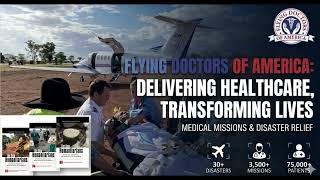
Flying Doctors of America, founded by Alan Gathercole, removes the friction that stops doctors from volunteering. A turnkey system handles permits and logistics so clinicians just show up. Over 16,000 volunteers have treated 85,000 people across four mission levels, from comfortable clinics to conflict zones.
Chapters
I want to start today's deep dive with a bit of a hypothetical scenario for you.
Okay, I'm ready.
Let's say it is 1990. You have a private pilot's license. You own a small single-engine plane. And you have exactly $700 in your pocket.
That's very specific.
It is. And that is your total disposable budget for the immediate future. Where are you pointing that nose?
Well, $700 in 1990, that's decent walking around money. So I mean, honestly, I'm probably charting a course for the Caribbean.
Yeah.
Just burn the fuel, find a beach, and worry about the return trip later. Or maybe a run up to Manhattan for a show and a really expensive steak.
Right. That is the rational, self-interested move. But we aren't talking about a rational vacation. Vacationer today.
No, we are not.
We are looking at a case study from our sources about a guy named Alan Gathercole. He looked at that exact same setup, the plane, the limited cash, and decided to fly directly into a remote, poverty-stricken village.
Just to provide medical aid.
Exactly.
Which is a bold move when you, you know, barely have gas money to get back.
He went literally on a wing and a prayer. And that specific choice, that refusal to take the easy path, became the seed for the organization we are breaking down today.
Flying Doctors of America.
Yes, FDOA. And the mission of this deep dive is to figure out exactly how this operates, because we aren't just looking at a charity here.
Right. The sources make it clear this is a unique operational model.
We are analyzing how they solve what you could call the logistics of goodness. We're going to look at the barriers that keep 99% of doctors from volunteering and how this group turns busy professionals into basically Indiana Jones-style humanitarians.
And while the name Flying Doctors sounds like a pretty standard charity setup, what's interesting here isn't just the humanitarian aspect.
No.
When you dig into the documents, you realize this isn't just about medicine. It's about solving a massive friction problem.
It's almost like a travel agency for heroism.
That is a slightly cynical way to put it, but honestly, it's accurate. FDOA is technically a nonprofit, nonsectarian organization. Now, our sources note that Gathercole has a background in theology and psychology.
Right. So there's that influence.
Exactly. So you see this concept of praxis, which is love as an action, baked into their DNA.
Hmm.
But the mechanism itself, the mechanism is purely about removing friction.
And they've scaled this mechanism significantly over the years. We are talking over 100 missions, treating over 85,000 people. Across Mexico, South America, India, Mongolia, Africa. It's huge.
The scale is impressive, but the how is what we really need to unpack for you today, because most people assume that if you are a doctor, you naturally want to help people, so you'll just go do it.
But the data shows something very different.
Very different.
Yeah. Let's talk about the logistics of goodness. I saw a stat in the research that Gattergold dug up during his time at Virginia Tech. It said 99% of doctors and dentists never leave their offices to deliver charity services.
99%.
That seems incredibly high to me.
It's staggering. And the immediate assumption is apathy, right? That they just don't care.
That would be the easy assumption.
But Gathercole found it wasn't about a lack of empathy at all. It was about friction.
Logistics.
Think about it. You run a dental practice. You have overhead, staff, a schedule packed 3 months out.
Right.
If you want to go help people in the Amazon, who organizes the flights? Who talks to the Ministry of Health in Brazil?
Who ensures the medicine doesn't get seized at customs?
Exactly. It's a logistical nightmare.
The cognitive load of planning the charity completely outweighs the desire to do the charity.
Precisely. You're paralyzed by the admin. So FDOA didn't just build a charity, they built a turnkey solution for altruism. They literally commoditized the logistics.
Turnkey is a business term usually reserved for franchises, like buying a fast food restaurant. How does that apply to a humanitarian mission?
In this context, it means you, the professional, provide the skill and the time.
Usually just a week or maybe 10 days, right?
Right. You pay your own way, and those costs are tax deductible, by the way. But FDOA handles all the friction.
They get the permits.
They book the travel, set up the clinic, handle the local government interactions. They completely remove the excuse of it being too hard to organize.
So for the dentist, it becomes a plug-and-play experience. You write a check, you show up at the airport, and you just do the work you're trained to do.
Exactly. And the argument from the sources is that this creates a triple win.
How so?
Well, the volunteers get a break from their routine, which is a huge selling point we'll get to. The corporate sponsors get tax benefits, and the needy get first-rate care they would never otherwise access.
You mentioned the break from routine. This is where the model gets really clever to me, almost manipulative in a good way.
Yeah, they lean into it.
They aren't just selling doing good. They are selling an escape from the mundane. I was looking at their level system for missions in the documents.
It reads like a difficulty setting in a video game.
It totally does. FDOA realized that different volunteers have different thresholds for discomfort. Not everyone is ready to go full survivor mode on day one.
No, definitely not.
So they explicitly categorize the misery Categorize the misery.
I like that phrasing.
Let's walk through these levels for you listening so you can picture this. Level 1 is the comfortable mission.
Right. This is the entry-level tier. This is for the volunteer who wants to help but needs a flush toilet and a hot shower at the end of the day.
Fair enough.
You're staying in hotels or hostels. You're transported to the clinics by a vehicle. It's low friction, high comfort. You're helping, but you aren't suffering.
Okay, but then you dial it up to level 2, the rural mission.
Now we're losing the amenities. Level 2 takes you further out into the field.
Usually no electricity.
Right. You're setting up makeshift clinics in schools or maybe churches. You may be sleeping on a cot in the local mayor's house.
And the hot showers—
Gone. You're washing up with a bucket.
And then there is Level 3, the arduous mission.
This is where it gets real.
This is the one that really caught my eye in the source material. Why would a successful dentist pay money to go on a trip where they have to dig their own latrine?
Because for a Western doctor trapped in a sterilized, air-conditioned office for 50 weeks a year, digging a latrine in the Amazon isn't a chore.
It's an adventure.
It is. Level 3 requires actual physical fitness screenings. You're hiking, riding horses, taking dugout canoes deep into the jungle.
It's the Indiana Jones factor.
It is entirely the Indiana Jones factor. It taps into that primal need to be challenged physically, not just intellectually. You are stripping away the rat race and getting back to survival.
And there is a hidden tier too, Level 4.
Yes.
You won't find this one advertised on their website.
It's the secret menu. These are missions into active conflict zones or refugee camps.
They happen during wars or immediately after major disasters?
FDOA handpicks these volunteers. They usually have military backgrounds or specialized trauma training. It's high stress, high danger.
That is intense. It really shows the breadth of what they are doing from a relatively comfortable hotel clinic to a literal war zone.
It's a massive spectrum.
But I want to zoom in on what happens when the rubber, or I guess the hiking boot, meets the road. Because the operational model gets you there, but the stories are what keep these people coming back year after year.
The stories are where the statistics become real human beings.
One that really stuck with me from the source material was the mission to the women's prison in Bolivia in 2007.
That was a landmark mission for them.
Yeah.
FDOA was actually the first non-Bolivian NGO allowed access to that specific prison. And you have to understand the context here. These inmates are the poorest of the poor.
Right.
In Bolivia at that time, if a mother went to prison and had nowhere to send her children, the children lived in the prison with her.
That is just a heartbreaking image.
It is. So the team is in there treating everyone—pediatrics, gynecology, general med.
And there is a specific account from a volunteer named Rosanne Carroll.
Right. She wasn't doing surgery. She was just distributing reading glasses, simple drugstore readers.
And there was a woman there, an inmate, who was absolutely hysterical. Yeah. Crying, terrified.
She was terrified she was going to miss her turn. She had prison chores she was mandated to finish, and she thought by the time she was done, the doctors would be packed up and gone.
She was desperate for a simple pair of glasses so she could see clearly to work.
And Roseanne just told her, I will save a pair for you. Wow. That small moment, just saving a pair of glasses, melted the woman's fear completely. Roseanne said the impact of that 2-minute encounter on her own soul was greater than anything she expected from the trip. It wasn't just about optics.
No, it was about dignity. It was about saying to this marginalized person, you matter enough for me to wait for you.
That leads to this recurring theme in the accounts of the oneness of humans.
There is another story we should highlight from Dr. Scott Carroll in Peru. This one felt like a masterclass in improvisation.
The riverbank clinic. The team is waiting for canoes to transport them upriver. And of course, there is a delay. They are stuck on a muddy riverbank with absolutely nothing to do.
And most of us would just sit there and complain about the delay. Like, where is the boat? I'm hot. This is miserable.
We'd totally be checking our watches and sighing. Right. But instead, within 10 minutes, they unpacked the gear and set up a makeshift clinic right there on the mudbank.
In 10 minutes? 10 minutes.
They treated the entire village before the boats even arrived. It's incredible.
It shows the difference between bureaucratic medicine, where you need a form in triplicate and a waiting room, and field medicine.
Where you just need a doctor and a patient.
And the source mentions that the volunteers often feel like they benefit more than the patients do.
It's the perspective shift. When you see people surviving and actually finding joy on $1 a day, it rewires your brain.
It breaks that slavery to schedules we get stuck in back home.
Which brings us to the business side of things, because you can't run an operation like this on just good vibes and perspective shifts alone. No, you definitely cannot.
And the source mentions a really interesting pivot they made regarding their assets.
This is a crucial part of the logistics of goodness we were talking about earlier. Originally, FDOA operated like a traditional aid group. Meaning what, exactly? Meaning they owned their own fleet of planes and had their own massive warehouses for medicine.
Which sounds impressive on paper. We have a fleet.
It sounds great for a brochure, but it's a financial disaster in practice. Maintaining aircraft is incredibly expensive. You have hangars, mechanics, certifications—
And storing medicine.
That's even worse. Medicine expires. Right. So they were bleeding cash on assets that weren't actually treating patients.
So they hit the no money, no mission wall? Exactly.
So they made a radical decision. They sold the fleet. They liquidated the warehouses.
That's a really bold move for an organization with the word flying in their name.
It was necessary. Yeah. They switched to using commercial flights for the long hauls to get the doctors into the country and then chartering local transport once they arrived. And for the medicine. They partnered with an organization called Medical Assistance Programs, or MAP. Why MAP specifically? Because MAP's entire existence is dedicated to collecting and distributing donated medicine. They are the absolute experts in that supply chain.
So instead of FDOA trying to duplicate that effort and failing, they just piggybacked on it. That is smart business strategy right there. You stick to your core competency. FDOA is good at mobilizing doctors.
MAP is good at moving pills. It's essentially a lean startup methodology applied to humanitarian aid. It maximizes the impact of every donated dollar.
Because they aren't paying for hangar space in Texas anymore. Right.
They are paying for canoe fuel in Peru. It's about efficiency, not vanity.
There is a deeper philosophy here too, beyond just the balance sheet. Gathercole talks about this alchemical process in his writing. Yeah, turning lead into gold. Now, he's not talking about actual chemistry here, right?
No, he's using his background in psychology. Yeah. He views the volunteer experience as transforming the lead, which he defines as the heavy, routine, schedule-driven life of a Western professional, and transforming that into gold, which is a life of purpose and genuine adventure.
I love that imagery. It's not just about healing the patient; it's about healing the doctor from the daily grind.
And embracing that inner Indiana Jones we talked about. It's acknowledging that we as humans need adventure. Mm. We need to feel like we are part of something epic.
By combining that deep need for adventure with medical relief, he unlocks a workforce that would otherwise just stay home on the couch. Exactly. So looking forward, where does this organization go? The source mentions some new directions they are exploring that go beyond standard Western medicine.
They are getting much more holistic. They've started integrating physical therapy, chiropractors, and massage therapists into the missions.
Which makes total sense. If you are a laborer in a rural village, your back and your joints are probably destroyed.
Skeletal and muscular issues are huge in these populations from a lifetime of hard labor. Right. But they're also looking at herbal medicines. They are researching Amazonian berries that might have properties to fight cancer. They are open to the idea that the indigenous people they serve might actually have medical wisdom to offer us.
And that ties directly into the environmental angle they've adopted recently. Yes.
The sources point out that this was heavily influenced by the environmental movements of the 2000s.
Specifically citing things like An Inconvenient Truth, right? Yes.
Now, we're just laying out their rationale here, but the connection they made was that you can't protect the health of indigenous people if you don't protect their environment. That tracks. If the jungle disappears, the medicinal plants disappear, and the people suffer. So the mission is becoming actively eco-friendly as well.
It's fascinating to see how it evolved from one guy with $700 and a single-engine plane to a global network. What are the numbers looking like now?
The database has over 16,000 volunteers. That's incredible. And over 10,000 of those are doctors and dentists. That is a massive army of good.
And they focus on that critical balance— immediate medical intervention, but also long-term community analysis.
Like building wells and infrastructure. It's the teach a man to fish concept.
But also heal the man so he can physically hold the fishing rod. Precisely. You can't work if you're sick. As we wrap up this deep dive, I keep thinking about Alan Gathercole's final advice in the document. It's pretty blunt, almost aggressive. It is.
He basically says, just do it. He strongly warns against being one of the "I was going to" people.
"I was going to"— that is a haunting phrase. It is the epitaph of a lot of good intentions.
I was going to volunteer. I was going to start that charity. I was going to write that book.
Gathercole's point is that you have to accept the clumsiness of starting something new.
You have to be willing to go on that wing and a prayer before you have the flight plan perfectly mapped out.
And he mentions that you have to accept the critics too.
Right. If you do something bold, people will criticize it. If you fail, people will eagerly point it out. Mm-hmm. But experience is the only teacher that matters.
You can't learn level 3 survival from a textbook. You really can't. So here is the thought we want to leave you with today. We talked a lot about how FDOA built a system to remove barriers for doctors, the logistics, the fear, the planning, all the friction. But for you listening right now, whatever your level 3 mission is in life, whether it's volunteering, starting a business, or just making a major personal change, what is the barrier stopping you?
And more importantly, is that barrier actually real? Or are you just waiting for a turnkey solution that is never going to arrive?
Sometimes you just have to buy the ticket and figure out the latrine situation when you get there.
That's the only way anything interesting ever happens.
Thanks for diving deep with us today. We will see you on the next one.
More from Dr.

2025 Mercedes-Benz CLE 450 4Matic Cabrio – Owner’s Views After a Year-and-a-Half as a Daily Driver

The Complete Guide to a Successful Everest Base Camp Trek – Post-Trek Debrief

The Complete Guide to a Successful EBC Trek – Post-Trek Debrief: What I Needed (and What I Didn’t)

What Went Wrong Customizing My New 2026 Porsche Carrera T …and what I did about it!

Coming May 1 At the Intersection of High Performance and Fulfillment: A Conversation with Alisa Cohn

From High Performance to Fulfillment: Lessons in Inner Mastery with Jim Murphy

Coming March 19: From High Performance to Fulfillment: Lessons in Inner Mastery with Jim Murphy

The New Humanitarians Volumes I - III:- Inspiration, Innovation, and Blueprints for Visionaries

The New Humanitarians Volumes I - III:- Inspiration, Innovation, and Blueprints for Visionaries

The New Humanitarians Vol I - III: Inspiration, Innovation, and Blueprints for Visionaries - Forward
