The New Humanitarians Volume I - Medicines Sans Frontiers
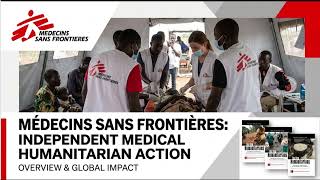
Dr. Chris Stout explores how Médecins Sans Frontières grew from a 1971 group of French doctors horrified by the Red Cross's silence into a major humanitarian force. MSF pioneered témoignage, bearing witness and speaking out, but faced constant tension between media activism and professional medical work. The organization won the 1999 Nobel Peace Prize while grappling with whether neutrality is possible when aid becomes a political tool.
Chapters
Today we are doing a deep dive into an organization that you definitely already know.
Oh, yeah. Everyone knows them.
Médecins Sans Frontières.
Yeah.
Or Doctors Without Borders. And today, they are basically the heavy artillery of humanitarian aid.
The absolute gold standard.
Right. You see them on the news with these massive white Land Cruisers, budgets in the hundreds of millions. They have the logistics to just drop a fully functional hospital into a war zone in 48 hours.
Which is incredible. They are the organization everyone else measures themselves against.
But the source material we're covering today, Kevin Phelan's book, From an Idea to Action, it paints a completely different origin story. Because in 1971, the medical establishment was not calling them heroes.
No, they were calling them medical tourists or cowboys.
Cowboys, exactly. Our mission today is to unpack how this tiny group of, well, break French doctors and journalists evolved into this professional humanitarian powerhouse.
And we really need to look at the internal wars. MSF didn't evolve through everyone just agreeing. It was shaped by some pretty vicious internal debates.
So let's set the scene. It's the late '60s. We have the Biafran War in Nigeria, massive starvation, a blockade, and a tidal wave in East Pakistan—
Okay.
—which is now Bangladesh. Right. And on the ground, you have these young French doctors working for the Red Cross, the ICRC. Now, the Red Cross is legendary, but they operate on this very strict transaction.
Access in exchange for silence. That is the classic Red Cross model. Neutrality above everything else.
They tell a dictator, "Let us see the prisoners, let us treat the wounded, and we promise we won't tell the world what you're doing." Which tactically makes total sense.
If you talk, you get kicked out and the prisoners die. But the doctors who ended up founding MSF, they were a generation haunted by World War II.
Right. They look back at the Red Cross's silence during the Holocaust.
Exactly. The ICRC knew about the camps but stayed quiet to preserve their access to POWs. These young doctors saw that as a massive moral failure.
They felt that silence could actually make aid organizations accomplices to a crime.
That's the core of it. If you treat a patient who is being systematically starved or bombed, and you say nothing, you just become the maintenance crew for the oppressor.
You're just keeping the victims healthy enough to be tortured again.
Yeah, which is a horrific realization, so they break away.
December 20, 1971. These Biafran firebrands merge with a group of journalists and doctors from a medical magazine called TONUS.
And that merger is key. It wasn't just doctors. That media DNA is crucial because it enshrined this concept of témoignage.
Which translates to witnessing, but it's a lot more aggressive than just watching.
It's witnessing as a political act. It means MSF has a dual mandate: yes, provide rapid medical care across borders, but also speak out about the causes of the suffering.
Refusing to stay silent. Right.
Refusing to separate the medical act from the political reality.
So they launch with this fiery philosophy. But reading the source material about those early years, like 1971 to 1976— It was a complete disaster. A total mess. They had no money, no logistics.
They were essentially hitchhiking to emergencies. They would rely on other organizations or even the French military just to catch a flight to a disaster zone. They were total amateurs.
Which brings us to the first major ethical crisis. Or really the great schism within the group.
Two camps form the battle for the soul of the organization.
You've got Bernard Kouchner, the charismatic founder, on one side, and on the other, the younger guys returning from the field like Claude Malterrey and Rody Brahman.
Kouchner was an absolute media genius. His whole argument was that MSF's strength was its informality. He said, look, when hundreds of thousands of people are dying, a few doctors with stethoscopes can't make a real medical difference.
So the goal should be symbolic.
Yes. Generate media outrage, shine a massive spotlight on the suffering to force Western governments to act.
But Malharait and Brahman, they were coming back from places like refugee camps in Thailand, and they were just frustrated.
They were fed up with the lack of resources. Their argument was, hey, we are doctors. If we actually organize ourselves and get proper supplies, we can be really useful.
And this all blew up in 1979 over the Boat for Vietnam project.
The perfect example of this clash: Kushner wanted to charter a ship, fill it with French intellectuals and journalists, and sail into the South China Sea to rescue Vietnamese refugees.
Which sounds incredibly dramatic. A total PR stunt.
That is exactly what Malraux called it. He argued that picking up a few hundred people on a media boat doesn't solve a massive refugee crisis. It just makes the donors in Paris feel good about themselves.
And Kushner's response was basically, if we don't do these symbolic acts, MSF is just going to become bureaucrats of charity.
Right. But Kushner lost that fight. He left to found Doctors of the World. And with Malhuret and Brahman taking over, MSF pivots hard. The 1980s becomes the era of efficiency and pragmatism.
The era of professionalization, which usually sounds so boring, you know, paperwork and meetings. But Phelan's book details how they actually revolutionized the mechanics of aid.
They essentially industrialized mercy. And this is where we get the invention of the logistician.
Because before this, you had highly trained surgeons out there trying to fix a broken diesel generator or digging latrines.
Which is a terrible waste of medical talent. So a pharmacist named Jacques Pinel looked at this chaos and realized that medical expertise is totally useless without a supply chain. If the anesthesia is stuck in customs, the surgeon can't do anything. Exactly. So they created a dedicated class of professionals just to handle the stuff, the logistics.
And Pannell develops this incredible concept of the kit.
Oh, the kit is brilliant. Before this, disaster struck and everyone scrambled to buy bandages here, antibiotics there. Pannell decided to prepackage everything.
They standardized it. I read they had a kit designed specifically for 10,000 patients for 3 months.
Yes, all sitting on a pallet ready to go. An earthquake hits, you throw it on a cargo plane, land, unzip it, and you are instantly operational. No scrambling.
They also stopped improvising medically. They wrote strict clinical guidelines and essential drug lists.
They realized that a massive refugee camp isn't just a giant emergency room; it's a public health challenge. You have to focus on vaccinations, water sanitation, cholera prevention. So they become these incredible technicians of survival.
But just as they master the logistics, they hit a massive political wall. Let's move into the 1980s Cold War context.
Right, the transition from logistics back to pure politics.
The 1984 famine in Ethiopia. It was this massive, globally televised crisis. Live Aid. We Are the World.
The whole world was pouring money and food into Ethiopia, and MSF is there running these huge feeding centers.
But they start noticing something deeply wrong. The Ethiopian government wasn't just struggling with bad weather. They were using the famine as a weapon. It was a trap.
The government was taking the food aid and using it as bait to lure starving people out of the north.
Because they wanted to weaken opposition groups up there. Exactly.
They lured hundreds of thousands of people into these feeding centers and then forcibly relocated them to government-controlled villages in the south.
And people were dying by the thousands during these forced transfers. MSF realized that their humanitarian aid was funding a lunatic project of social transformation.
The aid was literally diverting resources from rescue operations into a deportation machine. So MSF faces the ultimate dilemma.
Do you keep quiet, feed the people right in front of you, and accept that you are part of this deadly trap?
Or do you use Timornage? Do you speak out knowing you'll get kicked out and those people will starve anyway?
They chose to speak out. In 1985, they publicly denounced the Ethiopian government.
And they were immediately expelled from the country. But their denunciation worked. It pressured the US and European governments to start conditioning their aid, which eventually forced the resettlement program to stop.
It's such a heavy takeaway. They realized that the humanitarian act Humanity isn't inherently good all on its own. It can be manipulated.
It can absolutely be weaponized.
And that lesson just gets darker as we move into the 1990s. The Cold War ends, but we don't get peace. We get complex civil wars: Somalia, Bosnia, Rwanda.
The '90s really shattered any remaining innocence in the humanitarian world.
Let's talk about Rwanda in 1994. The genocide. MSF actually coined a phrase here that blew my mind. They said, Doctors and nurses cannot stop genocide.
It was a massive paradigm shift. MSF, an impartial medical organization, actually called for an armed military intervention.
They essentially begged the UN to send soldiers with guns.
Because they realized that when you are facing systematic extermination, handing out bandages is absurd.
And the nightmare didn't end when the genocide stopped. After the genocide, millions of people fled into neighboring Zaire and Tanzania. Setting up these massive refugee camps.
But the problem was the genocidaires, the perpetrators of the genocide, took control of those camps.
They used the civilian refugees as human shields, and they hijacked the international food aid to feed their militias and rebuild their army.
So MSF found themselves right back in the Ethiopia trap. But even worse, they were keeping the killers healthy.
Yeah, and this caused a huge split within MSF itself, didn't it? It did.
The different national sections actually disagreed on what to do. MSF France decided to pull out entirely. They refused to become accomplices to the militias.
But MSF Belgium stayed behind.
Right, they stayed and tried to practice what they called humanitarian resistance, trying to quietly undermine the militias' propaganda while still treating the civilians.
There are just no easy answers there. Which brings us to another concept the source material highlights from the '90s, specifically during the war in Bosnia. The humanitarian alibi.
This is a crucial concept. MSF witnessed the fall of the UN safe haven in Srebrenica and the massacre that followed.
And they saw how Western governments were reacting.
Western governments didn't want to take the political or military risk to actually stop the slaughter. So instead, they sent massive convoys of humanitarian aid. Food, blankets, medicine.
They used the aid as a fig leaf.
Exactly. The humanitarian alibi is when politicians use aid to hide their own political inaction. They say, look, we're doing something, we're sending food, while the people receiving the food are literally waiting to be massacred. It's so cynical. And MSF became fiercely critical of this. They refused to let their white trucks be used as an alibi for cowardice.
So moving into the 2000s, it feels like the battleground shifts. It's less about frontline war zones and more about massive medical catastrophes.
Specifically, the HIV/AIDS crisis. This completely redefined their mandate.
Because in the late '90s, treatments for HIV existed. But they cost something like $10,000 to $15,000 a year per patient.
Which meant they were completely inaccessible to patients in places like South Africa or Thailand. MSF doctors were sitting in clinics watching people die of a treatable condition simply because of patent laws and corporate monopolies.
So they didn't just accept it. In 2000, they launched the Access to Essential Medicines campaign.
They essentially went to war with Big Pharma. They advocated heavily for the production and distribution of generic drugs from countries like India and Brazil.
And it was a massive success. The price Prices eventually plummeted to under $150 a year.
It proved that MSF wasn't just about war anymore. They were willing to tackle global health inequality on a systemic level.
And right around this time, in 1999, the establishment hands them the ultimate validation.
They win the Nobel Peace Prize.
Which MSF was incredibly wary of. Because winning a prize like that usually means you've become a safe, polite organization.
And MSF's absolutely refused to be polite. The president of MSF at the time, James Orbinsky, used his Nobel acceptance speech to publicly condemn the Russian military for bombing civilians in Chechnya.
Right to the faces of the global elite in the room. Yes.
He basically said, thank you for the honor, but humanitarianism is not a tool to end war, and we will not be quiet.
They also used the Nobel Prize money to do something incredibly practical.
They funded the DNDI, the Drugs for Neglected Diseases Initiative to research treatments for diseases like sleeping sickness that pharmaceutical companies ignore because they just aren't profitable.
Which is such an MSF move. But I want to pivot to the final major challenge the book outlines: the post-9/11 world, the War on Terror.
This was a dangerous new frontier. The lines between soldiers and aid workers became completely blurred.
Because in places like Afghanistan and Iraq, coalition forces adopted this strategy of winning hearts and minds.
Right, you had heavily armed soldiers driving into villages, handing out food, in building medical clinics.
Which sounds helpful on the surface. But if you are an insurgent and you see aid being used as a military strategy—
Then aid workers become legitimate military targets. If aid is a weapon, the people delivering it are combatants. And that blur had tragic consequences.
In 2004, 5 MSF workers were assassinated in a clearly marked vehicle in Afghanistan.
The Taliban claimed responsibility, and MSF made the incredibly difficult decision to completely withdraw from Afghanistan.
After being there for decades. They had to.
They stated that the impartial humanitarian space simply no longer existed. They couldn't guarantee their staff wouldn't be seen as an extension of the US military.
Which perfectly explains their obsessive focus on independent funding. To protect themselves from government agendas, they push hard for private donations.
By 2006, over 80% of their budget came from private donors. Millions of individuals chipping in.
Because if you take money from a government, that money comes with strings attached.
Exactly. If your budget comes from the public, You have the freedom to say no. You can refuse to be part of a military strategy.
Which brings us to the close of the book. In 2006, MSF went through this massive internal reflection called the La Mancha Process.
It was a moment to pause and ask, after the chaos of the '90s and the War on Terror, who are we?
And they reaffirmed their core mission: rapid emergency medical aid combined with speaking out.
They accepted their limits. They know they cannot solve wars. But they absolutely refuse to be just silent technicians putting bandages on victims of injustice. It's an incredible evolution.
From a few angry guys smoking in a Paris office to this global network navigating the extreme limits of human suffering.
Always questioning their own impact. Always asking, are we actually helping or just providing an alibi?
And that leads to a final provocative thought I want you to mull over. As we look at modern conflicts today, where food and access to medicine are routinely used as weapons of war, the landscape is only getting more complicated. Is the era of truly neutral humanitarianism over? Can you ever really be neutral when you are providing aid in a war zone where suffering is the point?
It is the ethical dilemma that defines modern aid.
Something to think about the next time you see those white vests on the evening news. There is a whole history of fierce debate behind that logo. Thanks for joining us on this deep dive. Thanks for having me.
More from Dr.

2025 Mercedes-Benz CLE 450 4Matic Cabrio – Owner’s Views After a Year-and-a-Half as a Daily Driver

The Complete Guide to a Successful Everest Base Camp Trek – Post-Trek Debrief

The Complete Guide to a Successful EBC Trek – Post-Trek Debrief: What I Needed (and What I Didn’t)

What Went Wrong Customizing My New 2026 Porsche Carrera T …and what I did about it!

Coming May 1 At the Intersection of High Performance and Fulfillment: A Conversation with Alisa Cohn

From High Performance to Fulfillment: Lessons in Inner Mastery with Jim Murphy

Coming March 19: From High Performance to Fulfillment: Lessons in Inner Mastery with Jim Murphy

The New Humanitarians Volumes I - III:- Inspiration, Innovation, and Blueprints for Visionaries

The New Humanitarians Volumes I - III:- Inspiration, Innovation, and Blueprints for Visionaries

The New Humanitarians Vol I - III: Inspiration, Innovation, and Blueprints for Visionaries - Forward
