The New Humanitarians Volume I - REMEDY
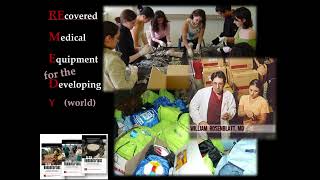
This deep‑dive episode explores Remedy (Recovered Medical Equipment for the Developing World), a grassroots organization founded by Dr. William H. Rosenblatt in 1988. The hosts trace the problem’s origin: U.S. hospitals discard perfectly sterile, unopened surgical supplies because strict waste regulations and liability concerns label any opened package as non‑sterile. This creates a massive, costly, and environmentally harmful waste stream. Rosenblatt’s experience providing anesthesia on medical missions highlighted the stark contrast between scarcity abroad and abundance at home, prompting the creation of a formal, nine‑step protocol for safely recovering unused supplies. The episode details each protocol step, the safety safeguards (no sharps, hazardous‑waste handling until sorting), and the logistical workflow that turns discarded items into boxed, inventoried donations. Remedy does not handle international shipping; instead it educates hospitals and connects them with established medical‑aid charities (e.g., Duke Recovery, MedShare). The model is financially lean (≈$200/yr per hospital) and yields environmental benefits through an EPA WasteWise partnership that quantifies greenhouse‑gas reductions. The hosts discuss barriers to wider adoption—administrative fear, legal liability, storage constraints, and institutional inertia—and how Remedy addressed liability with a Yale Law School opinion. They also explain Remedy’s strategic decision to avoid acute disaster relief, focusing instead on long‑term recovery where mixed‑supply boxes are useful. Impact metrics include 50 tons of supplies donated from the Yale pilot, a 1996 Rolex Award, and an estimate that $200 M of unused supplies could be recovered annually, potentially increasing U.S. medical aid by 50 %. The episode concludes with a forward‑looking vision of redesigning medical supply packaging for zero‑waste lifecycles.
Chapters
Welcome to your deep dive. Looking at the stack of sources you sent over, we are stepping into, uh, a world that you usually only see when you are incredibly vulnerable, right? We're going inside the modern hospital operating room, but, um, we aren't looking at the life-saving surgeries today. No, we're looking at a massive, completely hidden mountain of waste that is generated right alongside those surgeries. And more importantly, we are going to explore the, you know, incredibly ingenious grassroots system created to save that waste and actually put it to use.
It is a phenomenal subject to explore because on the surface this sounds like a, a simple story about recycling or, or reducing trash.
Yeah. Just putting things in the right bin.
Exactly. But it isn't just about trash at all. It is a profound look at the intersection of legal bureaucracy, environmentalism, and the stark disparities in global health.
Huge.
Today's focus is grounded in the foundational documents detailing an organization called Remedy, which stands for Recovered Medical Equipment for the Developing World.
The sheer scale of this waste is just— it's mind-blowing. When you think about medical waste, you probably picture, I don't know, contaminated items, blood, needles, that sort of thing.
Right. Hazardous stuff.
Right. But we are talking about perfectly good, untouched, brand new supplies that are thrown directly into the garbage. And the solution they came up with is so brilliantly simple, it almost makes you wonder why it took so long to implement.
Okay, let's unpack this, because to understand the solution, you really have to understand the origin story.
That story begins in the 1980s with Dr. William H. Rosenblatt. At the time, he was a pediatrician in training out in California at Stanford University.
Okay.
And while he was there, he became very aware of a program called Interplast. They were performing cleft lip and palate surgeries for indigenous populations in Latin America. Now, as a pediatrics trainee, he couldn't actually go on those surgical mission trips.
He didn't have the surgical skills.
Exactly. But things shifted dramatically when he moved across the country to become an anesthesiology trainee at Yale University. Suddenly, his specific skill set was in extremely high demand for these exact types of medical missions.
Right. They desperately needed anesthesiologists.
So, Dr. Rosenblatt starts traveling to Latin America to provide anesthesia for these surgeries, and this is where the contrast hits him. On these trips, he is confronted with a desperate lack of adequate medical equipment. He sees firsthand how difficult it is to provide care when you simply don't have the basic tools you need.
The profound impact of that scarcity really sets the stage for his epiphany. He would return from these resource-starved clinics, walk right back into the pristine, ultramodern operating rooms at Yale New Haven Hospital and witness the exact same equipment he was desperately lacking abroad just being tossed out, tossed straight into the trash. It wasn't broken. It wasn't contaminated. It was just excess supply that had been prepared for a surgery and ultimately wasn't needed.
You can just imagine the whiplash, seeing a lifesaving tool treated like absolute gold one week and then treated like garbage the next. To understand why this happens, you have to look at the historical context of how hospitals manage their physical environments.
What's fascinating here is that the exact regulations meant to protect public health inadvertently created a mountain of toxic, expensive, and completely usable waste.
It's so backwards.
It is. We have to go back to the late 1980s to see the trigger for this. The media was suddenly flooded with reports of medical waste syringes, vials, tubing washing up on the shores of Long Island.
Oh, wow.
As you can imagine, the public outcry was massive. People were terrified of walking on the beach.
Well, yeah, nobody wants to take their kids to the ocean and step on medical debris.
Exactly. And the reaction from authorities and hospital administrators was swift and, honestly, a bit panicked. There is an incident in the materials you sent over that perfectly illustrates this overcorrection. A barge was carrying general, everyday household waste.
Just normal garbage.
Just normal garbage. But during a routine inspection, a very small amount of medical waste was found mixed into the massive pile.
Oh no.
And instead of attempting to isolate or remove the medical waste, the authorities forced the hospital to dispose of the entire barge as if the whole massive shipment was medical waste.
You have got to be kidding.
Which is a catastrophic financial hit. Medical waste disposal isn't just throwing a black bag in a dumpster out back. It typically involves intense chemical treatments or industrial incineration.
But why not just hire people to sort it out at the hospital level? Why throw the baby out with the bathwater, so to speak?
The risk profile simply became too high. If a hospital chemically treats waste and puts it in a landfill, they run the risk of those harsh chemicals leaching into the groundwater. If they incinerate it, they are potentially producing and releasing airborne toxins. Plus, treating waste this way costs roughly 6 times more than normal hospital waste disposal.
6 times more.
Yes. So to avoid the public relations nightmare and the crippling legal risks of a stray piece of medical waste ending up in a regular landfill, hospitals in the early 1990s adopted incredibly strict blanket policies.
They just overcompensated.
Completely. Instead of trying to carefully sort general waste from medical waste, they just started labeling almost everything coming out of an operating room as medical waste.
Which leads to the absolute absurdity of the situation Dr. Rosenblatt witnessed. Think about the physical reality of an operating room. You have items like surgical gloves, sutures, drapes, and gowns.
Right.
In preparation for a surgery, these items are brought out and their outer packaging might be open so the surgical team is ready to go at a moment's notice. Every second counts in there.
Right. You can't be fumbling with wrappers during an emergency.
Exactly. But often the surgeon doesn't end up needing that specific suture or that extra pair of gloves. These items never touch a patient. They never come anywhere near bodily fluids or contamination. But legally, because that outer sterile environment was breached, they lose their sterile status in the United States. They cannot be used on a patient here. And so they are thrown directly into the high-cost, high-toxicity medical waste stream.
It's a perfect storm of legal liability, bureaucratic caution, and severe environmental consequence. But Dr. Rosenblatt realized something crucial: While these supplies couldn't legally be used in a US hospital, they were still perfectly viable and enthusiastically accepted by charitable organizations distributing to healthcare workers in the developing world.
Because the alternative wasn't a freshly packaged sterile tool?
It was often no tool at all.
Wow. That realization birthed Remedy in 1988. Dr. Rosenblatt started recovering these unused supplies right from the operating rooms at Yale New Haven Hospital. And he discovered that a lot of nurses and doctors across the country were actually already trying to do this voluntarily.
They were.
But they were doing it under the radar, essentially hoarding supplies in their lockers or hiding them in supply closets. It was erratic, undocumented, and frankly, it put both the individual healthcare workers and the hospitals at serious legal risk if anything went wrong.
They needed a formalized, defensible system. So Dr. Rosenblatt teamed up with Dr. David Silverman, and together they established a pilot program at Yale to research and prove that supply recovery could be efficacious, cost-effective, and environmentally friendly.
They needed the data.
Exactly. They didn't just want to collect a few boxes of supplies. They wanted to build a bulletproof protocol that any hospital administration could look at and approve without hesitation.
Let's actually walk through what that protocol looks like in practice, because the genius of the REMDI system is how incredibly simple it is to integrate into a high-stress stress hospital routine.
Right.
Picture a busy surgical wing. Step 1: In the hospital's central surgical supply room, staff simply place designated paper recovery bags onto what they call case carts. These are the wheeled carts that hold all the specialized instruments and supplies built out for the next day's scheduled surgeries.
Then step 2 takes place inside the operating room itself. After a procedure is finished, or even if a surgery is canceled at the last minute, The staff is already breaking down the room.
Just their normal routine.
Yes. And as they do, they take any items that were opened but never used and place them into that designated paper bag. But there is a crucial, non-negotiable rule here to protect the volunteers: absolutely no sharps.
No needles, no scalpels.
Nothing that can poke or cut.
Safety has to be the absolute baseline. So from that moment on until the sorting is totally complete, the hospital actually continues to treat those paper bags as if they are hazardous medical waste, just to be universally cautious.
Which is smart.
That brings us to step 3. The bags are taken down to the decontamination area, along with the heavily soiled surgical instruments that need actual chemical cleaning. But the paper bags are placed in their own dedicated bins.
Step 4 is where the manual intervention happens. A trained staff of volunteers empties these bags into specialized inspection baskets. They are meticulously looking to catch any unusable, contaminated, or sharp items that might have accidentally slipped in during the rush of cleaning the operating room.
You can't be too careful.
Right, and they don't take any chances with these volunteers. They observe strict standard precautions. They are fully suited up, wearing gowns, gloves, masks, and protective booties, which they must remove before they ever leave the room.
Okay, so once that initial safety check clears the items, steps 5 through 9 shift from hazard control to pure logistical organization. This is where the actual value is unlocked. The clean, unused items are meticulously sorted into highly specific bins based on what they are. Then they are boxed up, clearly labeled, and inventoried by item type and weight. You can't just send a mystery box overseas. It has to be documented, right? Finally, they're either picked up by a charity, shipped out, or stored in a designated area for an upcoming volunteer medical trip.
You'd be amazed at what actually makes the list of recovered items. It's the things you'd expect, sure, like rolled gauze, paper towels, and standard surgical sponges. But it's also highly specific, expensive surgical tools: disposable vascular clips, cast padding, staple removers, and sterile skin markers.
One of my absolute favorites from the inventory list is sutures. As long as the inner foil packet is intact and no sharp needles are exposed, they are totally recoverable. In fact, Remedy's protocol advises that if a hospital is short on physical storage space or volunteer capacity, they shouldn't overwhelm themselves trying to save every single paper towel. Yeah, they should just focus their limited energy on recovering the highest cost, most space-efficient items like those foil-packed sutures. It's a highly adaptable model by design. The founders explicitly state that not all hospital decontamination facilities have the same footprint or workflow, so the protocol is meant to be modified to fit the architecture of the building. The primary overriding goal is simply to never, under any circumstances, violate the hospital's sterile and standard precaution policies.
Which brings us to the actual charity model itself. And this is a major twist. You would think that Remedy, having collected all this material, is the one boxing all this stuff up, dealing with customs agents, putting it on cargo ships, and flying it around the world to these rural clinics.
But they don't.
They maintain a completely hands-off philosophy when it comes to the actual international shipping. Wait, so they just offload the hardest part of the job, the international shipping and customs bureaucracy, onto other charities? Isn't that just passing the buck? It looks like that at first glance, but consider the alternative. If Remedy tried to manage the logistics, they would be reinventing a massively complex wheel. There is already a massive, highly funded network of U.S.-based nonprofit medical charities—organizations whose entire infrastructure is built to support and deliver aid—groups like Duke Recovery, MedWorld, Supplies Overseas, Medical Bridges, and MedShare International. Oh, that makes a lot of sense.
Remedy doesn't need to learn the import tax laws in 50 different countries.
Exactly. These partner charities already have the logistics staff, the institutional knowledge, the shipping funding, and most importantly, the established overseas contacts. They know exactly which specific clinic in rural Peru needs cast padding and which hospital in Vietnam needs vascular clips.
So Remedy's role is entirely different.
Precisely. They operate as an educational catalyst. They created a comprehensive in-service teaching packet that they distribute to any hospital that asks for it, completely free of charge. They teach the hospital administration and staff how to safely recover the supplies using the 9-step protocol. Then, they simply connect that hospital with an existing logistical charity to take the supplies off their hands. They even encourage each hospital to target their donations to any organization or geographic project the local staff feels passionate about.
So what does this all mean? It means shocking operational efficiency.
The financial footprint is incredibly lean because they operate as an educational hub rather than a global logistics shipping company. The cost of running one of these recovery programs at a hospital is under $200 a year.
$200. That's nothing. And when you factor in that the hospital is no longer paying to dispose of tons of solid medical waste, which, as we discussed earlier, costs 6 times more than normal waste disposal, the hospital should actually realize a net financial savings just by participating.
They even push the boundaries on the environmental side to give hospitals more incentive. In 2004, Remedy partnered with the Environmental Protection Agency's WasteWise program. How does that work? This partnership allows hospitals to use the EPA's specialized waste reduction model. It essentially translates the raw physical weight of the solid waste they recover into concrete reportable estimates of greenhouse gas emissions prevented. Oh, wow.
So it gives hospitals a measurable environmental goal to hit, and they can put those numbers in their annual reports right alongside their humanitarian impact. Exactly.
It's a win-win on an operational, ecological, and public relations level.
Okay. But you're hitting on the exact friction point that many people wonder about when they hear this. What's that? Right. Because you are listening to this and you're probably thinking, if this is so incredibly cheap to run, if it saves the hospital money on waste removal, if it helps the environment, and if it provides millions of dollars in International Medical Aid, why doesn't every single hospital in the country do it immediately?
The reality of the modern healthcare system is that institutional change is incredibly difficult, even when the benefits are glaringly obvious. The documentation outlines several major roadblocks, and the most frequent one is simply administrative fear.
The public relations nightmare fear. Exactly. There is a fascinating example from a hospital in Washington State. They had a dedicated nurse who was diligently working to collect these surplus supplies, but the hospital administration actually pushed back and tried to shut it down. Why? They were terrified that having a formalized remedy recovery program would make them look bad to the public. They thought it would look like they were officially admitting to wasting too much expensive material in the first place.
That's the paradox Dr. Rosenblatt ran into repeatedly. By trying to solve the waste problem, you draw a massive spotlight to the fact you have a waste problem. Exactly. Yale New Haven Hospital shared this exact same administrative fear before they started their initial pilot program. They were very hesitant. They only relaxed when the subsequent media coverage turned out to be overwhelmingly positive. Journalists understood that waste is just an inevitable byproduct of the safety protocols in the healthcare industry. And they highlighted that Remedy was doing something incredibly proactive about it.
Hold on. Aside from PR, what about the legal liability? Risk management departments in hospitals are literally paid to imagine the absolute worst-case scenario. Very true. Their big fear has to be, what if we donate an unused scalpel or a sterile suture and a patient in another country gets injured during a surgery? Can that patient's family sue our hospital?
Remedy met that fear head-on because they knew it would be a dealbreaker for any hospital board. They went directly to the Yale School of Law and secured a formal legal opinion. The lawyers concluded that as long as the materials were donated as is and there was absolutely no financial sale or exchange of money for the items involved, the donating facilities were legally indemnified from that kind of international liability.
Oh, that's a huge relief for the admins. Absolutely. And then there are the practical physical roadblocks. Storage space is at a massive premium in any hospital. Every square foot is optimized for patient care or active inventory. Space is money. Yes. If you don't have a charity partner picking up your boxes on a very regular schedule, those boxes of recovered supplies start piling up in hallways, break rooms, and supply closets, and that becomes an operational and fire hazard really quickly.
When you look back at the history of the organization, Dr. Rosenblatt himself has been very candid about these structural challenges. After 17 years of running Remedy, he reflected that the organization had sort of plodded along in its growth. He deliberately didn't rush development in the early days because he had seen similar well-intentioned programs fail by trying to scale too fast without solid protocols. You want to get it right. Yes, but looking back with hindsight, he wished he had aggressively tried to secure grant funding and major foundation gifts much earlier to accelerate that growth and hire dedicated staff.
He also noted that the individual hospitals running these programs were operating too independently in their own silos. He really wanted to see them form tighter national networks, communicating with each other to share best practices, pool their storage resources, and coordinate with the charities more effectively.
That networking and coordination aspect is crucial, especially when you consider how Remedy approaches international crises. And this is perhaps one of the most surprising and counterintuitive elements of their entire operating philosophy.
This detail completely caught me off guard. When a massive earthquake hits or a tsunami devastating a region makes international headlines and everyone is rushing to help, Remedy makes absolutely no direct contribution to the acute relief aid. Zero. They sit it out.
This raises an important question: why would a medical charity, with access to millions of dollars in perfectly good medical supplies, deliberately sit out a catastrophic global disaster?
On the surface, it sounds cold, almost bureaucratic. It does. But when you dig into the logistical reality of their supply chain, it makes perfect practical sense. In an acute disaster zone, coordinated relief requires immense military-level organization. Doctors working in a triage tent in the rubble of an earthquake need absolute predictability. They need to know exactly what supplies are in a box before they open it, and they need everything to be totally compatible with their existing equipment.
You're looking at the chaotic nature of the recovered inventory. The supplies generated by Remedy are by their very nature a heterogeneous mix. It's a grab bag of whatever the operating rooms happened to not use that specific week. Right. A single box could contain 5 staple removers, 2 surgical drapes, a random assortment of vascular clips, and a handful of very specific mismatched sutures. If you send boxes of unpredictable mix supplies to an active disaster area, the overwhelmed healthcare workers simply do not have the time or manpower to open boxes and sort through them to find what they need.
You essentially just ship them a storage nightmare. There's no infrastructure left to organize it, nowhere safe and dry to put it, and the immense amount of money spent on flying that heavy mixed box across the world would have been much better spent on targeted, highly necessary uniform items. Exactly. Remedy explicitly recognizes this. They state that sending these mixed boxes to a disaster region might make the US donors feel really good about themselves in the moment, but it actually poses a massive logistical burden on the recipient, who is already fighting to save lives.
It forces you to evaluate the true purpose of medical charity. Is the primary goal to alleviate the donor's guilt and need for immediate action? Or is it to actually serve the person in need in the most effective way possible? Here's where it gets really interesting.
Remedy doesn't ignore the affected region forever. They just wait. They wait patiently until the acute crisis has passed, the rubble is cleared, and the international news cameras have gone home.
When the real hard work begins.
Exactly. When the affected communities transition into the grueling phase of long-term recovery and the local clinics are facing chronic shortages of everyday basic supplies, that is exactly when A Remedy steps in. They partner with charitable agencies that have an established long-term operational commitment to that specific region.
It is a deeply pragmatic approach that ensures the recovered supplies are actually unpacked, inventoried, and used to improve global health over the long term, rather than just becoming a different kind of waste sitting unopened in a different part of the world.
And the overall impact of this pragmatic, slow and steady approach is just staggering. By the time the foundational documents were compiled, the Remedy Pilot Program at Yale alone had successfully donated more than 50 tons of medical supplies. We are talking about millions upon millions of dollars in aid that went to under-resourced clinics in places like Nicaragua, Nicaragua, Vietnam, Sierra Leone, and Nepal, just to name a few.
The global scientific and philanthropic community certainly took notice of that scale. In May of 1996, Dr. Rosenblatt was awarded the highly prestigious Rolex Award for Enterprise in Science and Invention. To put that in perspective, he was one of only 5 winners chosen globally from a massive pool of 2,300 highly qualified applicants.
And that award put their grassroots movement on the map internationally. After the extensive media coverage from the Rolex Award, Remedy was flooded with requests for their 9-step protocols from healthcare facilities, not just in the United States, but in Japan, Kenya, India, France, the Philippines, all over the globe.
The potential scale of what could be achieved here is what truly stands out. The organization estimates that at least $200 million worth of these perfectly good unused supplies could be recovered from US hospitals every single year if the protocol was universally adopted. If that happened, it would increase the total medical aid sent from the United States to the developing world by a staggering 50%.
Just imagine that, a 50% increase in global medical aid achieved simply by catching the things we are already buying and throwing away.
If we connect this to the bigger picture, this entire deep dive has been about challenging the massive systems we just blindly accept as normal. The hospital administration, the legal bureaucracy, the waste management protocols, they all functioned on a default setting that created massive, expensive, toxic waste. Remedy had the courage and the analytical rigor to hack that system from the inside for the better, proving that with a little bit of volunteer effort, some paper bags, and smart logistics, you can literally turn administrative trash into life-saving treasure.
It really makes you look at every garbage can in a hospital differently. And as we wrap up, I want to leave you with one final thought to mull over. The materials note that Remedy is continually looking to the future. Including revisiting the actual chemical decontamination of surgical supplies. But let's take that a step further. If grassroots programs like Remedy can prove that what we call waste is really just a matter of perspective and poor logistics, what happens when we rethink the actual physical design of the supplies themselves? Imagine a future where medical equipment isn't just recovered by dedicated volunteers after the fact, but where the physical architecture of the operating room and the packaging itself is built entirely around a zero-waste lifecycle from the ground up? Who will be the ones to design that next frontier? Thank you so much for joining us on this deep dive. We will see you next time.
More from Dr.

2025 Mercedes-Benz CLE 450 4Matic Cabrio – Owner’s Views After a Year-and-a-Half as a Daily Driver

The Complete Guide to a Successful Everest Base Camp Trek – Post-Trek Debrief

The Complete Guide to a Successful EBC Trek – Post-Trek Debrief: What I Needed (and What I Didn’t)

What Went Wrong Customizing My New 2026 Porsche Carrera T …and what I did about it!

Coming May 1 At the Intersection of High Performance and Fulfillment: A Conversation with Alisa Cohn

From High Performance to Fulfillment: Lessons in Inner Mastery with Jim Murphy

Coming March 19: From High Performance to Fulfillment: Lessons in Inner Mastery with Jim Murphy

The New Humanitarians Volumes I - III:- Inspiration, Innovation, and Blueprints for Visionaries

The New Humanitarians Volumes I - III:- Inspiration, Innovation, and Blueprints for Visionaries

The New Humanitarians Vol I - III: Inspiration, Innovation, and Blueprints for Visionaries - Forward
