The New Humanitarians Volume I - Unite for Sight
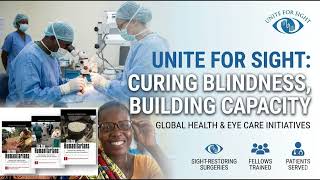
In this episode of The Deep Dive, hosts A and B unpack an excerpt from Jennifer Staple’s chapter “Unite for Sight,” exploring the massive global burden of preventable blindness—45 million blind and 135 million visually impaired people, 80 % of whom could be cured or prevented. They highlight stark disparities in eye‑care access, contrasting the U.S. ratio of one eye professional per 5,000 people with Liberia’s single ophthalmologist for 3.5 million. The conversation then follows the founding of Unite for Sight (UFS) by a Yale sophomore, its train‑the‑trainer, community‑empowerment model, and its $50 cataract surgery cost. Using the Buduburam refugee camp in Ghana as a case study, they describe how a refugee teacher, Kharis Hayes, connected the camp to UFS, leading to vision‑screening training for locals and teachers. Personal narratives illustrate outcomes: Mrs. Saki regains sight after 18 years of blindness; trauma‑induced blindness cases (Noal, Daniel, Finda) reveal deliberate wartime tactics that cause corneal, macular scarring and uveitis, rendering surgery ineffective. The episode also shows UFS’s pivot to social entrepreneurship—providing micro‑businesses (Ali’s water‑selling venture, jewelry makers Esther and Lucy) to sustain families when medical cure is impossible. Finally, the hosts discuss UFS’s scaling to 13 clinics, 500 000+ beneficiaries, volunteer‑driven fundraising, and the broader implication that restoring vision and economic agency can aid post‑conflict nation rebuilding.
Chapters
Welcome back to The Deep Dive. I am, I'm so glad you're joining us today because we are diving into a topic that, you know, it completely reframes how we think about healthcare.
Yeah, it really does.
And human resilience and honestly, global crises as a whole. Imagine you're holding a stack of research and field reports, right? And you want to understand not just what is broken in the world, but how brilliant grassroots solutions are actually fixing it.
Right, because there's a lot of focus on what's broken.
Exactly. So today, we're looking at this really profound piece of writing. It's an excerpted chapter titled "Unite for Sight" by Jennifer Staple. And it starts as an exploration of a massive global health crisis.
Preventable blindness.
Preventable blindness, yes.
Yeah.
But it quickly evolves into something much, much bigger. It's basically a masterclass in community empowerment, social entrepreneurship, and really confronting the devastating physical aftermath of war.
It really is a profound piece when you dig into the details here. You know, it forces you to look at global health not just as a clinical issue, but as a deeply human, deeply systemic one. It's about what happens when medical intervention intersects with extreme poverty and trauma.
So to get us grounded, I want to drop some staggering statistics right at the top just to give you the big picture. Picture of what we are actually dealing with here. There are an estimated 45 million blind people worldwide right now.
Which is just a massive number.
And it's huge. And on top of that, there are another 135 million visually impaired individuals. Those numbers are so massive, it is, uh, it's almost hard to comprehend that many human beings living in darkness or severe visual limitation.
They are massive numbers, but here is the critical contextualization that changes how you view this entire issue. Fully 90% of people who are blind live in developing countries.
Wow. 90%.
90%. But the real aha moment, the statistic that should make everyone listening stop in their tracks, is that 80% of this blindness is entirely curable or preventable.
Okay, let's unpack this.
Yeah.
Because that disparity is just wild, 80% is curable or preventable, we are talking about tens of millions of people who literally do not have to be blind.
They don't.
We really need to look at the inequality of global healthcare to understand why this is happening. Let's, uh, let's compare the numbers. In the United States, there is roughly 1 optometrist or ophthalmologist for every 5,000 people. You have an issue, you make an appointment, you get it fixed.
Right. It's routine.
Exactly. Compare that to Ghana, which actually has one of the highest numbers of eye doctors in Africa. There you have 1 ophthalmologist for every 59,146 people.
And then you look at Liberia, which is where a lot of the story originates. Liberia has a single solitary ophthalmologist for the entire population.
Wait, 1 doctor?
1 doctor for 3.5 million people.
That is just— I can't even fathom that.
Think about the math on that. If that one doctor worked 24 hours a day, 7 days a week, they couldn't even make a dent in the population's basic eye care needs. So when you have one doctor for millions of people, a completely curable condition—
like a basic cataract.
Exactly. It essentially becomes a permanent, lifelong disability simply due to a lack of access.
So when a gap in the system is that massive, how does a solution even begin to take shape. I mean, you can't just fly 1,000 doctors to Liberia overnight.
No, you can't.
And that is where Unite for Sight, or UFS, comes into the picture. This organization was founded by Jennifer Staple when she was just a sophomore at Yale University.
Sophomore?
Right. She was working as a clinical ophthalmology research associate, saw these preventable cases of blindness, and decided to actually do something about it. And it wasn't just, you know, a college project from a single volunteer, it has grown into a global force of 4,000 volunteers.
What's fascinating here is how the organization's model aligns perfectly with the World Health Organization's Vision 2020 goal.
Which aims to completely eliminate preventable blindness, right?
Yes, exactly. And UFS doesn't operate on the traditional passive charity model where you just build a clinic and wait for people to show up.
Right.
They actively go out and remove this specific systemic barriers to care that exist in these regions. We're talking about removing the lack of education, the fear of Western medicine, the impossible transportation logistics, and of course, the financial cost.
And here's the kicker for you listening: an average sight-restoring cataract surgery costs just $50.
$50!
For the price of a decent dinner out, you can literally restore someone's sight. That is incredible to think about.
Yeah.
And to really show you how this model works in practice, we're going to look at ground zero of their efforts in Ghana.
The Buduburam Refugee Camp.
Yes. You really have to visualize this place. It was established in 1990 by the Ghanaian government to host Liberian refugees fleeing a brutal civil war. By the time of this writing, it houses over 77,000 people.
That's the size of a city.
A small American city, all living in a temporary refugee camp. That includes refugees from Liberia, Sierra Leone, and the Ivory Coast, as well as some local Ghanaian villagers. And despite having 77,000 residents, the camp has exactly one primary care doctor.
And absolutely zero specialty care.
No eye doctors at all.
None. And the way Unite for Sight ended up, there is a pure testament to grassroots initiative. There is a man named Kharis Hayes, a refugee and a schoolteacher living at the camp.
He recognized the profound need in his community.
Right. He managed to get on the internet, searched for healthcare resources, found Unite for Sight, and reached out. It is that simple spark of connection. From there, UFS partnered with Dr. James Clark, an ophthalmologist who runs a private clinic located 2 hours away in Accra.
But UFS didn't just fly a bunch of volunteers in, do a weekend of surgeries, and leave.
Yeah.
That kind of parachute medicine doesn't create lasting change. What is so brilliant about this model is how they build infrastructure.
Yes.
How do you actually train someone who isn't a medical professional to run an eye clinic in a refugee camp?
You use the train-the-trainers model, which is incredibly effective and sustainable. Instead of relying solely on international volunteers to do the heavy lifting indefinitely, UFS trained the local refugees themselves to conduct the daily vision screenings.
They empower the community to take ownership of the program.
Furthermore, they went into the camp schools and taught the local teachers how to test basic visual acuity in their students.
Which is a massive paradigm shift. By teaching those teachers how to test vision, they gave them the ability to distinguish between a student who actually has a learning disability and a student who simply can't see the chalkboard.
Exactly.
Imagine being a child labeled as slow or unteachable simply because you need a pair of glasses. But no one has the tools to diagnose you. Giving teachers that diagnostic ability can change a child's entire educational and economic trajectory.
It absolutely alters the course of their lives. And the results of this grassroots mobilization are immediate and profound. When you have a community of 77,000 people that has been denied specialty care for over a decade, the backlog of curable conditions is immense.
But to bring that human element to life for you, we have to talk about Mr. and Mrs. Saki. They were an older couple living at the camp, and both were entirely blind from cataracts. Mrs. Saki had been completely blind for 18 years.
18 years!
Think about that—nearly 2 decades in complete darkness inside a chaotic refugee camp. She had desperately tried putting local herbs into her eyes, hoping it would somehow restore her vision, but of course, it only inflamed the issue and made her more miserable.
It's a heartbreaking reality of medical desperation. She expressed how she felt completely useless. She felt she had lost the respect of her family. Yeah. And she reached a point where she just wanted to pass away because the emotional and psychological pain of being a burden was so great.
But then the grassroots system worked. She was screened and Unite for Sight facilitated her surgery with Dr. Clark. When the patch was finally removed after 18 years of darkness, Her reaction was pure, unfiltered joy. It's amazing, she said. Blindness is hell. I can see the television light and God's creations. When she went back to the camp, she could finally see her husband again. She could see her children, and she was able to look at grandchildren she had literally never laid eyes on before. Wow. She described it perfectly. She said, I was dead, but I am now alive.
It is an incredibly powerful moment. You can truly feel the sheer joy and the restoration of human dignity that comes from that $50 medical intervention. But we can't just rest on that joyful moment. No. Because the medical realities of this specific refugee camp demand a much deeper analysis. Yes.
Here's where the story takes a deeply intense turn. We need to look at the darker, more difficult realities uncovered at this camp. Yeah. And we want to be very clear with you, we are impartially reporting these factual accounts and statistics exactly as they were documented.
Right. Without taking any political sides regarding the Liberian Civil War or the various factions involved.
This is purely an examination of the medical data and the human rights abuses that caused it. Because the data reveals a truly shocking statistic. Yeah. At the Buduburam camp, the operable cataract rate, the condition that Mrs. Saki had, was remarkably low. It was only 2.6%.
What's fascinating here is the medical explanation for why that rate was so devastatingly low. In a typical aging population, you'd expect a much higher rate of operable cataracts because cataracts are largely a natural product of aging. Right. But the medical data at this camp directly reflects severe, targeted human rights abuses. This wasn't natural aging. This was trauma-induced blindness on a mass scale.
The inoperable cases tell a chilling story. 35% suffered from severe corneal scarring, 14% had macular scarring, and 14% had uveitis.
Let's actually pause and define those terms because to a layperson, that just sounds like medical jargon. Yeah. But understanding what those conditions are is essential to understanding what these people survive.
What exactly is corneal scarring or uveitis? Let's break that down.
The cornea is the clear front window of your eye. Corneal scarring means that clear window has been physically scratched, burned, or traumatized to the point where it becomes permanently clouded over like a heavily frosted piece of glass. And macular scarring? That's even deeper. The macula is the center of your retina, responsible for your sharp, straight-ahead vision. If you force someone to stare at the sun, It literally burns the macula, destroying the eye's camera sensor permanently. And uveitis. That is an inflammation of the middle layer of the eye, the part that supplies blood to the retina. If left untreated, severe uveitis acts like a slow, painful, blinding fire inside the eye.
And it is harrowing to learn exactly how these patients acquire these specific scars. It wasn't from accidents. It was deliberate. We are going to share some of these survivor stories with you now because we need to look at the reality of the trauma they endured and the intentional use of Blindness as a Weapon of War.
The first account is of Noal, a 57-year-old woman. In 1992, rebels forced her and others in her village to beat seed rice with their bare hands until they bled and could no longer hold the pestles.
As a punishment for stopping out of sheer exhaustion, they were locked in a dark room overnight.
The next morning, they were brought outside and forced to stare directly into the blinding sun all day long. They were mockingly told to study the sun and become the first scientists from Africa to understand how it operates.
It's a level of psychological torture we can hardly wrap our heads around. It wasn't just physical abuse; it was a sick mockery of education. A 32-year-old woman in that group was killed simply for closing her eyes to protect them from the light.
Noal survived and eventually escaped to Ghana, but staring at the sun caused severe, irreversible macular scarring. She permanently lost her sight because her retinas were burned away by that torture.
There's also the account of a man named Daniel. In 1990, his town was attacked. He was beaten with guns and then at gunpoint forced to urinate into a cup and drink it after his brother was shot right in front of him for speaking out.
Daniel was tied up, a rock was shoved into his mouth to keep it open, and he was placed in the middle of the town facing the sun for over 5 hours.
He was forced to endure this while being urinated on until fighting broke out and he was eventually untied by government troops. Again, The goal was permanent, irreversible destruction of the eye.
And it was often used as a tool for targeted disenfranchisement, like in the story of Finda. She was a 60-year-old woman attacked in 1990 specifically because she refused to relinquish land she owned.
When rebels took over her area, she rushed home to find her nephew dead and her children on the ground. She was beaten, and her own daughter was forced to mix pepper with urine, which the attackers then forced directly into Finda's eyes.
As if that wasn't agonizing enough, one of the attackers used a belt to beat her directly in the eye until the physical trauma caused her to go completely blind.
And this is where you see the chilling tactical reason behind the violence. While she was blind, terrified, and in absolute agony, they asked her to choose between her life and her land.
She chose her life.
But because she could no longer see, her daughter had to write out the legal document signing away the land, and Finda was forced to place her thumbprint on it. They use blindness to steal her agency and her property.
It is incredibly difficult to process. For survivors like Noel, Daniel, and Finda, Unite for Sight cannot medically restore their vision. The damage from that level of torture is permanent. Western medicine has no cure for a destroyed retina.
However, there is one story of trauma that had a different outcome. Jeremiah was 19 years old. During the war, he was struck heavily in the right eye. Over time, he completely lost his sight in that eye.
But unlike those with the untreatable retinal scarring from staring at the sun, Jeremiah developed a trauma-induced cataract.
Right, which is an important medical distinction. The physical blow to his face didn't destroy the retina at the back of the eye. Instead, the trauma caused the lens at the front of the eye to cloud over.
It is essentially a thick, physical barrier blocking the light, but the processing center behind it is still intact. Because of this, his condition was actually treatable.
He traveled to the Buduburam camp, was evaluated by the local team, and Dr. Clark was able to perform the exact same $50 surgery to remove that clouded lens and restore his sight.
When you hear Jeremiah talk about the aftermath of his surgery, it hits so hard. He said, today my life is changed. I am no more disabled. I am sure I will be respected by my fellow men again.
It is a powerful reminder of how intertwined physical capability and social dignity are in these environments. When you are blind in a refugee camp, you aren't just visually impaired; you are often socially isolated and completely dependent on others for basic survival.
If we connect this to the bigger picture, this is where Unite for Sight realized a vital truth that sets them apart from traditional medical charities. What was that? In a refugee camp built on displacement and extreme trauma, medical care alone simply wasn't enough. Curing a cataract is a miracle, yes, but if that patient regains their sight only to return to a life of absolute systemic poverty, unable to feed their family, the healing is vastly incomplete.
And that realization is perfectly illustrated by the story of a man named Ali. Ali was a math teacher. He fled Liberia after his father, who was a popular local businessman, was executed right in front of his supporters.
Ali fled to the Ivory Coast, managed to build a completely new life there, but had to flee yet again when war broke out there in 2002.
He eventually ended up at the Buduburam camp with 13 dependents, extended family and children he was caring for, all living in a tiny 8-by-10-foot room. They could barely afford a single meal a day.
And medically, Ali's case was deeply tragic. He was one of the first patients evaluated at the UFS clinic, hoping for a cure. But his diagnosis wasn't a cataract. His retina was speckled with dark spots, which is the hallmark of retinitis pigmentosa.
If you aren't familiar with it, it's an incurable genetic condition. It causes a gradual, progressive loss of vision, starting with night blindness and slowly closing in like a dark curtain until you are left with extreme tunnel vision or total blindness.
It cannot be cured even in the most advanced hospitals in the world.
He quietly asked Julie, the UFS Ghana program coordinator, how he was supposed to study or work or feed 13 people if he was going permanently blind. Medicine had completely failed him.
But this is where the organization pivoted in a way that is just brilliant. They moved from pure medicine into social entrepreneurship.
Because they couldn't restore his sight, Julie developed a plan to help him generate sustainable income. UFS purchased a highly specific set of supplies for him. A deep freeze, a voltage regulator to handle the unstable camp electricity, a cooler, an extension cord, bulk water sachets, and the necessary electrical current registration.
They essentially bought him a turnkey water selling business. They looked at the local economy of the refugee camp, saw a need for clean, cold drinking water, and provided the exact capital needed to start that microbusiness.
With this business established, Ali was finally able to generate a steady income and support his massive family, even though his physical sight will never be restored.
They applied that same logic to others in the camp as well. There are two female heads of household, Esther and Lucy. They were invited into a micro-enterprise program where they craft these vibrant, beautiful jewelry pieces and eyeglass cases.
UFS buys these items directly from them, providing them with immediate, reliable income to support their families. Then, the organization takes those items and sells them on the global market, online and at universities across the US.
And they use 100% of those profits to fund more eye care back in the camps. It's an incredibly brilliant self-sustaining loop.
It is the definition of a holistic approach to global health. You are treating the patient's eyes when possible, but you are also treating their economic reality when medicine falls short.
Integrating microfinance directly into a healthcare delivery model acknowledges that a patient is a whole person living in a complex economy, not just a set of eyes needing surgery.
So as we zoom back out to look at the grand synthesis of everything we've discussed today, the impact is absolutely massive. What started with a college sophomore noticing a gap in the system has evolved into a standardized, highly effective model operating across 13 global clinics.
They have reached over 500,000 people and funded thousands upon thousands of sight-restoring surgeries.
And they have achieved that scale through incredibly efficient means. They don't waste millions on building new, redundant infrastructure. They utilize existing networks—local eye clinics, universities, medical schools—and they leverage the internet for recruitment and fundraising.
They rely heavily on passionate volunteers who fundraise to cover that exact $50 per surgery cost, and they ensure that 100% of those specific proceeds go directly into the field to pay the local doctors and buy the surgical supplies.
So what does this all mean for you listening right now? I think it really pushes us to reconsider the sheer power of social entrepreneurship. It absolutely does. It shows us that solving a massive, paralyzing global crisis like preventable blindness doesn't always require inventing a brand new billion-dollar medical technology. Sometimes the cure already exists. Sometimes solving the problem simply requires connecting the existing resources in a smarter, more empathetic way.
It is about taking the internet, willing volunteers, local doctors who are already in the country but under-resourced, and passionate community leaders like Karis Hayes, and linking them all together.
When you build those bridges, you can literally cure blindness for thousands of people.
This raises an important question, and it's a concept that lingers long after you finish looking at this data. With a newly elected president in Liberia, Many of the refugees at the Buduburam camp are finally beginning the long journey back to their home country. Yeah. And it leaves us with a profound reality to mull over. When an organization like Unite for Sight restores a refugee's vision or gives them the microfinance tools to support themselves after years of horrific blinding abuse, they aren't just healing a single patient in a vacuum. Right. They are fundamentally equipping that person to rebuild a fractured nation. As these individuals pack up their lives in Ghana and return home, we have to ask: how much does the physical and economic healing of a country's displaced citizens dictate the societal and infrastructural healing of the nation itself? You simply cannot rebuild a war-torn country if its people are left languishing in darkness.
That is an incredibly powerful thought to end on. Thank you so much for joining us on this deep dive. We hope this exploration into the intersection of global health, the realities of trauma, and the brilliance of community empowerment has been as eye-opening for you as it was for us. Keep asking questions, keep looking for those deeper connections in the world around you, and we will catch you next time.
More from Dr.

2025 Mercedes-Benz CLE 450 4Matic Cabrio – Owner’s Views After a Year-and-a-Half as a Daily Driver

The Complete Guide to a Successful Everest Base Camp Trek – Post-Trek Debrief

The Complete Guide to a Successful EBC Trek – Post-Trek Debrief: What I Needed (and What I Didn’t)

What Went Wrong Customizing My New 2026 Porsche Carrera T …and what I did about it!

Coming May 1 At the Intersection of High Performance and Fulfillment: A Conversation with Alisa Cohn

From High Performance to Fulfillment: Lessons in Inner Mastery with Jim Murphy

Coming March 19: From High Performance to Fulfillment: Lessons in Inner Mastery with Jim Murphy

The New Humanitarians Volumes I - III:- Inspiration, Innovation, and Blueprints for Visionaries

The New Humanitarians Volumes I - III:- Inspiration, Innovation, and Blueprints for Visionaries

The New Humanitarians Vol I - III: Inspiration, Innovation, and Blueprints for Visionaries - Forward
