The New Humanitarians Volume II - Braille Without Borders
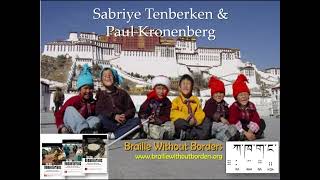
Sabrae TenBirkhan and Paul Cronenberg founded Braille Without Borders in Tibet, inventing Tibetan Braille and building tactile farming infrastructure for blind operators. They reframed disability through self-integration, where blind people build their own spaces rather than wait for accommodations, and scaled the model across Asia as elite crisis-management training.
Chapters
So the quote goes, "Dear parents, don't worry about your children.
The farm is clean and the food is excellent." Which it honestly sounds like the most generic summer camp postcard you could possibly get, right?
Yeah, it really does. Just having fun. Weather is great. Send more snacks type of thing.
Right.
But when you actually dig into the context of that quote, like who wrote it and who it was for, it completely stops being generic. It's actually revolutionary because that was a message from the deputy mayor of Lhasa, Tibet.
And he was reassuring parents about sending their blind children to a training farm, which is a massive deal because historically in the Tibetan Autonomous Region, you didn't send blind children to training farms.
No, not at all.
You hid them. They were often totally marginalized, kept out of the education system entirely, or just resigned to a life of begging.
So sending them to a farm to, uh, to learn actual skills wasn't just a field trip. It was a complete upheaval of the social order there. And that is exactly what we are unpacking today for you. We're doing a deep dive into Braille Without Borders.
Yeah, it's the story of Sabrae TenBirkhan and Paul Cronenberg. And looking through our source material today, which is this incredibly detailed report titled Braille Without Borders, do you need vision to be a visionary? It becomes clear pretty fast that this isn't just your standard feel-good charity story.
Far from it.
Right. It's really a story about engineering and linguistics and completely reframing the very concept of disability.
And the core mission here seems to hinge on this very specific term they use in the report.
Yeah.
They call it self-integration.
Yes.
Which is this fascinating pivot from the usual inclusion buzzwords we always hear. But, Before we get to the philosophy of all that, we really have to look at the mechanics of how this started because the logistics alone are just mind-bending.
Completely. And it all starts with Sabrae Tenbergen. She's German, and she became blind at age 12 due to a retinal disease. And her early education really set the stage for literally everything that happened later in Tibet.
Because the report mentions she started out in a school for the sighted, and the experience was, well, it was pretty awful.
It was intensely isolating. She talks about how people just didn't know how to interact with her at all. They would shout at her as if she were deaf, they would just smother her with pity.
I mean, that weird conflation where people assume blindness means a lack of intelligence or hearing, it's so common.
Exactly. But then she switches to a school specifically for the blind in Marburg, and the vibe just flips completely. They aren't wrapping these kids in cotton wool there. They're taking them whitewater kayaking and skiing.
Which is wild to think about, kayaking blind.
Yeah. But that's the key shift for her. It taught her that blindness is just a different mode of operation. It's not a total deficit. So she gains this immense confidence, goes to Bonn University and decides— she decides she wants to study Tibetology.
Which is a really bold choice for anyone, let alone a blind student in the early '90s. And this is where we hit the first major technical hurdle, because to study the language, you obviously need to read it. But in 1992, there was no Tibetan Braille. It simply didn't exist.
Right. Most people at that point would have just changed majors. You know, they'd say, okay, I'll study French instead. But Sabri decides to just invent the script herself.
And I really want to pause on this because the report glosses over it a bit quickly, but the linguistic challenge here is absolutely huge.
Oh, it's massive.
Because Tibetan isn't like English, right? It's syllable-based, it has these stacked consonants, and it uses a completely different structure than the Latin alphabet. You can't just do a simple one-to-one swap with standard braille letters.
No, you really can't. Standard braille is based on a strict 6-dot cell. So she had to fully analyze the phonetics of the Tibetan language and then map them onto those 6-dot combinations in a way that actually made logical sense. She essentially created a code that allowed the complex stacked nature of Tibetan script to be read linearly by touch.
And she did this without ever having been to Tibet.
Exactly.
She was just sitting in Germany decoding a language she can't see and creating a system from scratch. Right. And when she finally had a sighted scholar check it, he was totally stunned. It was perfectly readable.
So with that tool in hand, she travels to Tibet in 1997 to see if she can actually implement it in the real world. And that's where she meets Paul Cronenberg. He's a Dutch engineer just backpacking through, looking for adventure.
And their meeting is one of those crazy serendipitous moments. She's this blind woman telling people, I'm going to start a school here. And most tourists are looking at her like she's completely lost her mind.
Right. They think she's insane.
But Paul's the only one who actually engages with the idea.
He saw the underlying logic in it, but the real commitment from him comes 9 months later. Sabri is back in Europe getting funding and permits together. She calls Paul to say goodbye because she's moving to Tibet permanently, and she just expects a polite good luck.
Instead, he drops everything. He literally quits his job the next day. 5 days later, he's on a plane with her to Tibet. That's a level of conviction you just rarely see.
It's incredible. So they land in Tibet, and they are walking into an absolute crisis. The statistics in the report are staggering. At the time, the Tibetan Autonomous Region had about 30,000 blind people in a population of 2.5 million. That is significantly higher than global averages.
Yeah, the report breaks down the causes, and it's this brutal combination of environmental factors. You've got the high altitude, which means Intense UV radiation just frying the eyes. Then you have the indoor air quality people burning yak dung and coal in unventilated tents. So there's constant soot and smoke.
Add to that the dust, the wind, and widespread vitamin A deficiency in children, and you have a perfect storm for vision loss. But the physical causes are really only half the battle. The cultural barrier they faced was arguably much harder to navigate.
And this is where we have to tread carefully. But the report is quite clear on this. In the local belief system, blindness was often interpreted through the lens of karma. It was seen as a direct result of sins committed in a past life.
Which creates a massive social stigma. If you believe a child is blind because they were a murderer or a thief in a previous life, you aren't exactly inclined to educate them. You might even feel that helping them interferes with their cosmic penance. So blind children were hidden, ignored, or just treated as bad omens.
So how does Sabri and Paul handle that? Because they're outsiders. You can't just walk into a region and say your theology is wrong. That's a fast recipe for getting kicked out.
They used a brilliant rhetorical reframe. When locals or government officials would ask why they were helping these quote unquote punished children, the staff would say they aren't being punished. They have been presented with a very difficult challenge for their next life.
That is such a subtle but incredibly powerful pivot, isn't it? It respects the cultural framework of reincarnation completely, but it changes the status of the child from a sinner to a spiritual challenger.
Exactly. It turned the stigma into a form of respect. It allowed parents to feel proud of their children for facing this immense challenge rather than feeling ashamed of them.
So with the script in hand and the cultural narrative adjusted, they opened the preparatory school in Lhasa in 1998. And the speed at which these kids learned is Honestly shocking.
We're talking about children who had never held a pencil or sat in a classroom in their lives. They used homemade wooden boards with Velcro dots to teach the Braille alphabet because paper was just too expensive to waste.
And within 6 weeks, they had mastered the 30 Tibetan characters. They were counting in Tibetan Chinese and English.
It really speaks to the neuroplasticity of these kids, but also their sheer desperation to learn. And this brings us back to that term we mentioned earlier, self-integration. It's the driving philosophy behind this rapid learning.
I really want to drill down on this because integration is such a corporate buzzword now. You hear it everywhere. How is self-integration different from what we normally think of?
Think of it this way. Normal integration is like being invited to a party. The host makes space for you, maybe builds a ramp so you can get in the door, and you are allowed to be there. You are fundamentally a guest in the sighted world.
Okay, that makes sense.
Self-integration is building your own house and hosting the party yourself. It's the idea that the blind person doesn't wait for society to graciously make space for them. They force society to recognize them by demonstrating undeniable value and capability.
There's an incredible anecdote in the report about the student Kienzan that illustrates this perfectly. He's walking with a group of blind students, and some nomads start heckling them, calling them blind fools.
Right. And instead of ignoring it or looking for a sighted teacher to defend him, Kienzan turns around and confronts them directly. He shouts, I am going to school. I can read and write. I can even read and write in the dark. Can you do that?
It's the ultimate mic drop. I can read in the dark.
The nomads were completely floored because they were illiterate. Keanson wasn't asking for acceptance from them. He was asserting superiority in a specific, highly valued skill. And the result of that, 6 months later, those exact same nomads brought a blind boy from their own region to the school to learn.
That is self-integration in action. He changed their minds not by pleading for empathy, but by performing at a higher level.
But reading and writing are really only one part of the equation. Tibet is a harsh environment. To be truly independent there, you need hard economic skills. And this is where Paul Cronenberg's engineering background really shines. They set up a vocational training farm in Shigasi in 2004.
And this isn't just, let's grow some carrots. The engineering they implemented specifically for the blind is fascinating. I was reading about the Ecosen toilets, which sounds like a weird thing to focus on in a story about Braille, but it's actually a crucial piece of the puzzle.
It absolutely is. In Tibet, the soil is very poor. It has less than 4% organic matter, so you desperately need fertilizer. But water is also incredibly scarce, so you can't just use standard flush toilets. The Ecosen system actually separates urine and feces, right at the source.
It's basically a chemical separation at the point of use, right?
Because urine is sterile and high in nitrogen, it's urea. It can be diluted and used immediately as fertilizer on the crops. The feces are collected separately, dried out, and composted to destroy any pathogens before being used to build up the actual soil structure.
And the whole design was tactile, right? Easy for the blind staff to maintain independently.
Completely tactile. And that exact same design philosophy extended out to the agriculture with what they called the square meter greenhouses.
Explain the dimensions on those because standard greenhouses are usually these long sprawling rows. Why limit it to a square meter?
It's all about tactile control. If you have a massive open field, a blind farmer can easily get disoriented or accidentally step on fragile seedlings. So Paul and a collaborator named Michael Parent designed these small 1-meter beds with raised wooden barriers.
So you can just sit at the edge and reach everything in front of you.
Exactly. A blind person can sit on the Frame Reach into the center of the bed without ever stepping on the soil and identify every single plant by touch alone. They know exactly where the crops are and where the weeds are. It effectively turns farming from a visual task into a predictable tactile grid.
It's such low-tech, high-impact engineering, but they didn't ignore high-tech either. We have to talk about the software because it really closes the loop on the Braille script Sebrae invented back in Germany.
Yes, the Tibetan Braille software. This was developed by Eberhard Hahn, who is himself a blind mathematician. And this is significant because it wasn't a sighted person just guessing what a blind person needed.
How does it actually work in practice? I mean, how do you type stacked Tibetan characters on a standard computer keyboard?
They utilized a system called Wylie transliteration. Essentially, you use standard Roman letters on a regular keyboard to represent the Tibetan sounds. The software takes that phonetic input, converts it internally into the specific Tibetan Braille script Sabri invented, and then sends it straight to an embosser to print out the physical Braille dots.
So suddenly you have blind students in rural Tibet producing their own localized textbooks.
It's total autonomy. They are completely self-sufficient in their learning materials. And that drive for autonomy leads perfectly into the business side of things. Braille Without Borders didn't want to just be a charity forever. They wanted their graduates to make real money and be financially independent, so they They opened a massage clinic in Lhasa, which is a fairly common profession for the blind in many parts of Asia.
But they approached it like a high-end commercial practice. Prime location right on a main road, big neon signs to attract tourists. But the really interesting story here isn't the massage itself, it's the massive management crisis they had. The Gang of Three.
Oh, this is such a great example of cultural friction. In Tibetan culture, just like many traditional Asian cultures, seniority is everything.
Wow.
The oldest person in the room is automatically the boss. But at the clinic, the oldest staff members, the cooks, the cleaners, they weren't the ones with the modern business skill.
The young students were.
Right. So Sabri and Paul made a radical organizational decision. During their quote unquote "do it yourself" phase, they handed control over to a management team of former students, including a 17-year-old named Lobsang because he had the best communication skills. They called these young leaders the Gang of Three.
I can only imagine how well taking orders from a 17-year-old went down with the 50-year-old cook.
It was turbulent, to say the least. You had older staff flat out refusing to take orders from teenagers. They would say things like, I fed you when you were a child. Do not tell me what to do.
But this is the critical make-or-break moment for the whole organization, isn't it?
Yeah.
If Sabre and Paul step back in and fix the interpersonal drama, the whole self-integration model fails.
Exactly. They had to let the gang of 3 fight their own battles. So the founders stepped back, and to their credit, the young leaders stood their ground. They reorganized the curricula, they modernized the workflows, and they basically proved that sheer competence outweighs arbitrary seniority. It was a really painful transition, but it proved the organization could actually survive and thrive without the original founders holding their hands.
That transition from founder-led to community-led is exactly where most nonprofits stumble and fail.
True.
And speaking of challenging assumptions, we have to talk about the UK exchange trip. Because if you assume the poor blind kids from Tibet would be completely blown away by the advanced Western facilities, you would be dead wrong.
This was arguably the most fascinating part of the report. Two Tibetan students, Kila and Naima, go on a school trip to Totnes, England. And BWB is genuinely terrified they'll see the talking computers and all the liquid level indicators and just feel like like their Tibetan education is hopelessly primitive.
But the students were totally unimpressed. In fact, they were highly critical of it. They saw machines that beeped to tell you if it was raining outside.
Which is just absurd if you think about it. Just open a window and feel the air.
Exactly. And Naima made this really profound observation about the audio technology they were using. She said, "They just work with talking books. This has nothing to do with real reading." That is a searing critique.
This has nothing to do with real reading.
It really is.
She felt that relying entirely on a synthesizer to read to you removes the act of physical engagement with the text. Reading braille is active. Your brain is processing the touch. Listening to audio is passive. They ultimately felt the British students were much shyer and less confident because they had outsourced so much of their agency to machines.
It totally flips the script on how we view technology. We usually assume tech strictly empowers people with disabilities. But here, the Tibetan students felt that a lack of tech actually forced them to develop far superior internal skills. They could navigate a farm cook safely and travel completely independently, while the Western students seemed paralyzed without a battery-operated device to tell them if a water glass was full.
It raises a deep philosophical question about the social model of disability. Are we trying to remove the disability by surrounding the person with a bubble of tech, or are we trying to build a resilient person who can navigate the real world despite the disability. The Tibetan model is fiercely in the latter camp.
And now they are actively exporting that resilient model.
Yes, they established the International Institute for Social Entrepreneurs, the ICE, down in Kerala, India.
The fundamental idea being if you can navigate the world as a blind person, you are already an elite problem solver.
Precisely. They view blindness not as a tragic defect, but as an intense training ground for crisis management. Think about it. If you can cross a chaotic, busy street in Lhasa without sight, you can probably handle the stress of running a startup. So they teach fundraising, PR, and management to blind people from all over the developing world, giving them the tools to go back and become changemakers in their own communities.
It's scaling the mindset, not just the specific agricultural or braille methods.
And it all ties beautifully back to the name itself. Braille Without Borders. The authors of the report argue that borders are rarely physical walls. They are mental. They are the arbitrary borders placed on the blind by a well-meaning but limiting sighted world that says, stay here, it's safer for you.
Or don't touch that, you'll hurt yourself. Or just let me do it for you.
Exactly. The true mission is to aggressively remove those external borders so that people can determine their own internal limits.
It leaves you with a really provocative thought to chew on. Long after the report is over. We tend to pity people in developing nations for lacking our modern conveniences. But when you look at those students in Tibet, fully literate, running organic farms, managing profitable clinics, and navigating the dark with absolute confidence, and then compare them to someone who is basically paralyzed if their smartphone battery dies, you really have to stop and ask who is actually more disabled. The one with the white cane who can build their own house, or the sighted person who needs a machine to tell them the sun is shining? It makes you wonder if our obsession with hyper-convenience, you know, GPS, smart homes, AI doing our thinking, is actually constructing new borders for us. Are we eroding our own fundamental human capabilities by outsourcing everything to tech?
It's a question that certainly changes how I look at my own heavy reliance on technology every day.
Absolutely. Sabri and Paul didn't just teach a group of kids to read; they taught the entire world. A masterclass in what true human capability actually looks like. Thank you for joining us for this deep dive.
It's been a real pleasure.
See you all on the next one.
More from Dr.

2025 Mercedes-Benz CLE 450 4Matic Cabrio – Owner’s Views After a Year-and-a-Half as a Daily Driver

The Complete Guide to a Successful Everest Base Camp Trek – Post-Trek Debrief

The Complete Guide to a Successful EBC Trek – Post-Trek Debrief: What I Needed (and What I Didn’t)

What Went Wrong Customizing My New 2026 Porsche Carrera T …and what I did about it!

Coming May 1 At the Intersection of High Performance and Fulfillment: A Conversation with Alisa Cohn

From High Performance to Fulfillment: Lessons in Inner Mastery with Jim Murphy

Coming March 19: From High Performance to Fulfillment: Lessons in Inner Mastery with Jim Murphy

The New Humanitarians Volumes I - III:- Inspiration, Innovation, and Blueprints for Visionaries

The New Humanitarians Volumes I - III:- Inspiration, Innovation, and Blueprints for Visionaries

The New Humanitarians Vol I - III: Inspiration, Innovation, and Blueprints for Visionaries - Forward
