The New Humanitarians Volume II – Center for Urban Pedagogy
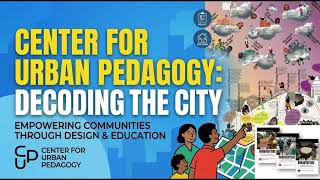
The Center for Urban Pedagogy pairs designers with high school students to decode invisible urban rules like zoning and building codes. A 1901 Building Code exhibit on toilets, a sneaker with an embedded video screen in Jamaica Queens, and a waste-transfer investigation that exposed environmental injustice show how the nonprofit makes cities legible to residents.
Chapters
Okay, so picture this for a second. You're walking down the street in your neighborhood and you do this every single day, right?
Yeah, we all do.
You step over a cracked sidewalk or you dodge a mountain of trash bags because it's Tuesday and you walk past a construction site that's been loud and dusty for like 6 months. You grab a coffee. It all just feels, I don't know, inevitable.
Right. There's just the background noise of your life.
Exactly. Like, the sidewalk is cracked because— well, sidewalk's cracked. The building is there because someone decided to build it. We're totally on autopilot.
It's the wallpaper of reality. We just stop seeing it.
Yes, the wallpaper. But— and this is the really brain-breaking thought I had while I was reading through our stack of sources for today— what if I told you that absolutely nothing you just walked past is accidental?
Not a single thing.
Right. That pile of trash, it's not just garbage. It's a physical manifestation of a logistics contract and a municipal border war. That construction site, it is the result of a zoning battle that probably happened 10 years ago in some room you've never even entered.
And that's the whole thing right there. We live in these incredibly complex systems, these cities, but we are mostly illiterate when it comes to reading them. We see the bricks. But we completely miss the laws that stacked them.
Which brings us to today's deep dive. We are looking at a group of people who are absolutely obsessed with fixing that illiteracy. We're talking about the Center for Urban Pedagogy, or CUP.
CUP, yeah.
They're a nonprofit based in New York, but honestly, their whole philosophy applies to any way humans decide to live in a cluster.
I will say urban pedagogy sounds a little bit dry, doesn't it? Like a 400-page textbook you have to buy for a college elective or something.
It sounds incredibly dry, but that is actually the trick here because these guys are doing some of the wildest and weirdest and most creative work I've ever seen to make the invisible visible.
Yeah, they really are.
We're going to talk about how they used sneakers to teach zoning, how they turn high schoolers into literal garbage detectives, and my personal favorite, we'll get into how they funded their startup with a piece of hip-hop history.
That is such a great story.
Yeah.
But you hit on a key phrase there, making the invisible visible. That is really their core mission. They want to create community education about places and how those places change. They talk a lot about this concept of legibility.
Legibility. So like looking at the city as a text that you can actually read.
Exactly. Think about it. If you walk into a library and all the books are in a language you don't speak, you have no power there. You can't find information, you can't learn, you can't argue your point, right?
You're just lost.
Yeah. And CUP argues that for most of us, the city is written in a foreign language. It's written in building code and zoning variance and tax abatement. If you can't read those languages, you can't really participate in democracy.
There's that quote from their materials that really stuck with me. It was, um, the power of imagination is central to the practice of democracy.
It's profound, right? Because you can't imagine a better neighborhood if you don't actually understand how the current one works. If you think the trash just sort of happens, you can't fix it. But if you know why the trash is there, you can imagine a totally new system.
So let's get into how they actually teach this stuff because they aren't just running night classes at the local YMCA. They started way back in the late '90s and their origin story is, well, it's actually about toilets.
It is, yeah.
Yeah.
Which is a huge leap from high-minded democracy to plumbing. But I mean, you have to start somewhere. Their first major splash was this exhibit centered on the centenary of the 1901 Building Code of New York.
Which on paper sounds like the most boring anniversary party of all time. Like, happy 100th birthday, Section 4, Paragraph B.
Right. But you have to contextualize what this actually meant. Before 1901, in the tenements of New York, you didn't have indoor plumbing. Oh, wow. Yeah, you had outhouses in the courtyard for hundreds of people to share. You had rampant disease. The smell was horrific. You had zero dignity. The 1901 code was the actual law that said no, every 2 families must have a dedicated indoor water closet.
So this incredibly dry legal document actually completely revolutionized the intimate daily lives of millions of people.
Precisely. So for this exhibit, it was hosted at the Storefront for Architecture and Art, and CUP didn't just pin the law to the wall. They explored the relationship between that piece of paper and the very human need to go to the bathroom.
Oh, love that.
They treated the code as a design tool that literally shapes our bodies and our privacy.
I love that pivot. It takes the law out of the courtroom and puts it right inside your apartment. It shows that policy isn't this abstract thing. It's the reason you actually have a door to close when you pee.
And that really set the template for everything they did afterward. They realized that if you want people to care about policy, you have to show them where it touches their skin. Yeah. They started informally in '97 with this how-to guidebook for urban objects, but they formally became a nonprofit in 2002, moving from just doing art exhibits to what they call project-based learning.
This methodology is really where they shine, I think. They don't just hire experts to tell people what's what. They pair these high-level pros— architects, graphic designers, urban planners— with community advocates and very often with students. And we're not talking grad students here.
We're talking high school kids, which is a pretty risky move if you think about it.
Oh, totally.
Giving 15 teenagers a semester-long project on urban infrastructure. Most people would just expect absolute chaos or just pure apathy.
Try getting a teenager to care about municipal waste management. But that is exactly what they did with the Garbage and Waste Project at the City as School High School.
This is one of my favorite case studies of theirs.
Mm-hmm.
So the context here is that New York City was shutting down its only massive garbage dump fresh kills. The city had no real plan for where the trash was going to go next. It was a genuine crisis.
So you have a massive system on the verge of collapse, and CUP takes a group of high school students and says, basically, go figure it out.
Essentially, yes. And they didn't just have them read articles online in the classroom. They sent these kids into the belly of the beast. They visited waste transfer stations. And if you haven't been to one of those, They are loud, intense, and incredibly smelly places.
I can only imagine.
They interviewed the workers, they talked to the truck drivers, the environmental activists.
Imagine being 16 years old, standing in a waste transfer station, watching tons of slime get compacted and realizing, oh, my candy wrapper ends up here.
It changes your wiring. But the real aha moment wasn't just about learning not to litter. It was about the politics of it all. The students started mapping out where these transfer stations were actually located. And surprise, surprise, they weren't in the wealthy neighborhoods.
Right. They weren't dumping the trash on Park Avenue. Exactly.
They were concentrated in low-income communities. So the students uncovered this massive issue of environmental justice. They realized that the cost of handling the city's waste wasn't just financial. It was being paid in asthma rates and noise pollution by specific marginalized neighborhoods.
And because they were kids and because they were working with actual designers, the output wasn't just some boring term paper. They made a 30-minute documentary. They hosted a panel discussion with actual city officials.
That's the pedagogy part, right? The teaching part. They turned the city itself into the school. Those kids probably know more about the economics of waste management now than most city council members do. And that knowledge empowers them. You can bet those students look at a garbage truck totally differently for the rest of their lives.
Okay, so that's the intense, gritty side of their work. But they also have this real flare for the unexpected, the sort of Trojan horse approach, if you will. Because let's be honest, even if you deeply care about your neighborhood, nobody— and I mean absolutely nobody— stops to read those community board notices stapled to telephone poles.
Oh, the ones in 10-point font, single-spaced, explaining a zoning variance? No. They are functionally designed to be ignored. They are technically a public notice, but in reality, they are completely invisible to the public.
So CUP decides to go where the eyes actually are. And this brings us to the Jamaica Queens project. Big up Jamaica.
This one is brilliant. So in this neighborhood, you had a bulletin board in the local food court that displayed the urban plans, but nobody looked at it. However, right nearby at the Goetz Mall, you had the sneaker mart and that place was packed.
Kids obsessing over Jordans, Air Force Ones, checking out every little detail, right?
The sources mentioned this specific obsession the kids had with customization. Things like green with blue tops or Velcro. That is where the visual attention of the neighborhood was entirely focused. So CUP thought, what if we put the zoning information there?
And they literally did it. They took a pair of Nike Terminator high-tops, classic shoe, by the way, and they modified them. They embedded a tiny video screen inside the shoe.
It's such a sci-fi cyberpunk kind of idea. They created an outreach module disguised as a sneaker. You pick up the shoe, maybe you're admiring the stitching, and suddenly you're watching a video on this little screen about the future of the neighborhood featuring interviews with residents.
It's genius because it completely disrupts your pattern. You're in shopping mode, your guard is down, you're just looking for something cool, and boom, civic engagement.
It asks a really provocative question too. Why can't information about the future of our own communities be as seductive as consumer products? Why does democracy always have to look so boring? By putting it in the sneaker, they're saying this information is as valuable as these shoes. It belongs in your hands.
They did something really similar with the Fulton Mall project in Brooklyn too, right? The one called What's Poppin'.
Yes. And this one really touches on the idea of perception versus reality. Fulton Mall is this incredibly busy, financially successful outdoor shopping street, right? But the powers that be, you know, the developers, the city planners, they often viewed it as blighted or low class, right? They saw it as a problem that needed to be fixed, usually usually by bringing in generic high-end chain stores.
Which is the classic gentrification playbook. The idea that it's not a good neighborhood until there's a Whole Foods.
Exactly. The sources outlined this tension perfectly. Yeah. But the people who actually used the mall, the locals, they saw it as a massive cultural hub. So CUP and the students did a deep dive. They did sketches, interviews. They just hung out there and they produced a zine, a small magazine that documented the vibrant culture that was already thriving there.
And it actually worked, right?
This wasn't just an art project that stayed locked up in a gallery somewhere. It really rippled out.
Hmm.
A year or so later, major publications like the New York Times started writing about Fulton Mall differently. They started acknowledging its unique cultural value rather than just framing it as an issue. CUP helped shift that narrative from this needs to be fixed to this needs to be understood.
And that goes right back to legibility. If you misread a neighborhood as broken when it's actually thriving, but just different, you're gonna destroy it with your fix.
Precisely. And sometimes making things legible means showing things that aren't even there at all. Which brings us to the visualizing the invisible aspect of their work. We have to talk about SPURA.
SPURA. The Seward Park Urban Renewal Area. I mean, even the name sounds like a headache.
It was a headache. Honestly, it was a heartache for the city. This was a site on the Lower East Side of Manhattan that was basically a giant empty lot for 50 years, 5 decades, because of a massive political stalemate between low-income housing advocates on one side and economic developers on the other.
Just imagine that in one of the most expensive real estate markets on the planet, you have massive empty lots just sitting there for half a century because nobody can agree on the paperwork.
There's a scar on the neighborhood, but if you just walk past it, you just see a chain-link fence and some weeds. You wouldn't see the history. So Damon Rich, the founder of CUP, did this project called the Dimes of March. He went up to the pavement surrounding these empty lots and he used thermoplastic markings.
Wait, like the stuff they use for lane lines on the highway?
Exactly. That heavy-duty reflective stuff. And he drew the ghost buildings.
That is so cool.
He drew the exact outlines of the buildings that were proposed in those plans but were never built. So as you walk down the sidewalk, You were physically stepping on the what-if. You were walking through the architectural graveyard of that political stalemate.
That is so powerful. It turns a vacuum, a totally empty space into a story. It makes you feel the weight of all that wasted time.
And it forces you to ask why. You're walking and you go, why is there a line on the ground here? Oh, because in 1970, a housing deal fell through. It connects the physical ground beneath your feet to the invisible history of the city.
Speaking of weird shapes and lines, we absolutely cannot skip Knoxville. This one actually made me laugh out loud when I saw the visual in the source materials. CUP made a physical sculpture of the city limits of Knoxville, Tennessee.
And it doesn't look like a city. It looks— well, it looks like a splat. Or a gerrymandered district on steroids. It has all these long, weird tentacles reaching out in every direction.
It looks like an octopus trying to grab a snack or something.
And that is literally what it is. CUP highlighted that this shape wasn't based on geography. It wasn't following a river or a mountain range. It was following the money. The city annexed these weird thin strips of land specifically to grab tax revenue from shopping centers and commercial businesses while purposely avoiding the residential areas right next door that would cost them money to service.
So the map of the city is basically just a giant tax receipt.
It is fiscal policy solidified into a physical border.
Yeah.
And that is the brilliance of CUP. They take something incredibly abstract, like aggressive annexation for tax revenue, which puts pretty much everyone to sleep, and then turn it into a weird, ugly sculpture that you cannot ignore. You look at it and go, why does my city look like a mutated spider? And the answer teaches you exactly how your local government works.
So we've talked about their philosophy, their methods, their wild projects. But I have to ask, who pays for this? Because teaching kids about garbage and making sneakers about zoning doesn't exactly sound like a venture capital darling.
It certainly isn't. They are a nonprofit and a very lean one at that. The source material notes a budget of around $200,000 at the time, which in the nonprofit world is absolute peanuts. They run on a skeleton crew, Roston Wu, who was the executive director, Damon Rich, and a handful of other key figures like Valeria Mogilevich and Lizze Mogul, they relied really heavily on volunteers for basic things like proofreading and shooting video.
But the best part is how they got their startup capital. I love this story so much.
It's the ultimate New York funding story.
So it's 2002, they have basically zero money, and somehow they get a donation from Hot 97, the legendary hip-hop radio station in New York.
But Hot 97 didn't just cut them a check.
No, they gave them a sound mixer, like a professional DJ board. Now, most urban planning groups would be like, "Uh, thanks," and just put it in a supply closet somewhere.
But CUP, they put that thing straight on eBay.
They flipped it. They sold the mixer, and that cash became their actual seed money.
It's perfect, isn't it? They literally used the tools of culture hip-hop radio, converted it into capital, and used that capital to start teaching everyday people about the city. It shows just how scrappy and resourceful they really are.
It really creates a vibe that these aren't just stuffy academics sitting in an ivory tower. They're hustlers. They're trying to get the message out by any means necessary.
And that scrappiness is necessary because of how they have to measure success. They aren't traditional lobbyists. They aren't trying to get a specific zoning law passed next Tuesday. They play the long game.
They call it interpretive impact, right?
Yes, interpretive impact. Yep. If you're a standard advocate, you measure success by asking, did the law pass? CUP measures success by asking, do people actually understand what the fight is about? Because their core belief is that if you build a coalition of people from high schoolers to grandmothers who genuinely understand how zoning works or how waste management functions, the policy changes will follow naturally.
It's about empowering the players rather than just trying to rig the game.
That is a great way to put it. They're acting as translators. On one side, you have the language of power, the dense, legalistic, bureaucratic wall of text that basically runs the city. And on the other side, you have the regular people who live there. CUP stands right in the middle and translates.
And once you have that translation, you really can't unsee it.
You really can't.
Which brings us to the big takeaway for you, the listener. We started this deep dive walking down the street, basically ignoring everything around us.
And I hope we're ending it with our eyes a little bit wider open.
Absolutely. Because the next time you see a jagged city border on a map or a weird empty lot that's been there for years, or even just a bulletin board with a boring notice on it, realize that those aren't accidents. They're clues.
They're the fingerprints of the system.
So here is my challenge to you for the rest of your day. Treat your own city like a CUP project. When you walk out the door, pick just one thing: a fire hydrant, a bus stop, a new condo going up, and ask yourself what invisible rule put this exactly here? Who decided this should look like this?
And more importantly, who benefits from it being here?
Exactly. Read the city, because if you can read it, you can start to rewrite it.
And that is where democracy actually begins.
Thanks for taking this deep dive with us today. We'll see you out there on the pavement.
Until next time.
More from Dr.

2025 Mercedes-Benz CLE 450 4Matic Cabrio – Owner’s Views After a Year-and-a-Half as a Daily Driver

The Complete Guide to a Successful Everest Base Camp Trek – Post-Trek Debrief

The Complete Guide to a Successful EBC Trek – Post-Trek Debrief: What I Needed (and What I Didn’t)

What Went Wrong Customizing My New 2026 Porsche Carrera T …and what I did about it!

Coming May 1 At the Intersection of High Performance and Fulfillment: A Conversation with Alisa Cohn

From High Performance to Fulfillment: Lessons in Inner Mastery with Jim Murphy

Coming March 19: From High Performance to Fulfillment: Lessons in Inner Mastery with Jim Murphy

The New Humanitarians Volumes I - III:- Inspiration, Innovation, and Blueprints for Visionaries

The New Humanitarians Volumes I - III:- Inspiration, Innovation, and Blueprints for Visionaries

The New Humanitarians Vol I - III: Inspiration, Innovation, and Blueprints for Visionaries - Forward
