The New Humanitarians Volume II - Common Bond Institute
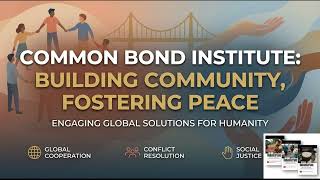
In this episode, the hosts transport listeners back to the late Cold War era to explore how psychotherapist Steve Alween, working from Michigan, founded the Common Bond Institute (CBI) as a citizen‑diplomacy vehicle. Rejecting traditional state channels, Alween built a virtual, grassroots network in 1989 using fax machines, expensive landlines, and snail‑mail to connect psychologists across the US, USSR, and the Middle East. The conversation details CBI’s innovative organizational structures – a “living idea” virtual institute, the mandala model of peer‑learning introduced at a chaotic 1992 St. Petersburg conference, and two core methodologies: Catastrophic Trauma Recovery (CTR), a training‑of‑trainers approach for war‑zone mental‑health care, and Engaging the Other (ETO), a de‑othering framework that uses shared ecological concerns to bridge hostile groups. Concrete projects such as the Beit al‑Hayat children’s trauma center in Nablus and the Capacity for Peace and Democracy initiative with Palestinian universities illustrate CBI’s on‑the‑ground impact. The hosts emphasize CBI’s strict neutrality, its focus on building local capacity rather than imposing Western solutions, and its broader critique of conventional diplomacy. The episode closes by contrasting the analog communication tools of the 1980s with today’s hyper‑connected world, asking listeners whether they have the “software” to act as citizen diplomats and build impossible bridges without institutional permission.
Chapters
So, uh, I want you to start by closing your eyes just for a second. We're gonna time travel.
Oh, dangerous territory. Uh, where exactly are we going?
The 1980s. But I mean, not the neon synth pop version of the '80s. I'm talking about the actual geopolitical reality, right?
The Cold War.
Exactly. The height of the Cold War. You've got the United States and the Soviet Union, these two massive nuclear giants. Locked in this endless stare-down. And the rhetoric is all about the evil empire. There are Star Wars missile defense systems being drawn up.
It was a completely binary world back then, just East versus West, you know, us versus them. And there was a very literal, very physical Iron Curtain dividing the planet.
Yeah. And the whole world honestly feels like it's holding its breath, just waiting for someone to sneeze and hit a button. Now, in the middle of this massive frozen conflict, I want you to zoom in past the Kremlin, past the White House, all the way to a psychotherapist in Michigan.
Right. Steve Alween.
Steve Alween.
Yeah.
Who is looking at this global mess and thinking something very different from the politicians.
He essentially decides that he's not gonna wait for the governments to fix it.
Exactly. He decides to bypass the red tape, bypass the State Department entirely, and build a bridge himself. Just a regular guy reaching out to the so-called enemy.
And this brings us to the core theme of our deep dive today, which is citizen diplomacy. It's such a fascinating concept, this idea that ordinary people can dismantle the enemy mentality simply by refusing to accept it.
Today we are diving deep into the Common Bond Institute, or CBI. We've got their final reports, their official history, and some of the personal writings of Steve Alween. And honestly, this isn't just a story about a nonprofit organization. It is a masterclass in how a vision-led idea can actually bend reality.
It really is. And I think what strikes me immediately in the source material is that CBI wasn't built like a traditional organization, right? It didn't start with, you know, a massive endowment or a fancy headquarters with marble floors. It actually started as a psychological principle that was being applied directly to international conflict.
So let's unpack this a bit because the way they organized themselves, keeping in mind this is back in the '80s and early '90s, it was honestly decades ahead of its time.
It really was. Olean refers to the early CBI as a living idea. From the very beginning, they established themselves as a virtual organization.
Okay, I have to stop you there. A virtual organization. Today, that just means we have a Slack channel and everyone works from their couch. But in 1989, That sounds completely impossible.
Or absolutely. I mean, there's no Zoom, there's no email as we know it today. But Alwyn was adamant. He didn't want a brick-and-mortar institution. He wanted to utilize what the sources call grassroots global communications.
Which meant what, practically speaking?
Well, it meant fax machines. It meant incredibly expensive international landline calls, snail mail. But the philosophy was the key part. The goal was to link energies, not just to connect physical offices. They wanted to create this sprawling network of creative change agents.
Linking energies. I mean, that Sounds a little woo-woo, doesn't it?
It does on the surface, sure. But look at the actual strategy behind it. They knew there were people all over the world, in the US, inside the Soviet Union, in the Middle East, who wanted to shift consciousness toward a culture of peace. But those people were isolated. They felt powerless.
So CBI's role wasn't to employ them.
Exactly. It was to connect them.
The sources mentioned this term, intentional community. It's almost like they were building a digital commune before digital was really even a thing.
That is a great way to put it. They were actively trying to circumvent the institutional chasms that are created by hostile governments because governments rely on the population believing that the other is a monster.
Right.
But if you connect a psychologist in Michigan with a psychologist in Leningrad and they realize they're both just worried about their patients and their kids, the monster myth just falls apart.
Because it's a lot harder to bomb someone you've just sent a fax to.
Exactly. You humanize them.
So you have this virtual network forming. It's loose. It's highly idealistic. But then we hit August 1990. And according to the history we're looking at, this is the massive sink-or-swim moment. Everything just converges.
It was an incredibly pivotal month in global history. Yeah. You basically have two massive crises happening simultaneously. First, Iraq invades Kuwait, which completely sets the Middle East on fire. And at the exact same time, the Soviet Union is convulsing and teetering on the edge of total collapse.
Let's look at the Kuwait side of things first, because this is where the mission of CVI really crystallizes. Alwin is listening to NPR, right?
Yes. He hears an interview with a Kuwaiti doctor on the radio, and the interviewer is asking all the standard humanitarian crisis questions. You know, do you need medical supplies? Do you need antibiotics, food, blankets?
And what does the doctor say?
It was incredibly blunt. The doctor said, we don't need equipment or supplies, we need therapists.
Wow. That is such a heavy realization. It implies that the psychological damage was vastly outpacing the physical damage on the ground.
Precisely. The doctor explained there was an absolute epidemic of trauma and the local healthcare system had no idea how to treat it. So Olwin, being a trauma therapist himself, calls the Free Kuwait office in Washington, D.C.
He assumes there's already a plan.
Right. He assumes there must be this massive mental health relief effort underway that he can join.
And what does he find?
Crickets. There was absolutely nothing. There were plenty of people sending food and physical aid, but for the psychological wounds, zero.
This is a huge aha moment for the whole organization.
Huh.
But I want to pause here for a second because the standard Western response to something like this, the arrogance of it really, would be to just say, "Okay, let's fly a bunch of American shrinks to Kuwait and fix them." And that is exactly what Alwyne realized would fail spectacularly.
You cannot just parachute a bunch of Western psychologists into an Islamic culture during an act of war.
Right. Think about the language barrier alone.
The language barrier, the deep cultural stigma around mental health, all the complex religious nuances. It would be a disaster.
So it wasn't just about going over there and helping. It was about actually being relevant to the culture.
Yes. He realized they needed a capacity-building approach. The solution wasn't for Westerners to treat the patients themselves. The solution was to train the local therapists, empowering the community to heal itself. Exactly. Because if you treat a patient, you help one person. But if you train a local professional, you leave a skill set that stays in that community long after you pack up and go home. It's the difference between sustainability and charity.
Now, while they're trying to figure this out for the Middle East, The entire other side of the world is falling apart. The Soviet Union. Olwein is coordinating exchanges for the Association for Humanistic Psychology, or AHP.
And we really have to remember the context of 1990 here. The saber rattling is intense, the arms race is still very much on, but these AHP members were traveling to the USSR anyway.
The sources mentioned they would sometimes leave for the airport before their visas were even confirmed.
I know, it shows incredible dedication.
I mean, that is stressful just to think about. Yeah. Packing your bags and thinking, well, I hope they let me in, otherwise I'm spending the weekend in a holding cell in Moscow.
They were holding meetings in people's private homes, which was technically illegal under the regime at the time. They were planning these exchanges late into the night. Olguin describes feeling a profound sense of urgency.
Because the door could slam shut at any minute.
Exactly. The Soviet Union was so unstable, it could have easily reverted back to a closed military dictatorship overnight. Ulwin felt they had to act right then to solidify these connections before that window of opportunity completely closed.
Okay, so he's got this massive urgency. He's got these huge ideas for Kuwait and for Russia. He goes to the AHP board, the parent organization, with what he calls a barrel full of proposals, and they completely blink.
They did. And to be totally fair to the board, you can understand why.
Sure. They're looking at the paperwork.
Right. They're looking at liability. They're looking at insurance and resource drain. They were terrified of dragging a reputable organization into dangerous, unpredictable territory. They were just overwhelmed.
But Olean is basically like, we do not have time for a committee meeting on this.
He essentially said, we don't have time to weigh the feasibility studies. So he spins off. And this is the actual birth of the Common Bond Institute as an independent entity. He wanted a vehicle that was leaner, faster, and bolder.
And the very first big test of this new bold vehicle was the conference in St. Petersburg in 1992. Now, usually when I hear the word conference, I completely zone out, but this sounded like absolute chaos.
It was controlled chaos for sure, but it's a great example of that living idea concept actually taking off. They originally planned a half-day seminar. They expected maybe 50 people, just a nice manageable workshop, right?
Just a few colleagues swapping notes.
But communication was so scarce that people were literally hand-delivering letters across the country to spread the word. And somehow it just snowballed. It turned into a massive 6-day event with nearly 450 participants from all over the world.
450 people in 1992 St. Petersburg. How did they even feed everyone?
It was a complete logistical nightmare, but it was also kind of a miracle. And it taught the organizers a massive lesson. They realized they couldn't control everything. The event took on a life of its own.
And this led them to adopt what the sources call the mandala model. I saw this in the notes. Unpack that for us. What is the mandala model?
So think of a traditional mandala image. It has a very strong center structure, but the intricate, beautiful patterns radiate out from that center. CBI provides the center. They handle the logistics, the container, the physical safety, but the participants are the ones who co-create the rest of the experience.
So it's not like a standard lecture format where I talk and you just sit there and listen.
Not at all. It's a true peer learning environment. It invites the teachers to be learners and it empowers the learners to be teachers. It's the difference between running a classroom and facilitating a community.
Okay, so they have the structure down with the mandala model. They have the virtual network, but what are they actually teaching? We talked about Kuwait and the desperate need for therapists. How did they solve the technical problem of treating complex war trauma?
They developed a very specific methodology called Catastrophic Trauma Recovery, or CTR.
CTR. What makes that different from just regular therapy?
Well, regular therapy assumes you have time. It assumes you are in a safe environment. War zones absolutely do not offer that. They looked at places like the Balkans and the Middle East where outside services were usually short-term fly-in, fly-out operations.
So CTR fixes that by—
By being a training-of-trainers model.
Going right back to that capacity building we talked about earlier.
Exactly. It's designed to be incredibly It's really simple, highly standardized, and culturally sensitive. You teach local relief workers basic, effective trauma interventions. You teach them how to stabilize the nervous system, how to process immediate shock, and then the key part, those workers turn around and teach others in their community.
It's almost like open-source software code. You just give the code to the community and let them run it on their own hardware.
That is a perfect comparison. It ensures the skill stays embedded in the community permanently. It's entirely about preventing dependency on Western experts.
Now, there's another acronym in the source material that really caught my eye: ETO. Engaging the Other.
Yes, this is really the psychological heart of their entire mission. While CTR treats the result of conflict, which is the trauma, ETO tries to prevent the cause of the conflict. It focuses heavily on the psychology of prejudice.
The Other. That capital O Other.
Right. They hold these massive conferences and are working on a book project that examines this highly subjective phenomenon. You know, how do fear-based belief systems create enemies out of thin air? Why do we dehumanize people who are just like us?
They even did a project with the Jane Goodall Institute on this, right?
Yes, the International Youth Conference on the Ecology of War and Peace. I find this specific project so fascinating. They used ecology as a common language.
Why ecology, though, out of everything they could choose?
Because if you get youth from different sides of a deeply entrenched conflict, say Israelis and Palestinians, and you start talking about politics or history, the walls go up immediately. It's a dead end. But if you talk about the water table or the regional air quality—
Right, because the river doesn't care about the political border.
Exactly. It completely bypasses the political rhetoric. If you can get them to agree on the environment, which is something they intrinsically share, it becomes this natural bridge to talk about the other. It humanizes the perceived enemy because you suddenly realize you are both fighting for the the exact same survival.
That is brilliant. It's like finding a third door when the front and back doors are totally locked.
It really is an elegant solution.
Now, I want to get very concrete for a minute. We've talked a lot about philosophy and these high-level models, but what does this actually look like on the ground? The sources list some very specific physical projects.
Well, first, we really have to mention the collaborators. This was by no means a one-man show. The sources highlight that Alwin's daughters, Jehan and Jessie, literally grew up organizing these massive conferences.
Child labor for world peace. I love it.
It was totally a family affair, and there were key colleagues like Sandra Friedman and their Russian partners from the Harmony Institute. But in terms of brick-and-mortar projects, there is Beit al-Hayat, which translates to House of Life.
This is in the West Bank, right?
Yes, specifically in Nablus. They identified that there were absolutely no trauma treatment services for children in that entire region. None. So the project was to establish a dedicated children's trauma center.
And there is also the Capacity for Peace and Democracy project.
Right. That is a direct collaboration with Palestinian universities. The goal there is to establish a permanent center for conflict resolution and human rights.
Now, this raises a really important point about their positioning. They are working in incredible politically charged areas, Israel, Palestine, Russia. How do they navigate that minefield? Do they take sides?
The expert insight from the documents here is their absolute commitment to neutrality. Or rather, their commitment to humanity over politics. The source material strongly emphasizes that CBI is a non-governmental, strictly non-political organization.
But isn't human rights inherently political in some of these conflict zones?
It can certainly be perceived that way by the factions involved. But their side, so to speak, is purely about increasing local capacity. They focus exclusively on human dignity and self-determination.
So they don't push a specific agenda?
No. Whether you are in Russia or the West Bank, the goal is just to give people the tools to heal themselves and govern themselves peacefully. They aren't trying to impose a Western political solution. They are trying to build the psychological infrastructure that makes peace even possible.
It's almost like they are soil engineers. They aren't telling you what political crops to plant. They're just making sure the ground isn't too toxic for anything to grow in the first place.
That is a beautiful analogy. Yes, exactly that.
It's just amazing how much they accomplished by essentially refusing to accept that they couldn't do it.
And that brings us right back to the core theme of the source material: the power of vision.
Owein writes about this directly. He distinguishes having a vision from just dreaming.
He says vision is taking the step of believing something is real and then acting as though it is real until there is no difference.
Until there is no difference. Man, that gives me chills.
It is so powerful. CBI didn't sit around waiting for a massive grant. They didn't wait for the State Department to say, okay, you are officially allowed to go to Russia now. They just acted as if the bridge already existed, and by walking on it, they built it.
It's a pretty incredible journey to trace. From a vague living idea in Michigan to a massive global network directly affecting trauma care in Russia and the Middle East.
And it serves as a massive critique, really, of traditional diplomacy. The sources suggest that official diplomacy often just maintains a logjam of mutual animosity.
A logjam.
Right. It often serves the interests of political structures to keep us separated, to keep defense budgets high, to keep populations rallied against an external threat.
But when you actually get people in a room or on a fax machine or, you know, in a Zoom call today, those barriers just start to dissolve immediately because you are actively engaging the other and realizing they are just you. So here is the question we want to leave you with today. We started this deep dive talking about the '80s, the era of fax machines and really expensive landlines. Today, you and I live in an age of total hyperconnection. You can talk to anyone, anywhere, instantly, for free.
Yet, statistically and psychologically, we seem more polarized than we have ever been.
Exactly. We have the hardware for citizen diplomacy right in our pockets, but do we have the software? Are we acting as citizen diplomats every day, or are we just logging on to reinforce the image of the other?
And to take it a step further, think about your own life. What impossible bridge could you build right now if you simply didn't wait for an institution to give you permission?
Something to really think about. Thanks for joining us on this deep dive into the Common Bond Institute. We'll catch you next time.
More from Dr.

2025 Mercedes-Benz CLE 450 4Matic Cabrio – Owner’s Views After a Year-and-a-Half as a Daily Driver

The Complete Guide to a Successful Everest Base Camp Trek – Post-Trek Debrief

The Complete Guide to a Successful EBC Trek – Post-Trek Debrief: What I Needed (and What I Didn’t)

What Went Wrong Customizing My New 2026 Porsche Carrera T …and what I did about it!

Coming May 1 At the Intersection of High Performance and Fulfillment: A Conversation with Alisa Cohn

From High Performance to Fulfillment: Lessons in Inner Mastery with Jim Murphy

Coming March 19: From High Performance to Fulfillment: Lessons in Inner Mastery with Jim Murphy

The New Humanitarians Volumes I - III:- Inspiration, Innovation, and Blueprints for Visionaries

The New Humanitarians Volumes I - III:- Inspiration, Innovation, and Blueprints for Visionaries

The New Humanitarians Vol I - III: Inspiration, Innovation, and Blueprints for Visionaries - Forward
