The New Humanitarians Volume II – Endeavor
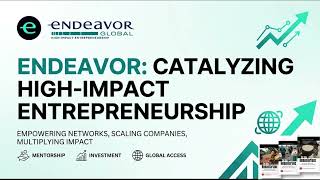
Endeavor identifies and scales high-impact entrepreneurs in emerging economies, addressing the "missing middle" of midsize firms. They screen 15,000 applicants to admit 333, then provide elite mentors and network access instead of capital. One founder, a former seamstress in South Africa, built a mining-safety company that now employs injured miners and dominates her market.
Chapters
Welcome back to the Deep Dive. Today we've got a fascinating stack of reports and case studies that essentially tries to solve this global economic riddle.
Yeah, it's a big one.
It really is.
Yeah.
Because if you look at the global economy, specifically in developing nations, you usually see two very distinct groups. It's almost like a, a, a dumbbell shape.
Right. You have the massive players on one side, the government-backed conglomerates, the huge multinationals.
Yeah.
You know, the, the too big to fail crowd.
Exactly. And then on the other end, you have the tiny players, the street vendor, the local artisan, maybe a subsistence farmer. And we have these entire massive industries built to help both of those groups.
You've got the World Bank and private equity for the giants, right? And then you have the microfinance revolution for the little guys, giving someone $100 to buy a goat or a sewing machine, which is great.
I mean, that's survival economics. Yeah, but the riddle that kicked off this whole research dive is where is everyone else? Where is the Starbucks of Argentina or the FedEx in Turkey? It feels like there's this massive vacuum right in the middle. Like, why aren't we seeing those midsize high-growth companies in emerging markets?
That is exactly what development economists call the missing middle. And today's deep dive is really about an organization called Endeavor that decided to figure out why that hole exists. And more importantly, they built an entire model to fill it.
And just to set the stakes for you listening, this isn't just a story about helping businesses get slightly bigger. It's a completely different theory on how you pull a country out of poverty. It's not about charity.
No, not at all.
It's about identifying and supercharging what they call high-impact anomalies.
Anomalies is definitely the right word. Because the people Endeavor looks for, these high-impact entrepreneurs, they are statistically rare. They're the ones with the ambition to scale up from a garage to a company that employs thousands.
But the environment they're in usually crushes them before they can get there.
Exactly. The system just isn't built for them.
So we're going to look at the Endeavor model. We'll break down their mentor capitalist approach, which is a term I absolutely love, by the way. We'll look at the insane hoops you have to jump through to get their help. And we have 3 incredible case studies. From the sources.
From office supplies to mining safety.
Right, which shows exactly how this works in practice. So let's go back to the origin story. We are in the late '90s.
Mm-hmm.
Linda Rottenberg and Peter Kellner found Endeavor. What was the landscape they were actually looking at? Why did they think this was necessary?
Well, the source material focuses heavily on Latin America at that time, and the picture's pretty bleak, honestly. You had this extreme polarization we mentioned. Resources flowed either to the very poor via charity or to the very rich via what's often called crony capitalism.
Crony capitalism, meaning you succeed because of who you know, not necessarily what you build.
Precisely. It was a completely closed loop. If you were a mid-sized business owner with a great idea, but you didn't have a rich uncle, you were just stranded. You couldn't get a loan because you didn't have massive collateral.
Because banks in these regions are incredibly risk-averse.
Highly risk-averse. And you couldn't get private equity because you weren't big enough for Wall Street to even care. You were stuck in this no man's land.
And Linda Rottenberg, who's a Yale Law and Harvard grad, she looks at this and sees a massive market failure.
She saw that the midsize sector, which is the engine of job creation in places like the US, was totally stagnant in Latin America. But when she started pitching the idea of a nonprofit to help these middle entrepreneurs, people thought she was delusional.
Yeah, the notes mentioned she was literally knocking on doors in Argentina and people were calling her la chica loca, the crazy girl.
They really did. Because in that culture at the time, entrepreneurship wasn't really a concept. If you had money, you held onto it. You certainly didn't invest in some random kid's idea.
Right.
But she had a very specific, very sharp argument. She went to these wealthy Argentine business elites, the Goliaths of the economy, and said, look, you have an obligation here.
An obligation. I mean, that is a tough sell to a billionaire who thinks they made it completely on their own.
Oh, it was definitely a self-interest argument disguised as an obligation. She basically said, if you don't help build a middle class, if you don't stabilize this economy by creating jobs, your currency is going to collapse. And when that happens, your billions won't be worth anything anyway.
Help me or you'll lose everything. That is incredibly bold.
But it was effective. She actually got funding from the Avina Group and some key Argentine leaders, and that burst their theory of change.
Let's double-click on that theory of change for a for a second, because usually when we talk about global development, we talk about volume. Let's help a million people a little bit. Endeavor seems to take the exact opposite approach. Let's help a tiny number of people a lot, right?
It's the multiplier effect. They believe that if you identify the right entrepreneur as someone with true high-impact potential, they won't just get rich, they'll create hundreds of jobs. More importantly, they will inspire 5 other people to start companies. They create a wave.
So it's heavily about human capital, not just financial capital. You're trying to create local role models.
Exactly. They aren't trying to fix the GDP directly. They are trying to fix the mindset around risk and success. If you see a guy from your own neighborhood build a global company, suddenly you believe you can do it too. That psychological shift is what actually changes an economy over time.
Okay. But if you're betting the farm on a few select individuals, you better be really, really good at picking them. And the selection process outlined in these documents seems— well, it seems terrifying.
Terrifying is fair. Honestly, it's harder than getting into Harvard.
Give us the numbers from the report.
So as of the 2007 data in our sources, they had screened 15,000 applicants.
15,000 hopefuls.
And out of those, they selected just 333. That is a roughly 2% acceptance rate.
Wow. So what exactly are they filtering for? Why reject 98% of people? Is it just about the profit margins?
No, and that is the key distinction here. First, they aren't doing startups in the traditional sense. They don't want a person with a dream and a PowerPoint presentation. They want scale-ups.
Meaning companies that already exist.
Yes, usually 3 to 5 years old creating actual revenue, but they've hit a wall. They need to prove they have a viable engine before Endeavor pours gas on it.
So you have to have proven the concept. But what's the second filter?
The second filter is role model potential. This is totally unique to their model. They ask, is this person ethical and are they willing to give back? Because the whole model breaks if the entrepreneur takes the help, gets rich, and then moves to Miami. They must agree to stay and mentor the next generation.
It's essentially a pay-it-forward contract.
Explicitly. And the process to determine all of that takes anywhere from 6 to 18 months.
18 months of interviews. That feels like a massive time sink for a CEO who's already trying to run a business.
It's intense. It starts with proactive research by the staff, then local screenings. Then they face the Venture Corps. These are senior business leaders who basically grill them on their strategy and their personal qualities. And finally, the International Selection Panel. And here's the kicker. The vote at that final panel must be unanimous.
Wait, one no and you're out?
One no and you go home.
That seems incredibly risky for the entrepreneur. You spend a year in this grueling process and potentially get nothing.
Well, Endeavor argues that even the rejection is valuable. I mean, you're getting grilled by top CEOs and consultants for free. You get real unvarnished feedback on your flaws. But obviously, if you get in and you you gain access to the mentor capitalist system.
Let's unpack that term mentor capitalist, because usually a capitalist gives you money and takes equity. A mentor gives you advice and maybe buys you coffee. How does Endeavor mix these two concepts?
The missing middle usually suffers from a lack of two crucial things: trust and networks. Money is actually secondary. If you have a great business in a developing market, you often can't grow because you don't know the right people, and foreign investors don't trust you because the local legal systems might be shaky.
So Endeavor essentially acts as a trust broker.
Exactly. Exactly. They have this network, the Venture Corps we mentioned. It's investment bankers, consultants, CEOs. The data shows these people donated over 23,000 hours of their time.
That is millions of dollars in billable hours just given away for free.
It really is. Plus, they bring in MBA students from Harvard and MIT's G-Lab for 10-week fellowships. Basically, they drop a SWAT team of elite consultants into your midsize business to fix your strategy, your books, your market entry plans.
That's the theory. I want to see this in action because the stories are wild. The story of OfficeNet in the '90s feels like the perfect example of this David versus Goliath struggle.
This is the classic scale-up story. You have Andrés Frayer and Santiago Belinkis in Argentina. Two young guys, 24 years old, working middle management at Procter Gamble.
Meeting at a bar every Thursday, sketching out business ideas on napkins.
Right. And they spot this massive inefficiency. The office supply market in Latin America was completely fragmented. You had to go to 10 different small shops shops just to outfit an office. So they wanted to build the Staples of Latin America, which in the U.S.
is a totally proven model. You have a catalog delivery, a centralized warehouse.
Simple, simple here. But in Argentina in the late '90s, investors said, no way, people here want to touch the product, delivery won't work, the mail system is terrible. They were rejected by absolutely everyone.
So they're desperate. They know the idea is brilliant, but they have zero capital.
They finally found a wealthy businessman willing to fund them, but he knew they were desperate. He gave them $50,000 in exchange for 100% of the company.
Whoa, wait, 50 grand for everything? So they just became employees of their own startup?
Essentially, yes. It was a predatory deal, but they took it because they believed so strongly in the vision. 6 months later, Endeavor finds them. At this point, they have 22 employees and sales are projecting to $2 million. They were totally right about the market, but they don't own any of it.
They have no skin in the game anymore.
And that is a huge problem for growth. Why work 80 hours a week if you own 0%? So Endeavor steps in. They didn't just give advice on logistics. They sat down with the investor and renegotiated the deal.
They acted as the heavy hitters in the room.
They argued that for the company to truly scale up, the founders needed equity to stay motivated. And they actually managed to get Andres and Santiago back 35% of their own company.
That is life-changing. That's the difference between drawing a salary and building generational wealth.
It is. And then Endeavor brought in a Stanford MBA to design their regional expansion plan. They introduced them to investors in Brazil.
And the result?
They became the dominant player in the region. By 2004, they sold the business to Staples, the very company they originally emulated.
And following the Endeavor rule, I assume they gave back.
Andres and Santiago became board members for Endeavor. They are now the ones investing in and mentoring the next generation. The loop completely closed.
I love that.
Yeah.
But OfficeNet is a very commercial success, right?
That's right.
We sold more paperclips.
I want to pivot to Stitchwise because this story shows that high impact doesn't just mean high revenue. This one really got to me. This is definitely one of the most powerful stories in the file. Natalie Khilassi in South Africa, she started a sewing company at a mine site, but she noticed this horrific trend. She saw men who had been paralyzed by rockfalls, terrible mining accidents, just losing their livelihoods.
Because if you can't physically work the mine in that economy, you're often just out on the street.
Exactly. So she decides to pivot completely. She persuades a massive mining company, Anglo Gold Ashanti, to give her workspace, and she decides to engineer a solution to the rockfalls herself.
But she's a seamstress, not a geological engineer. That seems like a massive leap.
That didn't stop her. She spent 18 months working in a deep underground mine test site.
Can you imagine? 18 months underground just to test prototypes? That is dedication.
It's incredible. She developed what they call backfill bags. Basically, they are support structures made of woven polypropylene that you fill with slurry to hold up the rock roof. They turned out to be safer and much more resilient than the traditional wooden supports they were using.
So she innovates this life-saving product. Where does Endeavor come in?
Well, she had the product, but she needed to scale the business to deal with these massive global mining conglomerates. Endeavor met her in 2004. Mentors helped her hone her strategy, and they sent in 3 MBA interns to help her structure the company. And this is the truly fascinating part. They helped her structure it for employee ownership.
And who are the employees?
She has 145 employees. Nearly half of them are paraplegics, former miners who were injured in the very accidents she is now trying to prevent.
That is— that's circular in the best possible way. She's employing the victims to save the next generation of workers.
And doing it profitably. The company generates nearly $4 million in revenue and captures 50% of the South African market. It proves that social impact and profitability aren't enemies. In fact, her social mission is her main competitive advantage.
That is amazing. Proof that a socially conscious business can compete on price and quality and save lives. And then briefly, we have Geomar in Chile. This touches perfectly on that trust barrier we mentioned earlier, right?
Javier Donoso. He wanted to export gourmet canned seafood using Chile's 3,000 miles of coast. Scallops, sea urchins, things like that, sending them to Europe and Asia.
But the barrier wasn't the product quality.
No, the product was great. The barrier was that a distributor in France had never heard of him. Why trust a small Chilean brand with food safety? In international trade, trust is your currency.
So Endeavor becomes the stamp of approval.
It's the Good Housekeeping seal. Endeavor mentors helped him navigate international currency transactions, supply chains, and they opened doors for leads in the U.S. market. The result was 225% sales growth. He bridged the trust gap.
So we have the stories, but we promised you all a deep dive, which means we need to look at the hard metrics. How does Endeavor actually justify its existence to its donors?
They use a framework they call the Five Capitals. It's a holistic way to measure value and impact. Beyond just purely profit.
Run us through them.
First is financial capital. At the time of this report, their companies had raised over $908 million in equity. That is money flowing into these emerging markets that otherwise might have just stayed in New York or London.
Check.
Second is human capital, jobs. The average Endeavor entrepreneur employs 263 people, but crucially, These jobs pay on average 10 times the minimum wage.
10 times. That's not just a job that's creating a middle class, that's buying a house money.
Exactly. Third is social capital, which is that network of mentors we talked about. Fourth is intellectual capital, innovation, patents, new ways of doing things like those backfill bags.
And the fifth?
Cultural capital. This is the hardest one to measure, but maybe the most important long term. It's changing the national mindset from keep your head down and stay safe to it's okay to take a risk and be entrepreneurial.
And that leads right back to that multiplier effect.
The data says Endeavor entrepreneurs have influenced approximately 5,800 other people to start businesses. It's viral. Thomas Friedman, who wrote The World Is Flat, he called this model the best anti-poverty program of all because it creates big business people who employ their neighbors because it's sustainable. Mm-hmm.
Which actually brings us to the future of the organization itself. A nonprofit usually relies on donations forever. It sounds like Endeavor is trying to break that cycle too.
They are. This give-back loop is crucial. In Brazil, for example, the entrepreneurs started pledging 2% of their equity back to Endeavor Brazil.
So the successful alumni basically fund the next batch.
It makes the organization self-sustaining. It's introducing a culture of philanthropy in markets where historically wealthy people just sat on their money.
And they aren't stopping in Latin America.
No, the expansion plan in the documents is aggressive. They are targeting 25 emerging markets, places like India, Turkey, Egypt, Lebanon, over the next decade.
It seems like a model that could work anywhere. But surely they've messed up along the way. The files do mention a learning curve.
They do. They admit that in the early days, they sometimes picked surefire successes. They picked people who were already rich, already connected, and were going to succeed anyway.
Right. That pads your stats. You can say, look, our guy succeeded, but you didn't actually do anything to help them get there.
Exactly. It's the deadweight problem. They realized they had to find the sweet spot. Companies that were good but genuinely stuck. That's where the mentorship actually changes the trajectory. If you help someone who doesn't need help, you're just wasting the resource.
So stepping back from all of this, what is the big takeaway here?
I think it challenges the traditional view of economic aid. We often think the solution to poverty is giving people things—money, food, medicine. And yes, that is absolutely necessary for survival. But Endeavor suggests that the solution to true development, to actually moving a country forward, is focusing on that missing middle.
It's about building a dynamic private sector that doesn't just rely on the government to provide everything.
And it proves that connectivity is an asset class. Who you know, who trusts you, who mentors you, that is just as valuable as the cash you have in your bank account.
Which leads me to a question I want to leave you listening with. We've seen how this mentor capitalist model unlocks massive value in places like Argentina and South Africa by simply connecting people and knowledge. Right. If it works that well there, Why is access to these high-level networks still the single biggest barrier for entrepreneurs everywhere, even here in developed economies? Because if you don't go to the right school or know the right VC, you're still stuck in the missing middle yourself. It's true.
We might not have the same level of economic instability, but the network gap, that is a totally universal problem.
Maybe we need a little more mentor capitalism closer to home. Thanks for taking this deep dive with us today.
Always a pleasure. Mm-hmm.
More from Dr.

2025 Mercedes-Benz CLE 450 4Matic Cabrio – Owner’s Views After a Year-and-a-Half as a Daily Driver

The Complete Guide to a Successful Everest Base Camp Trek – Post-Trek Debrief

The Complete Guide to a Successful EBC Trek – Post-Trek Debrief: What I Needed (and What I Didn’t)

What Went Wrong Customizing My New 2026 Porsche Carrera T …and what I did about it!

Coming May 1 At the Intersection of High Performance and Fulfillment: A Conversation with Alisa Cohn

From High Performance to Fulfillment: Lessons in Inner Mastery with Jim Murphy

Coming March 19: From High Performance to Fulfillment: Lessons in Inner Mastery with Jim Murphy

The New Humanitarians Volumes I - III:- Inspiration, Innovation, and Blueprints for Visionaries

The New Humanitarians Volumes I - III:- Inspiration, Innovation, and Blueprints for Visionaries

The New Humanitarians Vol I - III: Inspiration, Innovation, and Blueprints for Visionaries - Forward
