The New Humanitarians Volume II - Global Village Engineers
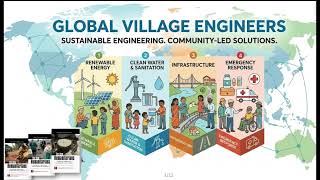
In this conversational deep‑dive, hosts A and B examine Global Village Engineers (GVE), an organization founded by Christopher Shimkin that challenges the conventional hardware‑first metrics of international aid. They argue that counting wells, roads, or concrete pours overlooks the real power of knowledge. GVE’s core concept, “Technical Enfranchisement,” means teaching local communities the engineering language—coordinates, hydrology, statistical design criteria—so they can audit, maintain, and negotiate infrastructure projects. The episode walks through several vivid case studies: the 1992 El Salvador levee project where a simple wooden stake became a teaching moment; a hydropower dam conflict resolved by explaining watershed lag time; a “10‑year storm” misunderstanding clarified through probability education; and personal empowerment stories of a subsistence farmer (Kants) and a local activist (Fernando) who used field‑testing skills and technical vocabulary to halt unsafe construction and gain political voice. The hosts also explore the motivations of volunteer engineers—mid‑career professionals seeking meaning—and Shimkin’s broader vision to institutionalize pro‑bono engineering akin to legal pro‑bono work. Funding challenges are highlighted, noting that intangible knowledge outcomes are hard to sell to donors. The conversation concludes with a call to listeners to identify their own “survey stakes” and democratize technical knowledge across sectors, from civil engineering to AI.
Chapters
I want to start off today with a bit of a provocation for you.
Oh, boy.
When we talk about international aid work or, you know, disaster development, we almost always measure success in hardware, right? We ask things like how many wells got dug, how many miles of road were paved, how many tons of concrete were poured. It's very tangible.
Yeah, it's measurable. I call it the ribbon-cutting metric. If you can take a picture of it for the annual report, it counts as a success.
Exactly. It looks great in a brochure. But we're looking at a stack of documents today for this deep dive, and they're all centered around an organization called Global Village Engineers.
GVE.
Right, GVE, and their founder, Christopher Shimkin. And the really fascinating thing is they argue that this hardware-first approach is fundamentally flawed.
It's completely backward to them.
Yeah. In fact, they suggest that the most powerful tool an engineer can bring into a disaster zone isn't a bulldozer, and it's not a blueprint. It's actually just a conversation.
Which, you know, sounds incredibly soft on the surface.
Right. It sounds a little like thoughts and prayers.
Yeah. A bit kumbaya. But when you really dig into the case studies we have today, specifically looking at their work in El Salvador and Nicaragua, you realize they're not talking about just chatting with people. They are talking about this concept called Technical Enfranchisement.
Technical Enfranchisement. That is a— that's a very heavy term.
It is, but it's really the core of everything we're going to talk about today. It's this idea that if a local community doesn't understand the physics or the math behind the massive infrastructure being built right in their backyards, they basically have no power.
They're completely in the dark.
Exactly. They are just passive recipients of aid. So GVE's whole mission is to take these really high-level, complex engineering concepts and completely demystify them. They teach them local farmers and villagers so those communities can actually advocate for their own safety.
Okay, so just to make sure I'm wrapping my head around this, instead of an NGO just flying in and building a dam, they actually sit down and teach the locals how the dam works so the locals know, say, when it's about to fail.
Precisely. It's a huge paradigm shift.
Yeah.
It's moving away from a savior model and moving toward a consultant model.
Wow.
And honestly, to understand why that shift is so crucial, we really need to look at where this all started. We have to go back to 1992.
Setting the scene. Hurricane, let's do it.
Right. So we're looking at the Bojo Lempa region of El Salvador.
And this is right in the wake of the civil war down there, and they're dealing with massive devastation from flooding. The source mentions Hurricane Mitch as well, just looking at that era of extreme weather impacts.
Exactly. The timeline is crucial context here. The entire area had just been absolutely hammered. You had the Lempa River, which is this massive, powerful body of water, and it's constantly flooding the local farms.
Mm-hmm.
So the international community responds the way they usually do. They send a bunch of money. And they send in foreign engineers to build massive levees.
Just standard civil engineering. Build a big wall, stop the water, problem solved.
On paper, yes, that's the logic. But in practice, you had this massive disconnect on the ground.
How so?
Well, you had these project overseers and professional engineers who were educated either in the West or over in the capital city. And on the other side, you had the local community.
Who were mostly subsistence farmers, right?
Right. Subsistence farmers who had been deeply traumatized by the recent war, traumatized by the floods. They're looking at these foreign engineers showing up on their land with total suspicion.
Because they literally don't speak the same language. And I don't just mean Spanish versus English. I mean the actual language of construction.
Yes. The project was practically stalling out because of this mutual mistrust. And this is where Christopher Shimkin steps in, essentially acting as a mediator.
Okay.
And this brings us to what is basically the origin story of GBE. And it revolves around something as incredibly mundane as a a single wooden stake in the dirt.
I love this detail from the sources because it is so small, but it completely changes everything. So Shemkin is out there trying to explain the levee design to the locals.
Yeah, he's standing in a muddy field with a group of local farmers, and he points to this little wooden stake that's been driven into the ground. Now, to a civil engineer, that stake is what they call a station.
Okay.
It's a very specific data point. It corresponds directly to a coordinate on a topographical map. It tells the engineering team the elevation, the alignment, the grade. It's packed with information.
But to the farmer standing right next to him—
To the farmer, it's literally just a stick with a random number painted on it. It means absolutely nothing. To them, it's just another sign that rich outsiders are coming in to tear up their land without even asking.
So what does Shymkin actually do in that moment?
He stops and he decodes it.
Yeah.
He takes the time to actually explain the coordinate system. He shows them the blueprint map, points to the drawn line on the paper, and then points physically to the stake in the mud.
He connects the dots.
He connects the dots. He explains, "Hey, this number here on the stick, this tells us exactly where the concrete wall is gonna go and exactly how high it needs to be built to stop the floodwaters from reaching your house." He takes the abstract data and turns it into their physical reality. Yeah. And there's this incredible quote in the source material from one of the local farmers there. He said that for the very first time in his life, the landscape actually made sense to him in a technical way.
Wow.
He could look out over the field at those wooden stakes and literally see the future levee in his mind.
That is the aha moment right there. It wasn't about the wood at all. It was about removing the mystery.
Exactly. Shimkin realized that the exact moment that farmer understood what the stake meant, the entire power dynamic shifted.
Because the farmer isn't just a victim of the project anymore.
Right. He becomes an active participant. He can actually audit the work now. He can walk out there and say, "Wait a minute, that stake is in the wrong place according to the blueprint." And that right there is technical enfranchisement. That is exactly it. If you understand the code of how things are built, You have rights. If you don't understand it, you're basically just crossing your fingers and hoping the experts are benevolent.
Hoping they don't mess up.
Yeah. And Shimkin realized that this translation of technical jargon was actually way more valuable than just offering free labor to mix concrete. So he quit his job and founded Global Village Engineers just to scale this specific methodology.
And their methodology is really distinct because they actually bill themselves as consultants, which, you know, feels very corporate for a disaster relief NGO. I think usually you picture young volunteers digging ditches, sweating out in the sun.
That's that Peace Corps image we all have in our heads. And look, there is absolutely a place for that, but GVE argues that physical labor is usually already available locally. The people there know how to work hard, right? What isn't available locally is the technical knowledge transfer.
Because if you just build a complex water pump system for a village and then leave, And then a pipe bursts 3 years later.
The community just stares at it. They have no idea why it burst, which means they have no idea how to fix it. GVE's whole philosophy is capacity building. They want to leave behind a community that understands the infrastructure just as intimately as the engineers who designed it.
I want to get into the weeds of this a bit because capacity building is a great buzzword, but I want to see how it plays out when things get genuinely tense. Because the documents mention that this approach isn't just about civic education. It's actually used as a form of conflict resolution.
Oh, This is where it gets really fascinating. We have this case study in the files regarding a hydropower facility in El Salvador, and it is the perfect example of how a lack of technical knowledge can literally lead to violence.
Set the scene for us on this one.
Okay, so you have a local community living downstream from this massive hydroelectric dam. These people have built their lives on the riverbanks, and they just keep getting flooded.
Yeah.
Constantly.
And the obvious assumption for anyone living there is that the giant dam upstream is doing it.
It's the only logical conclusion you can draw if you don't have the hydrological data. The villagers would be sitting outside on a perfectly sunny day, blue skies, zero rain, and suddenly the river would just rise rapidly and completely flood their homes. So naturally, they assumed the dam operators were maliciously releasing water to wash them out, or at bad, that the operators were just totally incompetent.
Sunny day flooding. I mean, it literally looks like a targeted attack.
It feels like an attack when your living room is underwater and it hasn't rained in a week. So tensions were incredibly high. There were actual physical threats being made against the power facility.
So what does GVE do?
Well, GVE comes in. Now, a normal NGO might have tried to mediate a peace treaty or get both sides in a room to talk about their feelings. But instead, GVE taught a masterclass to the locals on watershed hydrology.
Which is definitely not a standard hostage negotiation tactic.
No, it's not. But it was the only way to actually solve the root problem. They had to explain the massive scale of the Lemba River. It's roughly 350 to 400 kilometers long.
It's huge.
Right. It starts way up in the mountains of Honduras and runs through 3 entire countries before it ever hits El Salvador.
So they have to explain the concept of lag time to the villagers.
Exactly. They sat down with the community leaders and they drew it all out on a map. They explain that if a massive torrential storm hits the mountains in Honduras on a Tuesday, that sheer volume of water has to travel hundreds of kilometers.
Oh, wow. So it takes days.
Yeah, it doesn't arrive down in the lower Lemba area until Friday.
So the flood hitting their houses on Friday, the perfectly sunny day, was actually caused by the storm on Tuesday miles and miles away.
Yes. And once the community actually understood the physical mechanics of the river, the actual hydrology, all that anger just evaporated. They suddenly realized the dam operators weren't attacking them at all. The operators were just desperately trying to manage a massive flow of water that started 3 days ago in a different country.
That is incredible. It effectively turned an us versus them problem into an us versus the weather problem.
Exactly, which is a problem you can actually prepare for. Once they grasped the concept of lag time, they could start listening to the weather reports from Honduras. They could predict their own floods days in advance.
Knowledge didn't just stop the conflict. It gave them an early warning system.
It completely reframed their reality.
There's another case study in these documents that I think is even more relevant to you listening, especially if you deal with data or risk management in your day job. The 10-year storm panic. This feels like a classic, almost comedic failure of professional jargon.
Oh, this is a total nightmare scenario for an engineer, but it happens all the time. So in the spirit of good transparent governance, the local community was given open access to the technical specifications document for a brand new levee system being built.
Which is good. We want transparency.
It is good until they read the actual design criteria. The document explicitly stated that the new levee was designed for a 10-year storm.
Okay. And if I'm a local villager reading that and I don't have a master's degree in civil engineering, I read 10-year storm and I immediately think, oh, this wall's gonna expire in exactly 10 years.
That is exactly how they interpreted it. Or they thought, wait a second, you're building a wall that will just automatically fall down the next time we have a heavy storm. Why aren't you building it for the 100-year storm? Why are we getting the cheap cheap version.
And the local press got hold of this document, right?
Oh, yeah. The newspapers ran with it immediately. Giant headlines: "Government builds cheap wall with 10-year expiration date." Wow. It caused a massive uproar. People were protesting. They felt completely betrayed. They thought they were being given second-class, temporary infrastructure.
So GVE has to step in, play damage control, and teach a crash course in statistical probability.
Right. They had to explain what return period actually means in the engineering world. A 10-year storm isn't a timeline or an expiration date. It's a statistical probability metric. It refers to the magnitude of the storm.
So just to clarify, it means a storm of that specific size has a 10% chance of happening in any given year.
Exactly. It's a risk profile. And yes, a 100-year storm is obviously a much bigger storm, but building a wall to withstand that is astronomically more expensive.
Right.
So GVE had to walk them through the cost-benefit analysis. They basically said, look, we can build a 10-year wall for you today that protects you from 90% of the everyday floods, or we can wait 20 years to scrape together enough international funding for a 100-year wall and you'll flood every year until then.
Once they understood that it was just a probability metric and not a literal warranty date on the concrete—
Yeah.
—did the protests calm down?
They did very quickly. But it really highlights a massive blind spot in the expert class. Professionals use these terms constantly: 10-year storm, significant wave height, factor of safety, and we just blindly assume everyone else knows what they mean.
Because you use them every day.
Right. But when that technical jargon leaks out into the public sphere without any translation, it creates an information vacuum, and fear always, always fills that vacuum.
It really reinforces that whole idea of needing a translator. Hmm. You need a person who speaks fluent engineer and fluent public to bridge that gap. Absolutely. But I wanna pivot to the human side of this for a second. We've talked a lot about the crowds and the whole communities, but the source material highlights one specific individual who I think really embodies this entire transformation. Conception, or Kants, as they call him.
Yes. This is honestly my favorite part of the entire GVE history. Kants is the absolute hero of the story. Set the stage for Kants for us. So Kants is a subsistence farmer living in the Lower Lumpah. He has a first-grade education. He's just living off the land, trying to support his wife and two young kids. But crucially, he had been attending these voluntary GVE training sessions for about 2 or 3 years.
And again, they weren't teaching him how to code in CAD software or do advanced calculus. They were teaching him very practical, tactile field inspection. Right.
Basic soil mechanics. Specifically, they taught him how to physically check the moisture content of the raw earth being used to build the local levee.
Why does the moisture matter so much? I think most people assume dirt is just dirt, right?
Not when you're building a massive earthen dam or a levee. If the soil is too dry when you pack it, it won't compact properly. It just stays loose and crumbles. If it's too wet, it becomes highly unstable. It creates hydrostatic pressure inside the wall, and the whole thing can literally slide away. Okay. You need a very specific Goldilocks zone of moisture to get a structurally sound wall.
So they taught Kanzi what they call the hand test.
It's a simple, incredibly effective field technique. You just grab a handful of the raw soil, you squeeze it hard in your fist. If it stains your hand but still holds its shape without oozing actual water, it's good to go. If it's slick or soupy and runs through your fingers, it's dangerous to build with.
Simple enough. So one day, Konst is out there walking near the site, and he sees a heavy bulldozer operator actively working on a section of the levee.
And keep in mind, this is heavy commercial machinery. The operator is likely a professional contractor, maybe getting paid by the hour, maybe in a massive rush to meet a deadline. He's just pushing tons of dirt. Konst watches him for a minute, and he decides to run the test.
He just walks up and grabs the dirt.
He grabs a handful of the dirt right from the blade path, squeezes it, it and immediately realizes it's way, way too wet. If they keep building this section of the levee with that soil, it is going to be structurally compromised from day one. Now think about the social hierarchy here.
This is so crucial. You have a local peasant farmer with a first-grade education standing on foot, and you have a foreign contractor sitting up in a massive diesel machine who probably thinks he's the absolute king of the construction site.
The power dynamic is totally lopsided. It's David and Goliath. But Kuntz flags him down anyway. He tells the operator to cut the engine and stop working. And naturally, the operator just laughs in his face.
I can imagine.
He's completely dismissive. He's demeaning. He basically yells down, "Get out of the way, peasant. I'm working here. Let the experts do their jobs." But Kuntz stands his ground. He does. He refuses to move. And this is the exact moment where the years of GVE training pay off. An official engineering inspector, a licensed professional, happened to be walking nearby. He hears the shouting. He comes over, takes a sample of the exact same soil, performs the exact same hand test Kanz just did, and realizes Kanz is 100% right.
He actually backs him up against the contract.
He backs him up. He orders the bulldozer operator to shut the machine down immediately and halt the work. Wow.
That moment, that is the literal mission statement of GVE playing out in real time. It wasn't just about saving that one section of the levee from failing. It was about the fact that Kanz knew knew scientifically that he was right.
It completely flattened the social hierarchy. Kantz apparently tells the story constantly to anyone who will listen, not because he loves talking about soil moisture, but because that single interaction gave him profound self-confidence.
He stood up to the machine.
He realized that actual physical knowledge supersedes social status. He wasn't just a poor laborer watching the rich experts change his world anymore. He became an active guardian of his own family's safety.
The documents also briefly mention a guy named Fernando who had a very similar character arc.
Right. Fernando was a local who used to try to get meetings with local government officials to talk about flood protection for his village, and they would just completely ignore him. He was invisible to them. But after 2 years of working with GVE, he learned the technical vocabulary. He finally learned how to speak engineer. He did. He started dropping terms like embankment elevation and cubic meters per second in his letters, and suddenly his phone calls were getting returned by the mayor's office. That's amazing. He was literally invited to sit at the boardroom table with American and Japanese aid representatives. He gained a voice in his community's future purely because he gained the language of power.
It really drives home that demystification is really just a polite academic word for empowerment. When you strip away the mystery of all that jargon, you completely strip away the intimidation factor. And you create local accountability.
If the locals actually know how the levee is supposed to be built, they become a permanent army of inspectors. And that is a vastly more sustainable model than flying in an American engineer every 6 months to poke around and check on things.
I want to flip the lens for a second before we run out of time. We've talked a lot about the locals on the ground, but who are the people actually flying down to teach them? Who are these global village engineers?
Well, they are professional working engineers, civil, environmental, structural guys. And interestingly, Shimkin notes in the files that many of them actually sign up to volunteer because they are suffering from a bit of a mid-career professional crisis. A crisis of meaning, you mean? Exactly. Modern engineering, especially if you work in the West, can be incredibly alienating. You're sitting in a gray cubicle. You're staring at CAD software all day. You're designing, you know, a drainage ditch for a random strip mall or a parking lot in suburb you're never actually gonna visit. It's highly abstract. It is. You are completely removed from the actual human impact of your daily work.
And then you take a 2-week trip to El Salvador with GVE.
And suddenly you are standing in the mud, seeing the direct line between your math skills and a family's survival. Shimkin references this book in his notes by a guy named Samuel Foreman. It's called The Civilized Engineer. Okay. And the core argument of the book is that engineering is fundamentally supposed to be a humanistic endeavor. It's not about mass. It's about improving the human condition.
So for these volunteers, going down there is a huge moral boost.
It reconnects them with the exact reason they wanted to become engineers when they were kids. There's this striking visual in the source notes regarding the Las Colinas landslide mitigation in Santa Tecla.
Oh, that was a horrific tragedy. I remember reading about that one.
Something like 500 people died when that hillside collapsed. It was absolutely devastating. Entire neighborhoods wiped out. GVE worked extensively on the mitigation project thereafterward. And the after photo in the files shows this incredibly structured, terraced, reinforced hillside. It looks secure. It looks undeniably safe. Right. And for a volunteer engineer, looking at that photo isn't just looking at a job well done. It's literally looking at hundreds of lives that will be saved in the next earthquake or storm. That is a feeling you just are not gonna get from designing a suburban parking lot.
But despite all these massive successes— Constantine stopping the bulldozer, defusing the hydro dam conflict, the massive morale boost for the volunteers— Shinken sounds pretty frustrated in a lot of these source documents. It's definitely not all victory laps.
No, it's a constant uphill struggle for them. And the biggest hurdle they face, which probably won't surprise you, is funding. Why is it so hard to fund this?
I mean, hearing these stories, it seems like an absolute no-brainer for any aid organization.
Because it's an intangible asset. It loops right back to what we said in the intro. It is incredibly easy to sell a billionaire donor on a pitch that says, we physically built 50 water wells. Here are the photos. Right. It is remarkably hard to write a winning grant proposal that says, we sat in a room and taught 50 farmers how to understand watershed hydrology.
Donors want the brass plaque on the wall. They want to pay for the concrete.
Exactly. GVE is essentially selling knowledge, and knowledge is entirely invisible until the disaster doesn't happen. Shimkin talks openly about being repeatedly rejected for major fellowships. He's been told straight up by boards that empowerment is not a valid or measurable engineering output. That's incredibly frustrating. He's spent years just trying to convince the global aid industry that the soft science of human communication is actually the hard science of survival.
He has a pretty ambitious vision for the future of the industry, though, despite the pushback. He essentially wants to change the culture of the entire profession.
He does. He draws a really interesting parallel to the legal profession. In law, pro bono work is basically institutionalized. If you are a high-powered lawyer, it is culturally expected that you will do some legal work for free for the public good. It's baked right into the ethics of the bar association.
But in civil engineering, that concept doesn't really exist.
Not in any formalized way, no. Shimkin wants to instill that exact same pro bono culture into major engineering societies. He wants huge corporate firms to give their employees paid time off specifically for this kind of international knowledge transfer volunteering.
He wants to shift the entire industry from being purely profit and concrete focused to being holistically people focused.
Yeah. And he's actively looking to scale up the leadership to do it, establishing a formal board of directors, getting institutional backing because he feels the model is completely proven. Concisa standing in front of that bulldozer proves the model works. Works. Now it's just about making it the global norm, rather than a passionate side project for one guy and a handful of volunteers.
So, as we wrap up this deep dive, what's the big takeaway for you listening? We've gone from a single wooden stake in a muddy field, to a farmer stopping a bulldozer, all the way to a vision for a totally new kind of engineering ethics.
I think the biggest takeaway is a direct challenge to how we all define expertise. GVE's work proves that hoarding complex knowledge actually creates societal vulnerability. When experts keep the complexity all to themselves, whether they do it to protect their own elite status or just because they arrogantly think normal people won't understand it, they are actually making the entire system much more fragile.
And conversely, sharing that technical knowledge actually creates systemic resilience. It really does.
And this philosophy applies far beyond just civil engineering in developing nations. It applies to modern medicine, high finance, corporate law, tech. If you are the lone expert in the room and you are the only one who actually understands the structural risks, you are a single point of failure.
So the challenge for you, the listener, is this: what is your survey stake? What is the piece of complex jargon or the dense dataset or the insider knowledge in your specific field that you are holding onto?
And could you take the time to step back and translate it for someone else? Because as we saw with Kahn, the single most sophisticated and powerful tool on that entire construction site wasn't the heavy diesel machinery. It was simply the confidence to stand up and say stop.
And that confidence only ever comes from true understanding. Think about the digital infrastructure we interact with every single day. The opaque algorithms, the black box AI models that shape our lives. We are all essentially standing in that El Salvadoran field staring at a wooden stake we don't know how to read. Are we demanding the technical enfranchisement to govern our own digital lives, or are we just hoping the tech giants are benevolent? Something to chew on. That's it for this deep dive.
Thanks for listening.
More from Dr.

2025 Mercedes-Benz CLE 450 4Matic Cabrio – Owner’s Views After a Year-and-a-Half as a Daily Driver

The Complete Guide to a Successful Everest Base Camp Trek – Post-Trek Debrief

The Complete Guide to a Successful EBC Trek – Post-Trek Debrief: What I Needed (and What I Didn’t)

What Went Wrong Customizing My New 2026 Porsche Carrera T …and what I did about it!

Coming May 1 At the Intersection of High Performance and Fulfillment: A Conversation with Alisa Cohn

From High Performance to Fulfillment: Lessons in Inner Mastery with Jim Murphy

Coming March 19: From High Performance to Fulfillment: Lessons in Inner Mastery with Jim Murphy

The New Humanitarians Volumes I - III:- Inspiration, Innovation, and Blueprints for Visionaries

The New Humanitarians Volumes I - III:- Inspiration, Innovation, and Blueprints for Visionaries

The New Humanitarians Vol I - III: Inspiration, Innovation, and Blueprints for Visionaries - Forward
