The New Humanitarians Volume II – IESC GeekCorps
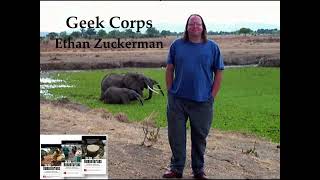
In this episode, hosts A and B walk listeners through the history, philosophy, and impact of IESC Geek Corps, a tech‑focused nonprofit that emerged from a 1993 epiphany in Ghana’s under‑funded university library. Founder Ethan Zuckerman realized that a single internet connection could leap‑frog decades of missing information, leading to the 1999 launch of Geek Corps (originally “Ghana 2000”) during the dot‑com boom. The program recruited tech volunteers to replace traditional aid with capacity‑building, targeting high‑leverage partners such as local ISPs. Early challenges included the mismatch between brilliant coders and short‑term volunteer stints, prompting a shift toward teaching and expectation management. After the dot‑com crash, Geek Corps was acquired by the International Executive Service Corps (IESC) in 2001, gaining institutional support and scaling to projects in Armenia, Mongolia, Senegal (e‑finance), Mali (radio network), and later East Africa (border‑control digitization) and Lebanon (ICT Academy). The episode highlights inventive low‑cost hardware hacks (the “bottle net” Wi‑Fi antenna, Desert PC, Cyber Tiggi) and the evolution from tech‑centric aid to embedding ICT as a foundational development tool. The hosts conclude that sustainable digital development hinges on human capacity, local adaptation, and frugal ingenuity rather than expensive gadget drops.
Chapters
I want you to try a little visualization exercise with me today.
Okay.
So for everyone listening, just close your eyes for a second. Right now, I want you to picture the Peace Corps. What's the very first image that pops into your brain?
I mean, I think for 90% of people, it's a really specific sort of mid-century archetype.
Right.
You're imagining this college graduate, maybe 22 years old, wearing rugged clothes, standing out in a field in some remote village.
Yeah, exactly.
They're probably, you know, helping dig an irrigation ditch, or maybe they're at a dusty chalkboard in a rural schoolhouse teaching the ABCs.
It's very manual. It's agriculture, it's analog. It's all about that sweat equity.
Definitely.
Now, I want you to keep that exact same spirit, that really idealistic desire to go help developing nations, but swap out the shovel, put a pocket protector in their shirt and a laptop in their hands. And just like that, you have visualized Geek Corps, which is the subject of today's deep dive. Welcome in, everyone. We are looking at a really fascinating stack of documents today detailing the history and the underlying philosophy of IESC Geek Corps.
It's a great topic.
And this isn't just some dry story about IT support for the developing world. This is really a story about how you take a country that the world considers a technology backwater and jumpstart it, trying to turn it into a leading ICT-enabled nation.
And just to clarify the acronym soup right up front before we get too deep, ICT stands for Information and Communication Technology.
Great. Thank you.
No problem. And what's so fascinating about the Geek Corps story, looking at these horses, is that it completely challenges the traditional model of foreign aid.
Yeah.
Because usually aid is about stuff— food, medicine, concrete. But Geek Corps was about capacity.
Human capacity.
Exactly. It was about the human element behind the hardware.
So let's unpack this because the origin story here is honestly kind of cinematic. It starts with a guy named Ethan Zuckerman.
Who is a huge name in the early internet world. He later became a really significant figure at MIT and Harvard.
But this is way before all that. All of that.
[Speaker:LATIF] Right. Way before.
[Speaker:LULU] It's 1993. Zuckerman is in Ghana on a Fulbright Fellowship. But here's the kicker: he's not even there for tech. [Speaker:LATIF] Right. [Speaker:LULU] He's there studying music. He's a percussionist. But, you know, being a naturally curious guy, he wanders into the University of Ghana library one day, and he notices something that just stops him cold.
[Speaker:LATIF] It was the dates on the books.
[Speaker:LULU] Yeah.
[Speaker:LATIF] He's walking the stacks, pulling these volumes off the shelves, And he realizes there is almost nothing in this entire university library newer than 1957.
1957, which for those of you who know your history, that is a very specific, very loaded date in Ghana.
It is. That is the exact year Ghana gained independence from Great Britain.
Wow.
So the realization Zarkaman had right there was that the intellectual infrastructure was effectively colonial. Once the British left, The funding stream that kept that library updated with the latest journals and encyclopedias, it just stopped.
Cut off completely.
Yeah. For nearly 40 years, the flow of physical information had just been severed.
And this is the aha moment for him, because if you try to fix that problem the old-fashioned way, like let's say you want to ship containers full of 40 years of books—
It's a logistical nightmare.
It's too expensive, it's way too heavy, and frankly, by the time you get it all there, the information is already aging anyway.
Exactly. It's an impossible game of catch-up.
Mm-hmm.
But Zuckerman realized that if you could get just a single reliable internet connection into that library, you don't need the shipping containers at all.
Right.
You effectively double, triple, quadruple the collection instantly. You completely bypass the physical limitations of development.
It's the ultimate shortcut. You skip the atoms and you just move the bits.
Right.
So let's fast forward a few years. It's 1999. The dot-com boom is at its absolute peak. Money is just flowing like water in Silicon Valley. Zuckerman teams up with Elisa Korenter and they found Geek Corps.
And they launched their first project, which was appropriately called Ghana 2000.
And the pitch to the public was actually pretty simple, but totally radical for the time. They said, we need tech volunteers. We don't need you to dig a well, we need you to lay code.
Which is such a great hook.
Now, I would assume just given the dot-com fever going on back then, that people were way too busy trying to become overnight millionaires to care about a nonprofit. In Ghana?
You would think so, right?
Yeah.
But the response was actually overwhelming.
Really?
Yeah. They were looking for just 6 tech volunteers, just 6 people to go over and set up a base of operations. They received almost 150 applications.
That is wild to me. Why do you think that resonated so much with the tech crowd?
Well, based on the history, I think there was a real sense of, I don't know, a hollowness in the dot-com era for some people.
Right. It was too corporate.
Yeah, exactly. You're making a ton of money optimizing pet food delivery websites, or building banner ads, but you're not feeling useful.
Sure.
So the idea of using those high-level skills for something tangible, something that actually bridged the digital divide—
Yeah.
—was incredibly magnetic. It offered purpose.
So they end up sending these 6 pioneers over to Ghana. But here is where the reality check hits. And the source documents are really honest about this, which I always appreciate. Oh, yeah. It wasn't easy. They weren't just going over and setting up Hotmail accounts for random people. They had to be extremely strategic about who they actually helped. Right.
It all comes down to the concept of leverage. If you have extremely limited resources, which they did, you have to target high-leverage partners.
So, who did they target?
They worked with an art gallery, a graphic design firm, and crucially, Ghana's internet service provider.
Now wait, why the ISP? That seems like you're just helping a specific business, not really helping the people of Ghana.
Well, because the ISP is the upstream bottleneck. Ah, OK. If you make the local ISP better, if you make it more stable, faster, better managed, then every single person, every business, and every school in the country that uses that ISP benefits. That makes total sense. It's a multiplier effect. You fix the pipe, and the water flows better for everyone.
But this brings us to the first major hurdle that's identified in the files we reviewed. And I really think this is a lesson for anyone in management, not just in the nonprofit sector. Absolutely. It turns out being quote unquote 10x coder or a computer genius makes you a terrible volunteer.
It often makes you a huge liability.
Explain that for us, because on paper you'd think you want the smartest tech guy in the room, right?
Well, Geekcourse realized pretty quickly that technical expertise was just the baseline. It was just the entry ticket to get in the door. Okay. Because the mission wasn't to do the work. The mission was to transfer the capacity. Got it. If a geek goes in, rewrites the entire server architecture, fixes the database, and then flies home without explaining how any of it works, what happens?
The server crashes a month later and nobody there knows how to fix it. You're just back to square one.
Precisely. You haven't helped them. You've just created a dependency.
So Geek Corps had to start introducing specific teaching exercises into the volunteer training.
They had to teach the geniuses how to teach. Exactly. They had to completely shift the mindset from I'm here to save you to I'm here to train you to replace me.
Which is a hard pivot for some for some personality types, let's be honest. Very hard. And there was another layer to this difficulty, too, which was the timeline. Peace Corps volunteers go for 2 years, right? Right. They have months of language training, deep cultural immersion. But Geek Squad assignments were often really short term. We're talking maybe 3 or 4 months.
Yeah. And that creates a massive cultural pressure cooker. In a traditional long-term volunteer scenario, you might have a month or 2 of in-country immersion. Just to learn the social norms and get comfortable.
Just to figure out how to buy groceries, how to say hello.
Exactly. But Geek Corps volunteers didn't have that luxury. They had to, as the documents literally say, hit the ground running.
So how did they solve that? Because you can't just download cultural awareness into a person like a software update.
They had to shift the timeline. The cross-cultural training had to happen before they even left home.
Ah, okay. Front-loading it. They had to front-load the adaptation.
But the absolute most important part of that training, and this is key, was managing expectations. Managing expectations.
Like whose expectations?
Everyone's. Aligning the expectations of the Geek Corps managers, the volunteers themselves, and the local businesses in Ghana. Why is that so critical? Because this is where a lot of aid projects fail. The volunteer comes in thinking, I'm going to revolutionize this company in 3 weeks. And the local business thinks this American wizard is going to magic away all of our problems.
And neither of those things is true, right?
If you don't reset those expectations on day 1 to, hey, we're going to make incremental improvements and we're going to learn from each other, everyone just ends up angry and disappointed.
It's basically about defining success realistically. Yes, it's preventing burnout before the plane even takes off. Exactly. But speaking of burnout, we have to talk about the business side of Geek Court itself. Because they started this whole thing in 1999, right at the height of the dot-com bubble, which was a blessing and a curse, right? Because the sources mentioned they started with about $300,000. Some of that was out of Zuckerman's own pocket and some came from donations from the dot-com community. Now, to me, $300 grand sounds like a decent chunk of change.
It sounds like a lot. Sure. Until you are actually trying to ship people and computer hardware across the Atlantic Ocean. And run daily operations in West Africa. Oh, true. In the logistics world, $300,000 is basically a rounding error. It burns incredibly fast. And then—
The bubble burst.
The dot-com bubble burst and the faucet just turned off completely.
Donations evaporated.
Yeah, because the donors themselves were going bankrupt overnight. So Geekcourse hit this massive financial wall. But this isn't the end of their story. It's actually the major pivot.
Right. August 2001.
Yes. In August 2001, Geek Corps gets acquired. And this acquisition is really interesting because it's a total clash of two very different worlds.
They were acquired by the IESC, the International Executive Service Corps. Now paint the picture for us. Who are the IESC? Think Mad Men meets the Peace Corps.
Okay.
I love that visual.
IESC is the establishment. They were founded way back in 1964. They are this massive NGO. That basically sends retired business executives, real corporate veterans, CEOs, CFOs to developing countries to give management advice.
So you have the suits from the '60s merging with the geeks from the '90s? Exactly.
It honestly sounds like a sitcom premise.
It really does.
But the analysis in the documents suggests it was a brilliant synergy. IESC had all the boring stuff that Geek Corps desperately lacked. Infrastructure. Right. They already had 200 programs operating at 100 30 countries. They had accounting departments, legal teams, and most importantly, they had access to USAID funding. We're talking $22 million a year in projects.
Wow. And Geek Corps had the one thing IESC was missing: modern relevance.
Correct. IESC needed to enter the information age. They knew exactly how to run a textile factory, but they had absolutely no idea how to run a computer network.
So they became IESC Geek Corps. Right.
Geek Corps basically became the information and technology division of this massive NGO. It stabilized their finances and allowed them to scale up way beyond what they could have done as a scrappy little startup.
So let's look at what that scaling up actually looked like, because once they had that IESC backing, they started popping up everywhere. The case studies in these documents are wild. We've got Armenia, Mongolia, Senegal.
The expansion was very rapid. By 2002, they were in Armenia sending software engineers to work with these up-and-comer tech firms. They're in Mongolia doing networking expertise. But the one that really stands out to me structurally is Senegal.
Yeah, the Senegal project was focused on finance, wasn't it?
Yes, specifically financial inclusion. The core problem in Senegal was that the rural areas were completely unbanked. Unbanked.
So meaning no savings accounts, no loans.
Exactly. If you lived in a rural area there, you had literally no access to interest-based savings or investing. All the financial power was physically trapped in the urban centers. So if you wanted to engage with the broader economy, you often had to physically carry cash on a bus to the city.
Which is incredibly inefficient and frankly dangerous. Highly dangerous. So how does a computer geek from the US fix a banking problem in rural Senegal?
By digitizing the money flow. Ah. They sent 15 volunteers over to focus strictly on e-finance. They strengthened local cybercafés, and they helped small to medium enterprises SMEs access markets using ICT.
So, bypassing the physical banks entirely. Right.
If you can move money and manage accounts digitally, you don't need a physical brick-and-mortar bank branch in every tiny village just to have a functioning economy.
That is huge. It's essentially the democratization of finance through code. Yes. But if we're talking about the democratization of information, we have to talk about Mali. This project started in November 2003.
Mali is such a fascinating case study because it perfectly highlights how Geek Corps wasn't just copy-pasting American solutions onto African problems.
What do you mean by that?
Well, in the US, we think of the internet as the primary information source, right? Sure. But in Mali, it's radio. Oh, right. Radio is the absolute lifeblood of information in Mali. It's how everyday people know what's happening. So Geek Corps didn't go in and try to replace the radio with laptops. They tried to supercharge the radio. Interesting.
How did they do that?
Their goal was to connect over 145 different radio stations into a single network.
So, instead of 145 isolated islands of information, you suddenly have a grid.
Exactly. By connecting them to the internet, and to each other, these local stations could share development information, news content, and educational material across the entire nation. Wow. They used the internet as the backhaul to feed the radio transmitters. It amplified the existing culture rather than trying to overwrite it.
And this project in Mali actually leads us to what I think is easily the coolest part of these documents: the MacGyver section.
I had a feeling you would like this part. This is where we get into the real hardware hacking.
I love this part because look, when you are out in rural Mali, you can't just run to a local electronics store if you need a Wi-Fi antenna, right? No, you definitely cannot. You have to innovate. And the sources detail some incredible hardware hacks that the volunteers and the locals came up with together around 2005 and 2006.
The bottle net is probably the most famous example of this. The bottle net.
I want everyone listening to just hear this ingredients list: a plastic water bottle, some window screen mesh, use valve stems from motorbikes, and some coaxial cable. I mean, it sounds like trash. It does. It sounds like a pile of garbage. But what did it actually do? It worked.
It was a fully functional Wi-Fi antenna. That's crazy. It could receive wireless transmissions up to 2 or 3 GHz. They essentially built a high-tech receiver out of junk and spare parts they just found lying around the village.
That is just pure ingenuity. And if you think about the sustainability of that, if you ship in some fancy $500 antenna from the US and it breaks in a sandstorm, you're offline for months waiting for a part.
Right.
But if a bottleneck breaks, you drink a bottle of water, find some wire, and you build another one in an hour.
That is true resilience. They also built something called the Desert PC, which is exactly what it sounds like. Computers are generally very sensitive to heat and dust, which are two things you have in massive abundance in the Malian desert. Right. So they designed a PC specifically to withstand high heat, high dust, and crucially, low electricity environments. They used lower-power components and better filtration systems. And then there was the Cyber Tiggi. The Cyber Tiggi. Uh. This was designed to make those radio stations we talked about self-sustaining. Okay, so a business model. Right. It's basically a mini cyber cafe in a box. It gave rural people access to laser printers, scanners, digital cameras. It allowed the radio station to charge a small fee for services like photocopying or printing passport photos.
But there's a cultural fun fact tucked in the notes about the CyberTiki that I loved. It wasn't just for, you know, boring business forms.
No, not at all. One of the biggest uses was actually transferring music. Yes. It allowed locals to transfer their music from old cassette tapes onto CDs or MP3s.
That detail about the cassettes is just so incredibly human to me. It shows that technology isn't just about spreadsheets and market data. It's about preserving culture. And just having fun. And video games. Right, really.
Yeah, it allowed them to play video games, and that's important. If you only build the boring stuff, people won't engage with the technology organically. You have to meet people where their interests actually are.
So, as we move into the later years covered in the source material, the mission of Geek Corps starts to evolve again. We see them moving into much more complex, almost governmental-level projects. We do.
We see the work in East Africa with the border control agencies, for example.
Yeah, tell us about that.
This was a major partnership with USAA. They had volunteers working to create a shared digital interface for Kenyan and Ugandan border agencies. So, places like Mombasa, Nairobi, Kampala. What was the goal there?
Was it just about speed?
Speed and standardization. They were trying to meet World Customs Organization standards. But think about the broader implications. Paper-based customs are incredibly slow, which kills trade, and they are opaque, which breeds corruption. Oh, sure. If you can digitize the border crossing, you reduce the opportunities for corruption, you speed up international trade, and you boost the economy of the entire region.
They were essentially coding for GDP growth. Exactly. And then there's the work in Lebanon in 2007.
Right. This was in a post-conflict recovery context. Lebanon had suffered massive devastation, and Geek Corps stepped in with something called the ICT Academy.
What did that do?
The idea was to mobilize tech skills and get affordable internet into rural areas to help the country get back on its feet economically after the conflict.
They also had a specific program there called AMIT, right?
Yes, Access to International Markets Through Information Technology. Got it. The logic was simple: the local market might be totally destroyed or depressed because of the conflict, but the internet connects you to the global market.
So you don't have to rely on the local economy. Right.
They help tourism operators and small producers sell their goods and services to customers in Europe or the US, totally bypassing the physical devastation right around them.
It's interesting to note that by this time, Ethan Zuckerman, the original founder, had actually left the organization.
He left in 2004 to go to Harvard's Berkman Center. But the sources are quick to point out that even without him, the mission continued to grow, and the underlying philosophy shifted slightly. How so? Well, in the very beginning, Geek Corp was the project. The tech was the headline, right? Yeah. But by the late 2000s, the tech expertise was being integrated into everything else. Tech was no longer a standalone silo. It was just a part of trade programs, tourism programs, education curricula.
It became almost invisible in a way, just part of the basic fabric of development.
Exactly. The expert summary in our documents frames it beautifully. They moved from treating tech as a gadget to treating it as a fundamental tool for peace and prosperity.
That's a great way to phrase it.
It wasn't about the server anymore. It was about what the server allowed you to do.
It's a complete maturation of the entire concept of digital aid. So zooming out, what does this all mean for us today? We've gone from a guy realizing a library in Ghana is stuck in 1957 to a global operation that is literally building internet antennas out of water bottles and motorbike parts.
I think the key takeaway here is really about the nature of the digital divide itself. We often think the solution to inequality is just more money or more fancy equipment, right? But Geek Corps proved that the gap is usually bridged by training, by human capital, and by local adaptation.
It's not about just dumping a crate of laptops on a village and walking away. Never.
It's about the geek who sits down and teaches someone how to use it or how to fix it when the dust inevitably gets in the fan. Yeah. It's about sustainability. You can't just drop an iPad in a village and expect democracy and the economy to flourish. You need the human infrastructure behind it.
And it's about that bottleneck. I really just can't get over the bottleneck.
It is the ultimate symbol of the entire program.
It really is. And that actually leads me to a final thought I want to leave all of you listening with today.
Let's hear it.
We live in a world of incredibly sleek, high-tech, sealed-shut devices. If our Wi-Fi goes down at home, what do we do? We call the cable company and we wait. We are very passive consumers of our tech.
We've definitely lost touch with how it actually works under the hood.
Exactly. But I want you to think about that volunteer in Mali or that local radio operator looking at a literal pile of trash and seeing a gateway to the entire world's information. Yeah. They looked at extreme constraints. No money, no supply chain, no stores. And they innovated anyway.
It definitely raises a question. It does.
It makes me wonder, in our own lives, are we overlooking simple, low-cost solutions? Are there digital divides in our own communities, or even just everyday problems in our own homes that we're trying to solve by throwing money at them when we really should be solving them with a little bit of ingenuity and the materials we already have lying around?
Sometimes the best technology isn't the newest gadget you can buy. It's the one you can build yourself. I couldn't have said it better.
Thank you so much for diving in with us today. It was a pleasure. See you next time on The Deep Dive.
More from Dr.

2025 Mercedes-Benz CLE 450 4Matic Cabrio – Owner’s Views After a Year-and-a-Half as a Daily Driver

The Complete Guide to a Successful Everest Base Camp Trek – Post-Trek Debrief

The Complete Guide to a Successful EBC Trek – Post-Trek Debrief: What I Needed (and What I Didn’t)

What Went Wrong Customizing My New 2026 Porsche Carrera T …and what I did about it!

Coming May 1 At the Intersection of High Performance and Fulfillment: A Conversation with Alisa Cohn

From High Performance to Fulfillment: Lessons in Inner Mastery with Jim Murphy

Coming March 19: From High Performance to Fulfillment: Lessons in Inner Mastery with Jim Murphy

The New Humanitarians Volumes I - III:- Inspiration, Innovation, and Blueprints for Visionaries

The New Humanitarians Volumes I - III:- Inspiration, Innovation, and Blueprints for Visionaries

The New Humanitarians Vol I - III: Inspiration, Innovation, and Blueprints for Visionaries - Forward
