The New Humanitarians Volume II - Introduction to Volume II
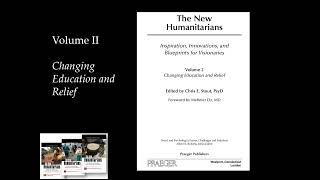
Dr. Chris Stout introduces a collection of NGOs working in education, capacity-building, and relief across the developing world. From blind-person-led schools to rural engineering and microfinance, each organization empowers local communities by building skills and opportunity. Stout shares how he met the founders and what each group has accomplished.
Chapters
Volume 2: Changing Education and Relief. Braille Without Borders, founded in 1997. Sabre, Paul, and I used to joke about how we were likely the poorest attendees in Davos at the World Economic Forum, and in spite of our modest bank balances, I can tell you that they were two of the most powerful of the movers and shakers there. Braille Without Borders wants to empower blind people in these countries so that they themselves can set up projects in schools for other blind people. In this way, the concept can spread throughout the globe so other blind and visually impaired people can have access to education and a better future. Room to Read, founded in 2000. I heard John Wood talk about his post-Microsoft adventure of founding Room to Read. His brainchild partners with local communities throughout the developing world to establish schools, libraries, and other educational infrastructure. They seek to intervene early in the lives of children in the belief that education is a lifelong gift that empowers people to ultimately improve socioeconomic conditions for their families, communities, countries, and future generations. Through the opportunities that only an education can provide, they strive to break the cycle of poverty one child at a time. Since its inception, Room to Read has impacted the lives of over 1.3 million children by constructing 287 schools, establishing over 3,870 libraries, publishing 146 new local language children's titles representing more than 1.3 million books, donating 1.4 million English language children's books, funding 3,448 long-term girls' scholarships, and establishing 136 computer and language labs. Global Village Engineers, founded in 1992. Chris Shimkus is a good guy and a good friend whom I first connected with in Geneva at the WEF, World Economic Forum headquarters. He took one of those proverbial leaps of faith and left his day job to devote himself to the work of Global Village Engineers, or GVE. GVE is a volunteer corps of professional engineers supporting the local capacity of rural communities in developing countries to influence public infrastructure and environmental protection. Its engineers choose to volunteer their skills to ensure the livelihood of these communities by building long-term local capacity, especially in situations of disaster prevention and rehabilitation and the need for environmental protection. They believe that infrastructure will best serve communities when they have the capacity to become involved from project inception through construction. Governments and project sponsors often do not invest in communicating basic facts to the community about design, construction, and maintenance. The mission of Global Village Engineers is to find these facts and develop local capacity to understand such facts. Common Bond Institute, founded in 1995. I first met Steve Olien, PhD, in an airport in Oslo, or was it Helsinki? We were on our way to St. Petersburg, Russia, to the conference he founded. That conference was a lightning rod of connections with people I continue to work with all around the world, from Sri Lanka to Tel Aviv. And that's just the tip of the iceberg of what Steve does. He founded the Common Bond Institute (CBI), which is a U.S.-based NGO that grew out of the Association for Humanistic Psychology's International Soviet-American Professional Exchange. The professional exchange was initiated in 1982 as one of the first Soviet-American non-governmental human service exchanges. CBI organizes and sponsors conferences professional training programs, relief efforts, and professional exchanges internationally, and it actively provides networking and coordination support to assist newly emerging human services and civil society organizations in developing countries. Its mission is cultivating the fundamental elements of a consciousness of peace and a local capacity building, which are seen as natural, effective antidotes to to small group radical extremism and large group despair, as well as to hardship and suffering in the human condition. To this end, enabling each society to effectively resolve and transform conflicts, satisfy core human needs within their communities, and construct effective holistic mechanisms for self-determination, self-esteem, and fundamental human dignity and worth is the purpose of their work. SWEEP, founded in 2004. The Jane Addams College of Social Work, University of Illinois-Chicago, Addis Ababa University, the Council of International Programs USA, and a network of nonprofit agencies are engaged in an exciting effort to develop the first-ever master's degree in social work in Ethiopia through a project known as Social Work Education in Ethiopia Partnership. Or SWEEP, S-W-E-E-P. The undergraduate social work program at the Addis Ababa University was closed in 1976 when a military regime ruled the country. Now with a democratic government in place, and since the early 1990s, the SWEEP project is working in collaboration with the university in Addis Ababa's new School of Social Work and non-governmental agencies in Ethiopia to develop social work education and practice. The Center for Urban Pedagogy, founded in 1997. The Center for Urban Pedagogy, CUP, makes educational projects about places and how they change. Its projects bring together art and design professionals—artists, graphic designers, architects, urban planners, with community-based advocates and researchers, organizers, government officials, academics, service providers, and policymakers. These partners work with CUP staff to create projects ranging from high school curricula to educational exhibitions. Their work grows from a belief that the power of imagination is central to the practice of democracy and that the work of governing must engage the dreams and visions of citizens. CUP believes in the legibility of the world around us. It is the CUP philosophy that by learning how to investigate, we train ourselves to change what we see. Endeavor, founded in 1997. Linda Rottenberg, a co-founder of Endeavor, is a Roman candle of energy, enthusiasm, and brain power. She and I met through our World Economic Forum days as Global Leaders for Tomorrow. She is amazing at delivering on what's needed in creative, intelligent ways. Endeavor targets emerging market countries transitioning from international aid to international investment. Endeavor then seeks out local partners to build country boards and benefactors to launch local Endeavor affiliates. Action, founded in 1961. ACION International is a private nonprofit organization with the mission of giving people the financial tools they need— microenterprise loans, business training, and other financial services— to work their way out of poverty. A world pioneer in microfinance, ACCION was founded in 1961 and issued its first microloan in 1973 in Brazil. Action International's partners with microfinance institutions goes on to today, and they're now providing loans as low, as low as $100 to poor men and women entrepreneurs in 25 countries in Latin America, the Caribbean, Asia, and sub-Saharan Africa, as well as the United States. Invisible Conflicts, founded in 2006, I first met Evan Ledyard at a talk I gave at Loyola University in Chicago, and he introduced me to the work he had been doing with an incredible group of students. Invisible Conflicts is a student organization that sponsors the education, mentorship, and empowerment of 20 Ugandan orphans and vulnerable children. A 21-year civil war in northern Uganda between the government and a rebel faction called the Lord's Resistance Army, LRA, has led the forced displacement of over 1.7 million people into international refugee camps. To support their rebellion, the LRA abducted more than 30,000 Ugandan children, forcing them to be sex slaves and to fight as child soldiers. Because of these atrocities, all of the DMP-sponsored children live in squalid conditions in and around many displacement camps. Because life around these camps is marked by poverty, hunger, and little to no access Without access to education, an entire generation of children find themselves denied a childhood and a chance to succeed in life. Building Educational Leaders for Life, founded in 1992. Building Educated Leaders for Life, or BEL, recognizes the pathway to opportunity for children lies in education. BEL transforms children into scholars and leaders through the delivery of nationally recognized high-impact after-school and summer education programs. By helping children achieve academic and social proficiency during their formative elementary school years and embrace their rich cultural heritage, BELL is inspiring the next generation of great teachers, doctors, lawyers, artists, and community leaders. By mobilizing parents, teachers, and young adults, BELL is living the idea that it takes a village to raise a child. Hybrid Vigor Institute, founded in 2000. I first met Denise Caruso at a TED conference. She was just stepping down from her position as technology columnist for the New York Times just before the tech bubble burst. Smart gal. I was immediately smitten by her intellect. In subsequent emails and conversations, she agreed to help me in the pondering of my nascent ideas for my center as she was building her institute in the form of Hybrid Vigor. The Hybrid Vigor Institute is focused on 3 ambitious goals. 1, to make a significant contribution towards solving some of today's most intractable problems in the areas of health, the environment, and human potential, both by producing innovative knowledge and by developing processes for sharing expertise. 2, to develop new methods and tools for research and analysis that respect and use appropriately both the quantitative methods of the natural sciences and the subjective inquiries of the social and political sciences, arts, and humanities, and to establish metrics and best practices for these new methods of collaboration and knowledge sharing. And 3, to deploy cutting-edge collaboration, information extraction, and knowledge management technologies so that working researchers from any discipline can easily acquire and share relevant work and information about their areas of interest. Our Voices Together, founded in 2005. Mary Ann Scott and I had a wonderful conversation one Sunday night that I will never forget. Without repeating it, I do want to say that I was touched by her humanity in a very powerful and lasting way. I knew that when she needed to be represented then in this project. Our Voices Together holds a vision of a world in which the appeal of lives lived in dignity opportunity, and safety triumphs over the allure of extremism and its terrorist tactics. The people of this organization see a future where terrorist tactics are not condoned by any community worldwide. They understand that to achieve this, you must trust— trust, pardon me, trust must be built on mutual trust and respect around the globe. They recognize the vast potential in engaging the United States in diplomacy by connecting communities, To this end, they promote the vital role of people-to-people efforts to help build better, safer lives and future around the world. Geek Corps, founded in 1999. Ethan Zuckerman has a wicked sense of humor, and he's not afraid to use it. I last saw Ethan in Madrid at an anti-terrorism conference, and we spoke of wikis as a solution to a puzzle I was working about Amazon Medical Services, of course. Ethan is the founder of Geek Corps, which has evolved into the IESC Geek Corps, which is an international 501(c)(3) nonprofit organization that promotes stability and prosperity in the developing world through information and communication technology, ICT. Geek Corps' international technology experts teach communities how to be digitally independent, able to create and expand private enterprise with innovative, appropriate, and affordable information and communication technologies. To increase the capacity of small and medium-sized businesses, local government, and supporting organizations in order to be more profitable and efficient in using technology, GeekCorp draws on a database of more than 3,500 technical experts willing to share their talents and experience in developing nations. Let's get going. I hope you enjoy learning more about these amazing individuals and their work. I certainly have enjoyed working them— with them and in completing this remarkable writing project. They all have a common denominator of changing people's lives, and isn't that truly the way to change the world?
More from Dr.

2025 Mercedes-Benz CLE 450 4Matic Cabrio – Owner’s Views After a Year-and-a-Half as a Daily Driver

The Complete Guide to a Successful Everest Base Camp Trek – Post-Trek Debrief

The Complete Guide to a Successful EBC Trek – Post-Trek Debrief: What I Needed (and What I Didn’t)

What Went Wrong Customizing My New 2026 Porsche Carrera T …and what I did about it!

Coming May 1 At the Intersection of High Performance and Fulfillment: A Conversation with Alisa Cohn

From High Performance to Fulfillment: Lessons in Inner Mastery with Jim Murphy

Coming March 19: From High Performance to Fulfillment: Lessons in Inner Mastery with Jim Murphy

The New Humanitarians Volumes I - III:- Inspiration, Innovation, and Blueprints for Visionaries

The New Humanitarians Volumes I - III:- Inspiration, Innovation, and Blueprints for Visionaries

The New Humanitarians Vol I - III: Inspiration, Innovation, and Blueprints for Visionaries - Forward
