The New Humanitarians Volume II – Social Work Education in Ethiopia Partnership
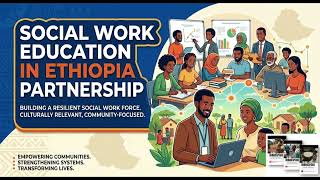
Kay McChesney and Alice Butterfield revived Ethiopia's social work education through Project SWEEP, rebuilding a discipline erased by the Derg regime. Starting with a $99,000 grant and 60 volunteer scholars, they launched a master's program in 2001 using intensive block teaching and real fieldwork, then scaled to a PhD program by 2006.
Chapters
Imagine being handed a directive, um, to launch a comprehensive graduate-level university program.
Right. Which is a massive administrative undertaking under the best of circumstances.
Exactly. But now imagine you have to accomplish this with zero budget. You have no computers, no office space, and absolutely no faculty on staff. How do you even begin to pull that off?
I mean, under standard academic models, it sounds like an impossible administrative nightmare. You know, you would usually spend years just securing the endowments and the real estate before you even think about admitting a single student.
Yeah.
But this actually happened, and the methodology behind how it was accomplished, it really forces us to completely rethink how institutions are built.
That is the exact journey we are exploring today. For this deep dive, we're pulling from a remarkably detailed document. It's titled sweep-final-14-feb.pdf.
It's a fascinating read.
It really is. It chronicles the social work education and Ethiopia partnership, which they refer to as Project Sweep. And our mission today is to examine how a completely destroyed educational discipline was resurrected from the ashes.
And they managed it using a brilliant kind of counterintuitive concept called the paradox of the poor, relying heavily on human connection rather than, you know, institutional wealth.
Yeah. And for you listening, whether you're currently trying to stretch a ridiculously tight budget at work or maybe attempting to get a startup off the ground or looking to build a community project from scratch, this deep dive serves as a masterclass.
Absolutely. It provides a stunning lesson in resourcefulness. It really demonstrates the true, boots-on-the-ground meaning of partnership, far beyond corporate buzzwords.
It totally challenges the standard operating procedures of modern organizations. And like many massive international products, this one started with a really simple question during a chance encounter.
Right, a complete coincidence.
Yeah, we have to go back to the early 2000s, in St. Louis, Missouri. There's an American woman named Kay McChesney who had recently adopted 3 children from Ethiopia, and she was attending an Ethiopian Orthodox Church. She strikes up a conversation with Dr. Ennegaw Mahari. Now, he was in the process of planning a medical delegation to Ethiopia to focus on the HIV/AIDS crisis. And Kay asks him, what about the orphans?
Which is such a pivotal question.
Yeah. And she couldn't travel herself, but she suggested that her friend, a University of Illinois at Chicago professor named Alice Butterfield, take her place on the delegation.
If we connect this to the bigger picture, we have to understand the specific historical landscape that Alice Butterfield was stepping into. When she started looking into the state of social work in Ethiopia, she uncovered a fascinating timeline.
Yeah, it wasn't always a blank slate.
Not at all. Back in the 1960s, social work in Ethiopia was actually a thriving, highly respected field. Haile Selassie University had a school of social work that was recognized throughout Africa as a premier center of excellence.
Wow.
The university was actively sending its young faculty to the United States to earn their doctorates, building this robust academic pipeline.
So it was a golden era for the discipline there, but that academic infrastructure didn't just slowly decline over time, it was abruptly dismantled.
Right. In 1974, the Marxist Derg military regime took power. And to understand the subsequent erasure of the program, we have to look objectively at the regime's stated ideology at the time Exactly as it is outlined in our source text.
Right. What was their justification?
Well, according to their doctrine, in a socialist state, social problems theoretically did not exist because the government apparatus was supposed to meet all human needs.
So by that logic, the very existence of a social worker implies that the state is somehow failing to provide for its citizens.
Precisely. The ideology held that social work was a reformist idea. It was viewed as an artificial construct designed to keep the working class in a perpetual state of dependence. The text notes it was officially deemed a bourgeois machination.
Wow.
Consequently, the regime completely closed the School of Social Work. The discipline was officially and legally erased from the academic roster.
Okay, let's unpack this because it leads to what might be the most compelling detail in this entire document. The discipline was officially erased on paper, but it survived in the shadows.
It's an incredible story of defiance.
It really is. Two Ethiopian professors, Seyoum Gibreselassie and Angargachu Tesfaye, who were actually among those original faculty members sent to the US for their doctorates, returned to Ethiopia and they essentially created intellectual contraband.
Intellectual contraband. I love that phrasing.
Right. They managed to covertly hide six macro social work courses within the university's sociology and anthropology curriculum.
It is important to clarify what macro social work means in this context because it explains how they got away with it.
Yeah, break that down for us.
We often think of social work as one-on-one clinical therapy, but macro social work focuses on large-scale systemic issues, policy advocacy, and community organization. Because it deals with societal structures, it was easier to camouflage these courses under the umbrella of sociology and anthropology.
That makes perfect sense.
And for decades, Those hidden classes were the only surviving remnant of social work education in the entire country.
It is a profound act of academic preservation. So fast forward almost 30 years to 2001. Alice Butterfield is preparing for her trip with the medical delegation and trying to find out if any social workers are even left in Ethiopia.
Right.
She does some digital detective work, sending an inquiry out to the ECOSA network. That is the Association for Community Organization and Social Administration. She gets exactly one reply.
Just one.
Just one. It's from a retired professor in Michigan who tells her, "I used to have a student named Seyoum Gebre Selassie. He went back to Ethiopia in 1979 during some very difficult times.
You should find him." And that single email lead sets everything in motion. In May 2001, Alice manages to locate Professor Seyoum. They meet for coffee at the Dizon Hotel in Addis Ababa.
The famous coffee meeting.
Exactly. Over that coffee, Seyoum lays out an incredibly bold vision considering the circumstances. He tells her, "We need to start the profession of social work in Ethiopia. First, we'll start with a master's degree." Just like that, the objective is defined.
That coffee meeting is the definitive birth of Project Sweep. Addis Ababa University, or AAU, and the University of Illinois at Chicago, UIC, form a partnership. And they manage to secure $99,000 in seed money from an organization called Higher Education for Development.
Which brings us to the logistics of funding.
Wait, $99,000 to launch a completely new international graduate-level program? That barely covers a single mid-level administrator salary at most US universities today.
Yeah, it's a remarkably small amount.
How far could that possibly go when you have to build a curriculum, recruit faculty, and manage international travel?
Under normal institutional guidelines, it goes nowhere. But what stands out in the source material is the ruthless efficiency of this specific partnership. UIC, the American partner, took 0% for overhead or administrative costs.
0%?
Zero. Every single penny of that grant went directly into the operational budget of the program.
That is almost unheard of in modern academia, where overhead can easily consume a massive percentage of any grant before the work even begins.
It is exceedingly rare. Furthermore, the faculty involved conserved the funds by flat-out refusing to pay themselves salaries for the time they dedicated to the project.
They did it for free?
They only expense their hotel, their travel, and a remarkably strict per diem of just $12 a day while in Addis Ababa.
$12 a day? That's wild.
I want you to consider the reality of that for a moment. These are highly credentialed experts operating in a foreign country on $12 a day to cover their meals and incidentals. Think about how often corporate or bureaucratic bloat stalls the momentum of a new initiative.
Oh, all the time.
Contrast that with Sweep's lean, mission-first approach. They stripped away all the financial padding because the objective was simply too important to fail.
That aggressively lean approach was a necessity because, as we established, they had no physical infrastructure, but they did have a unique caliber of leadership. And this is where we are introduced to Dr. Abay Tas.
His story is unbelievable.
His personal trajectory is staggering. Let's take a second to look at his journey. At just 16 years old, he flees Ethiopia as a refugee to escape the military regime. He spends time navigating refugee camps in Sudan, eventually migrates to Egypt, and finally makes it to France.
A completely grueling experience.
Yeah. And over the next 33 years, he builds a completely new, highly successful life from scratch.
He essentially reaches the pinnacle of his field. He earns his doctorate, becomes one of the top deans of social work in France, and is even elected president of the International Association of Schools of Social Work. He has immense institutional power and comfort.
To give all of that up and return to a country with zero academic infrastructure requires a completely different mindset. Why would someone at the peak of their career go back to a blank slate?
What's fascinating here is the specific philosophy Dr. Abay brought with him to answer that exact question. He called it the paradox of the poor.
The paradox of the poor.
He articulated it to his colleagues like this: the poor who have nothing, yet we have everything. On the surface, it sounds contradictory. But the text breaks down his realization beautifully. He recognized that while they lacked traditional physical resources—no faculty salaries, no budget, no computers—they possessed immense human capital and incredibly deep global networks.
He didn't just theorize about this paradox; he operationalized it in a highly audacious way. Audacious is the right word. Right. To recruit faculty for this unfunded university program, Dean Abai didn't go through standard academic hiring channels. He sent an email to his vast global network of colleagues, and the email basically pitched this: come to Ethiopia, pay your own way, give a seminar, teach, live in my guest house, and share my food.
It is a brilliant subversion of how we usually think about recruiting top-tier talent. We operate under the assumption that we need to offer massive financial incentives or prestigious titles.
Exactly. The usual corporate perks.
He offered none of that. Instead, he offered a shared mission, deep hospitality, and a ground floor opportunity to build something highly meaningful. And it worked. Over 60 international experts answered that call.
60.
They utilized their own vacation time and frequent flyer miles to travel to Ethiopia and teach for free. It really forces us to analyze the mechanics of asking for assistance. Sometimes the most compelling pitch isn't money.
Its purpose. But logistically, how do you sustain that? You can't run a standard 16-week university semester if your entire faculty is flying in on their vacation time. The traditional academic calendar simply doesn't support that kind of transient expertise.
You are absolutely right. It doesn't. So they didn't try to force their unique assets into a traditional system. They completely innovated the educational structure to fit their reality. They invented what they call the block teaching model.
Which completely changes the pedagogical approach. Entirely.
Instead of a student taking 4 different classes concurrently over a few months, they took 1 intensive course for a single month. The classes ran 4 days a week, immersing the students completely in 1 subject. That's incredibly smart. It was. This allowed an international faculty member to take 3 or 4 weeks of leave, fly to Ethiopia, teach an entire course from start to finish, and fly back home.
It is a masterclass in designing a system around the realities of your resources. And that innovative spirit wasn't just confined to how the schedule was built. It heavily influenced what the students were actually doing with their time. Here's where it gets really interesting. The fieldwork. Yes, the fieldwork. This program wasn't about sitting in a lecture hall absorbing theory. They were putting these students directly into the field to create immediate, tangible impact. For their practicum, they didn't just assign students to standard local nonprofits.
3 of the master's students were placed right inside the standing committees of the Ethiopian Parliament, which demonstrates an incredible level of institutional access and trust for a brand new, fundamentally untested program.
And their presence there was highly effective. They proved the value of systemic social work so clearly that 67 different parliamentarians later registered to take the admission exam to get their own master's degrees in the discipline.
They essentially converted the policymakers into practitioners. Exactly. The source material is full of these examples where the boundary between the university and the public was erased. They actively brought the community into the academic space.
The Kachin potters are a perfect example of this. The text details how the students brought ordinary citizens, like the women of the Kachin Potters Association, into the classroom to share their lived experiences and economic challenges.
Real-world application. Right.
And one of the master's students actually focused their thesis on these women of potters and the systemic barriers to their livelihoods. Because of the vast global network the university had cultivated, that specific thesis caught the eye of a businessman from Cleveland, Ohio.
Which is such a crazy connection. It is.
He ended up donating $5,000 to purchase clay mixing and grinding machines for the association.
It's a highly specific intervention that vastly improved the quantity and quality of what those women could produce, fundamentally altering their economic reality.
That economic transformation is powerful, but I'm curious how this grounded, community-first approach applied to larger systemic crises. Economic empowerment is one pillar, but what about the massive public health issues they were facing?
That is where the action research component of the program became critical. The text details a Fulbright research project led by UIC Professor Nathan Linsk. He was studying the rollout of HIV/AIDS antiretroviral drugs.
This was during the height of the epidemic there.
Yes, this was funded by PEPFAR, which stands for the President's Emergency Plan for AIDS Relief, a massive U.S. government initiative to combat the global epidemic. Millions of dollars of drugs were flooding into the country, but international health organizations faced a major unknown: could or would patients actually adhere to the strict daily regimens required for the drugs to work?
Because Having the supply chain figured out is only half the battle. If the medication isn't taken correctly, the intervention fails.
Precisely. And through a team of these newly trained Ethiopian master's students, they conducted on-the-ground research. They proved that while medication adherence was actually quite high, the cultural context of how the treatment was delivered needed to be completely redefined to make it sustainable.
Because they understood the local nuances. Yes.
The local students were providing vital, nuanced data to international organizations that foreign researchers simply couldn't gather with the same level of cultural fluency.
The momentum of these successes just kept building. By 2006, the leadership realized they had a new problem. Relying on 60 international experts flying in was an ingenious temporary fix, but it wasn't a permanent solution.
Right, eventually you have to stand on your own.
For true, long-term sustainability, Ethiopia needed to cultivate its own faculty. So they scaled the operation up and launched a PhD program. The goal was for the graduates in the master's program to eventually become the professors entirely replacing the need for the block teaching model.
This transition from a master's to a PhD program highlights a broader methodology they used. This raises an important question for you to consider in your own context.
Oh, this is a great point.
When you look at a struggling community or even an underperforming team at your job, Do you instinctively focus on their deficits, or do you actively look for their assets? The SWEET project utilized a formalized strategy called asset-based community development, or ABCD.
How does ABCD differ from standard developmental aid?
The text illustrates the difference perfectly through their work in Gedam Sifer, which is an urban slum area in Addis Ababa. Traditionally, aid organizations or consultants might come into an area like that, with predefined, fully funded projects, effectively telling the community what their problems are and how they will be fixed. A top-down approach. Exactly. The ABCD approach flips that dynamic entirely. The social work students went into Get 'Em, CIFR and simply mapped the community's existing assets, skills, and strengths. They facilitated conversations, allowing the residents to prioritize their own issues and design their own solutions.
The results of that localized approach are staggering. The best example the document provides from Get 'Em Seifer is the genesis of the community library. It was initiated by a local citizens association, and it started with exactly 4 books. Just 4. 4 books. But by utilizing the ABCD approach and tapping into the massive SWEEP network, they started organizing donations. First, they secured 1,400 books from various international partners. Then the network connected them with a larger organization called Books for Africa.
The scale of this is amazing.
The logistics of what happened next are incredible. Eventually, a 40-foot shipping container arrived in Ethiopia carrying 35,000 books. That initial 4-book library expanded into a facility serving 300 children every single day.
It is a definitive testament to what can be achieved when you empower a community to leverage its own assets rather than dictating solutions to them. And that philosophy of internal empowerment eventually crossed national borders. The source details how this evolved into a tri-partnership. UIC and Addis Ababa University brought in a third entity, the Institute of Social Work, or ISW, located in Tanzania.
It's one thing to get American experts to fly into Ethiopia, but how did they make sure the expansion into Tanzania wasn't just another Western academic model being imported, potentially missing the local context entirely?
That is the crucial dynamic of this final phase. Instead of Western institutions flying into Tanzania to impose American models of social work, the U.S. resources were utilized purely to facilitate what they call South-South collaboration. Ah, I see. They recognized that the locally adapted, highly successful Addis Ababa University model was far more relevant. So Ethiopian educators traveled to Tanzania to jumpstart graduate social work education there. It was African educators training African educators, structurally supported by their American partners, but intellectually led by the local experts.
It is an unbelievable academic and developmental trajectory to comprehend. We are talking about a discipline that was legally and systematically wiped out by a military regime. Completely erased. And from the intellectual contraband hidden by a few brave professors to a single coffee meeting in 2001, it grew into a thriving international catalyst for change. And the foundation of all of it was a remarkably lean $99,000 grant an audacious email asking peers to work for free, and the sheer will of deeply connected individuals.
Ultimately, the text grounds this massive achievement by centering on the pioneers who kept the discipline alive during the darkest years. It is noted that Professor Seyoum Gebreselassie, who covertly hid those original courses, passed away in 2007. Oh wow. But he lived long enough to see his life's work not just resurrected, but fully realized and expanded beyond anything he could have likely imagined during the decades of the Derg regime.
So what does this all mean for us today? To synthesize the heart of this entire document, the authors included a defining quote from Professor Sayum recorded way back in 1969.
This quote is so powerful.
It is. He stated, "The trained professional social worker works with the people, not for them, but with them.
You see, there is a difference between for and with." That quote is the perfect distillation of everything we have analyzed today, whether we are talking about the paradox of the poor, the block teaching model, or the asset-based community development approach. And it leaves us with a final thought to mull over.
Yeah, think about this in your own life.
Take a critical look at your own life, your workplace, or your community. When you are attempting to solve a complex problem or when you are trying to assist a struggling team, are you operating from a traditional mindset of doing things for them, or are you utilizing the paradox of the poor to discover their hidden assets, stepping back and putting in the collaborative work to build with them.
That is a phenomenal shifting question to carry forward into your own projects. Thank you so much for joining us on this deep dive into the SWEET project. We hope you found this exploration of resourcefulness and human capital as compelling as we did. We warmly invite you to keep learning, keep questioning, and keep exploring. Until next time.
More from Dr.

2025 Mercedes-Benz CLE 450 4Matic Cabrio – Owner’s Views After a Year-and-a-Half as a Daily Driver

The Complete Guide to a Successful Everest Base Camp Trek – Post-Trek Debrief

The Complete Guide to a Successful EBC Trek – Post-Trek Debrief: What I Needed (and What I Didn’t)

What Went Wrong Customizing My New 2026 Porsche Carrera T …and what I did about it!

Coming May 1 At the Intersection of High Performance and Fulfillment: A Conversation with Alisa Cohn

From High Performance to Fulfillment: Lessons in Inner Mastery with Jim Murphy

Coming March 19: From High Performance to Fulfillment: Lessons in Inner Mastery with Jim Murphy

The New Humanitarians Volumes I - III:- Inspiration, Innovation, and Blueprints for Visionaries

The New Humanitarians Volumes I - III:- Inspiration, Innovation, and Blueprints for Visionaries

The New Humanitarians Vol I - III: Inspiration, Innovation, and Blueprints for Visionaries - Forward
