The New Humanitarians Volume III - Exodus World Service
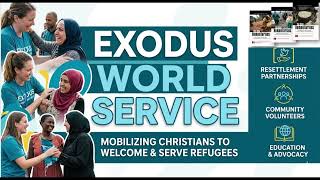
This content was created by Dr. Chris Stout. This content was uploaded by Dr. Chris Stout. This is a YouTube deep-dive episode titled "The New Humanitarians Volume III - Exodus World Service" (created 2026-03-11). Two hosts narrate an analytical discussion of source documents on Exodus World Service, examining the organization's hospitality-based approach to refugee resettlement—the Welcome to America pack, the New Neighbor Program, volunteer-centered design choices, stories illustrating social capital (the peanut story, Mohammed and Pat, James and Ellen, Beatrice), program tradeoffs (e.g., shutting down the Refugee Furniture Network), and their open-source scaling strategy. The conversation situates Exodus in the late-1980s resettlement landscape, contrasts transactional resettlement with relational welcome, and highlights practical lessons for volunteers and communities.
Chapters
Finding friends in America is like finding medicine in a refugee camp. Almost impossible.
Wow. That is— that is a gut punch of a quote to start with.
Yeah, it really stops you right in your tracks. It's actually from a refugee from Burma, and it's right there in the source material we are diving into today because Usually when you or I read about the refugee crisis in the news, what are we actually hearing about?
Well, it's mostly numbers, right? Borders.
Right.
Physical needs like food, tents, medical supplies.
Mm-hmm.
The basic stuff that keeps people alive.
Right. Survival.
Exactly.
But this deep dive is completely different. We are digging into this stack of documents about an organization called Exodus World Service, and their whole premise is that while food and shelter are obviously necessary, there is this massive gaping hole in the system that nobody talks about.
The emotional wound.
Yeah. The emotional wound of loneliness, the complete loss of a social network.
It's a fascinating case study because it forces us to look at the difference between resettlement, which is essentially a logistical process, and welcome, which is a fundamentally human one.
And the origin story here is just wild. It's classic startup lore, but for a nonprofit. We're going back to 1988. Picture an unfinished basement.
Oh yeah. 3 desks, 1 computer, and probably zero heating.
Basically, you have these 3 co-founders who had absolutely no business trying to solve a global crisis. The sources mentioned they didn't have big grants or government contracts. They literally pooled their own retirement savings just to keep the lights on for those first few months.
And context is everything here because in 1988, there were 13 million displaced refugees worldwide. 13 million. You had these 3 people in a basement going up against a problem of that magnitude, it's not just David and Goliath, it's David and the Goliath the size of a continent.
Right. And they weren't connected to the UN. They didn't know the president. So what was the actual mission? Because they clearly weren't trying to build another massive government agency from scratch.
No. And that's the key. They saw that the government agencies were doing something very specific, and they saw what those agencies couldn't do. Their goal was to mobilize ordinary people specifically tapping into local churches to offer hospitality to strangers.
But to get why that was such a radical idea at the time, we really have to look at how the system was broken, or maybe not broken, but just incomplete. Let's look at the landscape in the late '70s and '80s.
So the US State Department had a system in place. They contracted nonprofits to handle resettlement, but the mandate was incredibly narrow. The big buzzword was Economic self-sufficiency.
Which basically translates to get a job as fast as humanly possible.
Pretty much. The metrics for success were totally binary. Did you learn enough English to function on a factory floor? Did you get a job so you're off welfare? If yes, then success. Case closed.
It sounds incredibly transactional.
It was completely crisis-oriented. Funding went up and down like a yo-yo depending on how many people landed at O'Hare that month. And by the late '80s, you had this massive burnout. We call it compassion fatigue.
Oh, like the volunteers who had helped with the Vietnamese boat people years earlier were just exhausted.
They were totally done. So the agencies shifted gears. They stopped relying on volunteers and hired professional staff—caseworkers. Now, these caseworkers are heroes in their own right. They sign leases, they navigate the insane bureaucracy. But imagine you were a caseworker with 50, 60, maybe 100 families on your desk.
You definitely do not have time to come over for dinner.
You barely have time to return a phone call. You could help a refugee find a job at a factory, but you cannot replace the grandmother they left behind in a camp. You can't replace the village they grew up in.
That's the gap right there. You can be economically self-sufficient. You're paying your rent, buying your groceries, and still be the loneliest person in the city.
And what the research shows is that isolation is actually the biggest barrier to integration. If you don't know anyone, you never truly feel like you belong. You're just a ghost in the machine.
So enter Exodus World Service. They look at this landscape and say, we need a model that isn't tied to the government's panic cycle. They decide to— and I really love this term— productize hospitality.
That is the perfect way to put it. They didn't just guess what people wanted. They went out and surveyed 3,000 churches. They treated it like legitimate market research.
And the feedback was pretty blunt. People wanted to help. But they were terrified.
Fear is a huge paralyzer. People felt refugee ministry was this massive, heavy thing. They thought, I don't speak the language, I'm not a social worker, I don't have thousands of dollars, I'm gonna screw this up.
Plus, they were trying to appeal to a specific demographic shift happening at the time, the baby boomers. And the documents suggest boomers weren't looking for vague, endless commitments. Not at all.
They wanted a project, they wanted a start date, an end date, and a specific list of deliverables. They wanted to know exactly what success looked like before they signed up.
So Exodus invents the Welcome to America pack.
It's brilliant design, really. It's a starter kit for an apartment: bedding, pots, pans, rice, flour. It costs a group about $500 to put together, and it takes maybe 6 weeks to collect everything.
But here is where the friction comes in, and I want to dig into this because it seems so inefficient. The rules stated that the group collecting the stuff had to deliver it personally. Yes, that was non-negotiable. Now, if I'm a resettlement agency, I'm thinking, just drop it off at the loading dock. We have trucks. We can distribute this way faster than you can.
And the agencies did say that. They wanted the goods. They didn't necessarily want the amateur volunteers cluttering up their highly efficient process. But Exodus drew a hard line in the sand. They insisted on personal delivery right to the refugee family's new apartment.
Why fight that battle, though? It seems like it just makes things harder for everyone.
Because if you drop it at the loading dock, it's a transaction. It's just logistics. But if you walk into someone's living room and physically hand them a pillow, it's a relationship. It forces a human connection.
There's a story in the notes that captures this perfectly.
It's the peanut story. Oh, this one gets me every single time.
So a volunteer family goes to deliver a welcome pack to a Sudanese family. They bring their 6-year-old son along. Now picture this apartment. It's probably bare. This Sudanese family has just arrived. They likely have almost nothing to their name.
And there's that awkwardness, right? The adults are trying to communicate, maybe using some basic hand gestures, but the kids don't care about language barriers. You're right, exactly.
The 6-year-old American boy and the refugee boy just start playing. They're running around having fun. And when it's time to leave, the refugee boy stops them. He wants to give a gift.
But he has nothing. He literally just got here.
He goes to his little stash and pulls out a small bag of airline peanuts, the ones he saved from the flight over. It is the only possession he has in the entire world, and he gives it to the volunteer's son.
It creates a complete inversion of the power dynamic. The wealthy American family thought they were the benefactors. They thought they were the saviors bringing the stuff.
But in that moment, they are the ones receiving this incredible act of generosity.
That is the Exodus insight. That moment right there, it completely changes the volunteer. You can't walk away from that feeling like you just completed a checklist. You walk away feeling like you actually met a person.
But a bag of peanuts and some new bedding doesn't solve loneliness forever. You drop off the pack, you go home. How do you scale that into an actual lasting friendship?
That was the next major hurdle. The data showed that while the welcome pack was a great icebreaker, it didn't naturally lead to hanging out next Tuesday. Volunteers didn't know the rules. They'd think, "Can I call them? Is it that weird?
What if I say the wrong thing?" So they created the New Neighbor Program, a highly structured 3-month visitation program. And the design choices here are really interesting, specifically where they meet.
Always in the refugee's home.
Why is that so critical? Two reasons.
Practically, refugees rarely have cars, so it solves a huge transportation issue. But psychologically, it's all about power. If a refugee comes to your nice suburban house, they are the guest. They are looking at your big TV and your nice furniture, and the gap between you feels absolutely enormous. You're the host, they are the recipient. Exactly. But if you go to their apartment, they are the host. They serve you tea, they offer you a chair. It restores dignity. It empowers them in a system that usually strips them of all their power.
And what about the time commitment? The sources say the refugees wanted volunteers for a year or two, but the volunteers wanted less.
Exodus set it at 3 months. It was a calculated bet. They figured, we can get a baby boomer to commit to 90 days, and they bet that by the end of those 90 days, the friendship would be real enough that they wouldn't need a contract to keep seeing each other.
And that bet paid off. I want to talk about Mohammed and Pat because this story illustrates something the experts call social capital, which sounds super boring, but in practice, it's completely life-changing.
It's the difference between what a government can do and what a friend can do. Mohammed was a Somali Bantu refugee, and tragically, he had lost his sight while waiting in a refugee camp.
So he arrives in Chicago totally blind in a city he doesn't know at all, and Pat is just A volunteer. He's not a doctor, he's not a social worker, he just signed up to visit.
Just a guy, probably expecting to help with some English phrases or explain how the bus system works. But over time, they build trust, real trust. Yeah. And Mohammed finally confesses his deepest fear to Pat.
He says, "I don't know how I'm gonna survive in America as a blind man." Now if Pat was a caseworker, he'd probably just file a form for disability benefits, maybe get him a cane.
Right. But Pat isn't a bureaucrat. Pat is a neighbor. He has a network. He goes back to his community, his social capital, and starts asking around.
"Hey, does anyone know an eye doctor?" And it triggers this amazing chain reaction. He finds a friend who knows a specialist. That doctor agrees to a free consultation. Then they need an anesthesiologist. Pat finds one. Then they need an operating room. The hospital just donates it.
This is the network effect in action. The government could never have organized that. It would have been impossible amounts of red tape. But a friend calling a friend, that actually works. And the result? Pat was right there when the bandages came off. Mohammed saw his wife and children for the first time in years.
That honestly gives me chills. It's the profound difference between providing services and weaving a social fabric. But—
and this is a big— but getting to that level of connection required Exodus to make a really controversial decision. And this is where the business side of the nonprofit world gets a little thorny. The boardroom debate.
I read this section in the source material 3 times because it seemed entirely backwards to me.
It's what they called the trilemma. They realize they have 3 customers with completely competing needs. 1, the refugee who desperately needs support. 2, the resettlement agency who needs speed and efficiency. And 3, the volunteer who needs a meaningful, safe experience.
Okay, so they sit down to decide who the primary customer is, the one they design the whole organization around. I'm assuming since they are a humanitarian aid group, the answer is the refugee. You would assume that. Yeah.
But the board decided their primary customer is the volunteer.
Okay, hold on. I have to push back on that. That sounds almost cynical, maybe even selfish. You're telling me they prioritized the suburban mom with the minivan over the family fleeing a war zone?
It sounds terrible when you say it like that. And let me tell you, the internal fight was massive. The program staff, the social workers on the ground hated this idea. They argued that pampering volunteers was a huge distraction from the actual mission.
So why did the board push it through?
Because they looked at the churn rate. They realized that if a volunteer feels overwhelmed, unsafe, or useless, they quit. And if they quit, they never come back. And if they don't come back, no refugees get help long term.
So it's basically the put your own oxygen mask on first theory. Exactly.
They realized the volunteer is the engine. If you don't maintain the engine, the car doesn't go anywhere. Even if it annoyed the agencies, and it did annoy them, the agencies just wanted the stuff. Exodus said, no, we are optimizing for the volunteers' emotional buy-in.
And they actually had a program that failed because they ignored this rule, right?
The RefNet story. The Refugee Furniture Network. This is a classic case study in mission drift.
But on paper, it looked like a massive success. They were moving tons of furniture.
Who doesn't need a couch? Logistically, it was a machine. They had trucks, drivers, warehouses. They were filling apartments at record speed. If you looked at the spreadsheet, it was a total home run. So why kill it? Because they looked at the human experience. The volunteers, the guys driving the trucks, were absolutely exhausted. They were hauling sleeper sofas up 3 flights of stairs in Chicago summers. They were sweating. They were stressed.
They were in a rush. So they definitely weren't drinking tea with the refugees. They didn't have time.
It became purely transactional. They dumped the couch, wiped their brow, and rushed to the next stop. The refugees felt like charity cases receiving a handout from a delivery service, and the volunteers felt like free movers. Nobody was making a friend, right? So Exodus shut it down. They looked at a program that was working logistically and killed it because it failed the relational mission. That takes serious guts. Most nonprofits live and die by metrics like tons of furniture moved.
That is a level of discipline you rarely see. It really proves they were serious about transformation over transaction.
And that transformation goes deep. It's not just about liking each other. It's about basically becoming family.
Which brings us to James and Ellen. They were refugees from Liberia.
They had been married in a refugee camp, but you can imagine what that was like. Pure survival mode. Ellen always dreamed of having a real wedding.
So the volunteer team didn't just buy them a toaster. They threw them the wedding. The dress, the cake, live music.
But the detail that really matters isn't the party itself. It's the pearls. Ellen wore the pearls that one of the volunteers had worn at her own wedding.
That's heavy. That's not something you lend to a client. That's something you lend to a sister.
It signifies deep inclusion. And Exodus actually started measuring this. They moved away from counting towels and started tracking what they called the 7 Traits of a Refugee Champion.
I saw that list in the documents. Some seem pretty obvious, like advocacy. But there are two that stood out to me as really difficult: Lifestyle and Recruitment.
Lifestyle's the hardest one by far.
It asks, "Has your life actually changed to accommodate this new person?" What does that look like practically for you and me?
It's about inconvenience. Let's say you love your Tuesday night spin class. It's your me time. But your refugee friend works the night shift, and Tuesday evening is the only time they can get help reading their mail from the electric company. Do you skip the class?
That's a real cost. It's not just writing a check at the end of the year.
It's integrating them into your rhythm. It's changing where you shop for groceries so you can drive them. It's making space in your life, not just your schedule.
And what about recruitment?
That's the multiplier effect. A true champion doesn't just do the work; they bring others along. Exodus realized that one enthusiastic volunteer who brings in three skeptical friends is worth more than 10 grants. It's about spreading the virus of hospitality.
And eventually, this evolves into the refugees themselves taking the lead. The Refugee Bridge Group.
This is the maturity model right here. Exodus started training refugees to speak to school boards, to talk to county officials. They shifted from being people who needed help to people who influence policy.
Going from needing a blanket to telling the school board how to properly teach English as a second language.
Exactly. They became the experts in the room.
I wanna zoom out for a second on the organizational structure. Right. Because usually if you have a model that works this well, the welcome packs, the training, you franchise it, you open Exodus New York, Exodus LA, Exodus London. That's the standard McDonald's model.
Mm-hmm. Rigid control, central ownership. But they didn't do that. No, they didn't. They went open source. Think of it like the Linux operating system. They took all their intellectual property, their training manuals, their Bible studies, like entertaining angels, their how-to guides, and they just gave it away. Are free. For free. To churches in South Africa, the UK, Sri Lanka. They essentially said, here's what we learned. Go do it your way in your specific context.
That's incredibly risky. You lose complete control of the brand.
You do, but you maximize the impact. They chair this thing called the Refugee Highway Partnership. It's a global network. It connects all these disparate groups so they can learn from each other. But Exodus doesn't have to pay for a massive headquarters or manage staff. In 50 countries. It's a very modern, almost tech sector approach to scaling impact without scaling overhead.
So bringing this all back home for the person listening to this right now, maybe you're driving to work, maybe you're doing the dishes. Why does this matter to you?
I think it challenges the great man theory of history. We are trained to wait for a hero. We wait for a president to sign a bill or a billionaire to write a check or a UN resolution to solve the crisis.
We just assume the problems are way too big for us.
But Exodus suggests that the solution to a global geopolitical crisis might actually look like a $500 welcome kit and a bag of peanuts. It breaks the problem down to a size where you can actually do something about it.
It's about the on-ramp.
The welcome pack is just an excuse. It's a mechanism to get you to walk through the door of a stranger's apartment. Once you cross that threshold, the transformation happens.
There's a final image from the source material that really stuck with me. It's about a woman named Beatrice from Rwanda.
Beatrice had been through hell. She lost her husband in the genocide. She arrived here carrying a mountain of trauma.
And after a group of volunteers, just normal, probably slightly awkward people, filled her apartment and hung out with her, she stood up and she said, "Today, for the first time, I have forgotten my sadness." That is the only metric that actually matters.
Not economic self-sufficiency, but the ability to forget your sadness even for an hour.
We started this deep dive with a quote about finding medicine, so I want to end with one about fire. Gilbert Tuhabonye, a Burundian genocide survivor mentioned in the text, said, "It is easy to light a fire and difficult to extinguish it." That is the real challenge for you listening today.
What is the spark you can strike? You don't have to fix the US immigration system. You just have to say yes. To one small, uncomfortable act of hospitality.
Step out of the comfort zone, drop the volunteer label, and just be a neighbor.
And you might find that in the end, you needed them just as much as they needed you.
Which brings up a really provocative thought to leave you with. We spend so much time analyzing how to cure the loneliness of the refugee, but what if our own hidden epidemic of loneliness here in the West isn't something we have to fix before we can help? But is actually the very thing that connects us to them? What if a shared need for connection is the real foundation of hospitality?
That completely flips the script on who is helping who. Something for you to chew on today.
That's it for this deep dive into Exodus' world service. Thanks for joining us. Thanks for listening.
More from Dr.

2025 Mercedes-Benz CLE 450 4Matic Cabrio – Owner’s Views After a Year-and-a-Half as a Daily Driver

The Complete Guide to a Successful Everest Base Camp Trek – Post-Trek Debrief

The Complete Guide to a Successful EBC Trek – Post-Trek Debrief: What I Needed (and What I Didn’t)

What Went Wrong Customizing My New 2026 Porsche Carrera T …and what I did about it!

Coming May 1 At the Intersection of High Performance and Fulfillment: A Conversation with Alisa Cohn

From High Performance to Fulfillment: Lessons in Inner Mastery with Jim Murphy

Coming March 19: From High Performance to Fulfillment: Lessons in Inner Mastery with Jim Murphy

The New Humanitarians Volumes I - III:- Inspiration, Innovation, and Blueprints for Visionaries

The New Humanitarians Volumes I - III:- Inspiration, Innovation, and Blueprints for Visionaries

The New Humanitarians Vol I - III: Inspiration, Innovation, and Blueprints for Visionaries - Forward
