The New Humanitarians Volume III - Introduction to Volume III
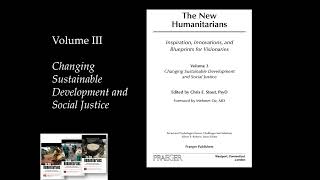
Dr. Chris Stout introduces Volume III by surveying fourteen humanitarian and human-rights organizations, from Witness to Amnesty International to the Southern Poverty Law Center. He draws on his own encounters with these groups, from a Chicago museum to Northern Ireland to Davos, to show how they document abuses, protect civilians, and push for policy change. The throughline: changing individual lives as the path to changing the world.
Chapters
Volume 3: Changing Sustainable Development and Social Justice. Witness, founded in 1992. I first saw some of the work of Witness at the Contemporary Museum of Art in Chicago, and I was quite disturbed and moved by the images I saw, which was the point. I then contacted Gillian Caldwell of Witness about this book project, and And I got the distinct impression that she wondered, "Who is this guy, and is he on the level?" So with some emails back and forth, and the good timing of the World Economic Forum's annual meeting, where she happened to be going, I gained some street cred with her as I had been an invited faculty, gone to Davos a number of years, and knew Klaus Schwab, who had also written the foreword to one of my other books. She then let me into the tent. And I'm very glad she did. Witness does incredible work by using video and online technologies to open the eyes of the world to human rights violations. It empowers people to transform personal stories of abuse into powerful tools for justice, promoting public engagement and policy change. It envisions a just and equitable world where all individuals and communities are able to defend and uphold human rights. The Community Relations Council, founded in 1986. I worked on a 3-volume book set, The Psychology of Resolving Global Conflicts: From War to Peace, published by Prager in 2005 with Mary Fitzduff, PhD, and I had no idea of the violence she was exposed to in Belfast as a child growing up there. Now it makes perfect sense as to her development of the Community Relations Council. Its aim is to assist the people of Northern Ireland to recognize and counter the effects of communal division. The Community Relations Council originated as a proposal of a research report commissioned by the NI Standing Committee, Northern Ireland, on Human Rights. The Community Relations Council was set up to promote better community relations between Protestants and Catholics in Northern Ireland and equally to promote recognition of cultural diversity. Its strategic aim is to promote a peaceful and fair society based on reconciliation and mutual trust. It does so by providing support, finance, training, advice, information for local groups and organizations developing opportunities for cross-community understanding, increasing public awareness of community relations work, and encouraging constructive debate throughout Northern Ireland. Amnesty International, founded in 1961. Amnesty International, AI's vision is of a world in which every person enjoys all of the human rights enshrined in the Universal Declaration of Human Rights and other international human rights standards. In pursuit of this vision, AI's mission is to undertake research and action focused on preventing and ending grave abuses of the rights to physical and mental integrity, freedom of conscience and expression, and freedom from discrimination within the context of its work to promote all human rights. Amnesty International has a varied network of members and supporters around the world. At latest count, there are more than 1.8 million members, supporters, and subscribers in over 150 countries and territories in every region of the world. Although they come from many different backgrounds and have widely different political and religious beliefs, they are united by a determination to work for a world where everyone enjoys human rights. Peacework Foundation and One Voice, founded in 2002. Daniel Lubetzky is one of those incredible people who turn on a room when they enter it. He does so not with bravado and brashness, but rather with a quiet power that captures those around him. He's a compelling person with a compelling mission. He founded One Voice with the aim to amplify the voice of the overwhelming but heretofore silent majority of Israelis and Palestinians who wish to end the conflict. Since its inception, One Voice has empowered ordinary citizens to demand accountability from elected representatives and to ensure the political agenda is not hijacked by extremists. One Voice works to reframe the conflict by transcending the left versus right and Israeli versus Palestinian paradigms, and by demonstrating that the moderate majority can prevail over the extremist minority. Although the needs and concerns of the Israeli and Palestinian peoples are different—Israelis wish to end terror and the existential threat to Israel, Palestinians wish to end the occupation and achieve independence, independent Palestinian state. The vast majority on each side agrees that these goals are achievable only by reaching a two-state solution. One Voice is unique in that it has independent Israeli and Palestinian offices appealing to the national interests of their own sides, with credentials enabling them to unite people across the religious and political spectrum. It recognizes the essential work many other groups do in the field of dialogue and understanding, but One Voice is action-oriented and advocacy-driven. It is about the process and demanding accountability from its members and from political leaders. A peace movement, no matter how comprehensive, will be ineffective without populations ready to support it. The focus is on giving citizens a voice, and a direct role in conflict resolution. Nonviolent Peaceforce, founded in 1998. Nonviolent Peaceforce is a federation of more than 90 member organizations from around the world. In partnership with local groups, unarmed Nonviolent Peaceforce field team members apply proven strategies to protect human rights, deter violence, and help create space for local peacemakers to carry out their work. The mission of the Nonviolent Peaceforce is to build a trained international civilian peace force committed to third-party nonviolent intervention. Peace Brigades, founded in 1981. Peace Brigades International (PBI) is an NGO that protects human rights and promotes nonviolent transformation of conflicts. When invited, it sends teams of volunteers into areas of repression and conflict. The volunteers accompany human rights defenders, their organizations, and others threatened by political violence. Perpetrators of human rights abuses usually do not want the world to witness their actions. The presence of volunteers backed by a support network helps to deter violence. They create space for local activists to work for social justice and human rights. Witness for Peace, founded in 1983. Witness for Peace is a politically independent, nationwide grassroots organization of people committed to nonviolence and led by faith and conscience. Witness for Peace's mission is to support peace, justice, and sustainable economies in the Americas by changing U.S. policies and corporate practices that contribute to poverty and oppression in Latin America and the Caribbean. Southern Poverty Law Center, founded in 1971. Throughout its history, the Center has worked to make the nation's constitutional ideals a reality. The Center's legal department fights all forms of discrimination and works to protect society's most vulnerable members, handling innovative cases that few lawyers are willing to take. Over 3 decades, it has achieved significant legal victories, including landmark Supreme Court decisions and crushing jury verdicts against hate groups. Human Rights Campaign, founded in 1980. After serving as a federal advocacy coordinator for the Hill, or on the Hill, for the American Psychological Association for 12 years, and at the state level for even longer, I have come to know and very much appreciate the twists and turns of lawmaking and the body politic. I also have come to know and respect the impressive work of those in the Human Rights Campaign, HRC. They have evolved from battling stigma to being a political force to contend with, no easy task in the Beltway or on Main Street, USA. The Human Rights Campaign is America's largest civil rights organization working to achieve gay, lesbian, bisexual, and transgender equality. By inspiring and engaging all Americans, HRC strives to end discrimination against GBLT citizens and realize the nation achieves fundamental fairness and equality for all. HRC seeks to improve the lives of LGBTQ Americans by advocating for equal rights and benefits in the workplace, ensuring that families are treated equally under the law, and increasing public support among all Americans through innovative advocacy, education, and outreach programs. HRC works to secure equal rights for LGBTQ individuals and families at the federal and state levels by lobbying elected officials, mobilizing grassroots supporters, educating Americans, investing in strategy to elect fair-minded officials, and partnering with all other LGBTQ LGBTQ organizations. Global Security Institute, founded in 1999. Back in the late 1990s, as a member of Psychologists for Social Responsibility and living in Chicago, I was asked to represent that organization at a meeting called Abolition 2000. The goal of that group was to have abolished nuclear weapons by the year 2000. I had the chance to meet its founder, the late Senator Alan Cranston, and I was smitten. That movement evolved into the organization Jonathan Grandoff now leads, known as the Global Security Institute. It is dedicated to the strengthening of international cooperation and security based on the rule of law, with a particular focus on nuclear arms control, nonproliferation, and disarmament. GSI was founded by Senator Alan Cranston, whose insight was that nuclear weapons are impractical, unacceptably risky, and unworthy of civilization, and continues to inspire GSI's efforts to contribute to a safer world. GSI has developed an exceptional team that includes former heads of state and government, distinguished diplomats, effective politicians, committed celebrities, religious leaders, Nobel Prize laureates, disarmament and legal experts, and concerned citizens. Search for Common Ground, founded in 1992. I first had the pleasure of meeting Susan Marx in Davos at a breakfast meeting in which we were co-facilitating a discussion. I could not keep up with her. She had us all enthralled with her perspective and experiences and I was astonished. She and her husband John started the Search for Common Ground, a vehicle to transform the way the world deals with conflict, away from adversarial approaches toward cooperative solutions. Although the world is overly polarized and violence is much too prevalent, they remain essentially optimistic. Their view is that, on the whole, history is moving in a positive direction. Although some of the conflicts currently being dealt with may seem intractable, There are successful examples of cooperative conflict resolution that can be looked to for inspiration, such as South Africa, where an unjust system was transformed through negotiations and an inclusive peace process. Project on Justice in Times of Transition, founded in 1992. Mary Fitzduff introduced me to Timothy Phillips in the context of working on his project, and needless to say, I was taken aback by their work. The Project on Justice in Times of Transition brings together individuals from a broad spectrum of countries to share experiences in ending conflict, building civil society, and fostering peaceful coexistence. It currently operates in affiliation with the Foundation for Civil Society in New York and the Institute for Global Leadership at Tufts University. Since its creation in 1992 by co-chairs Wendy Lowers and Timothy Phillips, the project has conducted more than 50 programs for a variety of leaders throughout the world and has utilized its methodology to assist them in addressing such difficult issues as demobilization of combatants, the status of security files, police reform, developing effective negotiating skills, political demonstrations, and preserving or constructing the tenets of democracy in a heterogeneous society. Through its innovative programming, the project has exposed a broad cross-section of communities in transition to comparable situations elsewhere and has contributed to the broadening of international public discourse on transitional processes. In recent years, the project has conducted programs that have helped practitioners and political leaders strategize solutions in a variety of countries and regions, including Afghanistan, Colombia, East Timor, Guatemala, Kosovo, Northern Ireland, Palestine, and Peru. Exodus World Service, founded in 1998. Heidi Moll was cheering my son and me on last fall in a 5-kilometer run that was a fundraiser for Exodus World Service and other agencies. I first came to know of their refugee work via a church that we used to attend, and it was remarkable. Exodus World Service transforms the lives of refugees and of volunteers. It educates local churches about refugee ministry, connects volunteers in relationship with refugee families through political service projects, and equips leaders to speak up on behalf of refugees. The end result is that wounded hearts are healed, loneliness is replaced by companionship, and fear is transformed into hope. Exodus recruits local volunteers, equips them with information and training, and then links them directly with refugee families newly arrived in the Chicago metropolitan area. It also provides training and tools for frontline staff of other refugee service agencies. In addition, Exodus has developed several innovative programs for use by volunteers in their work with refugees. International Institute for Sustainable Development, founded in 1990. The International Institute for Sustainable Development (IISD) contributes to sustainable development by advancing policy recommendations on international trade and investment, economic policy, climate change measurement and assessment, and natural resources management. By using internet communications, It is able to report on international negotiations and broker knowledge gained through collaborative projects with global partners, resulting in more rigorous research, capacity building in developing countries, and better dialogue between North and South. IISD is in the business of promoting change towards sustainable development. Through research and thorough, effective communication of their findings, It engages decision makers in government, business, NGOs, and other sectors to develop and implement policies that are simultaneously beneficial to the global economy, to the global environment, and to social well-being. IIISD also believes fervently in the importance of building its own institutional capacity while helping its partner organizations in the developing world. Let's get going. I hope you enjoy learning more about these amazing individuals and their work. I certainly have enjoyed working with them and in completing this remarkable writing project. They all have the common denominator of changing people's lives, and isn't that truly the way to change the world?
More from Dr.

2025 Mercedes-Benz CLE 450 4Matic Cabrio – Owner’s Views After a Year-and-a-Half as a Daily Driver

The Complete Guide to a Successful Everest Base Camp Trek – Post-Trek Debrief

The Complete Guide to a Successful EBC Trek – Post-Trek Debrief: What I Needed (and What I Didn’t)

What Went Wrong Customizing My New 2026 Porsche Carrera T …and what I did about it!

Coming May 1 At the Intersection of High Performance and Fulfillment: A Conversation with Alisa Cohn

From High Performance to Fulfillment: Lessons in Inner Mastery with Jim Murphy

Coming March 19: From High Performance to Fulfillment: Lessons in Inner Mastery with Jim Murphy

The New Humanitarians Volumes I - III:- Inspiration, Innovation, and Blueprints for Visionaries

The New Humanitarians Volumes I - III:- Inspiration, Innovation, and Blueprints for Visionaries

The New Humanitarians Vol I - III: Inspiration, Innovation, and Blueprints for Visionaries - Forward
