The New Humanitarians Volume III - Nonviolent Peaceforce
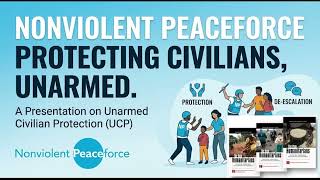
In this two‑host dialogue, Dr. Chris Stout explores the Nonviolent Peaceforce (NP) as a realistic, professionalized alternative to militarized interventions. The episode opens with a vivid grenade attack in a Sri Lankan village, showing how two NP field team members saved a victim and sparked a community‑wide public stand against terror. The hosts then trace NP’s origin: founder Mel Duncan’s spiritual fellowship, his encounter with Thích Nhất Hạnh, and the parallel vision of David Hartshaw, culminating in NP’s 2002 launch. They detail NP’s operational model – strict neutrality, a 15‑member international governance council, six‑week intensive training, two‑year paid deployments, and a funding structure that covers stipends, insurance, and logistics while costing a fraction of military deployments. Recruitment data reveal a global pool of applicants (55 countries, 10:1 competition). The conversation moves to field case studies in Guatemala (2007 accompaniment of human‑rights defenders), the Philippines (Mindanao cease‑fire support), Sri Lanka (large‑scale civilian protection), Colombia (indigenous peace communities), and Uganda (LRA‑affected areas), illustrating tactics such as visible unarmed presence, conflict mapping, and strategic communication that alter combatants’ risk‑reward calculus. Across these contexts, the hosts synthesize key insights: isolation fuels violence; women are often the primary grassroots peacemakers; NP’s role is to provide a protective shield that enables local actors to act. Finally, they contemplate the strategic implication of scaling civilian peacekeeping funding to match military budgets, arguing that such a shift could fundamentally reshape global conflict dynamics. The episode concludes with a call to re‑imagine peace as an active, coordinated, professional effort rather than a passive absence of war.
Chapters
Picture this. You are— you're in a small village in Sri Lanka. It's night, right? A man is walking down the street alone, and suddenly a second man approaches on a bicycle. Completely unprovoked, the cyclist throws a hand grenade at the pedestrian. The grenade explodes, critically injuring the man, and the cyclist just inconspicuously rides away into the dark like absolutely nothing has happened.
Just completely disappears.
Exactly. Now, in a terror-stricken community, fear usually takes over right at this point. That fear locks civil society into this desperate, terrified silence. Doors are bolted.
People just hide.
Nobody comes out of their homes. No one comes to help the helpless, bleeding man in the street.
Because that is the brutal, paralyzing reality of violence.
Yeah.
It relies on that isolation to thrive. The perpetrators are really counting on the fact that terror will isolate the community members from one another.
Mm-hmm. But on this particular night, the story takes a very different turn. Two field team members from an organization called the Nonviolent Peace Force happen to be nearby. They hear the explosion, they see the man lying in the street, and without a second of hesitation, they run directly toward the danger.
Which is incredible.
They rush to his aid, they manage to get him to a hospital in time, and they actually save his life. But what happens the very next night is what really changes the fabric of this community.
Yeah, the aftermath.
The residents of that village, the same exact people who would normally be locked away in fear, actually march through the streets. They celebrate the man's survival, and they publicly commit to standing united, just flat out refusing to succumb to their individual fears. It's this literal first step in rebuilding their local society.
And that reaction completely flips the script—
Right.
—on how we assume people have to respond to terror. It breaks the intended psychological effect of the grenade attack.
Which is exactly the dynamic we are exploring in our deep dive today. We are looking at the mechanics, the history, and really the sheer audacity of stepping into a war zone completely unarmed using the strategies outlined in the document, Nonviolent Peace Force: A Realistic Choice for the Future.
It's such a fascinating source.
Our mission today is to understand how this isn't just some, you know, feel-good concept, but a highly structured, realistic choice for future conflict resolution.
If we connect this to the bigger picture, you really have to look at the massive failures of the international community during the 20th century. Right. Think about the devastating armed conflicts and genocides in places like Kosovo and Rwanda. Often, the world just chose not to respond at all until it was far, far too late.
Or they sent in the military.
Exactly. If there was a response, it typically took the form of a massive militarized intervention. Both of those responses, silence or eventual military force, led to untold human misery. But there is a staggering estimate regarding the violence and genocide that devastated Yugoslavia in 1998. The numbers on this are wild. They are. Analysts suggest that as few as 1,000 people actively trained in nonviolence and strategically deployed could have prevented that atrocity. Wow.
1,000 people. Okay, let's unpack this, because when you hear a number like 1,000 people standing between peace and a literal genocide, it forces you to question why an organized unarmed force hasn't always been a standard global utility. It seems like such an obvious tool to have. Right. To understand how this idea actually took shape, you have to look at the origin story of the Nonviolent Peaceforce, or NP. It starts with its founder, Mel Duncan. Back in 1997 and 1998, Mel was on a fellowship studying the connections between grassroots organizing and spirituality. Right. He was looking at peace, justice, environmental movements, but he was hitting a wall. He found himself stuck in this dualistic, us versus them, right versus wrong mindset.
Which is how almost all traditional activism is framed. You identify an enemy, you label them the bad guy, and you fight them. It's a very combative approach to peace, which is inherently paradoxical when you think about it.
Exactly. So Mel's fellowship eventually leads him to a Buddhist monastery in southern France. Where he meets the renowned Vietnamese monk Thích Nhất Hạnh.
A legendary figure.
Yeah. And Thích Nhất Hạnh completely challenges Mel's worldview. He introduces him to the idea of unity, abandoning those strict dichotomies. And the most profound thing he tells Mel is this: "The human race is no longer in a place in history that takes sides." That is a massive paradigm shift.
It completely removes the adversarial nature of conflict resolution. You aren't there to defeat the bad guy; You are there to transcend the sides entirely and focus strictly on the preservation of human life and human dignity.
And that idea just takes root in Mel's brain. He goes back to the US, becomes a professor at the University of Minnesota, but he's constantly sketching out this vision for a literal international nonviolent peace force.
He couldn't let it go. He couldn't.
His wife finally tells him to stop just thinking about it and go for it. So he targets the 1999 Hague Appeal for Peace Conference.
Oh, right. The huge peace conference. Huge.
The whole goal of that conference was to eliminate war in the 21st century. So Mel scrapes the money together, finds a free place to stay, and goes, fully intending to launch his big idea right there.
Though bringing a philosophical idea from a quiet monastery into a massive international policy conference is quite a leap. And the reality of that conference was entirely chaotic. Absolute chaos.
They were expecting 5,000 people and 9,000 showed up. Wow. The background noise in the venue was so impenetrable that Mel later said even if he stood on a chair and yelled at the top of his lungs, no one would have heard him. That's incredibly discouraging. He feels totally defeated. He calls his wife that night, ready to pack it in and just go home, and she wisely tells him to keep his patience and just listen quietly. Good advice. Really good advice. So the next day, he's crammed into a room, literally wedged against the back wall, completely stuck in the crowd. And right there Over the noise, he hears another man talking to people about the exact same vision.
The exact same idea.
A large-scale international nonviolent peace force. So Mel pushes through the crowd, grabs the guy by the arm, and says, "If you're serious about what you just said, then we have to start organizing." And the man he grabbed was David Hartshaw.
What's fascinating here is the sheer synchronicity of it. Yeah. Mel Duncan was conceptualizing this grand idea while sitting in the tranquility of a Buddhist monastery in southern France. David Hartshaw, on the other hand, conceptualized the exact same idea while sitting in a Serbian jail cell, having just been arrested for administering nonviolence training to Albanian students. Talk about different environments! Right. The synthesis of those two experiences—the spiritual unity from the monastery and the gritty, dangerous reality of the jail cell—became the operational foundation of the organization. By December 2002, the Nonviolent Peace Force officially launched.
So what does this all mean in practice? It's a beautiful origin story, sure, but translating a philosophy from a monastery into a functional machine inside an active war zone requires a completely different anatomy. Absolutely. They couldn't just rely on good intentions. They had to build a highly specific structure. We know they aren't a military, but they also aren't just a passive NGO handing out food and medical supplies either.
The operational framework of NP is really what sets it apart. First, as we established from Fitch Nathan's influence, they do not take sides. Right. Their goal is not to declare a winner or litigate the historical grievances of the conflict. Yeah. They are there to create physical and emotional space between parties so those parties can de-escalate, discuss their differences, and reach their own solutions. Which is so crucial. Second, they are uniquely international from the top down. They're governed by a 15-member international governance council with representatives from every inhabited continent.
That's a huge logistical It is.
This includes people like Omar Diop, who brings 30 years of teaching and union organizing experience in Senegal, and Israel Naior, a civil engineer from Israel who survived the Holocaust as a child. It is a wildly diverse, highly experienced brain trust.
Wait, I want to push back on that first point for a second. How do you actually operationalize neutrality when you are standing in a war zone and one side is clearly the aggressor committing atrocities against civilians? Civilians. That has to be psychologically agonizing for the peacekeepers on the ground.
It is incredibly difficult, which is exactly why the professionalization of the force is so critical. Neutrality doesn't mean moral indifference to suffering; it means operational impartiality.
Ah, I see the distinction.
If a peacekeeper takes a side, they become a combatant in the eyes of the aggressor, and they lose their access and their protective power. Their singular mandate is civilian protection. By remaining strictly nonpartisan, they maintain the ability to speak with armed actors on all sides. They aren't there to judge the warlords. They are there to change the warlords' immediate behavior toward the civilians.
Which obviously requires an immense amount of specialized training. This isn't just a weekend volunteer retreat where people get a t-shirt and a pamphlet. NP set out to create a permanent, large-scale, paid team of professionals.
These field team members undergo 6 weeks of intense, hands-on training before deployment. We're talking about deep education in the local languages, the specific cultural nuances of the area, and exhaustive conflict mapping.
They really have to know the landscape.
Down to the smallest detail. They learn the psychological tactics of de-escalation and how to physically position themselves in volatile crowds. And it requires— A real commitment, a 2-year tour of duty. Wow, 2 years! Yes. They are paid a per diem that allows them to live exactly at the community level alongside the people they are protecting.
We also have to talk about the financial reality of this. Providing this level of training, a living stipend, and crucially death and injury insurance for these peacekeepers costs money. It does. They are acknowledging the severe risk involved, and building that safety net requires funding, even though it is a tiny fraction of what a military deployment costs. You might wonder who on earth would sign up for a 2-year deployment to an active conflict zone without a weapon, knowing the risks are high enough to require specialized life insurance.
The demand to do this work is actually staggering. When you look at their recruitment drives, the numbers speak volumes. For one recent 18-person field team deployment, they had to abruptly cut off the application process. But why? Because they reached 10 highly qualified applicants for every single available position.
That is amazing. And those applicants came from 55 different countries: Canada, Colombia, Ghana, Pakistan, Germany. The data from these drives highlights this beautiful reality about human nature. It is not enough for people to just resist war passively. People want to actively create peace.
They want to do something tangible.
Yes, they want something to say yes to when they say no to war.
It proves that the desire to intervene nonviolently is a global phenomenon. It isn't just a Western concept or an isolated ideal; it's a deeply human urge that crosses all cultural boundaries.
Let's look at what this actually looks like when these professionals have boots on the ground. The case studies in the source material provide a masterclass in tactical de-escalation. They really do. Take Guatemala in 2007. At the time, this was a nation that had officially ended a 36-year civil war 11 years prior. But peace accords signed on paper in a distant capital don't always translate to peace on the streets. Violence, political assassinations, and total impunity still reigned. Human rights workers trying to document abuses were in constant mortal danger. So leading up to the national elections, NP sent a team of 4 accompaniers to physically stay with these local human rights defenders.
And the perception of what an accompanier is really shifted because of NP's methodology. There is a highly memorable insight from a member of a local women's rights group in Guatemala. I remember this quote: She noted that locals used to think an unarmed accompanier was basically just an extra burden. If an armed group wanted to assassinate you, they would just kill you and the well-meaning international volunteer too. She literally referred to the old style of passive accompaniers as a heavy bag you have to carry around.
That's so grim. You're trying to do your human rights work and now you have to babysit an international volunteer so they don't get hurt? Precisely.
But she pointed out that NP professionals are entirely different. Because of their extensive training in conflict mapping and political strategy, they are active participants, right?
They aren't just standing there.
No, they deeply understand the political dimension of the local conflict. They aren't just passive human shields hoping not to get shot. They act as a sounding board, a strategic partner, and a highly visible deterrent.
We see that same strategic integration in the Philippines, too. In the Mindanao region, there is a complex, decades-long conflict over economics and land rights. That has tragically cost over 120,000 lives. A devastating toll. Just to give you the brief context, this involves the Philippine government and the Moro Islamic Liberation Front, or MILF. The roots of this tension go all the way back to the historical marginalization of the indigenous Muslim populations during Spanish and US control of the region, which created massive land ownership disparities. The history there is so deep. It is. And despite a ceasefire signed in 1996, The fear of localized violence breaking out was huge.
In that volatile environment, NP didn't just drop in and try to take over. They sent international professionals to work hand in hand with the local peacekeepers who were already trying to monitor the ceasefire. They bolstered the safety and the authority of the locals who were already doing the exhausting daily work of conflict resolution.
That model of building local capacity is also evident when you look at the the sheer scale of the project in Sri Lanka, which we touched on with our opening story.
The scale there was massive. The civil war there was devastating.
Over 64,000 deaths and 1.6 million displaced people. Unbelievable numbers. NP deployed more than 50 staff members there, deliberately split between local peacekeepers and international professionals.
What's crucial to understand about the Sri Lanka deployment is that the work is guided strictly by the local agenda. They don't swoop in with a Western savior complex to dictate terms or force a specific democratic model. Their stated goal is simply to reduce the barriers to civilian involvement in peace work. They create a secure physical space so the locals can build the peace.
They are also constantly analyzing upcoming deployments based on requests for help from vulnerable populations.
Yes, like in Colombia, for example, they focus on protecting indigenous peace communities. Tell us about those. These are local communities struggling to maintain strict neutrality while geographically caught between government forces, paramilitary groups, and guerrilla factions. These civilians face intense psychological pressure, juridical threats, and outright military violence from all sides trying to force their allegiance.
A completely impossible situation.
Right. So MP provides a protective international presence to link those isolated local workers directly to the global community, making it much harder for armed groups to commit abuses. In secret.
Another incredibly heavy deployment involves Uganda, addressing the devastation caused by the Lord's Resistance Army, or the LRA.
This one is particularly harrowing. It really is.
This is a conflict that displaced up to 2 million people and involved the forced abduction of an estimated 25,000 children who were brutalized and forced to become child soldiers.
Archbishop John Baptist Odama of Gulu described the 20-year civil conflict with a haunting phrase. He called it a war that now has grandchildren.
A war that now has grandchildren.
That is powerful. It perfectly encapsulates how cyclical and entrenched violence becomes when generations are born into nothing but conflict. As those displaced citizens and former child soldiers slowly attempt to return to their homesteads, the potential for vengeance and retaliation is astronomical. Naturally, NAP recognize that unarmed civilians trained specifically in trauma psychology and conflict resolution would be essential to monitor that fragile reintegration process and physically intercede to prevent retaliatory violence.
So when we look across all these radically different cultures, histories, and conflicts— Guatemala, the Philippines, Sri Lanka, Colombia, Uganda— what does the data actually tell us? What are the tactical lessons learned from the field about how human beings process conflict?
What's fascinating here is that the primary synthesis of NP's research reveals a fundamental truth. Nobody can make anyone else's peace. You can't just force it. It simply doesn't work to import a peace treaty. The most violent places in the world do not need peace handed to them. They already have incredibly courageous local peacemakers and human rights defenders risking their lives every day. And crucially, cross-culturally, the data shows that those frontline grassroots peacemakers are most often women.
They are the ones holding the social fabric together. Exactly.
NPs' role is simply to provide the shield behind which those women can work.
And a key dynamic those field teams learn from these local women is that isolation breeds violence. Combatants absolutely prefer their violence to be a localized, unreported phenomenon.
This is where we need to talk about the sociological concept of impunity. Armed groups thrive when they believe there will be no consequences for their actions. They want to operate in the dark, leveraging terror to keep the local population isolated and compliant.
Which brings us to a really powerful example of how MP breaks that impunity. There was a village in the Philippines with about 1,000 inhabitants. They suddenly found themselves embedded right between two opposing, heavily armed factions. A nightmare scenario. The situation was so tense that the entire village was packing up, preparing to abandon their generational homes and become refugees just to survive the impending crossfire. But the village leaders reached out to MP.
And NT responded.
They did. The peacekeepers didn't bring weapons to fight off the factions. Instead, they just visited the village repeatedly over the course of about a week. They made themselves highly visible. They initiated communication with the commanders of both armed parties. And just the sheer presence of these unarmed internationals gave the 1,000 villagers the confidence to unpack their bags and stay in their homes.
If we break down the mechanics of why that works, it comes entirely back to altering the warlord's risk-reward calculus. How so? The dynamic fundamentally shifts the moment an international group arrives in a branded vehicle with satellite phones. It removes the COVID of darkness. Suddenly, the combatants realize that if they open fire on this village, it won't just be a localized tragedy that gets swept under the rug. They are now susceptible to international pressure.
The stakes get much higher for them.
The presence of well-connected professionals introduces the sudden, very real threat of international tribunals, economic sanctions against their leaders, and the loss of their localized power. Furthermore, an unarmed presence actively encouraging peace entirely changes the psychological atmosphere. It forces combatants to look at their own behaviors in a new light, and it elevates the stature and the authority of the local people who are pushing for a peaceful resolution.
To bring all this together for you, the listener, the main takeaway here is a profound redefinition of how we view global stability. Peace is not just the passive absence of war. Definitely not. It is not something that just happens when everyone eventually gets tired of fighting. Peace is an active, highly trained, and intensely coordinated global effort. By deliberately stepping into the void with professional nonviolent strategies, organizations like the Nonviolent Peace Force are proving that ordinary civilians can physically halt cycles of violence.
They aren't relying on massive militaries or governmental threats or weapons.
Right. They are relying on physical presence, unified international networks, and an absolute refusal to succumb to the fear that armed groups —use as currency.
And they're proving this methodology works in the most volatile, unpredictable conditions imaginable, fundamentally altering the sociology of a war zone.
Whether you are prepping for a deep discussion on global politics, looking for alternatives to endless military interventions, or you are just immensely curious about the upper limits of human resilience, the mechanics of nonviolent intervention are real. We genuinely have more tools at our disposal to solve global conflicts than just the default mechanism of military force.
This raises an important question to consider long after we wrap up today. We've discussed the financial realities of this work, how paying for training, living stipends, and insurance for these "peacekeepers" requires funding. We've seen how combatants rely on localized isolation to commit atrocities with impunity, and we've seen how a highly trained, unarmed civilian force can completely dismantle that isolation. But currently, organizations doing this perilous, life-saving work are scraping by on grassroots donations and erratic It's a constant struggle for them. What would happen to the state of global conflict if the international community decided to fund civilian peacekeeping at the exact same scale and with the exact same economic intensity that we currently fund traditional military defense?
That is a profound thought to leave on, imagining a world where we resource peace as heavily as we resource war. Thank you so much for joining us on this deep dive today. Keep questioning the established narratives around how we handle conflict, keep looking for those creative, courageous solutions, and we will catch you next time.
Mm.
More from Dr.

2025 Mercedes-Benz CLE 450 4Matic Cabrio – Owner’s Views After a Year-and-a-Half as a Daily Driver

The Complete Guide to a Successful Everest Base Camp Trek – Post-Trek Debrief

The Complete Guide to a Successful EBC Trek – Post-Trek Debrief: What I Needed (and What I Didn’t)

What Went Wrong Customizing My New 2026 Porsche Carrera T …and what I did about it!

Coming May 1 At the Intersection of High Performance and Fulfillment: A Conversation with Alisa Cohn

From High Performance to Fulfillment: Lessons in Inner Mastery with Jim Murphy

Coming March 19: From High Performance to Fulfillment: Lessons in Inner Mastery with Jim Murphy

The New Humanitarians Volumes I - III:- Inspiration, Innovation, and Blueprints for Visionaries

The New Humanitarians Volumes I - III:- Inspiration, Innovation, and Blueprints for Visionaries

The New Humanitarians Vol I - III: Inspiration, Innovation, and Blueprints for Visionaries - Forward
