The New Humanitarians Volume III - Peace Brigades
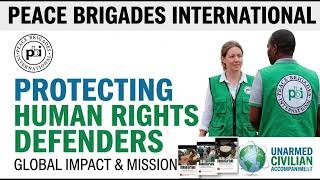
Peace Brigades International sends unarmed volunteers to protect human-rights defenders in conflict zones. Founded in 1981, the organization has worked in Colombia, Guatemala, Mexico, and elsewhere for 27 years without losing a single volunteer. Their strategy relies on visible international presence, strict neutrality, and grassroots networks that mobilize when threats emerge.
Chapters
So I want you to picture a bodyguard. Okay. Normally, when you imagine someone protecting a target in a dangerous war zone, you're picturing, you know, earpieces, dark suits, armored SUVs, heavy weapons. Exactly. Heavy weapons. Basically fighting fire with fire. But what if the most effective bodyguards in the world's most dangerous regions were armed with nothing but a foreign passport, a notebook, and a satellite phone?
It sounds completely counterintuitive.
Right. But welcome to today's deep dive. Our mission today is to explore the fascinating world of Peace Brigades International, or PBI. We're looking at their 27-year history of what they call nonviolent protective accompaniment.
It's a really incredible methodology.
It really is. And we're basing this whole conversation on a really detailed report by Barbara J. Wiene, the co-founder co-director of PBI USA. It gives us this inside look into how unarmed civilians operate on the front lines.
Yeah, before we really get into the tactics of how this works, I do need to set a quick ground rule for you, the listener.
Right. Good point.
Because the source material we are diving into today discusses some incredibly politically charged environments. I mean, we're going to be talking about US military aid in Colombia, the tensions between Maoist guerrillas and the King of Nepal, and violence from both left-wing and right-wing armed groups.
It's heavy stuff.
Very heavy. So, I have to explicitly state upfront: we are not taking sides, we are not passing judgment, and we're definitely not endorsing any political views or factions mentioned here. Our goal is strictly to impartially report the facts and the ideas just as they are presented in the source material.
Okay, let's unpack this. The core concept here is sending highly trained teams of foreigners right into areas of severe repression.
Unarmed.
Completely unarmed. Yeah. Their job is to protect human rights advocates from death squads and armed actors, which to anyone listening probably sounds like a massive liability.
It sounds like a suicide mission.
Yeah.
Yeah.
But the text uses this really relatable analogy. If you have to walk through a really dangerous neighborhood at night, would you rather do it alone or with a group of friends?
With friends, obviously.
Exactly. And they draw this historical parallel to the 1960s in the American South. You had all these college students traveling down to act as unarmed escorts for Black voters. They literally just walk them to the polls to deter violence from the KKK.
Right. The sheer presence of outside witnesses changes the dynamic.
Yeah. PBI is basically taking that exact idea, the peaceful bodyguard, and scaling it globally. But I have to ask, how does someone just standing there without a weapon actually deter a seasoned paramilitary group?
What's fascinating here is the psychology behind it. It is not magic. And it's not really about making a moral appeal to a hitman. It is a highly calculated political decision.
How so?
By placing international witnesses right next to these local activists, PBI completely disrupts the perpetrator's chain of command. You have to look at the calculus of, say, a local warlord.
Right.
They might have zero hesitation about taking out a local union leader, but when a foreign national is standing right there taking notes, holding a satellite phone, the risk matrix shifts.
But do they really care? I mean, a local death squad commander in the jungle, Do they really care about diplomatic fallout?
The guy pulling the trigger might not, but his bosses absolutely do. The political and military leaders higher up the chain realize that harming a local while foreigners are watching, especially foreigners connected to embassies, is going to bring massive international scrutiny.
It threatens their bottom line.
Exactly. Threatens foreign aid, trade agreements, their political legitimacy, The boss doesn't want an international incident over one local activist. So PBI basically weaponizes the fact that the world is watching.
That makes a lot of sense. And this strategy didn't just appear out of nowhere. The sources traced the formal start of this movement to Grindstone Island in Canada back in August of 1981.
Yeah, it was a really diverse group that founded it.
Really diverse. Buddhists, Quakers, disciples of Gandhi. They were looking at these Cold War era conflicts and trying to figure out how to intervene without just pouring more weapons into the mix.
And if you trace the history even further back, it gets super rich. The whole concept of physical accompaniment goes back to 17th century Quaker mediators.
Really?
Yeah. They operated on this core belief that every single person has inherent value. And then you have Mahatma Gandhi, who was a massive influence on the structure of this.
Oh, right. The Shanti Sena.
Exactly. In 1911 in South Africa and then in India, Gandhi organized the Shanti Sena, or the Peace Army. His thesis was that if you have neutral people who are willing to face abuse or injury to save others, they carry this undeniable moral authority.
An authority that kind of shocks the humanity back into the conflict.
Right, and forces factions to the negotiating table.
Here's where it gets really interesting, though, because you read that and think, "Oh, it's just a straight line of success," but it wasn't. The sources point out a previous attempt in 1962 called the World Peace Brigade.
And it was a disaster.
It completely failed. And the postmortem on that failure is so pragmatic. The founders looked at it and realized it failed for two very simple reasons: lack of money and lack of communication.
Yeah, trying to run a global rapid response network in 1962, relying on the Postal Service, right before emails or satellite phones, it was a logistical nightmare.
But that failure was actually the catalyst for PBI. When that group met in 1981, they were determined not to repeat those mistakes. They knew moral authority wasn't enough. They needed rigorous structure.
And that rigorous structure is exactly why their rules of engagement are so incredibly strict today.
Let's get into those mechanics, because if you drop a bunch of foreigners into a complex conflict zone, how do they not just become another disruptive force? We've all seen international aid groups catch heat for showing up and bossing locals around.
PBI's mandates are engineered specifically to prevent that. Rule number 1: They only deploy when they are explicitly invited by the local population. They never self-deploy.
Never.
And rule number 2 is absolute non-interference. It's a first-do-no-harm philosophy. They never tell locals how to run their campaigns.
They just hold the space open.
Exactly. And finally, strict neutrality. They absolutely refuse to advocate for one political party over another.
Which is how they stay safe. If they picked a side, they'd instantly become a target.
Right. They'd lose their value as an impartial observer.
The report also talks about their big footprint strategy. They don't do covert ops. They don't sneak into the country. When PBI arrives, they tell everyone.
The military, the police, local government.
Everyone. And the prep for this is wild. US volunteers actually travel to Capitol Hill in Washington, DC before they even deploy.
That is such a brilliant tactical move. They meet with their elected officials to get official, signed letters of support from members of Congress.
And they take those physical letters into the war zones.
Just picture it. A volunteer gets stopped at an isolated military checkpoint with a threatened activist. The volunteer just casually flashes a letter from a US Senator.
The message is pretty clear.
It says, "My government knows exactly where I am, they know who I'm with, and they are watching what you do at this checkpoint." Okay, but what if the checkpoint guard doesn't care?
What if a threat actually escalates? The report outlines this emergency backup system, right? The ERN and the PRN.
Yes, the escalation matrix. It's an incredible safety net. If a team detects a threat, they immediately trigger the ERN, the Emergency Response Network.
Which is just everyday people.
Exactly, grassroots citizens across 15 different countries. Within hours, These people start flooding the offices of local police chiefs and military commanders with faxes, emails, and phone calls.
It's overwhelming them.
Right. It signals instantly that the international community is monitoring this specific, local threat. Now, if that doesn't de-escalate things, PBI triggers the PRN.
The Political Response Network.
Yes. And that taps into the heavy hitters. High-level diplomats, foreign embassies, international ministries—they start exerting top-down political pressure on the local government.
The scale of that is massive. There's an organizational chart from 2007 in the report, and it looks like a global web. Got an International Assembly and Council at the top overseeing country groups in North America, Europe, the Pacific.
And they all operate under that one motto, the one right on their logo.
Making space for peace. Exactly. And we should talk about who they are actually making that space for. The range of people they protect is huge. It's trade unionists facing assassination, environmentalists fighting illegal logging. Women's rights groups, gay rights groups. Yeah, the most vulnerable populations in these internal conflicts. And crucially, they protect the families of the disappeared, people who are just demanding to know what happened to their loved ones who were abducted.
To really understand the gravity of this, we need to look at the actual front lines, the case studies in the text.
Yeah, let's take a tour of the hotspots mentioned in the report. And just a reminder to you listening, we're maintaining our impartial stance here. We're just reporting the history. Let's start with Colombia.
Colombia is a huge one. They've been there since 1994, and it's their largest project globally. Over a million-dollar budget. And they're operating in the middle of a 46-year civil war. With roughly 3.4 million internally displaced people. And the volunteers there aren't just doing occasional check-ins. They are maintaining a continuous physical presence in the offices of these threatened organizations. Every single day. Day in and day out.
Then you have Guatemala. This was actually PBI's very first deployment back in 1983. And the details on this one are honestly chilling. Escorting the scientists? Right. The volunteers were literally escorting forensic anthropologists into the field. These scientists were exhuming bodies from hidden mass graves to get DNA evidence for the UN. You can only imagine the hostility there. The death threats were severe. The perpetrators desperately wanted those graves stay hidden. If PBI volunteers hadn't been standing physically side by side with them at the digging sites, that evidence would probably never have seen the light of day.
Then the report moves up to Mexico, starting in 1998. They deployed into really highly militarized, impoverished areas like Guerrero and Oaxaca. And they were protecting groups like the CNI, right? Yes, the Association Representing Families of the Disappeared. In areas where local security forces might actually be complicit in those disappearances, having an international observer there is the only way these families can safely organize organize and demand answers.
The footprint goes all the way into Asia too. In Nepal, starting in 2005, PBI went into this rapidly deteriorating situation. They were monitoring protests and protecting the Dalits, the untouchable caste.
Right in the middle of extreme tension between Maoist guerrillas and the king's armed forces.
And then Indonesia in 1999. Yeah, Indonesia was logistically insane.
They were operating across this massive archipelago, deeply contested regions like Papua and notably Ace. The Ace deployment is wild. Talk about resilience. They were monitoring human rights during a violent separatist conflict, and then they survived the devastating Indian Ocean tsunami. And they stayed. They stayed. They chose to remain in the region to monitor the really fragile peace agreements that came after the disaster.
Hearing about these places— Colombia, Guatemala, Aceh— it begs the obvious question: who signs up for this? Who volunteers to give up their life to go stand in front of a mass grave in a foreign war zone?
They are heavily, heavily vetted. PBI They're specifically trying to weed out anyone looking for, like, conflict tourism. Right. No thrill seekers. Exactly. You have to be at least 25. You have to show emotional maturity. You have to commit to at least a year in the field. And the psychological toll is massive. I can't even imagine. Total loss of privacy. Living, eating, and working 24/7 with your team under constant threat. But despite that, they recruit from over 40 countries. You have lawyers, social workers, engineers, tradespeople all stepping up to do this.
The logistics of recruiting and training all those people globally brings up a huge hurdle, which is funding. A million-dollar budget for Colombia alone is a lot of money. But the report highlights this really strict financial boundary. PBI has never accepted US government funding. Never.
Which is a huge deal. It's vital to their security. You look at the history of US foreign policy and military involvement in a lot of these zones, especially Latin America, it's highly polarizing. If PBI took U.S. government money, they would instantly be viewed as an extension of foreign intelligence. They look like spies. Exactly. They would become deeply suspect to the local factions. It would destroy their neutrality and put the activists they are protecting in even greater danger.
So they rely entirely on independent fundraising, foundation grants, individual donors. And they are so efficient with it. The report notes that PBI USA sends 90% of all foundation grants directly to the field team.
Just 10% overhead. Yeah, that's incredibly rare for a nonprofit. Very rare. If we connect this to the bigger picture, all of these mechanics, the strict funding, the Capitol Hill visits, the intense vetting of volunteers, it all culminates in their track record.
Right. How do you measure the success of a strategy where the goal is for nothing to happen?
The metric in the source material is staggering. Yeah. In over 26 years of continuous operation in the absolute most violently volatile environments on the planet, Protecting thousands of targeted individuals, PVI has never lost a single volunteer. Not one. Not a single one. That combination of strict neutrality, the communications network, and their physical presence creates a highly effective invisible shield.
So what does this all mean? We consume so much news about these entrenched, violent conflicts, and the military machinery is so massive, it can make everything feel completely hopeless. Yeah, intractable. But this deep dive into PBI proves something really remarkable. It proves that ordinary citizens, armed with literally nothing but their physical presence and an international network, can step in and interrupt the mechanics of war.
Decades of data backing it up. Exactly.
It proves nonviolent intervention isn't just some idealistic philosophy. It's a highly effective, repeatable tactical strategy.
It really is a powerful testament to human courage. But looking at this report also leaves us with a provocative final thought, something for you to mull over as you watch modern conflicts unfold today. Yeah. The source material notes that early communication tech— satellite phones, early internet— made these emergency networks viable. But looking to the future, we live in an era where high-definition smartphone cameras are ubiquitous everywhere.
Everyone has a camera in their pocket. Right.
So as we move forward, will the digital eyes of the world ever be enough to deter violence on their own? If every citizen is holding a camera connected to the global internet, do we still need the physical international observer? Or is there something fundamentally irreplaceable, something uniquely human, about a person who is actually willing to put their physical body in the line of fire for a stranger?
Mm-hmm.
More from Dr.

2025 Mercedes-Benz CLE 450 4Matic Cabrio – Owner’s Views After a Year-and-a-Half as a Daily Driver

The Complete Guide to a Successful Everest Base Camp Trek – Post-Trek Debrief

The Complete Guide to a Successful EBC Trek – Post-Trek Debrief: What I Needed (and What I Didn’t)

What Went Wrong Customizing My New 2026 Porsche Carrera T …and what I did about it!

Coming May 1 At the Intersection of High Performance and Fulfillment: A Conversation with Alisa Cohn

From High Performance to Fulfillment: Lessons in Inner Mastery with Jim Murphy

Coming March 19: From High Performance to Fulfillment: Lessons in Inner Mastery with Jim Murphy

The New Humanitarians Volumes I - III:- Inspiration, Innovation, and Blueprints for Visionaries

The New Humanitarians Volumes I - III:- Inspiration, Innovation, and Blueprints for Visionaries

The New Humanitarians Vol I - III: Inspiration, Innovation, and Blueprints for Visionaries - Forward
