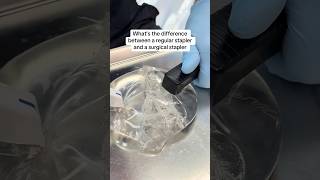
A surgical stapler curves staples from the top instead of the bottom, letting surgeons close wounds under the skin. They're thicker than office staplers, work well on scalps, and come out after healing. A follow-up shows what happens when you staple an implant.
Chapters
This is an office stapler. This is a surgical stapler. Obviously we use this during surgery. We use this for paper. If you fire it out, it shoots it out straight and it gets curved right here on the back, right? If you do a surgical stapler, it actually curves it from the top because obviously you can't have something underneath the skin. On the bottom looks like that. Okay, so these actually have a good surgical advantage for certain things like scalp incisions or temporarily closing parts of the body. Okay, so I use these quite often when I do tailor tacking and surgery. The staples themselves are a little bit more thick and robust, and they don't get left in. They're just temporary, and they allow us to kind of quickly maneuver the skin in a way so we can see what fits. Stay tuned for our next video where I show you what happens when I staple the implant.