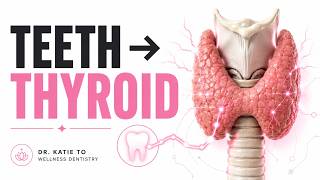
Dr. Katie To links teeth to organ systems through meridian pathways, arguing that root canals block energy flow like stalled traffic. She claims titanium implants divert 12.5-25% of meridian energy while zirconia diverts less, and urges dentists to coordinate with physicians before implant placement.
Chapters
That would be a great question for your primary care physician. Let's look at some of these teeth have eight teeth on a meridian. So on this paper, I've shown you that the lung and large intestine, the thyroid, the stomach, the breast, the pancreas and the spleen. And another meridian, the kidney, the bladder, the genital urinary, have eight teeth on all three of those meridians. If I have a root canal, it is like having eight stalled cars. The traffic's not going anywhere. I have a dead tree. The reason that they're stalled cars is because the tree is in the road. Now, the tree might have stachybotry, it might have Africanized bees in it. The bees are not the reason the cars are not moving. The stachybotry in the tree is not the reason that the cars are not moving. It's the tree. This is a root canal. We remove the tree and instantly the cars push on their gas pedals and they start moving. Now we want to place an implant. If I place a titanium implant, it's like a power pole just fell over all eight lanes of traffic and the wires are gone. Probably not the safest place to be. And the cars have stopped again. Whereas if I use a zirconia implant, it's like one stalled car in one lane of traffic. All the other cars in the seven lanes are free to move. And once they move around that, then I have eight lanes usable. I have other parts of your dentistry, in particular the wisdom teeth and the eye teeth that only have four teeth on the meridian that goes to the liver, the gallbladder and the eye and the heart and small intestine. It's the same principle. So a zirconia implant placed on one of those might interfere with 25% of the energy going through, whereas on an area where there are eight teeth, it would interfere with 12.5. If you don't have a problem with that meridian, let's say you have a tooth removed and it's number three, and you don't have a thyroid problem, you don't have a problem with your breast, you don't have a problem with your stomach, you don't have a problem with your pancreas, then you might be able to tolerate having one implant placed. What I don't want is somebody that's missing several teeth to end up with eight stalled cars all on the same meridian. And they now have blocked all, all the traffic. So I want to give a very visual about what happens when the implants go in. I Can only take it so far on the metal one. But I'm going to need a helper here and we're going to get back to my little child's toy that I have. I'm going to touch your hand and then we're going to have her touch the toy and we see that we connect and that the electricity is going not just through me but through her as well. Now we're going to disconnect. That's a root canal. We are not able to touch. So I don't see any electricity flowing. I choose to have a titanium implant done. What I can't show you is this. If I stuck this in an electric socket and bent it and stuck it in the bottom of the socket, I would likely short out that circuit. What I can show you is without touching her, the metal is very conductive. Now instead of having the titanium implant, I choose to have a zirconia implant done. This cup is porcelain. Just like the zirconia, it's porcelain. Electricity can't go through porcelain. Therefore when we connect, you don't see any electrical flow. And yet they are often taught that by chewing you will stimulate the meridian. So I want you to hold this cup because I'm going to simulate chewing and you tell me when you see that light come on. It doesn't happen because it's non conductive. Therefore it's an electrical disconnect. But we get back to how big of a burden is it? And again it's either going to be 12.5 or 25%. I am not anti implant. I am anti putting in an implant maybe for every tooth that's missing. I don't think that everybody needs more dentistry. We need a concerted effort between the physician to determine if this person is healthy enough to possibly give up some life giving energy through on that area. If this person has something that is compromising it, then you tell the dentist and the dentist looks outside of the box for what is the next option. Maybe that option is a bridge. Maybe that option is a removable partial. Until that person is healthy enough to be able to withstand whatever burden. Realize none of this is what God gave you. So it's going to be a challenge for the body to be able to handle that.