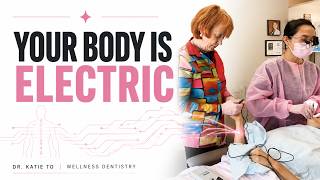
Dr. Katie To explains electroacupuncture (EAV), a 1940s diagnostic tool that measures electrical resistance at acupuncture points to find hidden imbalances behind dental problems. Gold needles stimulate points, silver needles suppress them. Rather than treating the symptom, EAV helps practitioners locate the underlying circuit problem, like an electrician diagnosing a broken dishwasher.
Chapters
EAV is an acronym for electroacupuncture. According to Vol, years ago, I guess Europeans went to Asia and they brought acupuncture back to Europe. The Germans were fascinated with it, but they didn't understand when it was appropriate to use a gold needle or a silver needle. So can you. We use gold to stimulate an acupuncture point. We use silver to depress it. And this is about the time frame of Tesla and Simon Ohm. So Ohm was making a meter and talked to Dr. Vohl and said, why don't we try touching these different points on the body that you seem to think you can gather information from and see if they are too high or too low and we'll know whether to stimulate it or suppress it. And honestly, thus was born a little use of an Ohmmeter to evaluate acupuncture points. That translated into computer technology being able to write things down for you. And then the programs went from DOS to Windows. And now we have some really cool software so you can run through and test the different points and it actually logs the reading on the computer for you and helps you figure out what's going on. I try to explain to a patient that I am like the electrician coming in your home. If your dishwasher worked yesterday, but today it doesn't, it might be because there's no power to your house. Hopefully you wouldn't call somebody if there was no power to your house. You would just figure that out. But if a breaker tripped, it might not be the first thing you think of. Or maybe the dishwasher legitimately burned up and you're going to have to go get a new one. Or maybe a mouse got in the wall and nibbled a hole in the wiring on the circuitry and that's why the dishwasher is not working. And you don't need a new dishwasher. You need the wire splice back together. So when I'm going through and testing the teeth, I may get a reading that is poor, like the dishwasher, but then I have to sit down and figure out where is the electrical problem and what in all likelihood is it. You might have a tooth that actually is uncomfortable. It's painful. You're in a dentist's office saying, I have a toothache and the dentist takes an X ray and can't find anything wrong with that tooth. If I tested it, and I told you it was because of the other end of the meridian, what I would be trying to tell you would be very similar to what people experience when they're having a heart attack and they have pain or numbness in their left arm, it would be of little value to cut off their arm to make the pain go away when actuality the source is the cardiac issue. So we try to look downstream and figure out what's going on. But it happens that way in dentistry as well. And so part of VAV is very helpful to determine why is someone getting cavities, but only in specific teeth is this tooth a burden to the rest of my body, and I can use this equipment and go through and gather that data.