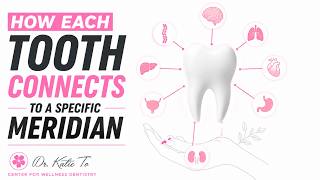
In this instructional video, Dr. Katie To explains how the human body conducts electricity and demonstrates a bedside bio‑electrical testing method. She begins with a simple circuit analogy using a 9‑volt battery and a toy to show that the body completes an electrical circuit, producing a sound and a measurable value when a probe contacts the skin. The core clinical protocol involves a brass bar and a handheld probe that the patient holds while touching specific teeth. The test targets eight points along the upper jaw (from the central incisor to the wisdom tooth), injecting a standardized input value of 50 and expecting an output between 48 and 52. The practitioner repeats the measurement at each point, disconnecting and reconnecting to ensure reproducibility, and uses finger‑on‑gum techniques when teeth are missing. A connected computer analyzes the readings to locate any electrical resistance issues, and the results are communicated to the patient’s primary care physician or dentist. The video also notes that dental mercury fillings can be a persistent source of heavy‑metal burden, requiring removal before systemic detoxification can be effective.
Chapters
First, we're dealing with electricity. If we think of a 9 volt battery, one of those rectangular shaped batteries that has two little bumps on the end, the positive and the negative. If I'm a light bulb and I have two metal arms and I touch one of those, I have electricity coming into me. But we have not completed the circuit. So there's no electricity flowing yet. And I can't measure anything if my other arm touches the other bump that's coming off of the battery. I have then completed a circuit. The best way I can show you is this little toy that I got on Amazon. And you can see that I'm holding onto it right now, but you don't see any lights coming on. But my body is electric. We prove that all the time when we do EKGs, EMGs, EEGs. But I am going to complete the circuit, and when I do that, we now have a flow of electricity. It's a cool example of what we do. When I'm testing a patient, I hand a bar to them. It's a brass bar, but there's no noise. You don't hear anything at all. Because I have not completed the circuit. I take a probe, and once I test that person, I hear a sound. The skin has conductivity all over. Wouldn't matter, really. If I touched a nose or an elbow or the bottom of their foot, I would get a sound. I would also get a number value, but it wouldn't have any meaning for me because I'm used to dealing with very specific points. This point on my hand has to do with the top teeth on this side of my body. It measures from the center to my wisdom tooth. That's eight teeth. Traditionally in that spot. It doesn't tell me which area. So I have to have the patient touch a specific tooth. I make the connection. I put 50 in the body. I want 50 out. The way I explain that to people is if I had a straw and I held it up and down, and I had a cup with 50 ounces of water, and I poured that 50 ounces of water into the straw. Logic would dictate I have 50 ounces of water in my lap now. But if we just saw drip, drip, drip, drip, I would instantly know that there's something in the straw that's blocking the flow of water. That's the way electricity is. So the moment I touch the patient's skin, it's as if I poured the cup in. And now I'm trying to figure out how much is coming out. So 50 goes in. I want 50 out. I have a margin of error that's really tight, 48 to 52. I'm just going to go on to the next tooth. They touch a tooth, I touch the point for the top teeth. We take a reading. Now, 50 went in. How many came out? If I don't like or I question that reading, I tell the person, stay right there, and I disconnect, reconnect, disconnect, reconnect. Because I always want to make sure that I'm reproducible. Then I ask them to disconnect from the tooth and move to the next tooth. I connect, 50 goes in. We measure how much comes out, disconnect, move to the next tooth. We do that eight times. If you're missing a tooth, I may have you push your finger up to the gum to simulate where that tooth would have been. Similarly, when you get back to a wisdom tooth, I may have you push your finger beyond where your actual teeth are onto the gum. Some people get so concerned about, was it in the exact area? Look, I'm just trying to be reflective of all eight areas in the jaw. My issue is, if it's not a good reading, I will stop in that area and make sure that that's where the problem is. Then the computer helps me determine where on that electrical circuit is the problem. And then we end up with an answer that goes back to your primary care or to the dentist. Sometimes those are connected, sometimes they're not. A dentist may have to remove a mercury filling in order for the physician to be able to do and get heavy metals out of the body, because that mercury filling is the continual source of mercury. So it makes sense that things are done in a logical order.