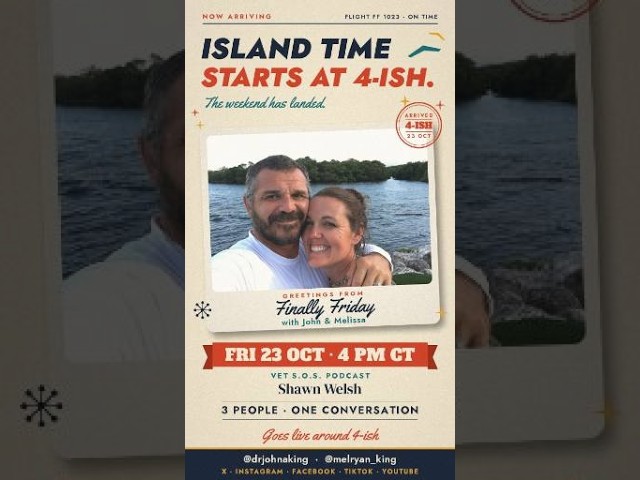
In this informal Friday‑day podcast, hosts John and Melissa introduce guest Sean Welsh, a retired Army veteran who runs the Vet SOS podcast and nonprofit. Sean shares his journey from military intelligence to corporate work and nonprofit leadership, describing how a mentor pushed him into podcasting and how that platform grew into a multi‑show network serving veterans. The conversation weaves through several themes: the role of creativity in planning and execution, the strategic expansion of a podcast network, the use of AI as a productivity tool (not a replacement for critical thinking), the challenges of digital distraction and the need for focused, analog time, Sean’s upcoming leadership‑fiction book that blends historical figures in a dive‑bar setting, and the importance of faith, resiliency training, and grace in veteran transition. John and Melissa also discuss generational shifts in technology, the value of failure as a learning catalyst, and practical advice for veterans—starting early, stepping out of comfort zones, and giving themselves grace. The episode ends with calls to action for listeners to follow Sean’s platforms and to embrace creative, purposeful work over endless consumption.
Chapters
Yeah, I know, I never quite work out that clock. Like, I'm thinking I'm waiting for it to do something, like to switch from the countdown and go into something else, but I never bloody know what goes on. Anyway, everybody out there, welcome to Finally Friday with John and Melissa, who run a tech company and don't know how the heck to work this software. And we've got a new friend, Sean Welsh, with us. Sean is a wonderful guy, as you'll find out, and we had the pleasure of connecting around some podcasts. He does some tremendous work in trauma and, uh, in, in that space and a range of other spaces. So it's going to be a fascinating conversation. So, Mel— Melissa, why don't you tell us a little bit about why Finally Friday, what we do and what our aim is and how we want to help people and connect with them?
Finally Friday is a place for us you and I. John is a writer and I'm a painter, and other creatives, anyone who we find who wants to come on and talk with us about creativity, the creative process, living a creative life, and how it's beneficial to people in their everyday lives to do creative things. And so that's Finally Friday. We start every Friday at 4-ish because Technology, and we're artists, so, you know,
whatever, it turns up when it does. So, Sean, welcome, brother. Tell us a little bit about you, what drives you, your passion, where people can connect with you, all that good stuff.
Oh, it's, it's a pleasure to be here. And Melissa, I finally got to meet you, which is wonderful. John, you and I have had fantastic conversation, um, so just really excited to be here. Um, I'm retired Army, Currently working in corporate world and in my free time, run a nonprofit called Vet SOS. It's a military transition-focused podcast that we started 4 and a half years ago. Currently have 5 shows running with 2 more in the works and working on some, you know, like online database type things we want to do to help our veteran community to understand they're not alone. Because that's the number one thing that we hear when we talk to people is, you know, we thought we were alone. So, we're working on some things there that hopefully will come to fruition here in 2027. I'm very excited to do that. And as far as what drives me, I mean, these days— and I couldn't have said this, you know, a year, year and a half ago— but these days, it's, it's wherever God leads me. It's where he takes me and what he wants me to do. And the doors that he has opened and the doors that he's been closing, uh, have truly just been amazing this past year for me.
That's interesting. And welcome everyone, Instagram and Twitter, YouTube. Great to have you with us. Uh, it's interesting you talk about doors opening and doors closing, but, but isn't that part of the life? Like, not only transitioning out of where you want, and you would have very obviously had this stage where you were in the military, then you are out of the military, but isn't that the way that life leads? It really is a river flowing to, to an unknown destination to some extent.
Oh, absolutely. I, I sure wish that I, I knew where the story was going to end, like, you know, yeah, the pathway I was going to take, uh, but But that would take some of the fun out of it, I think. And, um, for me, I, I've really changed my mindset. And it started during the transition process out of the military where I told myself I was going to get out of my comfort zone. I was going to do things I didn't normally do and try things. And I wound up saying yes to a lot of things that normally I would have just said no to, including starting the podcast, which I did say no to originally. Really? Oh yeah, it all started with no. We can get into that story too, but, um, it's just one of those things that, you know, it— the, the many doors that are available, and, and some of them are just truly amazing.
Yeah. So why did you—
That was gonna be one of my questions. I, I was gonna say, how did you get into podcasting?
Yeah, so tell us.
So I, I was 6 months into my transition out of the military. And I was doing a lot of things on LinkedIn, posting videos, just trying to kind of figure out what I wanted to do, who I was going to be.
Yeah.
And my mentor wound up calling me. He's like, hey, you need to start a podcast. No, I don't. And that was pretty much that conversation. That's not even on my radar. I don't know what you're talking about. And he spent a couple months consistently calling me saying, hey, have you thought about it? Have you thought about it? And I reminded myself that I wanted to get out of my comfort zone. So his business partner and cohost came on board to be my co-founder and cohost for the first season, and just sort of showed me the ropes of how they did it. And a lot of what they taught, taught me from the beginning is what we use. And we've made some changes over the years as they made sense. But it really, it all started with no. And 4 and a half years later, I have, you know, this nonprofit, you know, 7 co-hosts that want to help, you know, educate veterans and really just care about the mission. And it's, it's just, it's amazing. I can't imagine where I'd be right now without the podcast. So.
What, what drives your creativity? You know, you've got, obviously you've got a mission and a focus with what you do with the podcast, but even outside of that, what do you do as, as a man to, to continually stoke that creativity?
I'm one of those people where I, I don't know that my mind shuts down. It's always going. And there was definitely a switch because I was an intelligence professional in the military, so always really thought analytically. And there was definitely a transition as I was transitioning where I started to think more creatively, and it kind of went back to some of my earlier roots. Um, I wanted to originally be an A&R rep in Nashville for a record label. That was my original goal coming out of college. Wow. I've always loved music. I'm not musically inclined, but I always had a pretty good ear. So I wanted to get into that world, and 9/11 happened, decided to change pathways and go to the Army. But it— I think there's always been some creativity, but mine was, I think, more along the lines of the ideas, not so much the physical ability. Like, I can't sing, I can't play an instrument, I definitely can't paint. You know, so there's a lot of limitations to my artistic ability, but You know, some of the things that God blessed me with have really panned out, and being able to find some great people to join our shows as well, which is just helping the overall cause. So—
Being able to take an idea though and execute on it, that is a tremendous form of creativity there. Um, and it wouldn't matter if you were helping an artist, you know, you were helping someone get a book published, or you're, you know, whatever, being able to execute on a plan? Because you did mention in your show notes that you're a planner. So—
Yeah, the running joke is we did a large Thanksgiving meal for a veteran organization, and I put together a full-page spreadsheet of times from like when you got to take the turkey out of the freezer, because I had so many moving parts. We were planning for 100 people, and I had several different cooks going. And so that's been the running joke. And in fact, one of the ladies, she's like, I know how to cook a ham. You don't have to tell me.
That's
great. You know, but that, that's just kind of how my mind works. And like, when it, when it comes to doing things like that, I, I have no issue sitting down and building out plans. And some of my favorite software is actually like the mind mapping ones where you just get these dots and lines going everywhere. Um, it's cool to kind of see what comes of that.
That's,
that's very interesting. So planning is a creative exercise, it sounds.
Oh, very much so. And then I would also throw in the strategic thinking piece of it as well, because the reason we have so many shows now is because we had a backlog. We had, we had a waiting list to get on the show. And I'm like, all right, first of all, how do we get rid of this waiting list? And then second of all, is there something else we could be doing? So we started looking at veterans who own their own businesses, and we pulled that out and created an entrepreneur show. And the veterans come on and they talk about their journey. Um, and then we had some schools. I'm like, all right, well, let's start an education schools or show as well, because those two are two of the biggest pathways our veterans take when they get out, you know, starting a company or going to school. And, and so that's kind of how it started, using the strategic thinking and then the planning piece and trying to put it all together. And then, all right, now I got to find a host. And, you know, so it all just sort of builds on itself.
Yeah, very good.
So how many podcasts do you guys have?
So currently I have 5, uh, under our network, and we have 2 more that are in the works right now. Uh, so by the end of the year, a grand total of 7, and I think that's where we're stopping. But, you know, who knows?
Is there one place that we can send our folks to, to look at the whole gamut of what you do?
Oh, absolutely. Uh, Vet SOS Podcast on YouTube. Uh, you can see everything there, or you can go to our website, which is vetsospodcast.com. And there's links to, um, all the episodes individually on there, as well as, uh, links to the Spotify, um, account as well. And of course, we have links on the, on the homepage to go to all the different channels.
Great.
We're just putting it— well, I'm just putting it in Instagram. You've got— you've put it in YouTube there and the comments.
Yes, and X. So yeah, we got that out there for, for you guys.
Let's, let's, let's camp on the thinking thing for a minute. Um, Melissa, why don't you talk about that article you read? We're having— we were having conversations beforehand, folks, and we, we kind of wish we started at 3:45. So we may do that at some point because we always have these great conversations before the conversation.
It's true, it's true. I was reading an article this week, and, uh, it was by a painter and a lady who— she runs a podcast and works with other painters. We need to try to have her on. But she was talking about how doing hard things, whether it's working out your process as a painter or going through the sort of grind of editing a book or whatever it is, doing those hard things around creativity is a muscle that you have to build. You got to learn to flex that muscle. And there is a lot of critical thinking that comes with that, even Even if you're, you know, working out your painting process, which seems like a very hands-on thing, there's a lot of decisions that you're making, a lot of things you're saying yes to, a lot of things you're saying no to, to sort of refine that process. So that was sort of the lead-in to our discussion about critical thinking and AI and creativity.
Because I think if you can't critically think, I think AI— if, if you can critically think, AI is a force multiplier and getting to a series of actions. Like, you even ask it a medical question or you ask it about a very basic situation, it will give you a very standard answer based on its ability to be able to aggregate a whole range of sources. So whatever the average or the normal is, it's going to give you that back. And my concern is we've got a generation of people that will go to AI, and that will be the limit of their thinking, is whatever AI tells me the average or the normal people think is— that's just got what I'm going to accept. And I think we all understand, like, but even with what you're talking about, Sean, is like you had this situation, you had this backlog, and most people say, well, I'm just I'm wonderful, lots of people want to get on my show, and that's it. But it started to— you had to start to ask the question because your real thing that you were trying to do was to reach and meet people where they are. So how can I get there? How can I do that? And I think it's important that AI is a tool, but it's not the endgame. It's supposed to be a force multiplier, but not the answer.
I think you used the key word there. It's a tool. And I have that conversation often with my oldest son who's in college. You know, it's— he's fairly anti-AI because he wants to be a writer and he wants to write books and everything. And AI is taking a hit on that. But teaching him that it can do things that I can't naturally do, like, for example, create an image, a thumbnail for my podcast. Sure, I could pay somebody, but that also takes money. And, you know, we're not at that position to do that. Eventually, hopefully, we have a staff of people that we're paying to actually do that, and that'd be phenomenal. But AI enables me now to add that to what we're doing. And one of the things that I always try to convey to people is, is understand that it is nothing, it should be nothing more than a tool. If it's doing all your thinking for you, you're not going to be here very long. And, and I, I don't, I don't like to play the generational stuff, but it's hard to as you get older not to. Um, you know, personally, I'm Gen X, you know, and, you know, Gen X has that, you know, an attitude about them. And, and my, one of my favorite memes I've ever seen is, you know, we're, we're the generation that had records, then we had to buy cassettes and replace all our records, then we had to buy CDs and replace all our cassettes, and then we had to get rid of those and get MP3s. And Then we were free downloading from Napster and everything else, and next thing you know, now we're paying subscriptions to Apple for songs that we've owned 12 times already, you know. Yeah, yeah, yeah. But
yeah, we lost out on the music there along the way.
Oh yeah.
And so I just— for me, it's, it's weird to, to have some conversations or watch the, the younger generations and, and the way they try to come about decision-making. And you can tell that— I don't know what happened. I don't know if it was just AI or if it's just, you know, generation to generation, we all go in different directions and it all works out in the end. I, I don't know. But, um, you know, this generation today, my kids, they, they were born in a digital world. Everything they know is digital. I would love to, to get a home phone and, you know, get the 25-foot wire again so they, they have to use that and, you know, get the American Online and see if they can play one of their video games on that internet. Oh yeah. Because they have no idea. No idea.
Yeah, great.
I'm up, I'm up in South— I'm up South Carolina and I'm bear hunting. Um, it's even— it's 100% analog, but it isn't. Like, everyone uses GPSs and that to track the dogs and whatever, but it is an analog sport even with the add-ons and the things that make it easier for you, like, um, Not losing your dog and finding where the bear is. You got to traipse through the woods. You got to go find it. You got to spend hours out going up and down. You got to spend hours just talking and telling stories and lies. You know, which is half of the problem. Half the reason I think everybody does it. But there seems to be a people are losing that. And even these guys we're talking today, they're talking about how they have to work very hard to keep their kids engaged. And there comes a point normally around 13 or 14 where they just. Back out of it. And what they're finding as they now go through— their kids are coming back in their 30s understanding what they got as children, and they're bringing their children back into it because they're realizing, man, we've been through this, we grew up with this digital stuff, and it robbed us of so much. And I think it would be really sad— everyone talks about AI and technology as freeing us up with giving us more free time, but But we seem to want to cram more stuff into that time instead of letting our life breathe. And I don't think you can be creative in white noise. I think you've got to give pause to your soul to give you room to be able to think, to decompress, and your mind to wander. And it seems that we've got a generation that's just constantly consuming.
I remember growing up, especially in high school, getting ready for midterms and finals. just putting on Mozart or, you know, some classical music in the background just to have that, that, that little layer of noise. But it also had like a calming effect, you know, to enable you to study. And there were a lot of people that used to do that. Today you got your computer on, your game system on, your phone on, and everything else. And I don't know how people focus at all. There's just too many— I mean, your smartwatch, mine's buzzed 3 or 4 times since we started, you know, and it's like— It's just, it's those immediate distractions.
Immediate distractions. Talk about that in the creative process. Maybe you've got some thoughts on that, Melissa.
I do, actually. I, I think that, um, especially with, you know, you've got your Instagram account that you're sort of managing as an artist, you're trying to get your work out there, um, you can get so sucked in To those things, or it can be, you know, a notification popping up on your computer or your phone and, and really get so distracted that you don't actually ever get your paintbrush on your canvas. And you're, you're like, I've got 90 minutes to paint. And, and you end up scrolling Instagram. You're like, how did I do? What happened? How did I get here? You know, I think also too, I think we're so used to multitasking at our desks that I think when you come to your creative work, I think like John was saying, is to just let yourself sit and you got to like sit and stare into space for a minute or whatever it is where you can, um, like switch gears from multitasking to focusing on, you know, the one thing that you want to get done. I would imagine as a planner, Shawn, you would need some quiet space to start your creative process.
Yeah. Yes, I, uh, so I'm I'm still very much a morning person, so I typically go to bed between 8 and 9 o'clock at night, and I'm up at 3. Um, but that 3 o'clock to 6 o'clock time period is all mine to do, you know, whatever I want to do. And that's where I get a lot of the podcast work done. You know, I, I do my devotional time, I work out. Um, you know, it is— so all the things that I want to do and I don't want to be distracted doing, that's when I do it. Um, and even on the weekends, you know, I may sleep in a little bit later, but You know, I can get up and still do things before anybody else in the house gets up, especially with teenagers in the house. So it's, uh, I think you have to find that time that works for you because the number one killer of my productivity is death scrolling. You know, if I sit down and open Facebook and look at Reels, then, you know, next thing I know, an hour's passed. I'm like, what just happened? You know, and I'm not any better for it. And it's throwing my sleep schedule too.
That's part of the tragedy of it, isn't it? Is the lost time. Um, and I think that's part of it is, is I don't think it's getting caught up in the regretting of it, but reshifting the gears to imagine what I could have done with that time. Or how could I have used this differently? And I wonder if, if part of it is because you've just finished up a book, and I'd love to start to dive into that a little bit. Is because with writing, you, you have a certain number of things you've got to do. Like first draft, you always write for yourself. I just finished the first draft on a short story I'm writing, and I loved it, but then I went to bed and thought, that's total crap. And I've learned that's exactly how it's supposed to go. I'm supposed to get all my words out and be verbose and think how awesome these things are, and then you go, yeah, it's total crap. I liked it. No one's going to read that crap. I wouldn't read that crap if I wrote that crap. And I did write that crap and I don't want to read it anymore. So we go through that. But if you don't give yourself time and if that's not a priority for me, then I will find something else to fill in the time. Just fill it in.
Oh yeah, absolutely. And if I try to go to bed at 8 o'clock and I open Facebook at 8 o'clock, I'm not going to bed till 9, 9:30, 10 o'clock. Now I'm not getting up at 3. Now I'm getting up at 5 and I lost 2 hours. And my whole day's ruined, you know, because now I'm in a bad mood because I didn't do all the things I planned on doing. And yeah, it's just, it's a vicious circle.
Tell us about this book. It's fascinating. You're gonna love this, folks. It's a very creative way of looking at old material, let's put it that way. Like, you think everything's been done before, which is really fascinating to me, um, that we do think everything's been done, but you've come up with a way of dealing with things that is just very exciting.
So I'm excited about this, and, and I'm sure there's some English teachers that are going to roll over in their graves when they find out that I wrote a book. Um, I was not the best student in English class, that's for sure. Um, and I never— I don't think I ever dreamt of being a writer. It was just sort of one day it came to me, like, you know what, I want to write a book, you know? And because I enjoy talking and being in front of people, so like I'd read somewhere once that any book, if you have a book, any book, it becomes a platform, you know, and it can help you get into speaking roles and things like that. So maybe we'll write a book. So then, of course, then you go into the thinking about it process. And, you know, I had 4 or 5 ideas I'd been kicking around and didn't really know which route I wanted to go. And then through the Maxwell Leadership, I learned about— I'd already read several Maxwell's books. But then there was Running with the Giants, was a book he wrote, uh, where essentially a figure from the Bible runs a lap with this person in the story and partakes wisdom on them. And, um, I love the idea. It just sounded fascinating to me. And then, um, there's a country song called Beer with Jesus that I always, you know, thought was kind of comical, you know, and, and really liked the idea of, you know, and it got me thinking, you know, what would I do if I was sitting down and actually having that conversation? You know, and so the 2 of those just kept bouncing off of each other. And what I wound up settling on was writing a leadership book that is, you know, part fiction, has a story to it, but then also has 10 different leadership principles that I believe in and wanted to share. And so basically, I took 10 leaders from history, and I put them into this dive bar because, one, I'm an alcoholic. And I know dive bars well. So I wrote about what I knew, and that basically was how it started. So I was able to take these 10 figures that I respected in one way, shape, or form for something they did from the leadership standpoint, and I was able to put them in this bar. And everyone I picked had, you know, not necessarily like big drinkers, but there was a particular drink they were known to if they did. And so they're drinking that drink. And then I pulled something from their past as a, you know, a factual incident that occurred to use as the leadership principle. And then I also played off some of the characteristics. So in the bar, we have people like Martin Luther King Jr. and Teddy Roosevelt playing pool. Both were avid pool players, loved to do it. So I have them playing against each other.
That's great, mate. That's great.
And my favorite one, and I love— I still laugh every time I think about it, is Ronald Reagan was known for his singing voice. So I have Ronald Reagan on stage singing karaoke and he's singing Back in the USSR by the Beatles, which I just found hysterical while I was writing it. But I had a lot of fun with it because, one, I got to go back and read all these historical biographies to learn more about, about the individual. And then was able to take something that I did a lot of, which was hanging on dive bars back in the day, and place something in that situation. And then, of course, talk about leadership, which is something that's always been near and dear to my heart. So it was, it was a lot of fun.
So when's it coming out?
That's a great question. So it took me 2 years to write. I finished it earlier this year, and I have yet to do the editing piece. So Um, I was saying I wanted to have it out this year, but it most likely will be after the new year by the time I can finally sit down and get it all hammered out, because I'm sure it'll be more than one rewrite.
You're, you're in the hard part. You're in the hard part now.
Yeah,
this is the work. Everything else was fun up till now. Uh, the editing is— I, I've, I've managed to change my mindset with that. I, I've really come to love the editing process. I've come to really start to think about my readers and, and make sure they're getting the message that I'm trying to convey. And so that's turned it around from being— and I, you know, I think writing in some ways is selfish. You're sitting there and you've got this story you feel you want to tell, and you, you get about telling that story, and because you want to tell the story. And I've found in the process that the editing becomes very much about my reader. I love this story so much that I'm prepared to cut 2/3 of it so that what my readers get are the third that's going to touch them and do something, you know. And it's a little bit different in terms of when I write fiction. Now, I've written a bunch of nonfiction books, and I think nonfiction is more about that. But I just really have come to enjoy that editing process. I find it very— people don't think it's creative. I disagree. I think editing is very creative, very creative process. Love it.
Oh, maybe, maybe someday I'll grow to love it, but right now it's, it's stalled me in my tracks. So yeah.
I think, uh, I think that a good comparison in painting is, uh, there are certain things that I create that are just for me, and most of those go in my sketchbooks, and that's where I work out ideas and like, you know, new things I want to try. Um, and then when I come to Do a large piece or paint a canvas, or, you know, I'm thinking more about, would anyone ever want to hang this on their wall? I mean, honestly. And so you are, you're, you are switching from that sort of selfish, this is me process in your first draft to, I want my book to be on someone's shelf. I want them to enjoy it and have read it and pass it on to a friend. Um, so it's a— it is a shift.
Are you publishing it yourself? Sorry.
As of right now, that's sort of the plan. Uh, I don't really have a budget to work with, so to speak, to do this, and I'm not a Fox News anchor, so I don't automatically get a New York Times bestseller. So, um, but yeah, I'm looking at doing it that way. And, um, you know, I, I agree though with exactly what you said. You know, I would love for people to actually want to read this and, and to get something out of it. Yeah. Was it fun to write? Absolutely. I mean, there were some challenging parts to it, but— and part of it was a little therapeutic too, you know, and especially writing it, you know, during sobriety, which made it even more interesting. So it was fun, and I think it was a great exercise that was, you know, both creative and therapeutic at the same time.
You do a lot of work with veterans. What do you Is there a role— I won't, you know, impose it— is there a role, you think, for creativity in recovery, particularly in building resilience?
Oh, absolutely. I was a resiliency trainer in the military, and I loved the program. Unfortunately, there was a lot of, you know, negative thoughts about it. You know, that's what's making us soft and this and that. And what people wind up learning down the road, hopefully, is that that they need that. You know, there's a lot of things in resiliency training that are going to, one, you know, make you more resilient. It's in the name. But it's also going to help you. And I had a lot of anger issues back then in the military. And the resiliency training is, was probably the most beneficial. Mm-hmm. And I'd gone to anger management, but I wouldn't recommend the ones I went to, as far as the program, you know. But I think the resiliency piece really helped me the most. Um, because I went, I went 4 different times anger management, and only, only one of the doctors I talked to, like, was pretty good in my opinion, you know. Um, but, you know, it is what it is.
So in that, just running down this just a little bit more— resiliency, creativity, healing, coming to terms with who you are in your past— is there a connection for people?
Oh, I, I 100% believe there is, and especially if you throw faith in there. Um, faith is another big pillar that I think it all comes together. And, you know, everybody's at, you know, different walks in their, their spiritual sense. And, um, personally, I'm a Christian. I, I love the walk I'm on, and I love the doors that have been opened. And for me, everything I've been through ties in together now, and it makes sense. And the, the resiliency training stuff is things that I can still impart on other people today to help them cope with some immediate things that are going on. And, you know, the leadership stuff, I can always talk to people about leadership things. And, you know, the planning piece, helping people figure things out, you know. So all this stuff starts to come together. And then you throw in the strategic thinking that you learn in the military. And I went to several critical thinking classes in the military. And, you know, all these tools start coming together, and you start to realize, Maybe why you're here, you know, and what you should be doing.
Very good. Where can people find you?
My biggest footprint's probably on LinkedIn.
Excellent.
Under my name, Sean Welsh. I think, I think it's just Sean Welsh. I don't think it's 00, but it might be 00 at the end too. I have to look. I can never keep track of these things. There's way too many of them going on.
But, um, the— pull it up, man, so I can get it right for you.
There it is. Yeah, SeanWells00 is my LinkedIn.
Sean, let's put that in the comments for people.
But that's probably the easiest spot to, to interact with me. I don't do a whole lot of social media except for the podcast, so, uh, you can find the podcast on all the The social media networks, @BetSOSPodcast is the handle for most of them, and you can get to all of them through the website.
Great.
So I encourage you folks on Instagram and YouTube and Twitter, follow Sean, connect with him. He does great work. I had a privilege of being connecting with him and being on one of his podcasts, and I I would encourage you to get it, download his stuff. He's great. He's Very balanced, very insightful, and I've really enjoyed his material and what his teams produce. It's very, very good. Very good.
I really, really appreciate that. Uh, and like I said earlier in the conversation, I've been blessed to have some wonderful people around me who truly want to give back to the veteran community. And, you know, it's all about education and what we're doing. And I think that's part of being in the military is you, you being a servant leader becomes a part of who you are, and it continues. It becomes part of your DNA. So, um, but I do— I appreciate the, the kind words and appreciate you having me on here today.
So what would you— how would you encourage someone who is at the front end? Say you, 5, 10 years ago, you're getting out, you're not sure what you're up to, you just want to do something, you're not sure what that something is, but you just know it's not whatever the hell you're doing now. What would you say to them?
So there's 3 things I typically tell people. One, start as early as you can. Um,
what does that mean?
So typically when, when I transitioned out, we were allotted 2 years to, to go through the process, and that allows you to space out the school or the classes you got to go to. Um, now I think it's 18 months. Um, And there's other opportunities for training that you can go to through some of these veteran nonprofits and, and the SkillBridge program and some of those things that are offered to service members. So the earlier you start, the better you can position yourself. Um, 2, I always tell them to get out of their comfort zone. Don't be scared that this time period of transition is your chance to figure out what you want to do, who you want to be. You're no longer going to be a soldier or a sailor or anything. You're going to be a veteran. It's part of who you are, but it's not who you are anymore. And so, getting people to really get out of that comfort zone, just try new things. And then the final piece is I call it transitional grace. Give yourself grace because you're going to fail.
Very good.
You've never gone through this transition before. So, give yourself grace and understand that, okay, yeah, you may fail at that. Pick yourself up, dust yourself off, you know, examine the problem, try again, you know, and just keep moving forward and don't let it be a huge setback for you. And if you can do those 3 things, I think you, you can very well be successful with your military transition.
I love that. I think it's very important. I— because, okay, we were talking about Gen X a while ago. I— and I was reflecting as we were talking about that of how much we value— in our generation, we value competency, like self-reliance. Growing up, we had to learn to be competent quickly, or at least in my household we did. And I would imagine in the military, competency is really high up there too. And so now someone's coming out, they're looking at starting something totally new, like, oh, I don't know, like me at 45 deciding I wanted to try to paint. Yeah. And so, and used to being very competent in all the other areas of my life. And then now I'm here doing something totally new, and I really suck at it for like the first year. I'm sure it was at least a year. And so helping people understand that they're allowed to suck and really stink it up and just to give themselves some grace.
And imposter syndrome's a real thing. I mean, yes, especially if the longer you were in the military, the harder imposter syndrome is going to hit you because you're in a completely different world unless you stay in the federal system. Um, so it's, you know, be prepared for that and be able to recognize it, you know, because there's— there'll be times where, you know, I was beating myself up and realized, wait a minute, I can do this. You know, and, you know, think back to all the things that you accomplished in the military. I'm like, I can run a spreadsheet. I mean, what's going on here? You know, and just realize you just got to buckle down and put your mind to it and, um, you'll get it. You'll get there.
I think part of it's reframing failure as well. Like, if you're not failing, you're really not doing anything. Like, you're not trying. You're too scared. You're bound by fear and competition. And I, and, you know, to your point, I think that's where faith plays a huge role, is, okay, I, I am, I am going forward in a direction. I am trusting this is going to take me where I need to go, and I am prepared to fail and fail magnificently. Um, because what, what, what are you gonna— what, you're gonna get embarrassed? Like, who— Okay, congratulations, you're not 12. You know, it shouldn't be your first time. I think we have to give ourselves— or we wouldn't do anything. And I think that's— I think people actually hide behind their screens now because they can sit there and be spectators. We had a great guy on last week who has run his own personal campaign for 25 years of boycotting spectator sports. He just doesn't do it. He doesn't watch any spectator sports. He is currently writing a book on body surfing. He said no one needs to read a book on body surfing, but I need to write one. And this guy, you would love him, man. Um, Christopher McDougall—
McDougall, yes—
uh, wrote a great Natural Born, um, Heroes— Natural Born— I don't know if you've ever read it.
The running book was first, uh, it was Born to Run, and then he wrote Natural Born Heroes.
Which was about World War II, the Cretan resistance in World War II, and how all these fit young British men were just flabbergasted that 70-year-old Cretan shepherds were outperforming them running up and down the hills all day carrying sheep. And, and it was just talking about old man muscles and how the natural, you know, just being able to get up and go. So phenomenal guy. You'd actually love connecting with him. And I think we've got to be prepared to do that. I think if we're not prepared to fail, then we'll just never achieve anything.
There's a fantastic book. I think his name is Ryan Leak, Failing Forward.
Yeah, right.
Yeah, fantastic book. And you look at some of the stuff that he's done, and he put most of it on YouTube. I mean, that, that, that guy wasn't scared to just push the envelope and fail fantastically. So It was beautiful though, especially I love his story about, um, trying out for the NBA. You know, he, he thought he was good enough to do it until he learned he wasn't good enough to do it. But he learned a lot from that still. And, you know, he doesn't have to sit there and wonder. And that, that's a lot of peace of mind where you don't have to wonder about something.
I think that's a great observation. You don't have to wonder. Nah, that didn't work out. Okay, well, let's— let me go find my thing. You know,
yep, nothing worse than looking back on, man, I wish I would have.
Yeah, yeah, man, ain't that a waste.
Or go, or like, for the rest of your life saying maybe someday. That was mine, you know, maybe someday I'll paint. And, uh, and finally John, when I was 45, he was like, today's the day, you're gonna do it.
And she was crippled at the time, she couldn't walk. And I dropped her off and said, okay, look, I'll come back in an hour. Goodbye. You're crippled, you can't go anywhere, so bye.
Today's the day.
And she kept going.
She hasn't stopped for like 4 and a half years. I keep on dropping her at random places.
The one thing that I've been amazed by is the older I get, the better athlete I was in high school. It's amazing how great I was now that I'm in my 50s.
You wait till you hit your 60s, mate. I can tell you, tell you young fellas some stories. Hey, listen, mate, thank you very much for coming on the show.
Absolutely, brother. This has been great.
Yeah, look, and everybody out there on Instagram, social media, fantastic to have you. Always good to have you on Finally Friday. It's the end of the week, so get yourself your beverage of choice— a Topo Chico, a beer, or whatever it is you're doing— and watch out what you are— bag of chips. Kiss someone you love, order pizza because who wants to go out?
Have the best weekend ever.
Have the best— and get your creative on. Whatever it is, fail fantastically at it. Cheerio.