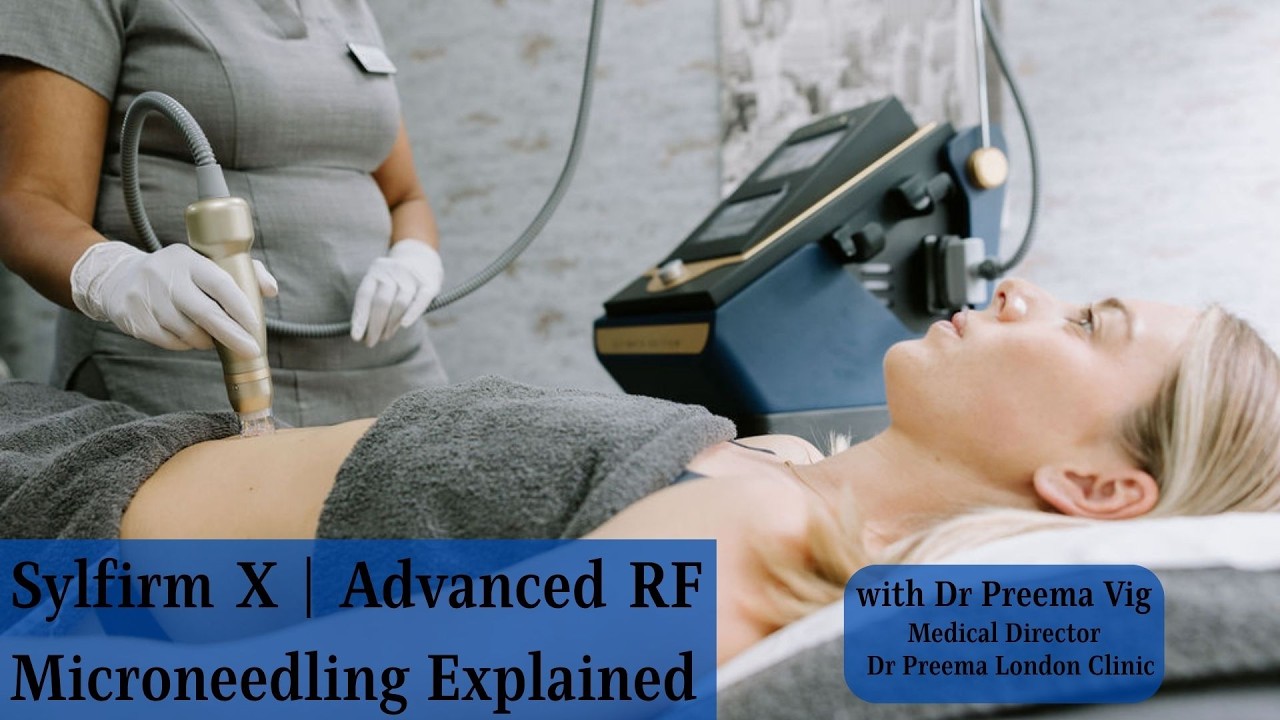
In this video Dr. Preema Vig, Medical Director of Dr. Preema London Clinic, explains the science and clinical use of the Silfirm X radiofrequency microneedling system. She describes its dual‑wave technology, which combines continuous‑wave RF (delivering steady thermal energy to stimulate collagen and elastin remodeling) with pulsed‑wave RF (targeting microvascular structures and the basement membrane around small vessels). These mechanisms make Silfirm X effective for skin laxity, fine lines, enlarged pores, acne scarring, and certain pigmentation and vascular‑related concerns such as melasma, though it is not a cure. Dr. Vig contrasts Silfirm X with traditional microneedling—adding thermal energy for deeper, controlled remodeling—and with Morpheus8, noting that Morpheus8 can reach deeper sub‑cutaneous layers while Silfirm X’s advantage lies in its dual‑wave mode and specific skin‑quality applications. She highlights patient comfort, often requiring no topical anesthetic, minimal downtime (redness, warmth, mild swelling resolving within 24‑48 hours), and a typical protocol of three treatments. Adjunct technologies like LDM Triple Ultrasound and Softwave may be incorporated. Finally, she emphasizes the clinic’s philosophy of personalized, natural‑looking results rather than using technology for its own sake.
Chapters
What makes Silfirm X different from other radiofrequency microneedling treatments? And why do we use it for everything from skin laxity and acne scars to certain pigmentation concerns? I'm Dr. Preema Vig, Medical Director of Dr. Preema London Clinic in Mayfair, London, and today I'm explaining the science behind Silfirm X and why it's such a versatile treatment. Silfirm X is an advanced radiofrequency microneedling system that uses something called dual-wave technology. Essentially, it combines ultrafine microneedles with 2 different modes of radiofrequency energy: continuous wave and pulsed wave. And that distinction is important. Continuous wave radiofrequency delivers controlled thermal energy into the skin. stimulating a wound-healing response and encouraging collagen and elastin remodelling. Over time, this can improve skin firmness, fine lines, enlarged pores, acne scarring, and overall texture. Pulsed Wave Radiofrequency works differently, delivering energy in short bursts rather than continuously. This mode has been studied for its effects on the skin's microvascular structures, including the basement membrane surrounding small blood vessels. That's particularly interesting when we're looking at conditions such as melasma and certain vascular-related skin concerns where inflammation and vascular changes may contribute to the problem. It's important to say that melasma is complex and Silfirmex isn't a cure, but for appropriately selected patients, it may form part of a wider treatment plan. So how is this different from traditional microneedling? Traditional microneedling stimulates the skin's repair response through controlled micro-injuries. Radiofrequency microneedling adds thermal energy, allowing us to target tissue at selected depths and stimulate additional collagen remodeling. And what about Morpheus8? Both Silfirmex and Morpheus8 use radiofrequency microneedling, but they're not identical technologies. Morpheus8 offers treatment configurations that can reach deeper tissue, including subcutaneous tissue, whereas Silphamex is particularly interesting for its dual-wave technology and its applications in skin quality, pigmentation, and vascular-related concerns. Neither is automatically better. The choice depends on the patient's anatomy, skin concerns, and treatment objectives. Now, something our patients really appreciate about Silfirm X is how comfortable they generally find it. Many radiofrequency microneedling procedures involve applying topical anaesthetic beforehand. But in our clinic, we often find that patients tolerate Silfirm X very well without numbing cream, although this depends on the treatment area, settings, and individual sensitivity. Downtime is generally minimal too. Some redness, warmth, or mild swelling is normal and often settles within 24 to 48 hours, although occasionally recovery takes longer. We typically recommend an initial course of 3 treatments, Because collagen remodeling takes time. And depending on the patient's needs, we may incorporate other technologies such as LDM Triple Ultrasound to support skin quality or Softwave for additional skin tightening. At Dr. Preema London Clinic, our approach is never about using technology simply because it's available. It's about understanding the skin, choosing the appropriate treatment, and ensuring optimal results. And creating a personalized plan that delivers progressive, natural-looking improvements. There we go, back on track. Because ultimately, great aesthetic medicine isn't about making you look different. It's about helping your skin look and feel its best.