Communicating in a family
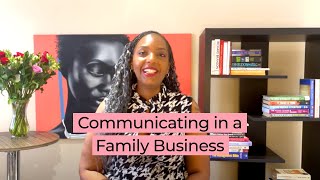
Dr. Natalie Bittere shares how family dynamics blur professional boundaries in family businesses. She recommends formal communication in front of staff, email with CCs for documentation, and pausing heated conversations. Base performance reviews on facts, standardize how you address family members, and bring in HR when needed.
Chapters
Foreign. Hi, I'm Dr. Natalie Bittere, and today we are talking about communications. But in family businesses, that's a specific, specific area. So like I always say, communication is so important. This is how you interact with other people, and other people is what makes the world go round. So the better you communicate, the better everything works out in your business. So I feel like in family business, the biggest thing that makes it different from a different business or a different organization is the family dynamics, right? And so that usually comes down to respect, because it's not like how you respect your boss and employees and your colleagues in other companies, but you have family dynamics at play. Because in families, especially in Africa, we have seniority in who is older, who are the uncles, the aunties, the parents, the grandparents, who are the children, the nieces, the nephews, the cousins. That is how the family structure is. But when you move the family into a business, it's not necessarily in the same structure. So someone who is senior in the family might be more junior in the company. Someone who is more junior in the family might be more senior in the company and the other way around. So you have to navigate how to communicate like that as well. And it's not just about seniority, but the way you interact with each other affects your team, affects the business. So as a family, you have to also put in some more effort to communicate in a professional and effective manner, especially in front of other employees, but even for yourselves when you discuss company matters. So I'd say that is the biggest issue and that's what you have to learn how to navigate. So always be formal, I think, because when you take it like you are sitting at the family dinner table and that's how you're talking to each other. If you do that in the workplace, it's easier for internal things to slip through, like the way you talk to each other, the nicknames you have, the language you use, it's not as professional and it's easy to fall into arguments or disagreements or joking around or talking about, hey, but on Sunday we're supposed to go to auntie this ones and meetings. So when you're in the family business environment, I say always go with formal communication. Another thing that's really helpful with all communication, there's so many types of communication, right? But I'm a big fan of emails when it comes to work, because we work in teams and emails have a better paper trail. You can always go back and check. We use WhatsApp a bit now. I know slack is popular in America, but it's good where you have evidence. You can always go back and say, what did that person say? Or who said this? Or who did that? Not to blame, but sometimes for clarification, to remember to check what amount was it? How much did this one pay? So it's good to use emails, but what I always encourage my team to do is always CC all the people involved on that project in the email. You'd always rather send too many emails than too few. Because if I'm working on a project and now I have to involve different people, this one has approved this, that one hasn't approved this, this one is taking long, this one has got their part done. If everyone is always in the email thread, they're in the loop. And that really helps with family, especially because it keeps it formal. Instead of you having this disagreement with your relative in the company, you. You can do it on email where everyone has to be more polite and you say, this is what I expected. This is what needs to happen. This is what's going on. Thank you so much. And everyone else is present. So it forces you to stay professional and respectful and it helps things to keep formal. I think that's what really helps with family businesses, because working with family members, it's like working with a colleague you've known for 20 years. It's so much harder because you have all these layers of your relationship, the emotional stuff, the. The other agendas, the different people who are involved. And it can also be much better. It's more fun, it's more enjoyable. You know each other, you know each other's strengths and weaknesses, what you can say, what you can do. It's fun to have lunch with your family members at work. You know, small things like that. But you want to make sure you stay that balance of your judgment in your communications. So you need to try and stay formal and respectful. It's useful. The other area, I think that is always challenging, it's talking to family members who are now senior to you or you are senior to them, and how you keep that balance of respect. So something people find funny is that I call my dad Chairman, but I'm so used to doing it now because when I first started working, it looks very bad when you're sending emails and it says daddy at the top, and then you're sending a formal email and there are other people in the email. It was not a good look for me. So what I did is I changed his name in my phone and all my contacts to Chairman, because that's what we all refer to him as so I don't want to be in a meeting and I say Patrick or PB or Chairman or Daddy or it's like different every time and I don't want it to be weird. So what I thought was better was we all call in the same thing. So what all the other team members and like my peers call in is what I call them so that it's clear and it's simple. Now I also work with my mom and we call her Madame, but we also call one of the GM's Madame, and some of the staff call me Madame. So we always have to be careful in which Madame we mean. But when we say Madame, most of the time it means her. So there are small things like the name that you use, the language, the way you describe someone, the way you interact with them, that makes a difference. Something I also do is with the senior managers, like some of them, I always try to use their names or say Mr. This one or Ms. This or Madam that in front of the junior staff. Because if I also just start throwing out their names casually and yet that's not how they address them. It affects the culture in the company, right? And I don't want a senior manager to feel disrespected. So I take that same attitude with family members. So you make sure that it's formal and that you have a clear way of doing it. That's what helps you to keep in that professional space. Because you need to be able to communicate clearly. You can't afford to be having clashes. It affects the whole company, it affects everyone negatively, and it demoralizes your staff, your teammates, whoever you're working with. So in a family business, I know it's kind of weird, but I've also seen other families do this. Like, I know some. One of my friends, they call their dad Chairman as well. If just more organized and more formal, you don't want to be saying Daddy in a meeting. It's strange. So there are small things you can do to address these situations. The other challenge is usually when you have family members working with you and things become difficult. Like for me, I have family members above me and family members below me in the hierarchy of the system. So sometimes it's my job to have difficult conversations with a family member who is not living up to expectations. But I can't treat them differently from another team member. I. I can't say, oh, because this is my relative. Yeah, they didn't perform, it's okay. No, I have to be able to sit there with them. And talk to them in a calm way so they don't start getting defensive. When we were kids, you did this. You said this. Now you think you can boss me around. We don't want that. Stick to the facts. This is what I always say. Stay professional and formal. It helps you because there's nothing to hide behind. When you stick to facts, things are transparent. You have evidence. Show them. This is the email that they sent you. Six weeks have passed. You've not delivered. This is the thing that you did. This is the thing that you said. This is what the issue is. You've not performed. These were your targets. You've not hit them. Make sure you stick to the facts. You're not attacking someone's character. You're showing them where they've gone wrong and how they can improve in future. So this is what we've thought about. Sometimes it also helps to have HR there. If you have an hr, let them be involved. Just because it's two family members involved in something, it's a company issue. Is the issue that they are bringing personal things from home to work, or is it an actual issue at work or are they mixed? Having an HR there as a mediator is useful. It forces you to also try not to start to fight with your sibling, how you do at home. But you also get to communicate clearly. People stay calm. Because the thing with working with family members, it's so much easier to just go straight into anger or crying or shouting or whatever because you have these deep emotional relationships that. That you're living at home. So I'm not saying it's easy, but I'm saying it's doable. It's possible. You can do it. You just have to practice doing it. And I'm not saying I'm perfect at it. I'm sure there are family members who get vexed with me. I also get annoyed with them. Sometimes we don't handle it well. But over time, we've learned how to communicate better as a family in formal settings so that we can make decisions for the company. We can. We can put our feelings aside because we know one of us has to give in or someone has to change or we have to agree we'll see another way. Because. Because we have to move forward. So it's a hard process, but if you're intentional about it, it's doable. You just have to try. My biggest piece of advice when things are heated with family members is pause. When everyone is adding fuel in the same fire, nothing gets done. Nothing moves forward. No one is saying anything useful. At that point, you're just hurting each other's feelings. So pause, Take a few deep breaths. Try and see the logic. Try and see the facts. I know the feeling when you're so upset and you can't even think clearly. You just want to get angry with someone or you want to shut down and not say any. That's not what I'm saying. To pause is to take a break. Breathe. Let your brain get back in control of your systems, not the emotional hijacking that you're going through. Pause and see. How can I tone this down? How can I inspire this person? How can I get things to turn around so we can move forward? Go back to the facts. Be transparent, be open, be calm. So there are so many things you can do. Once you get your breath back and you're calm and you're focused, you can communicate better. It's a hard thing to do, but it's worth it. Because when your family business thrives and you all learn to work together and you're communicating well, it's really a wonderful thing to enjoy, to embrace, to experience. So I encourage you to work on your communication with your family members that you work with. If you found this video useful, be sure to subscribe on my social media channels so you can get more information. I believe in you. I want you to succeed and I'm here to support you.










