LIVE EVENT Q&A: Dr. Andrew Huberman Question & Answer in Toronto, ON
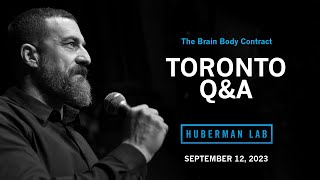
Transcript of the Huberman Lab Podcast live event (Meridian Theatre, Toronto) containing an introductory sponsor read for Eight Sleep and AG1, and a transition into the recorded question-and-answer session following a lecture titled “Brain Body Contract.” The intro highlights product features (Eight Sleep temperature control and sleep tracking; AG1 daily nutritional drink) and promotional links/offers.
Chapters
Welcome to the Huberman Lab Podcast where.
We discuss science and science based tools for everyday life.
Recently, the Huberman Lab hosted a live event at the Meridian Theatre in Toronto, Ontario. The event consisted of a lecture entitled the Brain Body Contract followed by a question and answer session. We wanted to make sure that the question and answer session was available to everybody regardless of who could attend in person. I also want to make sure to thank the sponsors of that event which were AG1 and 8 sleep 8 sleep makes smart mattress covers with cooling, heating and sleep tracking capacity One of the key things to getting a great night's sleep is to make sure that the temperature of your sleeping environment is correct. And that's because in order to fall and stay deeply asleep, your body temperature actually has to drop by about 1 to 3 degrees. And in order to wake up feeling refreshed and energized, your body temperature actually has to increase by about 1 to 3 degrees. With eight sleep, you can program the temperature of your sleeping environment in the beginning, middle and end of your night. It has a number of other features like tracking the amount of rapid eye movement and slow wave sleep that you.
Get, things that are essential to really.
Dialing in the perfect night's sleep for you. I've been sleeping on an eight sleep mattress cover for well over two years now and it has greatly improved my sleep. I fall asleep far more quickly, I wake up far less often in the middle of the night, and I wake up feeling far more refreshed than I ever did prior to using an Eight Sleep mattress cover. If you'd like to try Eight Sleep, you can go to eightsleep.comhuberme to save $150 off their Pod 3 cover. Eight Sleep currently ships to the USA, Canada, UK, select countries in the EU and Australia. Again, that's eightsleep.comhuberman AG1 is an all in one vitamin, mineral probiotic drink. I've been taking AG1 since 2012, so I'm delighted that they sponsored the live event. The reason I started taking AG1 and the reason I still drink AG1 once or twice a day is that it provides all of my foundational nutritional needs. That is it provides insurance that I get the proper amounts of those vitamins, minerals, probiotics and fiber to ensure optimal mental health, physical health and performance. If you'd like to try AG1, you can go to drinkag1.comhuberman to claim a special offer.
They're giving away five free travel packs.
Plus a year supply of vitamin D3K2. Again that's drinkag1.comhuberman to claim that special offer. And now, without further ado, the question and answer session from our live event at the Meridian Theater, Toronto, Ontario.
Okay, what motivated me to do the guest series with Paul Conti? Okay, so first of all, for those of you that don't know, Paul Conti is a psychiatrist. He's a Stanford and Harvard trained psychiatrist. And I wanted to do the series with Paul for several reasons, and we initiated that series. First of all, he's incredibly talented as a clinician. And yet, despite having written an excellent book about trauma, I felt that two things were true for sure. One is that most people won't get the opportunity to work with Paul. Sadly, he's time limited. And second, that his expertise is incredibly vast, not just restricted to trauma. Traumas, if understood, can be transmuted into, you know, deep sources of knowledge that other people can benefit from. And indeed, what I found in Paul as I got to know him is that he has just profound insight into the unconscious mind. And people had long asked me, you know, around, in and around the podcast, what about the subconscious? What about the unconscious? And I was of the mind that the supercomputer of the human brain is the forebrain, the thinking, planning, context setting piece right behind our forehead. So that, you know, it's the reason that we're not the house cats, the house cats are the house cats, and it's the reason we're the curators of the planet. But Paul said, oh, no, no, no, no, no, no, no, no, no, no. The unconscious mind is the supercomputer of the mind. I'm like, well, that sounds great, but how do we understand the unconscious mind? And he has a really biological and psychological and psychiatric understanding of the unconscious. And in that series he talks about these so called cupboards that we can look into in order to better understand our unconscious unconscious mind, in order to allow our unconscious mind to teach us things about ourselves that are useful. And there are three main places where our unconscious teaches us useful things that allow us to be more conscious of the way that our brain is working in useful ways. The first is in these liminal states between waking and sleep. It really does seem to be the case that when, surprise, surprise, we're completely still and we're emerging from, or we're dropping into states of reduced autonomic arousal. But our level of thought, if you will, is still active enough that we are aware, maybe even lucid dreams. And also in dreams, our unconscious mind uses, as I think Jung and Freud Pretty well understood symbols to teach us things. But everything's flipped in there. Gender's flipped like, like the per. Like just because you're having a conflict with somebody in your life who's a man doesn't mean that that person shows up as a man. They could show up as an animal. So species are flipped, the symbols become mishmashed. But Paul made it very clear that all this can be parsed if you do a certain kind of introspective work. And I thought that would mean a lot of talk therapy, that people would. How are we going to get people to learn how to do talk therapy by themselves? We want to keep things as much, you know, independent of cost and things like that. And the practices he started talking about were incredibly simple things like mirror work. This, some of the psychologists in the room will be familiar with this. I thought, mirror work, what is that? And he said literally people trying to activate their unconscious, you know, or excuse me, access their unconscious in sleep by a practice of staring into the mirror for some period of time while awake and reflecting on self and aspirations and the idea of the body as a container. All this stuff, even for a kid from Northern California, sound really, woo New Agey. But here it's scripted by Paul into a formal structure that one can use to parse your own mental health and enhance mental health. So that was the reason for, for doing the series and especially the. The episode on relationships, not just romantic relationships I found hasn't come out yet. Incredibly interesting because he talked about how in his clinical experience all, virtually all the stuff that people pay attention to in relational stuff is are they a narcissist, are they obsessive, Is this person a musician versus whether or not I'm an accountant, Are we compatible? That none of that stuff predicts anything as well as the balance of these three drives, the aggressive drive, the pleasure drive and the so called generative drive. And I found it to be fascinating and I'm excited for that episode and the other episodes to come out, but basically because Paul's brilliant and he makes the. What I consider pretty obscure and opaque, very clear and concrete. And there are a bunch of worksheets, again, all available at zero cost and none of them are requiring that you do therapy with anybody if that. If you choose not to. This is all the kind of work one could do on oneself. And the last thing I'll say about this is that, and I should have said this first, is that the primary motivation was we did a series of Dr. Andy Galpin on physical fitness. Why Isn't there a series on mental fitness? Right. Like, what is that? Why do we talk so much about mental health when we're. And it's usually a conversation about mental illness? What people should have tools and practices that are zero costs, I believe, to be able to introspect in a structured way and enhance their mental health independent of, you know, their level of income. And I think Paul was the guy to do it. And we'll do more of that with other people as well, because no single episode about any topic or series can exhaustively cover any topic. Although Lord knows we. We will try. Okay, next question. What are the recommended protocols and best practices to enhance emotional resilience and develop effective responses during highly triggering situation? You're asking the wrong guy. Yeah, I mean, I don't snap. I don't snap. I was a wild teenager, but I don't snap. I'm not the aggressor. But I do have a snap button and it's been pushed before. And I have to say, when that happens, it's really kind of a scary thing. Not to me. Right. And it's been many years. But I think anyone who's. Who's hit that threshold where you just. You try not to say something, you say it anyway. You know, that's usually how it shows up for people. I think we hear the statements like, be responsive, not reactive. Okay. That's why I became a biologist, because stuff like that makes no sense to me in that moment. How are you responsive, not reactive? So to me, it was like, what are the tools? Clearly, as you go up that continuum of autonomic arousal, it becomes much harder to do, whatever that means. Right. So that, hence the. The tools for reducing stress in real time. I think the one that we haven't emphasized so much on the podcast. And by the way, thanks to some great therapy, and that was not voluntary. I. I was able to, you know, I was a wild kid. A wild, wild kid, hung around wild kids. And things were pretty different then, and we worked it out. But I think nowadays it's wonderful because I think people are more conscious of the need to understand their nervous system, their own psychology that wasn't as common back then. In fact, I hid the fact that I had to do therapy for a long time, thinking, wow, everyone's gonna think I'm crazy. They did call me crazy. I think things have really changed. I think the last 20 years have brought about a profound shift in the way that we think about our own species and what are useful tools and practices. And I think that one of the things that is abundantly clear is that that threshold for a stress response really is different for different people, different in different situations, but that it is something that can be practiced and elevated. And in terms of not getting near that trigger point, through the types of practices I talked about earlier, getting more comfortable with adrenaline circulating in your system is what it's really about, frankly. But of course, it all starts with a good night's sleep, right? It's going to make you far less reactive. But of course, when you're stressed, that's often when you're not getting good sleep. So I think that ultimately that our ability to, as you know, more emotional resilience and effective responses during triggering situations is really the consequence of practices of taking good care outside of those situations. And then of course, inevitably there will be situations where people get triggered. And it's actually interesting to see the way that people behave online and the fact that, you know, many people, in fact, in science as well, have literally lost their jobs for having, you know, not being able to control their thumbs up. It's kind of. We're in an odd time where there's the distancing of doing things online as opposed to in person, where people somehow engage in saying things and doing things that they wouldn't in person. But I think that ultimately it's the consequence of good self care. And this gets actually back to some of the things that are covered in the Conti series. You know, we hear about self care as. We think that means massages, which are great, by the way. And we think that that is about exercise and that's wonderful. But much of self care is about really making sure that our nervous system is in the state that we need to be in in order to go about our day. And I think this is why morning routines and practices are so vital. I think that those set the stage for the emotional resilience, those set the stage for avoiding getting triggered, so to speak. I don't think there's a lot that one can do in real time, except perhaps physiological size. So sorry to give you a sort of empty answer. I'm not a pessimist on this front, but it's. I think that ultimately it's like saying, well, what if you have to scale the side of a building to get in? You locked yourself out. You know, what can you do to prepare for that? Well, you can buy a ladder, but if you don't have a ladder, you know what? Because what you probably should do is be physically fit enough to climb up a Railing or something like that, and know how to pick a lock or something like that. So I think ultimately that it's the consequence of stuff that's done away from those triggering situations. Next question, please. How would you describe the brain activity of somebody when they're suddenly inspired? And how do you foster inspiration in your life? Well, I talked a little bit about this, but I. I will say that the best way to foster inspiration is in the words of the great Joe Strummer. They actually call it Strummer's Law. No joke. No input, no output. I think one of the things that I've observed over and over again is that as much as we need to dedicate ourselves to our craft, to our families, to our friends, that ultimately our best ideas come from disparate experiences when we're not seeking a particular kind of input to get ideas. Now, maybe this practice of being completely still while being alert fosters a lot of. I think the way I understand it is more of a geysering up of stored information in the unconscious. So I think Rick would talk about it or Paul Conti would talk about it as geysering up from the unconscious, because when we are focused on the outside world, we're taking in sensory information exteroception, as opposed to interoception. And of course, that external information, sensory information that no input, no output, is that those are the raw materials that our nervous system uses to construct ideas about anything. So my belief, and this is a practice I do every week, is I make sure that at least once a week, I either walk or hike or run without any earphones, and I'm trying to get into states of wordlessness states where I'm not digesting a podcast, where I'm not reading a book, where I'm not listening to a lecture, where I'm not in conversation and essentially trying to turn off the linguistic narrative. We are a storytelling species. We tend to take all of our internal and external experience and construct things around language. But language is not spoken. Language is not the language of the nervous system. The language of the nervous system still remains to be identified. It's something else for people that think and feels. It will certainly incorporate that. Spoken language, of course, is important, and we have some core structures to spoken language. We covered this in the podcast episode with my friend Eddie Chang. But ultimately, the. The way to come up with new ideas, inspiration, is going to be to collect the raw materials of experience and then give ourselves these periods, maybe even just five, 10 minutes. You have to lay around half the day Doing nothing, still wide awake. And give that those raw materials the opportunity to, to marinate and combine in whatever ways that are unique to you and then to geyser up what inspiration looks like in the brain. We don't really know there's awe. There are some studies about awe, but that's different. The word that better comes to mind is delight. Awe in my mind is something that we, we witness that sort of overwhelms our attention. Like, wow. Delight is when it somehow links up with our own internal narrative. Like I have something to do with what's happening. I'm not just here to witness it. You know, fireworks show, really impressive. Fireworks show is like, aw. But there's nothing to do about. Doesn't relate to anything about you, really. You're purely a spectator. Whereas delight is when you see something and it somehow links to something and you're emotional or personal history or how you're wired that now there's something to do about it. That's inspiration. And we don't understand where that exists in the brain or what that looks like. But I think we all recognize that feeling when it happens. And it's oh so wonderful. Okay, next question please. How can Canadians fight the seasonal depression? Winters are too long here. Okay, okay, well, this gives me an opportunity to share with you what I think is one of the coolest things about our species. Notice I say that about many things. So we've talked about circadian rhythms, right? Sunrises, sunsets. And we get that information transmitted into our nervous system by looking at the sunrise. By the way, you don't have to watch the sun cross the horizon. It just needs to be low solar angle, low in the sky. Once it's overhead, it's a different signal. So low solar angle, that's what it's about. It's not necessarily about seeing the sun cross the horizon. By the way, someone the other day on my team said, wait, won't you get cataracts if you look at the sun? Low solar angle, sunlight is very unlikely to cause cataracts, especially if you're just doing a 10 to 30 minutes. That solar, you know, the sun overhead is when it's quite bright. Yes, indeed. Some people are going to be at risk for cataracts. So ophthalmologists in the audience can attack me for that one. But it was our chair of ophthalmology at Stanford that said it, so I'm going to trust him. Okay, that's circadian 24 hour rhythms. But there's also these circannual rhythms. So if you're at a fairly northern location on the planet, nights get very long, days get short. In winter, what happens then? Well, melatonin, the hormone of darkness, right. Is essentially obliterated by light, by sunlight. So what's happening when days are, you know, 12 hours long, you have very little melatonin. The duration of the melatonin signal is very short. Then, as you proceed into the fall, days are getting shorter, nights are getting longer. The duration of the melatonin signal is getting longer and longer. Then is, of course, in winter, there's a lot more darkness. Melatonin signals are very long. Daylight signals are very short because the days are short. So you could say, okay, well, that's obvious, thank goodness. But what that means is incredible. What that means is that you have a hormone, melatonin, that's secreted from your pineal gland, which Descartes called the seat of the soul because there's only one of them in the brain. I don't know how he came up with that one. But the pineal secretes melatonin, and you suppress melatonin secretion with sunlight viewing. There's a couple of synapses in between the eye and the pineal, but it gets there up through the neck, basically the cervical ganglion. What's wild, therefore, is that the location of the Earth around the sun and the tilt of the Earth is translated into a neural and then a hormonal signal in your brain, which to me is amazing. That literally means that the position of the Earth around the sun and its tilt are translated into a physiological signal that's working unconsciously to tell your brain and body what time of year it is. But it doesn't care what time of year it is. It cares about where you are in this orbit, about the sun. So if you think about when days are, say, eight hours long in the fall versus eight hours long in the spring, what's different? What's different is how long the signal was the day before. So the seasonal depression we now know is the consequence of the melatonin signal getting longer, not an absolute duration of the melatonin signal. In other words, in the spring, when a day is eight hours long, but yesterday the day was seven hours and 48 minutes long, your brain has a memory of how much melatonin was released the day before, much more than that particular day. So it's a slow integrating clock. So this is a very roundabout way for me to teach you about the melatonin seasonal rhythm cycle and answer the question directly by saying if you want to offset seasonal depression, what you want to do is extend the amount of bright light that you're getting in the morning slightly as days get shorter, but it's the extension of the bright light exposure. And if you can't do that with sunlight because there's no sunlight, because you live in Toronto, not Toronto, what you want to do is find some artificial source that you can look at in the morning before, before you leave your home. And I haven't talked much about this on the podcast because our listeners are extended around the globe and not just in northern locations. But what this essentially means is getting maybe two to three minutes of bright light exposure as you're heading from fall into winter. Bright light from an artificial source. You do not need to purchase a so called SAD lamp, one of these very expensive seasonal effect depression lamps. You can. What I did was I purchased because I'm very sensitive to seasonal changes in light, even though I don't live very far north is you can get a 900 lux drawing tablet. These are quite inexpensive. They're not zero cost, but quite inexpensive. And just put that on your desk or on your, wherever you make your coffee in the morning, 90 minutes after you wake up, this sort of thing. And just get five or so minutes before you leave the house. And then as you extend into the winter, you don't have to be neurotic about increasing the duration every day. You could actually, the way these slow integrating clocks work, you could actually even just hold it a little bit closer each day. Don't burn your eyeballs out a little bit closer each day. But essentially, if you just dose yourself with a little bit more bright light early in the day as you extend into winter, that will essentially trick the melatonin system into thinking that you're going from 8 hours into 10 hours of light, as opposed to 8 hours into 6 hours of light. Okay, Very simple. And if you can't get one of these 900 lux tablets or something off a website, then you could do this with any bright incandescent bulb. Should work. Again, just be careful not to put it directly against your eyeball. Next question please. How do you increase neuroplasticity? Well, this, this is an opportunity to talk about something I should have said earlier, which is that ultimately, whether or not you are triggering neuroplasticity through elevated focus or whether or not you're taking high dose psilocybin, your business, not mine. And we could talk about psychedelics if you want. Just decriminalized in California or soon to be decriminalized cool. People are enthusiastic. Yeah. The one thing I, I've, I've been pretty vocal about my belief that the data are really interesting, to say the least, about not microdosing. By the way, there's not a lot of evidence that microdosing is useful. I'm not saying it's not, but they're not a lot of clinical trials showing that. But the two macro dose with effective therapeutic support trials are very encouraging, not just for major depression, but also for various eating disorders. Alcohol use disorder, which is by the way, the term that people are starting to shift to, as opposed to alcoholism or alcoholic alcohol use disorder, which is not to be politically correct or just so you understand what they're talking about when they're talking about alcohol use disorder, whether or not psilocybin, whether or not it's mdma, whether or not it's frustration brought about by your inability to play an instrument and, you know, your determination to do so. It's, in the end it's all about deployment of these neuromodulators. Neuromodulators being some combination of dopamine, serotonin, acetylcholine or epinephrine, again usually in combination. What's very clear is that the neuroplastic effects of mdma, the neuroplastic effects of psilocybin are brought about by huge increases in serotonin. This is also can help us understand why for some years and to some extent still now, it was thought that the, the SSRIs, the selective serotonin reuptake inhibitors, would be good treatments for depression. I think some people, by the way, have experienced tremendous relief from the SSRIs. We don't want to demonize them. At the same time, it's very clear that depression is not simply low levels of serotonin. That's also not true. Hence why there's effective in some people antidepressants like rupirin that increase dopamine and epinephrine and, and not serotonin. The point here is that these neuromodulators, as they're called, allow for what? They allow for modulation of synapses, which effectively allows for neuroplasticity. I mean, ultimately, whether or not it's through talk therapy, kundalini, breathing, you know, high dos psilocybin, mdma, or the combination which I think is called a hippie flip. Never done them together. I confess, never done them together, but have done them with a clinician, by the way, in legal circumstances and not a lot. Not, not Often that is, it's very clear that it's opening windows for plasticity. Now what's intriguing, if we're going to just talk about psychedelics for a second, is why a drug like mdma, which increases dopamine, which by the way, MDMA is methylene dioxy, meth, amphetamine, don't let anybody tell you it's something there. It's meth, it's meth, but it's meth with a lot of serotonin thrown in there too. But it's meth. And it's clear that for the treatment of PTSD it holds promise. It's not absolutely safe, especially for people with cardiac conditions. And you, if you're going to go down that path, you want and need a, a skilled guide. And this is where I think the laws are really going to have to pay careful attention to what, who and what is a skilled guide. Okay. And when it comes to psilocybin, the serotonin increase is what effectively causes broader connectivity in the brain. And what's interesting is that both of those drugs increase plasticity mainly through increases in serotonin, but working on very different receptors. So they have different types and outputs of plasticity. What's interesting to me is that because I'm a strong believer that children should not be doing psychedelics, nor should we be giving children psychedelics, is that the, the increases in connectivity in the brain that are the consequence of playing a musical instrument or ideally an instrument with others as a child mimic a lot of the broader scale connectivity, so called, so called resting network connectivity that occurs when people take psychedelics as adults. In other words, and I can't emphasize this enough, and again, I failed at music, music miserably. I'll tell you a story about that in a second. But so getting kids to play an instrument is, it's very clear, improves their ability to learn all sorts of things for their entire life. It's just so, so important. I don't really know what to do about this or who to shout at or talk to about keeping the arts active in, in schools and physical education. But the idea that we would just train kids in math is just, is frightening because if you want them to be truly good at math and science, you'd also have them play instruments. By the way, when I was a kid, I played the violin my parents made me was not the instrumental I want to play. And we have only one picture and it was, they taught me the Suzuki method you're supposed to learn by ear. And there's one picture and all the other kids have their bows up and my bow is down and I'm standing here on the stage and my fly is down and. And I. And that. And literally the neighbor's dog howled. And I quit after that concert. So I was traumatized by. They showed me the picture. My sister teased me relentlessly. So, neuroplasticity. Figure out your choice way to increase a neuromodulator like serotonin or epinephrine, acetylcholine or dopamine. I honestly would not encourage pharmacologic or psychedelic approaches as your primary entry point. I really don't. I think that there's a place for that in certain circumstances, but that would not be the primary entry point. Next question, please. What type of movement protocol do you recommend for somebody who's working from home sitting behind the computer from 8:00am to 5:00pm? Oh, okay. Well, a couple things. I mean, I can make all sorts of recommendations like get up early and you know, move and if you can take breaks and walk this sort of thing. But let's assume that all of that is kind of understood, that there are certain forms of exercise that we should all be doing. Three, I think now it's very clear, based on the beautiful work of Peter Attia, whose brother is in the audience by the way, tonight. Yeah, yeah. He's got a younger brother. He's got a younger brother. Can you imagine if Peter Attia was your older brother? Imagine. Be pretty cool. The I sort of adopt people as siblings because they don't know it, but I do it. But I just assumed Peter was my older brother, but turns out he has a younger brother already. And Peter's essentially hammered home the truth, which is that we should all be getting somewhere between 150 and 200 minutes of so called zone two cardio where we're walking a lot and we're moving about where we can just barely hold a conversation. I noticed people in Toronto seem to walk a lot, so that's great. And then three days, a week or so, resistance training, and there are a bunch of other mobility things that we should all do so that we. We don't fall and break our hips because that's. Or another bone because that's another way that people really limit their health span and lifespan and so on and so forth. But two things that can make being at a desk, which I loathe, even though I like to learn, I hate sitting still. You can do the standing desk thing. I do that by stacking boxes. The other thing that was interesting. Did anyone see this study out of the University of Texas, I think it was in Houston this last year, about the soleus push up? Did anyone see this? This is pretty interesting. So the soleus, this wider flat muscle below the gastrocnemius of the calf, is a really unique muscle in the human body. It's 1% of the total human musculature. But it has an ability, what will soon be for obvious reasons, to dramatically shift fuel utilization in the body. What they did in this study was they had people who were sitting for three or four hours a day just simply raise their heel. Seems almost silly, right? They call it a solus push up. When I called it that online, I literally got attacked by the gym bros telling me that's a seated calf raise. Okay. You know, I mean, like, okay. No wonder they, you know, this whole bro science thing gets kind of, you know, people get really aggressive. They lift their heel and they put. They're pushing their toe down. And some people think of it as bouncing the knee, but it's really about pushing the toe down and lift, lifting the heel. So they just simply had these sedentary people do this heel raise. And what they saw was that there was a dramatic, highly statistically significant increase in blood glucose utilization and reduction in, in both insulin levels during that activity and around the clock. Really interesting. What they were doing was mimicking some aspect of walking. Now, is it as good as walking? No. But if you are stuck behind, you know, working from home, sitting behind the computer from 8am to 5pm getting. What they found was that people getting into this unconscious pattern of lifting their heel over and over and shifting back and forth mimicked a lot of the effects of walking. It's not a replacement for exercise, but the shifts in glucose and insulin output and utilization. Excuse me, utilization and output respectively, were, were very impressive. And this a group down at the University of Houston, University of Texas in Houston, is starting to incorporate this into people who have limited mobility. And it doesn't seem like other limb movements can do this. There's something special about the soleus. It was designed in air quotes to be a muscle that's used repeatedly over, you know, extended hours of time and that has this unique pathway of fuel utilization. So is it going to cure obesity? No, but if you're to supposed stuck behind a desk, that would be something useful. I have this little fidget thing. I was too lazy to build one, but I found one online for a couple bucks where you just. When you stand at your desk and just, you Kind of kick it back and forth. Anyone seen these? These are kind of cool. Then you just kind of kick them back and forth. And some people will treadmill at the desk. I can't do that. I can't do that many things, but I also am still like working on this one. I can't. Can't quite do that. Next question, please. My morning meditation, because. Okay, and then I think we're about out of time. But the. Yeah, so my morning meditation is not really a meditation. It's a perceptual exercise. And that perceptual exercise is. Has a weird name because I gave it a weird name. And I didn't intend to sound mystical and I don't want credit for it, but I call it space time bridging. But it's not that. What it really is is that the. To me, one of the most interesting things about the nervous system is our ability to orient in different time domains. This gets a little bit abstract, but we know from states of high stress that we start fine slicing time. We know this, right? The world becomes like a slow motion video because frame rate has increased. We as a visual vision neuroscientist, I can tell you that in my laboratory we were doing studies with virtual reality where we can crank up people's level of stress by giving them certain visual stimuli. And then their ability to parse information is clearly increasing in the time domain. They're fine slicing much in the same way that when you look at a slow motion video, somebody dunking a basketball or something of that sort, it's because the frame rate went up. Right? So when we are in high alertness states, our frame rate increases. When we're very relaxed, our frame rate decreases. So if you're Rick Rubening and you're lying there looking at the sky, your frame rate is probably slower than if you're hyper focused on. Oh, my goodness. You know, like you said, like, imagine a dreadful situation where somebody sends you a text message. Well, let's make it positive. Somebody's having a child in your family. And you're like, you know, is it a healthy or mom and baby? Okay. I mean, seconds feel like minutes, minutes feel like hours because you're fine slicing time. Okay. And then mom and baby, you're fine. Okay, Great. Happy story. Happy, great. So when we're very relaxed, we tend to bin time more broadly. Now, it's also true that your visual system and your perception of time are inextricably linked, such that if you close your eyes and you focused on your internal state you are fine slicing time. And the second hand, if you will, is more or less the metronome rather is your breathing or. And your heart rate from combined. When you open your eyes and you look at something in your immediate environment, when you move from so called interoception to exteroception, you start, you. Your perception of time shifts fairly dramatically. And you now perceive time according to, believe it or not, the speed of images moving in your environment relative to you. And then as you look out further on to say, the horizon, you extend the time domain even more. If you then imagine yourself kind of in the whole globe, you extend your time domain even more. So my morning meditation, if you will, it's more of a perceptual exercise, is to step through these different time domains to close my eyes and focus on my internal state, open my eyes and focus on something close by, look a little bit further, look a bit further. Think about sort of myself on a. On the globe, the whole world moving. So you're really extending your space domain and then the time domain expands with it, you know, and this comes up when you see these little memes of, you know, anytime you're worried, just remember you're a little dot on a little blue dot spinning in the universe, you know, this kind of thing. But you don't think that way when you're stressed. You're thinking, I'm the blue dot, you're the problem, whatever, you know, I want that, you know, you're not thinking. So this perceptual exercise is a way of training the nervous system, my nervous system, to shift deliberately between these different time domains. And for me, it's been very useful for improving task switching. Something that, as you probably have noticed, I'm not very good at. I go into the trench, I don't leave the trench very easily. So that's been very useful. And if you are interested in this in more detail, there's a wonderful book called the Secret Pulse of Time. And there's a Hitchcock movie that's discussed in that book, which the movie is about 75 minutes long. And during the course of that movie, the background actually includes rising and setting of the sun and a bunch of different speeds of movement and interplay between the characters and your perception at the end of the movie is that a much, much longer period of time occurred because of unconsciously your brain was paying attention to these circadian signals and these other signals. And it absolutely fascinating. Hitchcock. Not a huge Hitchcock fan, but now I, after seeing that, I was like, wow, that's genius. He captured this space time thing. What you see out the window is in one time domain. In the room is a different time domain. I won't tell you who killed who, but it's very, very interesting. And so the point being that when your visual system is up close, focusing on things up close or internally, you're. You're fine slicing. When you focus on things further away, you're more broadly focusing, and so on and so forth. So that's a morning meditation. I do it only. Perceptual exercise only takes about a minute or so. And the other thing is that on the monitors, they're flashing. Now, that was your last question. So I, I want to just say a couple of things before we go. First of all, thanks to all of you who stood out the night for the long duration. I realized this stuff is, like, nerdy detailed, and there are a lot of other things you could be doing with your evening and your time. And so I'm very grateful that it all came together tonight for this, what I like to think was a discussion. And I also just want to thank everyone for your interest in the podcast. You know, it is a labor of love. I'm highly dependent on my team for doing all of it. I don't do it alone by any stretch. But as much as it might seem like it's me talking to all of you, it really is about all of you. That's the reason I do it, and I'm ever so grateful. And I'd certainly be remiss if I didn't say thank you for your interest in science.










