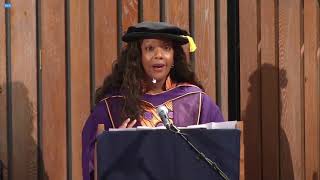
This is a first-person graduation speech by Nataliey (Natalie) Bitature delivered at Keele University. She thanks the university, family and mentors, recounts studying at Keele and teaching at St. Teresa's School for Girls in rural Uganda, contrasts educational opportunity and inequality, and reflects on global challenges (climate change, SDGs). She identifies herself as a social entrepreneur and declares a personal goal to positively impact 10 million young women.
Questions this video answers
2013
10 million
Chapters
First and foremost, I would like to thank the great institution that is Keele University. This campus, the professors, support staff, students and community were so good to me and continue to be a blessing in my life. To the Chancellor and the Vice Chancellor, I accept this honour with great humility and promise to do you proud. To my parents, thank you for being examples of discipline, integrity and resilience for me. If not for your teamwork and sacrifice, I would not be who I am today. I may not say it often enough, but please know I am grateful to my siblings, cousins, family and friends. You will always be my first community, my confidants, cheerleaders and challengers. I appreciate your understanding, honesty and all the fun you bring into my life. And to my mentors and colleagues, the brave souls who interact with me every day, teaching me, whether on purpose or by accident, you continue to open my eyes and my heart to to new challenges and opportunities. For this I thank you. 10 years ago I was a student living here in Barnes Hall. I remember being the only student doing business management and education studies. An odd combination, one might say. But you see, the year before I was a second year law student. Frustrated by my prospects, so I dropped out. You can't really call it a gap year when you take it halfway through your degree. But nevertheless, I moved to rural Uganda to teach at St. Teresa's School for Girl. Unbeknownst to me at the time, this experience changed the trajectory of my life. Technically, this school was in the village where I'm from, my father's father's village. But I was born at St. Mary's Hospital in London. Was this what made me different from these girls? Is this why I have more agency or ambition for my life? I wasn't sure, but I knew it wasn't fair and there had to be something I could do about it. I spent the next few months fundraising for the school and we built a classroom block and added some computers. Surely this would even the playing field. Meanwhile, I broke at peace with my parents and we agreed I could go to Kiel to learn how to become a teacher and also to obtain a business degree, just in case. I thought I had found the solution. Better education. Sponsored by philanthropy. This will overcome the injustice of inequality. A year later I returned to the school and to my dismay, there were now even more teenage girls packed into the new, larger classroom block. And the computers had been off for months. As they couldn't afford to repair them. I began to see cracks in my understanding of the world. Luckily, I was still at Keele. I had the opportunity to pick and choose from so many modules and topics, professors and professionals. Here I learned that if I didn't show up, it counts as a fail. If I pretended there was no issue and continued with business as usual, I was failing these girls. Keel equipped me with the tools to investigate and navigate my path to purpose. I spent four years living here, leaving the harsh contrast between our village here and my village there. In 2013, I graduated from this hall and I was eager to dive into changing the world. Turns out changing the world is not very straightforward, so I worked for a year, went on to do my master's in social entrepreneurship, and four years ago I moved back to Uganda to face it all again. But the context had changed. Climate change, rising inequality, an increase in conflict zones and escalating discrimination are the challenges of our time. In the case of Africa, I had a massive population boom. People today face these issues and their consequences every day, and for the first time in history, we experience them together. Thanks to technology, the ecosystems are broken environmentally, politically and socially. We face excessive challenges and targets like the SDGs are set out to guide us back onto a path of safety and inclusive prosperity. However, we also live in very inspiring times. We have activists like Greta Thunberg bringing attention to climate change, Kylie Jenner, the youngest self made billionaire ever, and Sana Marin, Finland's exciting new prime minister. These women are pioneers, breaking barriers for their achievements. So why can't Esther, a teenage girl from St. Teresa's in rural Uganda, also be given the opportunity to thrive, to reach her fullest potential and contribute to the solutions the world needs right now? All marginalized young people deserve the access to opportunity we in this room have been afforded. What will it take? A solar panel? A microloan? A mentor? What does it take to change the mindset of an underprivileged youth? To empower them by giving them agency to explore and to earn? I am determined to find out. Three months ago I turned 30. According to the UN, I'm long past youth, but for me, it was the first time I had stopped to reflect on the path that had led me here and the journey that I still have ahead. So I'm honored to share in this special day at Keele as I look forward. We cannot change the world without being the change. We must all do our part. I am a woman, a global citizen, a social entrepreneur. My name is Natalie Bitaturi and I am personally committed to positively impacting the lives of 10 million young women over the coming days and years so that we can begin to fully unlock the potential of African women today and generations to come. Thank you. It.