Dr. Josiah Fitzsimmons' Interview
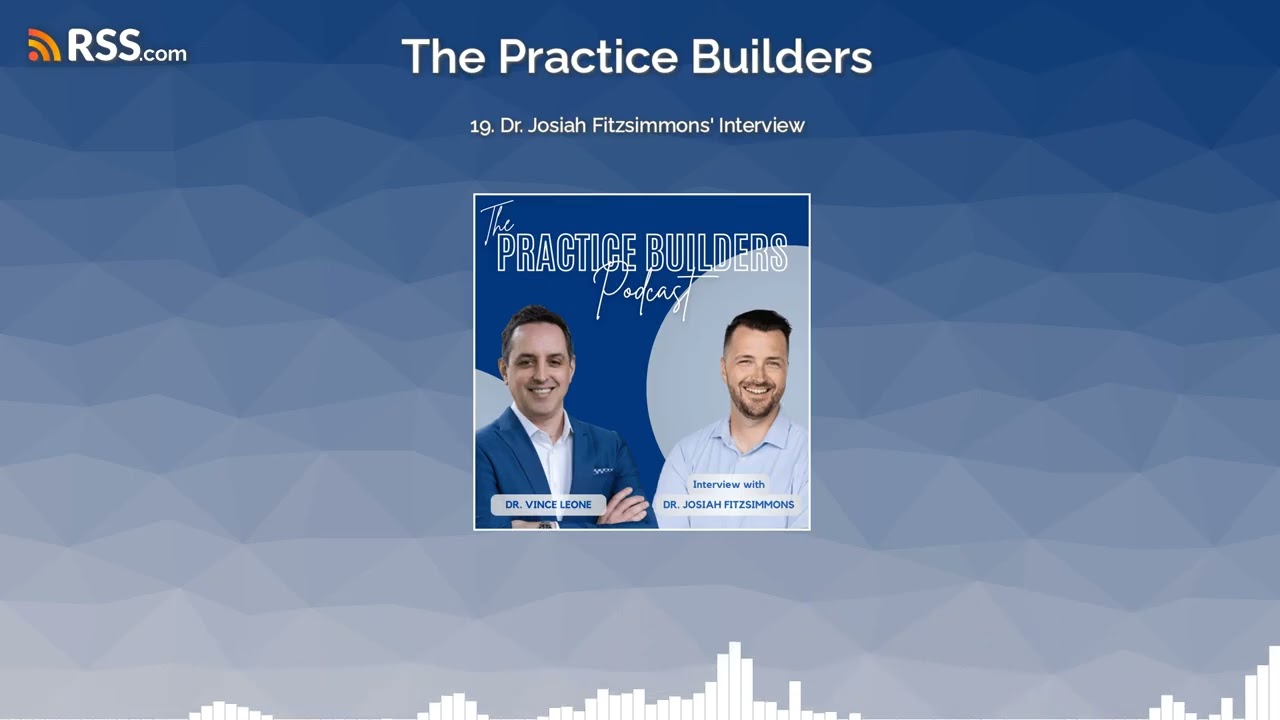
Dr. Josiah Fitzsimmons grew his chiropractic clinic from solo practice to multi-million dollars using a capacity-utilization formula that reveals untapped revenue. He tracks KPIs, lifetime value, and ROI across marketing channels, invests in technology like decompression and laser, and runs intensive weekly team training. His core advice: know your numbers.
Chapters
Hey there, and welcome back. I'm Dr. Vince Leone, executive producer and co-host of the Practice Builders Podcast. With my partner in crime, Dr. Kyle Pankinen, we deliver proven strategies to help you grow fast, specialize with confidence, and build profitable staff-run practices. Let's go ahead and dive into today's episode now. Hello and welcome everybody to the Practice Builders Podcast. My name is Dr. Vince Leone, your host, and Dr. Pankinen is on vacation this week, so we'll miss him. him, but we have a special guest today, Dr. Josiah Fitzsimmons. How are you, sir?
Hey, doing great, Dr. Vince. Thanks for having me.
Yeah, absolutely. We're very excited to have Dr. Fitzsimmons on the call today, or on the, the podcast. Um, actually, I met you, I think it was at Matt Loop's, um, Social Media Revenue Summit last year in 2024. Um, and, uh, had a great story to share and, uh, I think that this podcast will be incredibly valuable for, um, for all our listeners. So, um, get out the notepads and, uh, 'cause I think there'll be some, some great information that you can, uh, take tactically as well as, you know, come from a more strategic standpoint. So, but let's kick this off, you know, take us back to kind of the early days, Doc. Like, what did the practice look like when you first started?
Yeah, great question. Fortunately, I had some great insights before I actually even went to chiropractic school. I was pre-med, I was in an MCAT prep class, worked at a hospital. I played football in college, I got hurt, went to this local chiropractor, and I got amazing results, um, from my football injury. And he's like, you know, you can be a doctor and an entrepreneur. And I was like, Entrepreneur, what? Like, what did you just say? Like, I don't even know what that word means. Like, grew up, my mom delivers newspapers, my dad still waits tables. Like, I had no idea what he was talking about. And he's like, paints this picture of what an entrepreneur can be. And he's like, you know, more holistic approach with chiropractic. And I'm like, that sounds awesome. Like, that sounds much better than medical doctor, you know, working for a hospital where I was working at right now. None of the doctors seemed happy. So I was like, all right, let's, let's, let me go visit. And that's how I decided to, you know, become a chiropractor. And so I was fortunate with that experience that I was like, okay, I got to learn not only how to become a doctor, chiropractor, but also become an entrepreneur. So I had that mindset, thankfully, going right into chiropractic school. And so I was like, okay, where do I learn? Who's going to teach me? What, what classes in the curriculum? You know? And I quickly learned, all right, that's not a big part of the curriculum.
Um, it's not a part of the curriculum, right? Yeah.
And So I was like, okay, well, I need to learn this. I gotta figure it out. If it's not at school, where am I gonna learn it? And so I was just really big on the front end too, as, you know, I wouldn't call myself a technique junkie, but I was just very into clubs and learning, you know, how to deliver the best care. And so I'd always go up to those doctors at conferences. I went to Palmer and Davenport. And so, you know, all the techniques and speakers would always come in there for the school, and I would always go up and ask them, You know, some more of those, well, hey, this is awesome, I want to deliver great care, but like, how do we get new patients and how do we do this and how do I run systems? And they're like, well, you want to come shadow my office? And I was like, yeah, heck yeah, of course. So before I graduated Palmer, I actually went to over 50 clinics, uh, all around the country.
Wow.
After my second trimester, a couple of them started being like, well, hey, I do these screenings on the weekend, do you want to can you help with the event? I'll fly you out, pay for your hotel. And I was like, yeah, can I stay in the office on Monday or Friday and, you know, shadow you too? And they're like, yeah, of course. So literally, um, I got pretty good at doing these marketing events for doctors. One of the first few that I ever did, I signed up 98 new patients for this guy in a 2-day home show. Wow. And he's like, what did you do? You know? And I was like, You know, I filled out your health survey, I asked them some questions, I figured out what their complaint was, how was it affecting their life, and I scheduled them. He's like, I don't know what you did, but I'm gonna tell all my friends they need to bring you out. So I literally had like 5 to 7 doctors a week asking me to come to their office and do events for them for the next 2, 3 years at Palmer. And so that's how—
Wow.
I went to all these offices for free, learned how to communicate, learned how they ran their clinics. And so with that, you know, learning while also going through Palmer, I was really able to learn more of the business side of things. And so yeah, I opened my own clinic right out of school. 4 months after I opened, I already had over 400 prepaid appointments. Before I ever opened, did over a million. My first year in practice.
Unreal. Was there a kind of a pivotal moment after you opened where things started to kind of click and scale for you?
Yeah. So really, so second year in practice went to $2 million. Third year in practice was COVID. And so that was like, okay, like, what am I gonna do? Um, I want to keep growing. You know, we all had a lot more free time suddenly on our hands, you know. And so I was like, I gotta, I gotta do what I just did in school. Like, hey, I learned from all these clinics got me here. Now I gotta go find all these 2 million plus clinics that I can go learn from. And I was like, I couldn't find very many of them. And I'm like, okay, this isn't very common in our profession. Like, I'm 2 years out of school and I've already reached the top echelon of the profession. I'm like, something's wrong. Like, something's— like, we have the greatest healthcare product in the world. I'm getting miracle testimonials. People's lives are being changed. And 2 years in, like, this is the— this is it. Like, this is the summit. And I was like, that can't be it. Like, what do we— what is— what is missing? So I'm like, well, it doesn't seem like chiropractors have it figured out, you know, is what— is what I came to the conclusion of. And I was like, I need to look outside of the chiropractic profession. What are they doing that other professions are scaling? I had a brother-in-law at the time who worked for Tesla.
Hmm.
And I was like, man, tech companies were a great example in my mind that literally seemingly were created overnight and within a few years were these billion-dollar behemoths with thousands of employees. I'm like, okay, like how do you do that? You know? And so I just became a book nerd and, you know, just tried to learn, you know, business books and try to learn all these different methodologies and scaling frameworks and analysis and The most fundamental thing that I learned in this process was that you need a funnel or a filter of insights into your company's data to make decisions. And so that's really what helped me then. I, as I had this framework of how to make decisions, to make the best decisions to grow, you know, that was really what I learned from this is I needed to be much better at understanding my key performance indicators, my data. to make the next smartest decision. Because I was always, I think this is what I should do. This is what I saw this doctor in Utah do one time. You know, this is what I think is due. But it's like, is that actually the best choice? Well, what I found is this scaling framework of just analysis and data analysis and decision-making from these books I read. And so that's what I implemented. So then the next year we went to, you know, $5.5 million in 1,800 square feet. Wow.
That's wild. Was there one book that really stood out for you?
I would say right off the cuff, 2 books. I would say, uh, number one being Traction, um, by Gino Wickman with the EOS operating system and kind of putting all the framework behind scaling, utilizing structure. And, you know, in chiropractic, I think we have very good systems— day ones, day twos, processes, table talk— but we don't have structure of actually how do you grow and So forth. And the other one is what's called The Lean Startup, and it's more of a book for tech founders. I kind of mentioned the tech, you know, kind of slant that I tried to look into, and they use— and then, and that explains a methodology, what's called agile methodology, where you work on what's called sprints, and they're 2-week intervals in your business where you essentially evaluate your entire business. And what is the top thing that's gonna take the least amount of work that's gonna have the greatest impact on the business? Work on that one thing, you know, for 2 weeks. And then, you know, essentially one week into that, you say, what's the next thing I'm gonna work on when this one's done? And then you're just constantly doing this short cycle business evaluation to constantly be focused on the most important thing.
That's amazing. So Traction by Gino Wickman, Lean Startup. I, I have followed Traction for a while. I really like that, that kind of structure for business. But, um, but The Lean Startup, I've always seen that book, never read it. Now I'm gonna go to Amazon when we're off this and, and get it. Or I love that every 2-week sprints, um, you know, just to, to really kind of get some momentum, um, especially for those doctors that may feel a little stuck in practice. I feel like that could be something super valuable for them.
Yeah, so the other big piece of it is what's called in there— again, this is a little more tech, I kind of adapted it for chiropractic— but in there they call it MVP, or minimum viable product. And so basically that's the entire premise of software development, is you could, you could build some massive huge undertaking that no one's ever going to use, and you could do all this waste on time and effort and energy when that might not be the next best thing.
Mm-hmm.
And so that's why I feel like a lot of chiropractors is they buy this piece of equipment, eventually it's sitting in their garage. You know, they, they go to this seminar and then like nothing, you know, hey, 2 weeks of excitement and then like nothing happens. They bought this manual and then soon it's collecting dust, you know, and so forth like that. And so with MVP, with the whole concept of minimum viable product, is you're trying to always evaluate What is going to take the least amount of work that's going to have the greatest impact? And so that's the whole entire premise is you always want to do this in these small increments, small, very impactful increments. And then after you do that, get a feedback loop. Okay, that worked, that didn't work, that improved this, that optimized this, customers liked it, team members, whatever the feedback that you need, and then do the next smallest most impactful thing. And it's, um, and that's kind of the whole mindset with that.
Yeah, I love that. And so, you know, probably most of our listeners are doing some type of high-value cash service, decompression, chronic knee pain, neuropathy. So a form of an MVP, if they, you know, if they were thinking about maybe going into these niches, maybe they're not in it yet, is just reaching out to their patient base and seeing what type of their, you know, Absolutely. Sending some type of email sequence, hey, are you suffering from chronic back pain? Do you have herniated discs? And see what type of response you get. Because, you know, maybe not all practices have— maybe a practice that has a younger patient base, maybe they don't have as many of that. Whereas you have 50, 60-year-old patient base as your kind of core, well, there you're probably going to have quite a bit in there. But that may be a nice kind of— if you're thinking about decompression, a great way to just start and say, hey, Is there interest within my own patient base?
Absolutely. I think that's phenomenal. You could even, you know, depending on your EHR, pull a list of what are all your top complaints or top codes, you know, and you could probably get that even yourself. But customer feedback would be a huge part of it. But I would totally agree. That's one thing that I feel like I've really tried to do a better job of is, you know, going slow to go faster. Just taking that little amount of additional time on the front end to do a little bit more evaluation, a little bit more thoughtful planning, you know, and then the path to success in the end is actually much shorter.
Uh, that's a great point. I, you know, I feel like a lot of doctors do get kind of quote unquote sold a piece of equipment at, you know, a seminar event, etc., and, uh, but they don't really have the plan to implement it. They get excited because they can see, hey, I can help more people and potentially build my practice with this, but they don't really have, you know, the tools, the plan, etc., to implement it. Um, I always say you need 2 investments. The first is the equipment, the second is in yourself, you know, in the—
in—
into those skill sets. Uh, could be reversed though. First investment in yourself, second in the equipment. Um, was there anything—
Yeah.
Um, that you like kind of intentionally did not do that you feel helped you grow faster? Hmm.
I think one thing right off the cuff on that one is really optimizing your current offering or your services or implementing just one additional service, optimizing. I think a lot of doctors are trying to implement too much at once. And so they're trying, they're spreading themselves too thin, and then they think none of them work, but they never went deep enough. You know, a lot of, a lot of practices are a mile wide and an inch deep, you know. And so I think just going deeper into, you know, A, what you're already doing, B, if you want to implement something new, you know, pick one thing, really crush it, dial it in. Because once you get that one first thing dialed in, Then I really feel that second thing is 1,000 times easier. If you're trying to bolt something on to a shaky foundation, then you think the bolt-on is the problem, but you just never had a good foundation to build a second floor in the first place.
Mm-hmm.
And so solidifying that stable foundation, like I said, structure, systems, rhythms, feedback loop processes, You know, all these things are all fundamental, whether it be chiropractic care, neuropathy, knee pain, softwave decompression, all these things. You have to have the baseline fundamental foundations of success first, no matter which of those pillars or second stories you're trying to build.
So speaking of that, what do you think some of those baseline foundations for growth, some of the key ones are?
Yeah, I mean, I would say Right off the bat, you know, for me, is the reason why I started Lucro is this understanding of financial data.
Mm-hmm.
Is doctors need to have a better understanding of what's my revenue, what's my profit margin, how much am I spending on team overhead, marketing, the big buckets of how the biz— what's the health of the business, right? We're always talking to patients about their health. Here's where your health is at, here's where you want your health to be. Let's lay out a game plan to get you from, you know, where you are to where you want to be. Well, do you know the same thing about your business? What is the health of your business? What's your revenue, your profit, your profit margin, all these spend, all these major categories? Which one of these areas is going to have the biggest impact on your practice? Is it, is it marketing? Is it improving your team? Is it improving your operations? Is it reducing your overhead?
Hmm.
So that to me fundamentally You need— if you can have the financial evaluation first and foremost, then you can look into show-up rate and sign-up rate and retention rates, and you can look into marketing spend and ROI and conversion. And there's 1,000 key performance indicators that you could drill down into. But first you wanna look at overall health of the business. And so that's really the whole premise of why I started Lucravis, because I felt like doctors just skipping that whole entire step. They're using a bad bookkeeper that's a month or 2 behind, not caught up on their finances. They're only looking at their books for the one day a year to file taxes. And so understand the financial health of your business. I mean, that's why we're entrepreneurs in the first place, right? The reason we work— we're okay working harder, longer, 7 days a week, oftentimes on the front end— is because we want the freedom, the higher ceiling of that being an entrepreneur, being the CEO of a business has.
Yeah, I love that. Uh, morelucro.com is the website. And, um, you know, Dr. Fitzsimmons was just sharing that they've already grown to 38 employees after 1 year. So I know several of our clients are using it with great success and they really enjoy it. So I would— we'll go into Lucro a little bit later, but, um, definitely check that out if you don't have a strong grasp on your financials and KPIs or key performance indicators. How do you think about scaling? Obviously, you did $1 million year 1, $2 million year 2, and now you're at— where are you at now? I mean, you did— last time I talked to you, you were at like $5 million, and then you're probably at like $50 million now. What the heck?
We are just under $7 million last year.
Amazing. Amazing. So how do you think about scaling? Is it more new patients? Is it better retention, bigger care plans, or all the above or something else?
Okay, this is great. I literally did this presentation this morning. I actually have a formula for scaling. Let's hear it.
I love it.
Um, so let me, um, I can share my screen.
Yeah, yeah, let me, let me—
will that work?
Well, um, uh, it will.
Some people might listening audio, some people might listening video, so I'll, I'll do— I'll share my screen if you're listening video. Um, if you're listening audio, I'll, I'll explain it well enough.
If you're listening to audio, um, just go check out my, uh, YouTube channel. I'll be posting this there, uh, youtube.com/ Specialized practice?
Okay, cool. So my scaling framework is very simple, and I think it should be. Scaling actually is incredibly simple when you break it down. And so the whole entire first premise of scaling is maximizing what you're already paying for. Okay, so the easiest example I always give to this is I was talking to a business owner this morning And I said, hey, if I had 1,000 new patients waiting at your front door all next week, how many new patients could you actually process? And she was like, well, usually 30 minutes. You know, some doctors tell me 60 minutes for a new patient. That's the typical. You know, offices are open typically somewhere between 20 and 30 hours, you know, a week. It's like, depending on staff, depending on room. How many new— if you had 1,000 people at the door, how many of them could you actually process as a new patient that week? And she's like, 30. And I said, okay, 30 you could, you could get in through the door. You got 1,000 waiting. Out of 1,000 people, you're only— there's gonna be 970 people that you're gonna turn away, you know? And she's like, I can only get 30 in. I'm like, all right, 30. So 30 a week. So if you do, there's 4.3 weeks in a month. So 30 times 4.3. And if you're listening to this or watching this, do this for yourself, okay? So what is that number? You got 1,000 people Out your front door. Pause it right now if you need to and calculate it. How many can you see per hour? How many 30 minutes? Is it a team member constraint? Is it a room constraint? You know, where, where it, whatever that is, you need to know this number. This is fundamental, you know, CEO-level data that you have to have every single week.
Okay?
But let's just say in this hypothetical example, it's 30 times 4.3 weeks in a month. That's 100. And 129 new patient capacity on a monthly basis. And so I talked to this doctor and I said, okay, that's your capacity. What are you averaging the last 6 months? How many new patients are you averaging per month? And she was like, 35. I said, okay, 35 is what you're averaging divided by your potential of what you could see divided by 129 equals 27%. Was this example literally from this morning? And I said, okay. So right now you're filling 20% of your scheduled capacity. She's like, yes. I said, all right, now if you have 100% of your schedule filled, is your rent going to go up? Is your payroll going to improve, increase? Is your utility bill going to change? Is your water bill— are any of your expenses going to change except the acquisition cost Of those new patients scheduled? And she's like, no. And I said, what is your revenue last year? And she said $900,000. 100, she's at 27% capacity. So that's right at about 400 divided by 27, right at about 4. Time multiple of what she could be, what she has the potential for, what she is already paying for, what she already has the expenses Of a business 4 times bigger, 'cause she has the capacity to see 129 people a month, but she is only filling 35 of those slots for 27%. So $900,000, we did this math with her, she almost threw up, times the 4, what she could be. She has the revenue potential in her clinic right now without increasing her staff, her hours, her work, of a $3.6 million clinic.
Wow.
And so this is the massively untapped potential that I have realized in every single clinic around the country is this exact framework of understanding your schedule first and foremost is that you already have way more capacity than you are utilizing and you are already paying for it. Again, your rent does not change whether you're open 1 hour a week or 24/7. Your rent is not going to go up, right? In the same— if you— whether your doctor, you know, has someone on a schedule or used to have someone on your schedule, or they're waiting for a patient, they're not going to cost any less, you know, depending on maybe if you have some type of contract based on their adjustments, right? We can get into the weeds on that. But in general, the entire premise of scaling is first and foremost maximizing what you are already paying for.
Okay.
And we use— I use new patients as the example there, but you need to— you can do the exact same calculation for adjustments, decompression, shockwave, laser, any other appointment type in your office, you need to understand what is your capacity that you are already paying for, and then what percentage of that capacity are you utilizing. And so that's first and foremost, is understanding what your capacity is. And so then your entire goal is to simply maximize your capacity or your schedule of what you already have the expenses for. Okay, are you following with me? Any question on that, Dr. Vance, so far?
No, it makes perfect sense. I mean, let's—
it's honestly the most simple thing.
Well, you had, you had, um, went over this at the, uh, Matt Loops event, and I was, uh, you know, I was like, oh my God, I wish I had known that, uh, back, uh, in 2007 when I graduated. But anyways, uh, it made a ton of sense then, makes a ton of sense now. I think these are some of the the, the kind of the core principles that doctors could really, um, get a lot of value out of if they leaned into it?
Yeah, so that's the first step, is maximizing your schedule. Okay, and so to really do that to the fullest T, okay, you really ideally want to understand the lifetime value of your client, you want to understand your profit margin, and then like I said, you want to understand what percentage of your schedule is being filled. Because if you don't understand your lifetime value or you don't understand your profit margin, then you don't understand how much you have the ability to spend to acquire those new patients. How do you—
so for you, how do you calculate lifetime value?
So I have an entire spreadsheet. We can get the link for your, um, your people on. I have a video on it, everything. So it's depending on— there's, there's quite a few factors. Yeah, that can go into it. So I would say, without going too deep on that topic, I would say I'll get you that link. We could post it with the podcast and people can do the whole spreadsheet I have built out and then calculate. Because there's a chiropractic patient is different, you know, you need to have a lifetime value for every style of marketing or channel or protocol that you offer. You need to understand the different lifetime value for each of them because if you make, you know, way more money off of one type of patient than another type of patient, then you have the ability to spend more. To acquire that person than you do with the other one. So you don't wanna lump them all together when one might have $1,000 lifetime value, another one might have $6,000 lifetime value. And so you might think you're not getting good ROI, but you just like, because, but the LTV is so much higher, you have the ability to spend. So from a marketing perspective, that's always the number one thing I tell people is stop asking the question, how much should I spend on marketing? It's the completely wrong question. No one should ever ask that question. It's this, It's just a bad question. The correct question is, how much can I spend to acquire a new patient based on my own individual personalized data? Because the other question is a very vague, well, how much does my buddy Tom spend? And how much did this person at the seminar spend? You know, that's totally unique to what style of practice they want, their team, their overhead, their profit margin, where state they live in, their taxes. There's all sorts of factors that go in. That it's not apples-to-apples comparison. So you need to have a very individualized answer to that question. Like I said, I got a whole thing. We can calculate that pretty easily.
Mm-hmm.
Um, the most basic, if you wanna make it like completely basic, do this while you're on the call. You're like, I don't wanna do that LTV thing, spend the time to, I don't wanna make that, I don't wanna make that much money. You know, let's just say you wanna do, uh, let's just say you wanna do 100 divided by your profit margin. That's my shortcut. Answer. Okay, so do $100,000 divided by your profit margin. Any doctor, hopefully off the top of your head, you know a general rough estimate of your profit margin. Unfortunately, it's probably bloated with tax strategies and family vacations and clothes and meals, you know, so you're altering it a little bit to pay the least amount of taxes, which you should for the one day a year. But the other 364 days a year, you want to actually know your real true profit margin. And so 100 divided by that number, let's just say it's 40%. 100 divided by 40 is 2.5. What that means is you need a 2.5x return on your marketing spend. If you spend a dollar, you need to make $2.50 to break even. Okay? And so the basic framework of that, let's just say it's a 33% profit margin. 100 divided by 33, you need a 3x ROI. If you put a dollar into the machine and the machine gives you out any more than $3, how many dollars should you put in? Unlimited. You should put in unlimited dollars if it's giving you more than you're putting in until your schedule is filled, right? And so once your schedule is filled, well then what's the bottleneck? Is it your team? Is it your hours or is it your space? And so 99% of people, it's gonna be their team.
Right?
Because you're probably, you know, uh, can process more people if you had more team members. First and foremost, you go to Chick-fil-A at lunch and there's 40 14-year-olds in there delivering your hot, uh, chicken tenders in 35 seconds.
My pleasure.
Exactly right. You know, so most likely it's your team. It could be your hours, you know. But again, remember, you're running a business first and foremost. I see so many doctors that are open from And these are my hours when I first started, you know, 10 to noon, 3 to 5, Monday, Wednesday, closed Friday. You know, it's like, hey, that's totally cool if that's what you want to work. Okay. But you, again, you realize your rent isn't changing whether you're there or not there. So again, utilizing team members— team members are by far the number one bottleneck to scaling. So if you want to scale, team has got to be at the top of your list. We're in a service-based profession. We're not selling a product that you can just order online that gets shipped to you in your Amazon box, right? For the most part. So you need to have— you need to realize that team members are your number one assets, and you need to have more team members. You want to have more assets, or you don't want to have more liabilities. You want to have more assets. And if team members are truly assets, revenue-generating centers, then you want to have more of them. You want to have better of them, right? And so you need to have that mindset around team. Eventually it might, you might have an hours problem. And after that you solve that problem and you hit, like I said, $5.5 million in 1,800 square feet, then you might have a space problem, right? And then once you expand that again, then you're just going back up. After you expand whatever those are, team, hours, or space, then you're just going right to maximizing schedule, hit capacity, expand. And that's all, literally all scaling is, is— Maximizing your schedule and expanding on repeat.
I, I love that simplicity. Uh, it doesn't need to be complicated, and, um, I like that broken down like that. What role does technology play in your clinic— decompression, laser, shockwave, etc.?
Yeah, I mean, that was really for me to go from, you know, the $2 million adjustment-only clinic to the $5.5 million. That's I had to implement additional protocols because I was out of space. I couldn't see any more volume. And so I had to increase the lifetime value, the quality of care, the level of service that I was delivering, you know, to get people better and faster results.
Hmm.
So I'm a huge proponent, you know, of those protocols and everything that you teach with specialized practice because of exactly that. If you can get better, faster results and be more highly compensated, you know, for the same Around the same amount of energy that you're inputting in. Remember what I talked about earlier? Minimum viable product. What takes the least amount of work that's gonna have the greatest outcome? That's what everybody wants in all areas of life. You know, what's gonna take me the least amount of time to make me lose the weight the fastest? What's gonna take the least amount of time, you know, for my kid to get into Harvard? What's, you know, whatever it might be. Like, you can apply that to anything in relationships, in life. You know, everyone wants the shortcut, the biohack. You know, so like if you can deliver that same thing for your patients where they can come into your office and get the adjustment, the shockwave, the laser, the decompression under one roof, get better results, get faster results, and then obviously you are being compensated for better, faster results. It's a win-win.
Yeah, 100%. Let's kind of shift to team because you had, as you just mentioned, it's such a valuable part of growth. Um, how have you trained your team to, to help deliver the care and drive outcomes without you having to do everything? Hey there, it's Dr. Vince. And if you're getting value from this episode, please make sure to hit that subscribe button so you never miss an episode. And if you know another doc who's ready to grow their practice, share this with them. It might be exactly what they need right now. Thank you in advance. And now back to the show.
Absolutely. So fundamentally, is from a foundational standpoint, we close our entire clinic down 9 AM to 4 PM on Tuesdays every single week just for training. Wow.
That's, that's crazy. I've never heard that before. And I think everyone should listen to that because I have trouble getting my doctors to do a team meeting once a week. You know, for like an hour. Uh, so you're closing down all day— well, 9 to 4. I don't know if you'd practice after that, but, um, every single week just for training?
Just for training. We do every— now, when we started, we just had a one-team meeting, right? But as we've grown, now each department— we have a marketing department, we have a sales department, we have a clinical department, we have an executive leadership department— but each of those departments has their own meeting. Then there's a team, all team meeting, and then it's, and then it's 3.5, 4 hours straight of just training. And so whether all those things that you just brought up, the answer for most of those is training. It's like, here's where we are, here's where we want to be, what's the gap analysis? Okay. And then where, how do we close that gap? And the answer, you know, is hire better people to begin with. Or make the people that you have better, right? I mean, those— that's it, you know? That is literally— that's it, right? It's like, get better people or make your people better.
I love that. So a lot of doctors, they're not sure sometimes as they grow which team member to hire in what order. So if you were rebuilding, uh, your practice from scratch right now, what, what roles would you hire in what order?
Oh man, that is a great question. I'm gonna tell you, Dr. Vince, it's the wrong question though. It's the—
Okay, good. Tell me the right question then and then answer that.
Okay, so that is definitely a question that there should be no general answer for. There should be no one-size-fits-all answer. The answer to your question is what we just covered, is what percentage of— is your percentage of schedule filled? What of your— where are you hitting capacity? Where are you at bottleneck? That is why it's, I think, the greatest stat in the entire profession that nobody tracks, because it tells you the answer to your exact question. Is it your adjusting schedule that's totally bottlenecked? Is it your day one schedule that's totally bottlenecked? Is your paperwork not getting done in a timely manner? You know, is your decompression machine overloaded? What if all of your appointment types are bottlenecked? And so that is literally giving you the exact answer To your question, right? And so it doesn't just mean there's staff, right? You could be— it's again, that's going back to the training piece, is efficiency of your staff, right? And so that's where you need to have baselines. You need to have— go— you need to go to all your team members and say, let's just say adjusting, for example, and say, hey, you know, I know I love for you to get the most income that you possibly can. I really want to understand, like, what is your capacity? Like, how many adjustments can you do? Every hour, every 15 minutes. You know, you need to first figure out what is the capacity of your team? What do they think it is? Involve them in the process, 'cause you don't wanna just say, hey, you should be doing, you know, 5 adjustments every 15 minutes, you know, and they think it's not possible. But if you get them to come up with the answer first of what that capacity they think it is, and it's like, okay, you told me that you can process 1 new patient every 30 minutes. Okay, you said that, right? Absolutely. Okay, cool. So, you know, you're working X amount of hours a week, you know, that's— you can do 2 an hour, so you can process, you know, 35 new patients a week, right, based on what you told me?
Absolutely.
Okay, awesome. So every week we're going to track what percentage of your schedule is filled. My goal as a CEO, as owner, is to fill your schedule, you know, so you have the most opportunities, you know, to be successful and increase your pay and your You know, performance in the clinic. Does that sound good? Awesome. Okay, we're on the same page. Then you start tracking. Okay, hey, this is what percentage of your schedule is filled, or hey, you're taking way too long on these appointment types, so forth like that. So you need to have first to understand what that capacity is of your current team, your current hours, your office space. Figure out that first, track against it, know your percentage of schedule filled, and then that's gonna literally give you the answer. If they're butting into bottlenecks. The biggest nuance I would say to that is, you know, let's just say for a doctor, for example, is what else are they doing outside of adjusting? You know, are they taking x-rays? Are they writing care plans? Are they doing report of findings? Are they doing RAD reports? Are they, you know, notes? You know, so you need to factor that in. And that might either be block A block scheduling or, you know, a throttle down. actual capacity because they're not only doing that one singular activity, you know, their entire 40-hour work week. So there's a little nuance in calculating the capacity itself. But once you have the capacity itself calculated, then that literally answers all of your hiring questions, when to hire and who to hire.
I love that. So you're talking, you know, basically letting data drive your decisions. Um, and as you were growing, did you set aside specific time to quote unquote work on the practice where you would be? Because I know what a lot of doctors are probably thinking is like, where do I find the time to do this? You know? So—
2 AM.
Yeah. Late at night. Um, so just let me give some, some strategic Uh, thoughts on just like, how do you think about the time in the practice versus on the practice and try to have some type— I know, like, you know, I— who was it? Um, Ed Mylett. He was like, you know, maybe a 70/30 split. I think it's every, you know, probably different for everybody. 70% in the business, 30% on. Um, but I don't know, what are your thoughts on that?
Yeah, I mean, my My shortest first response is, how bad do you want it? Yeah, there you go. Is that— is that— I mean, if that's— if you're good, you want to clock in and clock out, I mean, you might as well be an employee. I mean, personally, that's my thought process on, on people that are— that want to have owners but they have employee, employee mindsets, you know. So I would, I would really first evaluate your personal mindset, you know, first and foremost. Now I'm going to go into tactical next, and I'll give you a great answer for that, but I think That if you have that mental block in the first place, it's going to be very difficult because there are absolute times where you're, you're not going to be in balance. I mean, that's just a big factor in owning a business is there's going to be seasons of highs and lows, and there's going to be seasons that you're, you got all the staff and you're on vacation for 2 weeks, and then you lose a couple people. And it's like, who's filling the gap? You got to fill the gap or your business is going to suffer. And so what are you okay with? You know, are you going to step up and, you know, make it happen and right the ship, or are you okay with, you know, getting a, you know, getting a few knocks and, you know, having other, other problems? You're gonna have, you know, problems either way. I'm a really big proponent of that, you know, hard-easy concept. You either have an easy life on the front end and the rest— and your most of your life is very, very hard, or you put in the work and do all the hard things to begin with, and then the rest of your life is way easier. Uh, and so I'm a big proponent of that. But from a very tactical, strategic Answer to your question, the number one thing that I recommend every clinic owner does on a monthly basis at minimum is fill out what I call the delegate and elevate quadrant. Okay, and this is something that you can simply Google, um, and find. Um, but like I said, if you're watching live here, I'll show my screen here because I have this at the ready because I tell this to doctors so frequently. But this is a very basic quadrant. You take a piece of paper and you draw it into 4 parts. And so in the top left, you're putting, you know, what do you love to do across the very top header? And then what do you don't like to do across the other top header? And then on the left side, you're putting what are you great at for the top sections? And then what do you not like to do or not good at? Apologize. And then so every month, literally, you should download your brain. Every single thing you did in the last month, okay, for your practice should go into one of those 4 quadrants. On what that is and what your strengths are, you need to figure out your strengths and your weaknesses first, evaluation of yourself, right? So ideally eliminating that lower right quadrant, you know, on a monthly basis, and then eventually you can start working up into these other next level quadrants with the ultimate goal of 80 to 90% of your work being done in this love to do it and great at it, uh, category. Um, and so yeah, I mean, that's The block off, you know, in the training, you know, the— you definitely need to block off CEO time. You know, I'm a big proponent of, yeah, of block scheduling, um, whether that be adjustments, report of findings, CEO time, training. I think there's lots of inefficiency and waste when you're trying to do everything at once.
Yeah, 100%. Now let's, let's shift to— if I don't ask you about marketing, I'm gonna get like strung up. So, uh, let's, let's go into A little bit of marketing, because there's no way you can scale to, you know, a skosh under $7 mil and not have, you know, a comprehensive marketing approach. What's working best for you right now in terms of new patient acquisition?
Yeah, I mean, I'm gonna go back just real quick to that marketing framework. If you don't have those KPIs and numbers dialed in, knowing what your minimum marketing ROI is, yeah, then don't even go to the next question. So I'm going to say you got to know that. You got to have that dialed in first because any of those marketing strategies, how do you analyze if they are, if they are working or if they are not working unless you know that minimum baseline, what you need. So first and foremost, do that, put in a little bit of work and the time to make that happen. And then, okay, let's jump into the question everyone cares about because we as chiropractors, we like skipping the most important part and getting to the shiny object as fast as possible. So let's give the people the shiny object.
We are 50 minutes into the interview, so at least we We took care of some basics before we got to the shiny object.
Yeah, yeah, no, I understand. I understand. So I would say, again, self-evaluation. I'm going to tell you what I'm doing great. Sure. Does that mean that's going to work in Idaho and Florida and California and Vermont, Chicago, you know, style of practice? I mean, that's where I think it's just, you know, no offense to you. It's not— you're not the bad person, Dr. Vince, asking these questions. These are the questions everyone asks. I just think most people are asking the wrong questions. Um, and so I think we need to change our mindset. We need to ask the right questions, um, because we're continually asking these questions that are tripping us up, and then we're frustrated with like— I mean, I heard a great quote a number of years ago that's really resonated, something I really try and teach my kids, is the quality of your life is determined by the quality of your questions.
Hmm.
And that is something that I really hold true, that I'm trying to teach my kids, you know, to ask, to ask right, the right questions, because you can get vastly different answers and go in completely wrong directions Not because it was the bad answer, but because it was just not— that wasn't the right question to ask in the first place. So with all that being said, you know, I literally do everything from TV to newspaper to radio to in-person screenings, health talks. I go live on TV once a week. Social media, Google Ads, website, focus really heavily on getting Google reviews. Our clinic has over 1,500, you know, Google reviews.
What are you doing on TV?
So we do TV commercials and then also the TV interviews. They're just local, uh, noon, uh, shows, um, that I do go on and do 5-minute interviews every week, every week on. And that's one of the best ROI things we've done. We do seminars.
I did that. I did that when I was in practice, and that was— we loved doing that. That was great, you know.
Yeah. And that's what— and here's the thing is like for a 2-year period, our best strategy, like by far nothing came close to it, was direct mail. And then for some, some reason it just like fell off a cliff.
Hmm.
And I, you know, and then, you know, right now the TV commercials are crushing, you know, my social media is not doing as good, you know, but it's like in 6 months it could completely invert. And so that's why I'm a massive proponent of having a little bit of eggs in each basket and then turning up or down the dials. On all those strategies based on you know what's hot, and so you know that's where it's like people a lot of people just kill the whole scenario. Hey, that didn't work or that died. I don't do that anymore. I think that's totally wrong. I think you you can you need to tile it down to a low low amount, but don't totally crush it because otherwise you have no idea that this could just be blowing up and you lost this entire opportunity cost of what was potentially possible. So, I would really say have a little bit in each basket, monitor, and then every month you're looking at your stats and you're just going up or down on your strategies.
Yeah. I think the TL;DR on that is do as much as possible. I always give the analogy like if you're going to go deep-sea fishing and rent a fancy boat and a captain and you bring a bunch of buddies, you're not going to go out there with one pole. You know, and that's like this expensive practice, and you have one source, whether it's— maybe it's referrals, or you, uh, are doing, you know, um— yeah, got you on that, Doc. Um, maybe you're doing Facebook. It's like, you know, growing the business is— you need to have as many poles in the water as possible. Can't do it all at once, but, you know.
Yeah, I love that analogy. You got different bait. On each one, you know, what worked today, you know, certain baits just going crazy. But if you never got that bait in the water, then you never— you have no idea.
Absolutely. So, you ready for some rapid-fire questions?
Let's do it.
And then I want to— then I want to hear about Lucro and, and give doctors an opportunity to reach out to you. So, best book you've read this year?
Best book, I would say Dan Martell, Buy Back Your Time.
Love it. What is one habit that is non-negotiable for you?
I would say weekly meeting with my wife.
Love it. Favorite patient success story recently?
We had a lady that didn't have a bowel— had one bowel movement every 7 to 10 days for the last 50 years. What? And she came into our office 3 and a half hours one way. She said she went to Vegas one time on vacation for a week and didn't go to the bathroom. And within a few months, she was going regularly. Her boyfriend said she's not full of crap anymore and we got to start helping pay for their toilet paper.
I love that. That is a great patient success story. I was just talking to a doctor yesterday and he's helping a 22-year-old with erectile dysfunction. I'm like, what's the matter with the kids these days? Anyways, if you could give every chiropractor one piece of advice, what would it be?
Know your numbers.
Know your numbers. I knew you were gonna say that. Okay, tell us about Lucro.
Yeah, so Lucro was really founded on that exact premise. I had all these doctors saying, how are you doing this? You just scaled your clinic to $7 million. I'm in all the same groups as you. I'm doing the same marketing. I got the same website company. I'm doing all the same things you're doing. What's the difference? What are you doing differently than me? And I would say, well, what are your numbers? And they're like, I don't know, you know. And then The few that did say, oh, here's my numbers, then they would ask me, what do I do with them? Mm-hmm. And so that's what I realized is there's only 1% value in knowing your numbers. There's 99% value in taking action, knowing what to do with your numbers. And so you can have all the data in the world, you do nothing with it, doesn't matter, right? And so the whole premise with Lucro is you do your bookkeeping for you, you have dedicated team member who does your books every single week. We give you a report by the 10th of every month that says, these are your data points. This is how you compare to other 400 clinics we have in our software, the top performers in the country. What action steps should you take as a result of this financial insights to scale your clinic? That's gonna take the least amount of work, that's gonna have the greatest impact on your business. And so every single month you're just getting this constant feedback loop to always point you into the true north to generate the highest level of revenue, have the most freedom.
I love that. How can they find out more if they are interested?
Yeah, morelucro.com is our website. We also have tons of awesome content on there as well. We got some content, um, on all different categories. Like I said, the whole— my whole premise, my whole purpose behind Lucro is to uplift the chiropractic profession. Like I said, we have the greatest healthcare product in the world. Jesus and chiropractors, we're the top miracle workers in the history of the world. And so why do not more people utilize the care that we provide? Is simply because we don't— running the best businesses, getting the word out, communicating the message that we already know is true. And so that's what I want to help with from a fundamental standpoint, with understanding your numbers, take those actions, have a greater impact.
I love it. Thank you so much for your time, Dr. Josiah, and the wisdom that you have shared. I think it's, uh, amazing, and it's great to see your success story, and I appreciate you coming on the Practice Thank you for having me. Okay, that's going to wrap it up for us. Uh, you can check us out, this particular episode, in, uh, on YouTube if you want to see the visual. Uh, thank you for listening, and we'll see you all next week. Take care. Hey, it's Dr. Vince again, and hope you enjoyed that episode. And if you're ready to grow your practice fast with high-value decompression patients, then The Decompression Accelerator could be a phenomenal option for you. This is our 90-day sprint to help you scale with proven systems, staff-driven protocols, and full marketing support, and it's all guaranteed. Spots are limited. Head to www.decompressionaccelerator.com to learn more.










