Dr. Vince | Mastering Objections Webinar
Dr. Vince Leone teaches doctors selling high-ticket cash plans how to handle patient objections using a six-step process anchored by the "mirror" principle: the practitioner creates the objection. He categorizes objections by type, stresses that unspoken ones are most dangerous, and provides scripts and financing options to increase close rates.
Chapters
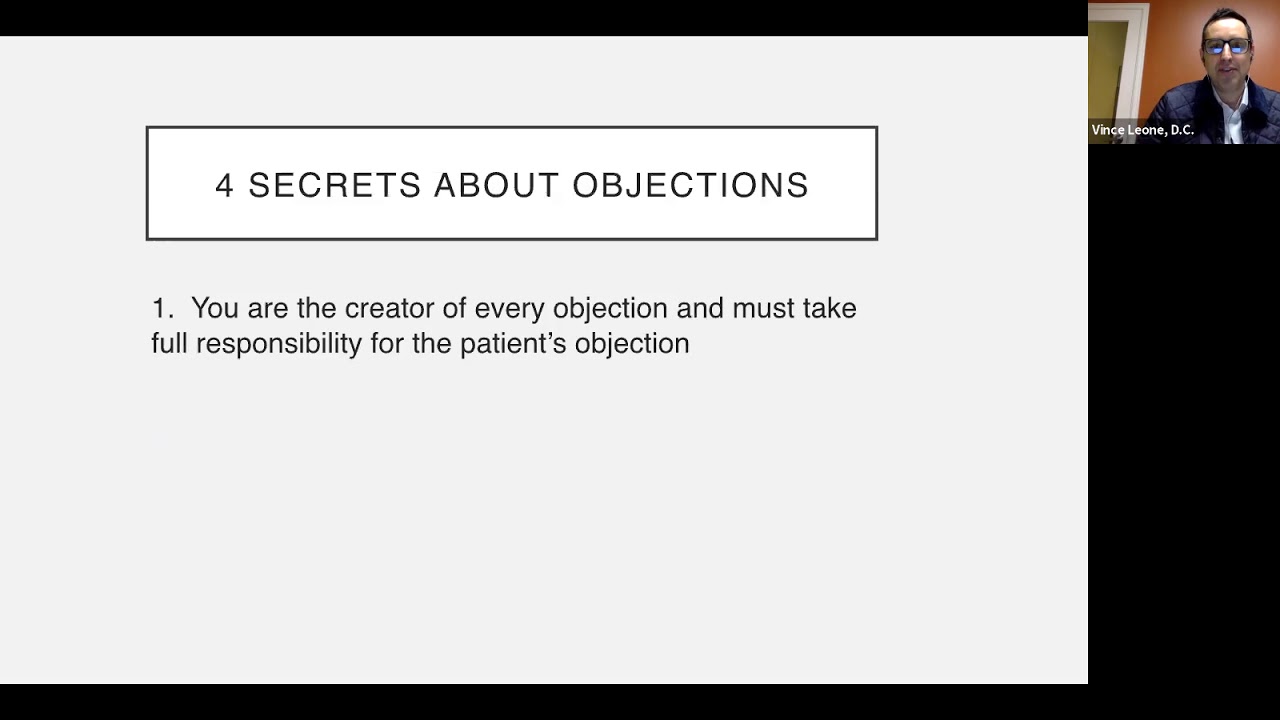
What's up everybody, Dr. Vince Leone here. Welcome to the show. Today's training is mastering objections, what to do when they say this, that, or the other. Um, so today's— this is really geared towards doctors that are doing cash-based care plans, um, you know, $3,000, $5,000, $7,000, $8,000 for For decompression, neuropathy, stem cell, functional medicine, those types of conditions and care plans. And so what I can tell you, you know, after you know doing this for a long time and and being in the room with hundreds and hundreds of these patients, is you're going to get hit with objections. They're going to not really want to just give up their hard-earned money and. So there's a lot of groundwork that needs to be laid in terms of associating value with what you are offering them. But at the end of the day, after we present our case and recommendations of care and go through everything, they're going to typically present some objections. It doesn't mean that they don't want to move forward. It does mean that they have some concerns, and so they need to be addressed, right? Right. So let's go ahead and jump right into the material. First of all, what the heck is an objection? Well, if we look at a dictionary, a reason or argument offered in disagreement, opposition, blah, blah, blah. The act of objecting, opposing, disputing. A feeling of disapproval, dislike, or disagreement. Very, very true. Now, let's look at what a patient objection is defined as. It's a statement or a question raised by the patient prospect which can indicate an unwillingness to move forward with care. Objections include price, of course, your service, the timing either with your service or with their life in general, your company, you, the competition, the economy, confusion, lack of information. It can fall into any of those categories. So if you are not a master at overcoming objections and closing in the room, there are consequences, right? So it can inhibit confidence, it can inhibit momentum, it can reduce your new patients, it can reduce your income, it can reduce referrals, and it can reduce your lifetime value. See, a lot of docs, they don't think of the ramifications of losing just one patient a month. So, what that is, is lost potential value, right? So, think about if your average case value is $5,000 and you lose 1 qualified patient a month. Well, that's $60,000. Okay, I mean, just off the top. Now, that doesn't include any of the other stuff that they may buy from you. It doesn't include any of the referrals. And it doesn't include any additional care. Okay, so, so we have to look at lifetime value, right, to see how important this is to really get a grasp on this. Because if you're sitting in front of highly qualified patients and they need the care and they want the care, then, you know, you need to close them. All right. So, so the steps to mastering objections. Well, as with anything, first we have to commit to being a master, right? Just like when we went to chiropractic college, we committed to becoming a master at chiropractic and finishing school and getting out and building a practice. It takes commitment. So we got to commit to this aspect of it. Obviously, they didn't teach us this at school. They didn't— they don't typically teach this at practice management courses or whatever because Well, I don't know why. I'm not going to speculate. But the point being is, doesn't mean we don't need to still be very, very good at it. We need to be good at persuasion in the room. And by the way, from an ethical standpoint, if you believe in your service 100%, if you know without a shadow of a doubt that they are going to be better off with it than without it, and they are a good candidate— in other words, that they qualify for care, you feel like they're going to have an excellent clinical outcome— And, you know, they can find the money. It's really, really important that you get them under care, right? So because I know that, you know, and, you know, I'm a full-time consultant at this point, but when I was practicing, which was really just up until the beginning of this year, I knew that their life would be 10 times better off with my care than without it. So their $6,000 to move forward with care I mean, to me, that's just a drop in the bucket of life, right? Their quality of life is gonna change. I mean, they're gonna be able to walk with their spouse. They're gonna be going on vacation without complaining. They're gonna be able to do the things that they love, spend time with the ones that they love, play with their grandkids or play with their kids. That's not worth $6,000? Yes, it is. It's worth $60,000. It's worth— it has no price tag. So, that's almost number one. First of all, you gotta really wrap your head around The change that you're making in these people's lives. So, and most doctors are already there. So we got to take responsibility for every objection. Okay, and we'll go into that in more detail. We got to define what objection is and is not. This is very important. Identify where objections are going to take place. Prepare until you can predict each objection. Master until you can handle each, and then you got to practice right now. By the way, guys, What you'll notice here is this is not your typical BS webinar where they're going to give you the 3 secrets and then sell you at the end. Now, I am going to offer you something for sale at the end, but this is true training. Okay, so, you know, buckle up. We're going to have, you know, this will be a good hour of training. Okay, so types of objections, right? And by the way, how did I come up with all this? Well, 5 years in a 7-figure practice, knee-to-knee with hundreds and hundreds of patients asking for $6,000 for care plans, but also training and studying guys like Grant Cardone, Jordan Belfort, who's the Wolf of Wall Street, Tony Robbins, Robert Cialdini, Dan Kennedy. All these guys are masters of sales and persuasion, right? Yeah. And I knew, hey, if I was going to be successful really in life, right? Like, sales is just really persuading someone that what you have to offer has enough value for them to exchange value, typically money, for that product or service, right? And so anyways, side note. Types of objections. Internal, you say these to yourself. Okay, external, the patient says these to you. Valid. This is the real objection. Invalid. Not the real objection, right? Even though they may say it is. Spoken. This is what they're going to tell you. And unspoken. What they're not telling you. Okay, so let's talk about 4 secrets about objections. Number 1, you are the creator of every objection and you must take full responsibility for the patient's objection. Okay, and you know, we'll dive into this. 2, the most dangerous objection is the unspoken one. Number 3, most objections are complaints that should not be handled but used as a reason to close. And number 4, objections are never a reason not to close or to stop moving forward with the report of findings. Okay, so let's go back for these in just a second. First, you're the creator of every objection. So there's this concept called the mirror. Okay. Didn't make it up. One of my mentors, you know, I learned it from him, who I'm sure learned from somebody else. All this, you know, guys, all this stuff is, it's all out there, right? Um, it's just a matter, are you going to dig enough? Are you going to do the research? Are you going to study? But the point being is there's concept of the mirror, and what that says is we do not have business problems, we have personal problems that are then manifested in business. Okay, so in other words, if you're getting a lot of objections from patients saying, I I can't afford it. Do you have payment plans? You know, I don't have the money, etc. Most likely you are having that same situation in your personal life. In other words, when you go to buy a car or to buy a mattress or whatever, you're looking for the cheapest deal. You're looking, hey, can I finance this? You know, trying to, you know, chisel the guy down on price, all this type of stuff. What you do in your life Is manifested right back at you. That's, that's why it's called the mirror, right? So if you— if the patient says, I just, I just don't have time for this in my life right now, you know, I mean, I work, I have kids, you know, I have whatever, whatever the excuses, that's probably happening in your own life. In other words, you feel overwhelmed with your schedule. It's not structured so that you have time for the important things in your life, blah, blah, blah. That's coming back to you. And so what— and we'll get into an exercise later on, but that's super, super important, the concept of the mirror. So we don't have business problems, we have personal problems manifested in our business because we are our business. Okay? Our practice is us. It's a direct manifestation of us. Now, the most dangerous objection is the unspoken one, right? What does that mean? It means they're a lot of times not telling you What the real issue is? Okay, so what do I mean by that? Well, they may say, "Wow, that's pretty expensive. You know, I don't know if we can afford that," or "I got to talk to my spouse," or "Gosh, we're going on this vacation," blah blah blah. The the the real objection, and the only way you can get to it is getting to is digging, probing, and we'll go into this in a little bit. But you know, their real objection—it may not be money; it may not be timing; they may really want to do it. But maybe they have a best friend that's like an orthopedic surgeon and he golfs with them once a week. And so he's going to have to explain to him why he can't go golfing with them because he's in your office 4 days a week. And he's going to say, wait, you're doing— you spent $5,000 with a chiropractor to do what, fix your feet? Are you kidding me? That may be the real objection. And whatever, maybe he has to talk to his spouse, but, and then the real objection is that he doesn't want to try to convince her to spend $5,000 of their money to fix his problem. Okay. So the, the reason why it's so dangerous is because if you don't address the real objection, he won't buy. Okay, so you have to get to the bottom of that. And again, we'll go into that a little bit. This is huge. Most objections are complaints and they should be handled as such. In other words, gosh, that's really expensive. That's a complaint. Wow, $6,000. That's a lot of money to, you know, to fix my neuropathy. That's a complaint. Okay, he's complaining that the price is high. Well, hey, I'm trying to change your life. That's going to have— that's going to have a monetary value associated with it. So, or, you know, I got, you know, I got to talk with my wife. Well, that, that, you know, that's not necessarily an objection. That is a complaint. I got to talk with my wife. Do you? You know, what do you think she would say? And the point being is they should never— there should never be a reason to not move on and close the deal. Okay. And this is the biggest one, because even if they're giving you real objections, you know, I just don't know how I'm going to pay for it. Well, let's talk about that. You know, let's, you know, you're saying that you cannot write a check even though you get 20% discount. You're saying there's no way you could write a check for $5,200? No way in hell. Okay. Now you said you have a job, right? You're working. Yeah. What if we were able to finance you? Do you feel like there is some room in your budget? Well, actually, first of all, do you even want to do this? Oh, absolutely. Or, I don't know, you know, I don't know if this condition is, you know, really bothering me that much. That's the real objection. They are not at a point where it's affecting their life enough, and that's okay. Hey, no problem. If this isn't that important to you, it certainly isn't important to me. I only want to help people that are really, really, you know, intent on fixing their condition. You're not There, and that is okay, but let's not waste any more time. And boom, get out of there. You know what I'm saying? Um, but the point being is just because they're going to give you objection, real or valid or invalid, it's never a reason to stop. Okay, never a reason to stop moving forward with care or with the report of findings. So I split the report of findings into 2, right? You have the front half and the back half. The front half is where you go through the 4 questions, right? Mm-hmm. What's wrong? Can I help? How long and how much? That's the front half. Once you get the first objection, and you're going to get 2 or 3, like, just understand that, you know, 5 to 10%, 10% at the most, are going to say, yeah, that sounds great, write you a check, let's go. Okay. And everyone dances and gets happy about that, goes home, you know, super pumped. Point being, it's a very small percentage, and you don't ever want to rely on a very small percentage, right? Because your close rate's only going to be about 50%, maybe 60%. So you have 5 to 10% of your 60— 50 to 60% that's going to be super, super easy. So the bulk of the people that it will close, because you should be at least 50% close rate, the bulk of those you're gonna have to work for. So go into it with the idea that you're gonna get hit with 2 or 3 objections, you're gonna have to address them. So if you go into it with that understanding, you're not going to be surprised. You're like, oh, okay, yeah. Yeah, I knew I was gonna get that one, or whatever, you know. And there's only— there's only— here's the beauty of it. There's only so many. There's only so many objections that people have for our particular type of care. And so that's why we're going to go over them and address them, and you're going to give you some tools to work with them. Okay. But anyways, so never stop when you get an objection. Because listen, I've heard talks literally, oh yeah, he said it's too expensive. So, you know, we wrapped it up. Or yes, talk to his spouse. Okay, see you later. What? No, no, no, no, no, no, no, no, no, no, no. You keep moving forward even if they have to go talk with their spouse. Well, yeah, okay, I totally understand. I, I would agree. I would talk with my spouse too. I don't want, you know, I wouldn't want her to be mad at you. Um, but, you know, let's, let's get through some of the basics here. Would this work for your schedule? Or how, how can we work this, you know, make this work for your schedule? Finance, you know, how are we, you know what I'm saying? Keep Keep going, you know. Keep going, like make progress, and then bring in the spouse. Or maybe you're getting get to the end, and he's like, "Wow, you know what? Let's just do it." You don't know unless you unless you probe, unless you get more more information, right? And it again may not have been the real objection. I got to talk with my spouse. That sounds like, that sounds like a complaint to me. You know, I gotta talk to my spouse, you know, it's $5,000. Maybe it's not, you know, maybe he controls the purse strings and he doesn't— isn't quite sure about you, and that's his out. Okay, he's not gonna tell you he doesn't like you, or he doesn't tell you that he can't quite, quite trust you, or whatever the real objection is, that I gotta talk with my spouse. She may not have anything to do with it. She, she, she may— sure, honey. I mean, if you— it's your money. I mean, you make— if he's the breadwinner, then it's his money, right? Or vice versa. If she's the breadwinner, hey, maybe, maybe she doesn't have to talk with her husband. But it's a, it's an easy out. Okay, because people don't want to tell you the truth. Okay, they don't want to tell you, well, You know, your place is— this is kind of a crap hole. I mean, we're in a strip mall and you want $6,000? Hey, they're not going to tell you that, right, if that's the case. Or, you know, they're thinking in their head, goodness gracious, if I have to look at that front desk person and that, you know, and have her treat me like she did when I first walked in here every time I come in, I'm coming in 24 visits, no way. I'm gonna find somebody else, right? That's the real objection. Right, but they're thinking it in their head. They're not telling you. Okay, and you won't know until you probe. But again, we'll get to that later. Okay, let's go into steps to determine valid versus invalid. Okay, so 6 steps. First, 1, gotta listen. Gotta listen. 2, acknowledge. 3, isolate. 4, validate to determine the real objection. 5, determine the type of the objection, and then close. So step 1, listen. Man, you gotta listen, okay? Stop talking, man. I— my dad, he, he just loves to hear himself talk, and I, and I'm just like, you know, people want to be heard. People are in pain. People are trying to figure out whether they want to spend the next 3 months of their life with you and $6,000. They want to be heard, so stop talking and listen, okay? So So, okay, let me, let me write this down. These are responses, right? Okay, please, please tell me. I want to hear this. Okay, I got it. I got it. Okay. And what else? Tell me more. Thank you so much for sharing. Hey, tell me, tell me everything about what you've experienced with this. Let people talk. They want to be heard. It develops rapport, right? Okay. And they'll start to trust you. Step number 2, acknowledge. You're right. Now, guys, these are object— these are what we do to— what is going on here? Um, these are what we're going to do to determine whether it's valid or invalid. So in other words, we're addressing the objections here. Number 2, we're going to acknowledge it. You're right. I agree with you. I can see that. I'm in total agreement. I feel the same way. I get it. So I said, God, that's expensive. You're right, it is. It's not a cheap program. I've invested a ton of time, a ton of effort, a ton of energy, and a ton of money into this program. Not only in the first-class equipment, but like, you know, courses for me to learn. I mean, I've been studying this for the last 5 years, you know. So you're right, it is expensive. But it's also effective, highly effective, and long-lasting and natural, and you're not gonna have to have surgery and all that stuff. Or I agree with you, you know, absolutely you should talk with your spouse. I mean, look, I don't want to cause rifts in your marriage over, you know, over this. But what do you think that she would say? You know, yes. So you want to agree with them. You want to always agree with them when they give you an objection. Next, isolate. They say, wow, that's really expensive. Absolutely, I agree, it is expensive. We just talked about What are your other concerns? Okay, we're trying to isolate, we're trying to figure out what else is bothering. Well, I need to talk to my spouse. Well, no, not much. I mean, it's just really expensive. I don't know if I can afford it. That's the real objection. Well, let's talk about that. What else bothers you? I'm not sure about the timing. Okay, you're not sure about the timing. So the finances don't bother you? No, I'm okay with that. You don't need to check with your spouse, like, you know, you're the decision maker? No, I'm, I can Yes, I'm the decision maker. So other than the timing, I mean, is there any other reason that you would not move forward with this? No, no, I just— I look, I run a company. I own my own company. I got to figure out whether I can fit this into my schedule. Okay. Okay, great. Let's, let's figure that out. Let me— so you know what, anyways, and then you go into figuring out, get on their side. Okay, think of it like a, like a tennis court. Okay, they're over there and you're over here. There's a net between you guys. And as long as there's a net between you guys, you are adversaries. Okay, get on their side. Work together, right? So get on the same side and then have time or money or whatever the real objection is on the other side. You're going to work together to beat it. Okay. So get on their side because that is really important. You have to work together. They have to see you as you're on their team, okay, working to solve the problem, and then everything changes, okay. So isolate, isolate the objection, validate the prices. Say it's price. That kind of— that's really expensive, but I totally agree. It is expensive, you know, and it— I've invested a ton of time, effort, energy to really give you the best care possible. But, and I agree, it is expensive, but that wouldn't keep you from moving forward, would it? I mean, this is your health. You said— you've told me that you can't sleep at night. It's bothering you. It's affecting your work. It's affecting the ability to play with your grandkids. I mean, $5,000, that's not going to stop you from moving forward, right? I mean, it takes cojones to do this, but guys, you're the doctor. We know what happens when they don't get care, how much their life is affected. They don't— they may not know that yet. They may not know what life looks like in 5 to 10 years. And I'll tell you what, it sucks. Okay, if you have a herniated disc, if you have severe neuropathy, if you have a severe condition that needs to be fixed, in 5 to 10 years life goes downhill. And they are not aware of how bad it can get. We are because we've seen those patients. So you need to future pace them and say, hey, Mr. Jones, I'm not trying to scare you here, but I've seen what this looks like in 5 to 10 years and It ain't pretty. I ain't trying to scare you. I want you to be fully aware of what the ramifications are if you don't go forward with care, okay? Just talk to them. Be honest. You know, if you're coming from a place of integrity, they'll— I mean, if you're trying to scare them, they'll know that. If you're coming from a place of integrity that you actually give a damn about them, they'll know that too, okay? So here's another thing. Validate. God, that's really expensive. Look, I get it. No, it's not cheap. I've invested a ton of time, effort, and energy in this. But what's your real objection? Well, I just, I honestly, I have no idea if I can fit this in my schedule, or I have got to get my wife on board with this. You know, it's not the money. Or maybe it is. No, it's just, it's the money. I have no idea how I'm going to afford it. Hey, now we know the real objection. Or what's your real concern? If you don't want to say objection, hey, what's your real concern? Okay. Ask the tough questions to get the right answers. Again, guys, you're like, wow, we have to do all this? I mean, you've decided to play at a higher level. You're not using insurance and doing, well, we'll get you adjusted a couple times a week for a couple weeks and see what happens. No, that's not the game you're playing anymore. This is the big boys. This is where we're trying to hit 10 to 20 of these new patients a month. So, we're looking at $50,000 to $100,000 a month. Hey, let's help a lot of people and make a lot of money. Why not? You want to do that? You got to get good at this stuff. Determine the type of objection. Now, this is an internal process. You have to— the wheel has to be turning in your head. You must know why the patient is objecting and about what. Okay. And you got to be thinking, okay, is that valid or invalid? Okay. And then you just have to start to narrow it down. Okay. It didn't really seem like it was price. It, you know, it doesn't seem like— I mean, he's retired, so it can't really be time. Maybe he has to, you know, maybe, maybe the wife controls the money. You know, and then, and then, and then ask that question. Hey, your wife isn't here. Why not? You know what I'm saying? So in your head, you're going to have to start saying, or at least rolling the dice and say, I think this is the real objection and I'm going to really address that. And then address it and start asking some questions. And I'm going to give you some questions to go through and then close or handle. You know, once you address the objection, then you're going to close. Now that's That's out of this, out of the realm here, right? I mean, handling objections and closing are 2 totally different things. So we're not gonna, we're not gonna cover that here. Now let's talk about the biggest mistake, biggest mistakes in handling objections. And you said you see that this is too— we'll cover that next module. This is all in a training I have that I'll tell you about at the end. Let's get a time check here. 1:27. Good, we're on track. Um, Biggest mistakes in handling objections. The biggest one is treating objections as objections that are actually just complaints. You know what I'm saying? So in other words, they say, God, that's expensive. And I understand. Yeah. Well, look, it was super nice to meet you. And like, what? It was just a complaint. You didn't drill down. You know what I'm saying? And if you let him off the hook, and and if he's not super, you know committed, then he's gonna go home and think about it. And you know, nine times out of ten when they when they leave, it's it's done. Okay. So that's why you got to ask questions. You can't. You have to find the real objection, and and most are just going to be complaints. Wow, God, that's gonna be 9— how many visits? 3 a week for how long? You know, 24 visits. Holy cow, that's a lot of visits. It is. It takes time to heal the body, Mr. Jones. I mean, how long you've had this condition for? What, 3 years? And I mean, look, I understand that, you know, the pharmaceutical companies will try to tell you that they can solve us Solve your, you know, your, your 3-year-old problem with one pill. But that ain't the way the body works. I'm here to tell you the truth. That's not how the body works. It takes time. We are unwinding this condition and healing your body. It takes time. 3 months? I actually think 3 months is a super short period of time to fix this that's been going on for 3 years. You know what I'm saying? So yeah. You know, talk, tell the truth, and don't accept all the objections. In fact, initially, consider the objection a complaint until determined otherwise. Okay, so a complaint, a complaint is just an expression of discontent, regret, pain, or resentment. Oh God, that's gonna hurt. That's gonna hurt writing that check for $6,000. Well, Hey, you know, keep— now keep this in mind. Just because it hurts doesn't mean they don't want to do it and doesn't mean they can't do it, right? A lot of patients— a lot of doctors are like, oh, I don't want to deal with Medicare patients, you know, they're such a pain in the ass, blah blah blah. They don't have money. What? They don't have money? They've been working for 50 years. They got money. They probably got more money than you saved up and they're just not going to tell you. My mother-in-law has a lot of money. She lives like a pauper. She still goes to Taco Time, right? How she was raised. Never got out of that lack mindset, you know. So these people can have tons of money, but they'll come across as, I don't got any money, I can't, I can't afford that. That's, you know, that's when you start really have to start associating more value with your service versus The cost to them. Gotta talk about future pacing, how you're going to, you know, paint a picture of what life looks like if they move through care and if they don't move through care. Okay, so it's just, just, it's a complaint, you know. So golden rule of objections: treat all objections as complaints until isolated and validated as legitimate objections. Okay, so we're going to acknowledge the complaint and close. So most time the doctor is handling a complaint that never required more than the Look, I understand. I agree with you. And I felt the same way, but that's not going to stop you from moving forward with care, is it? I mean, this is your health. Get this wrapped up and start your treatment. Have you ever said that to a patient? If they said, wow, that's more than what I was thinking. And by the way, guys, there's a lot of, like, with injections and stem cells, all this type of stuff, people, like $5,000, $6,000, they're almost expecting it these days. Okay, so it's not, it's really not going to be a lot of sticker shock. And typically, if it is, they're not qualified, right? So, but the next time someone says, you've zeroed on the complaint, right? What else are your concerns? I mean, do you feel like you can fit this in your schedule? Yeah, I do. Do you feel like you need to talk to your spouse? No, I don't need to talk to my spouse. So it's the finances? It is. Well, look, I understand. You know, I agree it's not a small amount of money, and I feel, I feel the same way. But look, that's not going to stop you from moving forward with care, is it? I mean, this is your health. Let's get this wrapped up and start your treatment. Try that. Try it just once. Just once. When one patient says, God, that's expensive, don't try to figure out how— initially, don't try to figure out How it's going to fit in their budget or whether they're going to take a 20% discount for the full pay or blah, blah, blah. Say this. Say that. I understand. I agree with you. I feel the same way. But that's not going to stop you from moving forward with care, is it? I mean, this is your health. You know, you're telling me you can't sleep at night, can't play golf, you can't go on vacation. You're not able to take walks with your spouse. It's affecting your relationship. Let's get this wrapped up and start your treatment. Try it. Just try it. Okay? It works. Okay. Another secret to handling objections. When you handle a mere complaint as a valid objection, you validate it and you make it into something that it's not. That's why you have to ask the questions, right? Because if they say, God, that's expensive. And you don't— well, okay, I understand it is, it is expensive. What are your other concerns? Right? So you want to start— what else is going on? Is it— so we're trying to narrow it down, right? Because if they say, wow, I just honestly, I mean, I don't know if there's any way in the world I can fit this into my schedule. If you had not asked that question, then you would have started to try to address the finances and he didn't even He didn't even really care. I mean, yeah, $6,000. It's not a small amount of money, but that doesn't mean he couldn't afford it. You know what I'm saying? And so, but if you didn't ask the question, find out, wow, it's really his time. You know, he's an executive or he owns his own company or whatever. That's the real objection, right? But if you had, if you didn't ask the question, what are your other concerns? You wouldn't have given him an opportunity to say that and tell you, and you would have started zeroing in on the finances Well, how can we make this work for your budget? And he's sticking his head— budget? I don't need a budget. I'm going to take the 20% discount even if I even do this damn thing. But I don't know how the heck I'm going to fit it in with my work schedule. You know what I'm saying? So he's immediately thinking, what is this guy? You know, he doesn't even— he doesn't even really know what's going on with me. Get it? So that's really important. That's why it's so— I mean, you just got— you got to get to what is the most important, and they will tell you if you probe. Because remember, like, at this point you've been with the patient for 20 to 30 minutes, right? You've already had a consultation, you've already had the evaluation, you've essentially demonstrated your expertise and developed rapport and some trust. You can ask the hard questions at this point, you know. And if you don't, and then you start drilling down on something that's not even the main objection, then they're going to be thinking that exact same thing. This guy doesn't even know what I'm What are you talking about? I mean, you know, I don't care about the money. I just don't know if I can fit this in my schedule, you know. Anyways, so first things first. First thing I do when I hear what appears to be an objection is to treat it like a complaint until further validated as a real objection. If it's a legitimate objection, you're going to know soon enough, right? Because when you try to handle it as only a complaint, your prospect will make it clear it's more than that. God, that's expensive. It is, I understand, but that's not gonna stop you from moving forward with care. Yeah, yeah, I don't know if I can afford— I have no way. There's no way I can write a check for $5,400, I'll tell you that. That's the real objection, you know what I'm saying? They will tell you, um, but, but not until you start digging things up. So, um, anyways, this is what we just said. Okay, the rule of responsibility. Look at the objections you continue to get, and you're gonna— I assure you that you will have some agreement with these objections in your life. Okay, so in other words, this is happening to you because of you. This is what— this is the concept of the mirror that we talked about before. So if you're— okay, so here's what I want you to do. If you are getting these complaints, Like on a regular basis. I can't afford it. No way. Or there, you know, there's— it's too much time. For the next week, start writing down every objection you get from your prospects, right? And then see how many of those you use in your own life. Okay. And so what you want to do is start writing down all the primary objections that you get with your consultations. Okay. And then start looking at your own life and see if it's financial. Are you struggling financially? You know, are you, are you, are you basically acting out the same objection in your own life? Okay. Or if it's time, if they're always saying, you know, I just, there's no way I can fit this in my schedule. I'm so busy. I'm, you know, my life is crazy. Is that happening in your own life? Okay, the point is you got to quit asking your patients to do what you won't do. Okay, super important. So, um, what happened here? Okay. So here's some things to think about. Do you ever say this to yourself? I need to think about it. You know, I need to check with my spouse. I never make a rash decision. It's not in our budget. I need the best deal. What else is included? What else can you give me? Or, I need to wait until... Do you ever say stuff like that? So let's talk about what generates a patient's objections. Fear, uncertainty, misinformation, the information they've been given, lack of information, mistakes they've made in the past, Upbringing, you know, fear. Gosh, I'm going to spend a lot of money with this doctor. I've never heard of him. I don't know if he has any Google reviews. Uncertainty. This guy's going to fix my feet. He's a chiropractor, you know. Misinformation, or, you know, like, then that kind of goes in with upbringing, right? Oh, my parents have always warned me about chiropractors. It still happens, guys. It's still out there whether we believe it or not. That stigma is still there. Mistakes in the past. Oh God, I did this before and I got burned. How many times have you had patients come in and say, yeah, I, I tried decompression, you know, or I tried this somewhere else, I don't think it's going to work for me? Happens. So some of the patient's fears: wasting time, making a mistake, being taken advantage of is huge, looking bad to others. We talked about this, you know, with their friends. They're going to have to, um, So when we make a decision, first we make it from an emotional standpoint and then we justify it with logic. Well, from an emotional standpoint, we got to be thinking, or the patients are thinking, I'm going to have to justify this to my spouse, to my friends. I'm going to have to tell my friends I'm doing this and they're going to ask me questions and I'm going to have to try to validate why I'm doing this. So they don't want to look bad. No one wants to look bad. Fear of pressure. They may, when you're asking for them to pay for care, some people just don't like that. They're uncomfortable even having to make a decision or telling you no. Some people have a hard time saying no. Some people have a hard time saying yes. Jeez. Fear of failure. Of course, that's probably the biggest one. Right. Right? Is this going to work? Is this going to work for me? That's why you got to have testimonials. That's why you got to have data, research papers, all that stuff printed out and handy. Stuff on the wall, plaques of your accomplishments. All that stuff has to— all that needs to be there to overcome some of these fears. So, how to handle patient fears? Well, communication. is your secret weapon, right? Like your report of findings, I mean, it should be tailored to, you know, I mean, you should have it down. Like, I mean, like Lawrence Olivier on the stage, like you should have your report because guys, we're dealing with the same types of patients. Like if you're doing neuropathy, you're going to be, I mean, even though they have a different cause, you're still dealing with a patient with neuropathy, with nerve damage. Okay. So your delivery is going to be the same. So what you don't want to do is be making it up every time. You want to have a, you know, you don't necessarily have to have a script like written out, but it needs to be structured where you're going to go through this and I'm going to accomplish that, this here. In other words, you're going to explain their condition and why they're having it and why no one else has told them what's really going on. Then you're going to go into the research so that if they are a left-brain type person, you You know, you essentially quash those, those questions and those fears, because if they see data behind what you do, that gives them assurance, you know. All— anyways, so, um, now this, this is outside the scope because this is prior to— this is the first half of the ROF, right? Handling objections is the back half of the ROF. But, um, you know, all that stuff needs to be addressed. Okay. You know, before you even get to the objections, because otherwise then, you know, the biggest objection they're going to have, and they'll never tell you this, is they just don't trust you. You know, so all the ground— I mean, this is like the fact that we're handling objections is assuming that the front half of the ROF has been done properly, right? And that your consultation was done properly and your examination has been done properly. Now, for most doctors, I mean, like most doctors at this level, There's no problem with consultation and the examination, right? They've demonstrated their expertise, they develop rapport and trust in the consultation. But the report of findings is where a lot of doctors, especially the super smart ones, struggle, right? Because they're like, gosh, I know I can fix them, why don't they go forward with care? Because you didn't communicate it well enough, you know? So that front half of the ROF has to be down, okay? Because Then once you get to the objections, then you're going to be able to address them, right? And you got to be willing to ask the hard questions. Okay, what are some hard questions that you got to ask? Let's go through these. Quick time check, 1:43. Good. Hard questions. Why haven't you done this already? Like, why, why have you waited 3 years to start doing research into some other solutions? That's a hard question because it kind of puts them on the spot, you know. Have you ever done something like this before? What's your real concern, Mr. Jones? If I resolve your concerns, are you going to move forward with care? Would you move forward with care? If I handle everything, are you in a position to make the decision? Okay, is he or she the decision maker? It's important. Other than yourself, who needs to be involved in this decision, you know, both from a financial standpoint and a time standpoint? How can you justify investing this much money? This is takeaway selling. Because they're going to be like, what do you mean, how can I justify this? Well, look, it's as you said, it's not a small amount of money. It's expensive. It's $6,000. I mean, how are you going to justify investing this in your health? Well, I'm worth it. I mean, I want to, you know, I'm 65 years old. I'm going to live until I'm 80 probably. I mean, I don't want to be in a wheelchair in 10 years? They are proving your point, right? Those are hard questions. Hard questions get honest answers. Hard questions get honest answers, and they'll respect you for asking the questions. You're the doctor. Okay. And so, we have to drill down and find out what is stopping them from moving forward. Because if they drove to your office in their own vehicle and they have a job, or, you know, and they're like, they're not on Medicaid, they have the money. They can find a way to finance it if it is important enough for them. Yeah. Okay, and you're like, well, CareCredit doesn't finance anybody. They don't because their floor of the FICO floor is 650. But there's other solutions out there, guys. Patient Payment Solutions is one. It's like their FICO floor is 440. Okay, so do some research and get some more options for your patients. If they want to move forward with care and you're not providing a solution for them from a, from a financing perspective, that's your fault, right? They want to move forward with care. They've got to figure out how it's going to work in their budget. You know, or if you don't want to do that, then you use something like Cash Practice. I don't— I'm not affiliated with any of these companies. Use Cash Practice where just you're not the bank. You kind of are the bank, but you're not the bank because the debit is going to come from another source. But they'll follow up with the patient if the card gets declined or whatever. So it's not you, it's not your staff and making things uncomfortable when they come into the office. Okay, that's important. But you got to have the systems in place if that— if they want to move forward with care. You're like, well, I just want prepaids. BS. That— not everybody can prepay. Get the money wheel going. Okay, if you get 10 people a month on $300 a month, that's $3,000 a month from one month, right? And then the next month it's $6,000, and then $9,000, and then $12,000. You know what I'm saying? So get that money wheel going. Don't be afraid of that. That's good. You're helping people, and then you— and then they're going to give you referrals, right? And they're going to buy other stuff off your shelves. So, um, so make sure that you have the solutions in place. Okay, now rules of handling objections in the ROF. Never give any one objection too much power. Okay, never talk while the patient objects. Never, ever, ever interrupt a patient. Let them talk. Okay. And never take an objection personally. They're not, you know, they're not saying, doctor, you suck. Don't take it personally whether it's addressed to you or not. Do not take it personally. You're the doctor, they're the patient. You're not friends, okay? You're not friends. This is not a friendship. This is a doctor-patient relationship. You are here to provide a service. They are here to get it. Okay, so don't take anything personally, right? Leave it at the office. And never handle more than one objection at a time. Well, let's see how we can, you know, make this work for your budget and your schedule, and then, and then, you know, we'll get your wife. No, no, no, no, one thing at a time. Okay, a confused mind will always say no. Okay. A confused mind will always say no. Never abandon the close because of an objection. Okay. Never disagree with the patient. When you disagree with the patient, then you're— remember that tennis court analogy? Now you're back on the other side of the fence or the net. Okay, get on the same side of the net by agreeing with the patient. Never confuse the person with the objection. Okay. Never believe the objection will keep the patient from moving forward. Don't believe it. Okay, always believe that it is a complaint until proven otherwise and assume the patient's going to move forward with care. Okay, your assumption that the patient's going to move forward with care is going to give the patient confidence that they're going to move forward with care. Okay, confidence and commitment and courage oozes out of you. Okay, it just does, or it doesn't. It either does or it doesn't. Okay, and the only reason it wouldn't is because you don't have it. Okay, so assume the patient is going to move forward with care. Be surprised if they are not. Okay. Um, never let an objection get you down. Don't, don't get discouraged. Okay, don't ever get discouraged because either you lose a patient or, you know, they start complaining about something. Don't, don't ever let that get you down. Okay, just, just look, think of yourself like You know that, like you have a Kevlar vest on. No big deal. Hey, we're going to solve this. You have you a you are a problem solver. Okay, you're a doctor. They have a problem. You got a solution. You are a problem solver. It does not stop with the treatment. You need to take again because we're playing at a higher level and asking for a lump sum of money. You know, we're asking for a larger. payment for a solution, we need to solve some more issues. We've got to help the patient get there. Ultimately, it's just where they're at in terms of confidence in you, your service, and your practice. That's it. Never ignore an objection. Never ignore an objection. Don't pretend you didn't hear him say he has to talk with his spouse. Or that it was too expensive. Like, don't like, God, that's expensive. So how do you think? No, no, never, never, you know, because when you ignore it, then they feel not heard. And that is, is that pisses people off, you know. Never quit communicating, you know. And never blame the patient or other conditions for the objection. Take full responsibility for everything, and when you do that, you're free. Okay, what do I mean by that? It means that you can always improve it. If, if you're going to let a situation— okay, well, the economy, or the patient, it was the patient's fault, you know, I'm getting bad patients, or the economy sucks, or whatever it is— all those things are out of your control. When we're out of control, it's very discomforting to us. Okay? Whereas if we take responsibility for everything, economy doesn't matter. It's people's health. You know, or, hey, what do you mean Medicare? Medicare are great patients. I mean, they've been saving their whole life. They got, probably got more money than me. Just start thinking this stuff. Okay? Because you are now taking responsibility for everything and then you can work on it and on improving it. As opposed to it being out of your control. Never let something be out of your control. Final thoughts. Look, objections are never a reason to stop the deal, but a reason to close the deal. One of my good friends is an agent in Hollywood. He reps some of the biggest writers and directors in town. When he hears no, He feels like that is when the conversation actually starts, when he's in a negotiation with the studios. Okay, so when you hear no, i.e., an objection, that's when the real conversation starts. Okay, so never let an objection stop you from moving forward. Master the objection, and then you have a chance to master the close. And again, we talked about there is a difference between mastering objections and closing a deal. And we will cover closing the deal in another training. Now, if this has been valuable to you, we have a training called Master Chiro Closer. It is just $497. It is— let's go, uh, what is covered in it. So this is Module 5, Overcoming Objections. Module— so there's 6 modules total. Okay, Module 1, We look at a 30,000-foot overview of the conversion process. We talk about the 3 10s and the 2 kinds of certainty. Okay, you're like, what the hell is that? It's, it's all about— this is, again, this whole thing is all about how to become a master closer. Okay, in the room, Module 2, the 5 Keys to the Master Chiro Closer. What is looping? And in the first 4 seconds, Module 3, tonality and body language. Huge. Module 4, state management and how to get in the perfect state. You got to do this before going into your ROF. You cannot go into your ROF harried, okay, or you're bumbling files, or you're not— anything other than being absolutely prepared and centered and ready for this particular patient is a mistake. Okay, so you got to get in the right state management. Number 5, identifying and overcoming objections. Okay. And then module 6, putting it all together, creating your game plan, moving forward. And, and then all of this, right? All this is the close. This is, this is the close. So all of that is in what I call the Master Chiro Closer. It's a 6-video training series, obviously accessed online. You have lifetime access to it. And it's awesome. Okay, so when we look at what— oh, and we got a couple bonuses here. So I have a group coaching called DC United. You get a 1-month free membership to that. A million-dollar— the million-dollar phone script. We've used this for years. It's responsible for millions and millions of dollars. It helps develop authority, trust, and rapport on the phone so you can train up your staff and she can have that With— he or she can have that with them. Then the Video Training Vault. I've done so many videos, I forgot them all, or half of them, but tons of stuff. How to Start and Grow a Neuroptics Practice, 5 Ways to Double Your Decompression in Neuroptics Practice, How to Create Your First Facebook Ad, Conversion A to Z, Million Dollar Scripts, CA Training, and more. There's tons, tons, tons. So, but the point being is I put this all into this program. Okay, you get lifetime access for it. Or to it. It's just $497. And the way I look at it is I always want to deliver 10x the cost of a program. Okay, so we're looking at $497, big whoop. If you close the average neuropathy decompression stem cell functional method, the average patient care plan is about $5,000. Okay. If you close one patient, you just 10x your return. I always look at return on investment in anything I do, not just finances, time, you know, relationships. I mean, we all, we want things to matter, right? And so if you go through this program, right, and you really commit to becoming a ninja in the room, Right, becoming really, really good at this stuff. You're already a really good doctor. I know that you are. You've already invested the time, effort, energy, and money in the service, in the equipment, all that stuff. I know you deliver great results because you would not be still doing it if you weren't. You're just not closing enough patients at this point, right? And I'll tell you what, when you have a frustrated patient Walk out the door, like a patient that was qualified, had the condition, had the money, could have paid for it, and then still walked out. That is heartbreaking. One, they didn't get the care, right? So they're going to continue to suffer for the rest of their life because they're probably not going to find anybody else that can do it like you, right? So that's a huge loss. 2, you lost a new patient. You lost $5,000 in revenue that month. And their lifetime value and all the referrals and all the other stuff that they would have bought from you. Okay, so that's a big loss. That's why I say this is a small amount of money to pay to get really good at this. Go through these modules, become a master in the room. Okay, so just go ahead, go to masterchirocloser.com, and you can go ahead and sign up for there, and you'll get instant access. So thank you so much for, uh, being on the training. It's 1:57. Thank you. We are right on time. I'm Dr. Vince Leone. I hope this was super powerful for you. Thank you so much for your time, and go change some lives. Take care. Thank you.










