In this training segment Dr. Vince Leone explains the often‑overlooked "transition" that bridges the Q&A portion of a medical dinner talk and the final close where attendees are asked to schedule a paid appointment. He frames the talk structure as content → Q&A → transition → close, emphasizing that doctors are usually strong on content and Q&A but lose confidence when moving to the ask. The transition is presented as a scripted, tone‑shifted segue that recaps key points, engages the audience with a question, and smoothly leads into the enrollment pitch. Dr. Vince provides a concrete 30‑second script, advises slowing pace and lowering tone after the upbeat Q&A, and suggests using nodding and reciprocity cues. He outlines preparation tactics: write and rehearse the transition, video‑record talks, and study persuasion masters (Brian Tracy, Jordan Belfort, Grant Cardone, Tony Robbins). Conversion metrics are highlighted – aiming for a 50/50 split where half the audience books a paid appointment and half of those enroll, translating a 40‑person talk into roughly 10 new patients and $50,000 in care plans. He also covers handling common objections (insurance coverage, cost) and recommends a monthly dinner‑talk cadence to sustain a strong patient pipeline without over‑relying on other marketing channels. The video ends with contact information for further questions.
Chapters
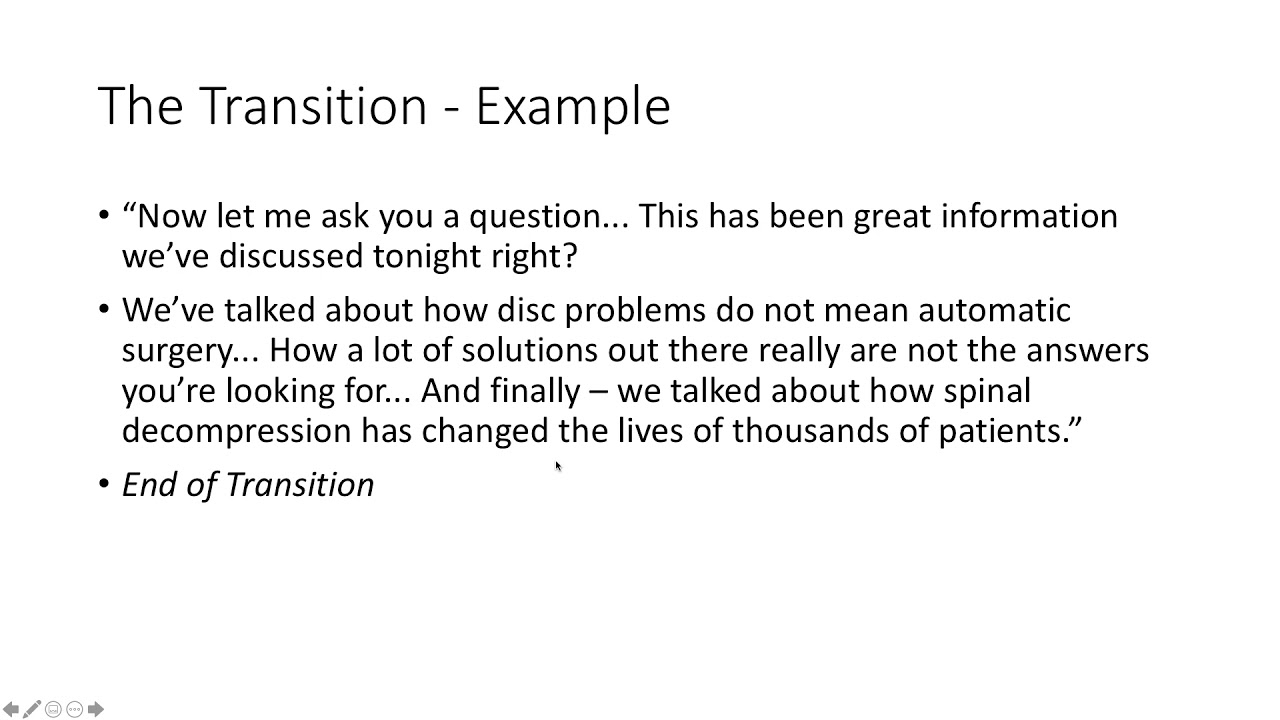
Hey everyone, Dr. Vince here, and welcome to this brief but very important training on what I call the transition. And this is part of my Perfect Workshop System, and it's primarily for doctors who are going to utilize like dinner talks, dinner seminars, those types of things, even webinars that, you know, to generate new patients for their practice, usually in cash-based care plans, whether it's decompression, stem cell, neuropathy, etc. But the transition is a really kind of a little-known part of the entire talk, but it's super important. And if we look at, well, you know, what is the structure of a great talk? We have our content, we have our Q&A, we have our transition, and then we have our close. So the content obviously is where we're going to talk about what we do and why it's so great. Then we do our question and answer, right, so that we can, you know, Answer all their questions, overcome any objections that may be lingering in their head. You know, a confused mind will nine times out of ten say no, right? So they're not going to move forward. They're not going to make an appointment. They're not going to do anything if if they are confused and that confusion is not resolved, right? So then once that's done with the Q&A, that's when we have the transition. Now we have the close when we're going to actually ask for an appointment, and that should be you know thought out and and even written out and and rehearsed so that you feel very comfortable there because the whole. The whole point of this is that typically doctors, when they're in public speaking mode, they're very good with the content. They can answer all the questions. But when it gets time to ask for a paid appointment, really asking for someone to make a commitment, that's where things not necessarily go off the rails, but they kind of lose the conviction, the confidence, the calmness that they may have had prior. That is reflected back to them from the audience, right? So we need to stay in confidence mode. We need to keep our message consistent in our tone, all that type of stuff. And so the transition is rarely paid attention to, and it can really be a lifesaver. I kind of liken this to a professional pitcher, right? So Pitchers typically, and I'm not a massive baseball fan, but pitchers typically have a pitch, right, that they're just, that's their go-to. Like if all, if everything else is, is going sideways and they can't, you know, they're just kind of on an off night or facing someone really tough, they'll kind of, they'll have this go-to pitch and maybe the curveball, whatever it is. Yeah. This is kind of your go-to in a sense that It's going to be what you utilize prior to going into your close. And it's something that you can always use. It's like step by step. So you just know, hey, I'm going to do my content, I'm going to answer their questions, I'm going to do my transition, and then I'm going into my close. And so it's a natural segue and it helps the audience as well. So it can be kind of a lifesaver for you. If it's done incorrectly, it can be a deal breaker. Right, because if you kind of stumble and bumble your way into the close, not only will you be going into, in there, into that section, which is so, so important and obviously not included in this particular training, but you're going into probably one of the most important parts of the talk haphazardly, right? We don't want to go into our close haphazardly. We want to go into it smoothly and seamlessly. So How to start? Well, we want to change our tone, our pace, so that it gives a natural transition that people just instinctively know, okay, we're making a shift. Okay, and so you may have been, you know, very upbeat and very excited talking about your content, answering questions, and, you know, all that type of stuff, but then you want to kind of, you know, bring it down. It's okay. Kind of, if your tone is up, then you want to kind of bring the tone down. If your pace is fast, you want to slow it down a little bit. And, you know, what I recommend is something very simple. You just say, so look, let me ask you a question. I mean, this is— this has been some really great information that we've discussed tonight, right? You know, we've talked about how disc problems, they don't, they don't mean automatic surgery. I mean, we talked about how there's a lot of solutions out there. That really are not the answers that you're looking for. And finally, we talked about how spinal decompression has literally changed the lives of thousands of patients. And that's it. That's the end of your transition. And then you go into your clothes. Again, we're not going to talk about the clothes right now, but, but that's your transition. It's like 30 seconds, but it's so simple. And it just— it's like You know, it just sets you up, right? And the question thing is perfect because it's like, hey, so let me ask you a question. This has been some pretty cool information that we talked about tonight, right? And nod your head, right? And then look around. Who's nodding their head as well? You know, you want to start to see, okay, who's engaged, who's— and not everyone will do it, but if you've given a good talk and everything else has been done correctly, Most of the people, the majority, 75%, they'll be nodding their head with you, right? Because it's true. You have given them great information. There's that aspect of reciprocity where you've given them a good meal, you've made a nice evening out of it, maybe you had some giveaways, maybe you— Maybe it was funny. Maybe you were, you know, You know, you have put on, you know, somewhat of a show, and you want to now kind of lead into the next section where we're going to ask them to sign up if it seems to make sense for them. But we want to do it smoothly. And then this section here where we talked about this, there's an old adage with public speaking that says like, You know, tell them what you're going to tell them, then tell them, then tell them what you told them. So here, this is kind of— we're telling them what we told them, and so we're recapping the whole thing very succinctly, right? Well, we talked about disc problems and how they don't mean automatic surgery, and we talked a lot about a lot of the options that are out there. This should actually say options, not solutions, that are really not the answers that you're looking for. And then finally, we talked about how spinal decompression, how you may not have even heard of it before, but it's changing thousands of lives. And then that's it. And then we go into your close. So, hey, how would you like if I helped you step by step figure out if this is the right solution for you? That's the beginning of your close. And if you don't like close, you can call it enrollment, whatever. It doesn't matter. We're not selling cars here. We're not trying to make it sound crass by any stretch of the imagination. That's just a general term. So hopefully that doesn't kind of throw you off. But the point being, this transition, if you practice it, and I would write it out so that it makes sense for your talk, I would practice it a ton. And when you do give your talks, I would video them, right? If you're going to go through all the time, effort, and energy of putting together these dinner talks, And you want to make them an ongoing strong source of new patients for your office. I mean, do everything in your power to make each one better than the last, okay? And then finally, hey, just have fun. Know that you're changing lives. I really enjoy public speaking. I built my neuropathy practice with dinner talks in the beginning. After that, we went into pretty extensive advertising, but in the beginning, you know, inserts. I used newspaper inserts as the primary source and just filled rooms and just, you know, did this. And I, you know, all of the stuff that I talk about in, in the Perfect Workshop System and, and all this, all my training is, you know, um, you know, most of it was learned just from, you know, trial and error. But then, you know, I was studying all, all the other, um, people that talked about these subjects as well. Stuff like, people like Brian Tracy, Jordan Belfort, Grant Cardone, Tony Robbins. All these guys talk about presentation and persuasion and speaking and all this type of stuff. And so you can just take all this information and just, again, just continue to hone it until a point where you just feel super comfortable. And you should, in terms of conversion, I always look at, you should You should be at the 50/50. I like the 50/50 mark where 50% of the people in the audience are gonna make a paid appointment, and then 50% of those are gonna sign up for care. So if you had 40 people in the audience, 20 people are gonna make a paid appointment, which means that, you know, 95% of them are gonna actually show, and then you close half or you enroll half, right? So 40 people showed, 20 people made paid appointments, 10 enrolled. So if you could do that one time a month and your care plans are $5,000, and, you know, you're in that one campaign that you do every single month, you can get 10 new patients, you know. So that's how the numbers work, and they work really well. And so that's why it's really worth dissecting these different aspects of the talk So that, you know, you just know, okay, my content's rockstar. Okay, Q&A. Well, maybe I should start addressing some of the, the big elephants in the room. I always recommend this to clients. Hey man, tell them that insurance doesn't cover it and then give a really good explanation. You know, it's like, hey, so now I want to open up the floor for Q&A, but you know, before I do that, I always get 2 big questions. You know, does insurance cover it and how much is it? I always would do— I would always tell them insurance doesn't cover this. And then I would go, you know, have a detailed explanation of why. That way someone doesn't throw a curveball and I don't have a prepared answer. But, you know, you just break up your talk like this and you just continue to hone each one and, you know, you just get better and better. And then pretty soon you can just have one Of many, right? I never recommend having just one source of new patients, but you can have a really strong one that you get out into your community. It's just once a month, so you're not going to burn through Facebook or TV or anything like that, or inserts, whatever you're doing to generate attendees there. If you do it just once a month, you're not going to burn through unless you have a really small town. But by and large, Once a month is kind of the money spot, and you can get a, you know, just put all time, effort, energy with the clinic and the staff to really make it great. And then, and then you're just rocking and rolling for the next 2 weeks in consults. So, okay, I'm Dr. Vince. I hope this was helpful for you, and if you have any questions, you can just, you know, leave them in the comments below or shoot me an email, drvince@drvinceleone.com. Take care.