How to Acquire Chiropractic Practices with Dr. Matt Houchin
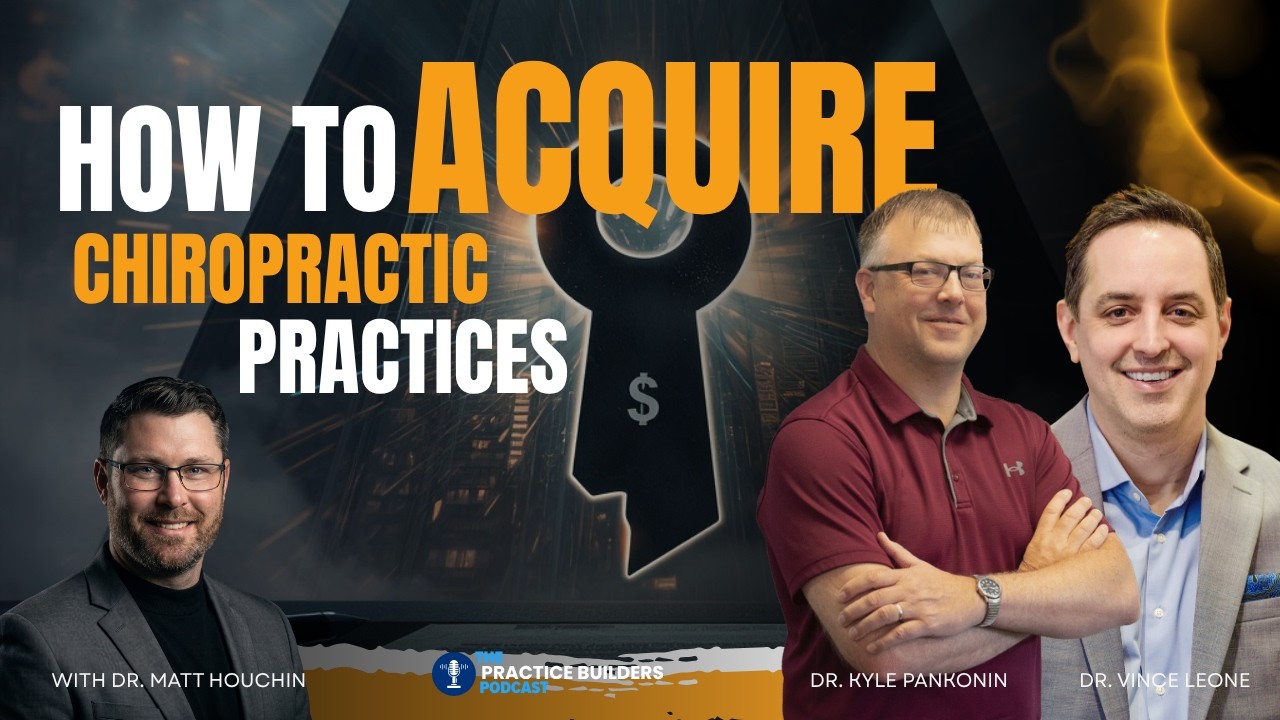
Dr. Matt Houchin built a five-clinic chiropractic group across Kentucky, Cincinnati, and Fort Wayne by buying practices using SBA loans and seller notes. He targets clinics with revenue over $150k and cash flow above $250k, values EBITDA multiples between 1.4 and 3x, and pays associates a baseline of $90k plus performance bonuses. His coaching firm, Alpha Omega Advisories, helps chiropractors navigate acquisitions while avoiding common mistakes like ego-driven rapid changes.
Chapters
Hey there and welcome back. I'm Dr. Vince Leone, executive producer and co-host of the Practice Builders Podcast. With my partner in crime, Dr. Kyle Pankinen, we deliver proven strategies to help you grow fast, specialize with confidence, and build profitable staff-run practices. Let's go ahead and dive into today's episode now. Hello and welcome to the Practice Builders Podcast. My name is Dr. Vince Leone.
And I'm Dr. Kyle Pankinen, and we got a special episode for you today. We're excited. We have a guest with us that Dr. Leone knows and is gonna introduce him to you. And this is gonna be good stuff, docs.
Yeah, absolutely. So we'd like to welcome a friend and client, Dr. Matt Hauchen. Dr. Matt, how are you today?
I'm doing great, Dr. Vince, Dr. Kyle. It's great to be with you guys today.
Yeah, well, thank you for coming on and taking the time. And just to kind of prep this, so Dr. Matt is a client in the Decompression Accelerator. But what really intrigued me was Dr. Matt owns 5 clinics in, um, let's see, well, there's one in Kentucky and then the rest are in, uh, um, refresh my memory.
Yep, yep. So 3 in Cincinnati, uh, 1 in Fort Wayne, Indiana, and then 1 in Kentucky.
Oh, okay, perfect. And so, and that's incredible, right?
We—
I love hearing doctors that are entrepreneurial in nature. And, uh, and, you know, from Dr. Matt's perspective, there's a lot of opportunity out there for doctors. Um, so We wanted to bring this episode to you. Obviously, we typically talk about best practices in terms of growing cash services, but I think it's also valuable for our listeners to hear what other very successful doctors in our profession are doing, not only for the tactical aspects but also just from a mindset perspective of, of all the opportunities that are really available to us in chiropractic. So just to— let's just kick this off. Um, so Doc, you own 5 clinics. Uh, which is incredible. Um, can you take us back and share how you got started in chiropractic and just what led you down the path in terms of multi-clinic ownership?
Yeah, so I graduated actually a small Christian college, Cedarville University, in 2008. I moved down to Nashville, Tennessee as an exercise physiologist, just working in the gym doing like VO2 max, uh, all those kinds of testing. My baseball college, or my collegiate baseball coach's son was a chiropractor. And so I called him up while I was in Nashville and I said, Coach, I'm bored out of my mind. I need something else to do. And he said, go find a chiropractor, just shadow them. They're all phenomenal, usually phenomenal people. They will let you come in and just see what they do. So there's a doc on my way to work and I just called their office and they said, yeah, come in on a Friday. I went in on Friday from like 9 to 11 o'clock. Um, absolutely fell in love with everything that he was saying to the patients, his communication, the way he was moving, the way he adjusted. I didn't even— I'd never been adjusted at this point, never saw chiro, nothing. Uh, within 2 weeks, I had all my classes scheduled at Palmer in Iowa.
2 weeks?
Oh, 2 weeks. I had my apartment, everything. Um, and I moved within, I think, 4 weeks up to Iowa from Nashville, Tennessee. To get started. So graduated in 2012 from Palmer, moved back to Cincinnati, back home, and I got into a clinic with a guy who was— I don't want to say he was on his way out, but he was definitely planning it. I was going to be his successor. And the way that our contract was written is it was kind of your average— I think it was like $30,000 a year, but percentage of collections over X amount.
Mm-hmm.
Luck has it for me, I guess. He goes down with an injury and his shoulders gave out. And I saw 100% of the patients from like month 4 to when I bought it. So I was able to make enough money that first year in practice to put down enough of a payment so that I could purchase my first office, essentially. So that was kind of my first foray into Practice ownership, and I wasn't necessarily planning on doing the whole purchase thing. I didn't know what that looked like. I don't think I did it very well, but it was sufficient for what I needed at the time. And so I dealt with the immediate struggles of not knowing what I'm doing right out of chiropractic college to then having to steer this massive boat. And we weren't a huge practice. We probably saw 190 a week-ish, maybe 220 a week-ish. And then we had this massive drop because I had no idea what I was doing. I didn't have a great day 1, day 2. I didn't know how to communicate the principle of chiropractic. I didn't really communicate subluxation as well as I needed to. I didn't have a goal for those patients when they came in and got them through a treatment plan. So it took me about 5 years to kind of figure that out with coaching and training. That's when I got my first associate. And this is how I stepped into multiple clinics. I realized really quickly with my first associate that I didn't know really how to make it about them. Because when your associate's coming in, they're competing with you. And associates coming right out of college, they don't have this wonderful inherent value that a medical doctor does. This medical doctor graduates from college and he's got an immediate You know, amazing salary. He's got patients that he can see all over the place. We don't have that in our profession. And I didn't create that very well for him. And that's also when I learned the difference between hunters and farmers. And this particular associate is a farmer. He's got fantastic hands, communicates really well, but he wasn't going to go out and fill up his schedule.
Mm-hmm.
That's when I started to look at, well, what if I have this great doctor and I can put him in a practice of a leaving doctor and do exactly what I did, and I just own the practice and I take the risk. And so that's when I started to look into practices that are even for sale. And, you know, there's websites that— I didn't know that there were websites where they had practices for sale with brokers and all of that. So about 5 or 6 years ago, that's when I started getting into that space, and I got my second my second practice with this gentleman.
Hmm. And that was your second practice in Cincinnati as well?
Yeah, it wasn't too far away. It was, oddly enough, I didn't know this until after I looked at the practice, but my mom had worked in this practice many years prior. Yeah, yeah, really random. Wasn't on purpose. Wasn't used for leverage. But yeah, it was, it was really random. It was actually a partnership. And, uh, I, I bought out 55% of, uh, it was initially the 55% of the partnership was for sale. I went to the other selling doctor and I said, well, I'll pay you 100% of whatever you're asking if you just sell it to me now instead of me having to do another transaction when you're ready to retire. And I'll just hire you back on and, you know, you make whatever you make. And he agreed to that. So I bought 100% of that practice. And, uh, so that was, that was number 2 in Cincinnati.
Very cool.
What would you say— oh, go ahead.
No, no, no, go ahead, Doc.
What would you say some of your biggest challenges as you've now added a second clinic and now third and a fourth and a fifth, I believe?
Yeah.
What are some of the biggest challenges or obstacles you've run into along the way that you've had to overcome?
Yeah, that's a— I think that's, that's always going to be the main, the main question when you get into this. You know, I don't have private equity money behind me. I don't have a whole training area Everything, everything that I do has to be about timing. You know, I either have a clinic available that I have put money down to hold so I can go find an associate to work in there, or, or I have a doctor that's ready to go get into a clinic, and I have to go find a clinic for that person. And so that timing has to work out pretty perfectly for it to make sense. You know, clinic number 3 was in Fort Wayne, and in that specific scenario, I had an amazing doctor out in Portland that was tired of— I don't know how to say this politely. He was tired of driving to work and dodging feces, essentially.
That's Portland.
And so he's like, dude, I need to get into the Midwest. And I said, okay, I have an SBA typically has like a 3-hour radius. If you can get to that clinic within 3 hours, then they're usually okay with dealing with you in that, in that scenario. So Fort Wayne is exactly 3 hours away from me, so I was able to get an SBA, uh, loan, or get the SBA to agree to loan me the money to buy that clinic. So he was in that clinic within, I think, 4 months of us even looking at it, and he's been, been there ever since. He's doing really well.
What are your—
Follow-up?
Yeah, yeah, go ahead.
You know, most graduates like you, I mean, and I coming out of school, you have $100,000 plus in student loans. I guess that's a personal question. Way more than that.
Yeah.
So how do you, how do you come out of school, just start a practice, and, and then be able to have the money to buy other practices and get financing for that in a sense? Because I know for myself, I— it was a battle for me to get my first initial loan to just even remodel a building coming out of school to start my practice. So I'm sure the average doc listening to this is, how are you getting the financing and the money?
That's the beauty of buying a practice is immediate cash flow. You know, if you get into an office that's doing— and in my philosophy, the bigger the better. I'd rather fail bigger. Um, so for example, if there's a practice that is doing, you know, $750,000 revenue and the net's $400,000, uh, the bank's going to look at that very favorably and they're going to probably give you a pretty Pretty good loan no matter what your student loan debt-to-income ratio is. It doesn't— I don't want to say it doesn't matter, but it doesn't matter that much because that practice is doing so well that they know that you'll be able to pay back their loan. They wouldn't take that big of a risk. So, yeah, I mean, we get loans for students that are coming out all the time with— and it's not— I wish I could say it was $100,000. It's more like the average is $250,000. And, you know, if we're getting into established practice, the bigger the better. Um, you know, minimum that, that they're going to probably need to put down at least now is 5%. So if we get an office that's for sale for, you know, half a million bucks, you know, they're going to need, uh, you know, 5% of that, sometimes maybe 7%, and that's if we can get the seller to give us a seller's note. Uh, the SBA just changed some rules to where the seller used to be able to provide the full 10%, uh, note so that you wouldn't have to have any money down and you can get into a massive clinic. Um, not like that, they just changed that rule, you know, a couple months ago. But those are kind of the ways that we can work, um, on some of these deals. Now, in my case, since I already had one, I was able to do expansion loans on my practice. So, uh, that came with zero money down. So Out of like the $2.8 million or so that I've borrowed, uh, to buy clinics, I've put down $50,000 cash, uh, total. So there are different avenues that we can take, um, to not have to use, you know, money that you've paid taxes on to, to buy into a clinic.
Very interesting. What are your parameters when you're looking at a potential practice to buy? What, what do you like to see in terms— what, I don't know, I'm I'm sure you have some, you know, kind of qualifications. What are some of those kind of high-level ones?
Yeah, it depends. So, it depends on the person, and there's going to be— you're going to fall in one of two buckets, and I can work with either, and some are better than others. Uh, the primary bucket is, are you going to tell me where you want to live? And if that's the case, that's fine, but I'm going to relegate your, uh, choices a little bit.
So, are you saying you're finding the associate first and then buying the practice?
If I'm talking about me, me personally, I'm going to find the practice first.
Okay.
And then I'm gonna look for an associate unless I have somebody that I know that wants to move to Cincinnati, and then I'm gonna, you know, tell them this is where we're gonna be at, or I'm gonna get close. But if I'm working with somebody who wants to buy a clinic as a client, um, I'm going to ask them, do you care where you live? And if you don't care where you live, I can find you a monster deal, a monster practice, and you can make a ton of money But you have to move where I tell you to move. And so we have to be able to answer those questions because you can't put— you can't pigeonhole, you know. I can't guarantee that in, uh, Tacoma, Washington, that you're gonna find a, a, a NUCCA practice that's doing $500,000. You know what I mean? See where I'm going?
Yeah.
So like, that happens sometimes. Uh, now if you're like, I want to move anywhere in the country, I can do diversified, I can do decompression, and maybe I want to do one other thing and I don't care where I have to go, you just opened up a million doors for yourself. I love that. Yeah. So those are the primary 2 buckets that, you know, I want to put somebody in first before I even start going into, you know, techniques or desires or locations or, you know, how much money do you have down? Because I want to know what exactly, you know, what, what problem we have to solve first.
Yeah, in terms of the— and then in terms of the practice that you are then looking to acquire, is there, um, a revenue level that you won't go under, uh, that it's generating?
Oh yeah, yeah. Uh, I mean, an SBA— first of all, an SBA loan or a bank, they're not probably going to touch you if it's less than $150,000 cost. The cost of the practice is less than $150,000, which means that that doctor's not making more than best case $80,000, maybe $70,000 a year. Um, I, I, me personally, I, I want to be over $500,000, uh, for the cost of the clinic. Now that means that, you know, depending on, on multiples, and we can get into some of that later on, but a singular clinic at a, at a multiple of like 1.4 to 2.8x of EBITDA, so that net revenue or that net that goes to the doctor.
Mm-hmm.
We want to be able to support $250,000. That gives us enough to pay back the loan and give the doctors a really good salary. We pay our doctors really well, and we do it on purpose because I like to think of myself as like I'm a chiropractor's chiropractor. I love the profession. I love the doctors. I see the sacrifice that they make. And although I see the value in private equity coming into our space, And I know that more money can't necessarily be bad in our space. Uh, I still would like to keep it in the doctor's hands for as long as possible.
Yeah, absolutely. I want to just, just really quick example. So we have $500,000 gross revenue, say to keep it super easy, EBITDA is $250,000. Is that kind of okay? So then, then you would be at 1.4 in terms of the sale price, you would be 1.4, 1.5 of the $250,000. Is that correct?
Yeah, yeah, of the $250,000.
Yep. And then you would do 5% down on that?
5% down on that. Yep. And then there's all the variables, you know. Do they have an associate? If they have an associate, that multiple goes up a little bit. Uh, do they have some passive things where you don't have to do anything? Associate ran, or, uh, staff ran decompression, or staff ran lasers or shockwaves, or, you know, what have you. Then those multiples go up a little bit. Uh, but it just depends.
What would you say the highest multiple you've seen?
Um, for one clinic?
For one clinic.
Oh, 3.
Okay.
I've seen somebody pay, pay 3x for a clinic that absolutely justified it. They were doing— that office was doing about $1.4 million a year, uh, with a net to the doctor. The owner was taking home Uh, $500,000, uh, bottom line. That's after, after all the add-backs, after the benefits and all that stuff. And we paid $1.5 million for it, and I thought it was a reasonable deal. Wow, very nice.
You mentioned decompression, you mentioned laser, you mentioned shockwave. Of course, we're working with you a little bit to implement more decompression. What are you seeing so far in terms of impact on your practices and also patients by adding some of these cash-based revenues, uh, to your practices?
Yeah, great question. And, and I've— we have decompression tables in every single office. Uh, the, the, uh, Kentucky office is the only one where we went with the, the high-dollar Hill tables. All the other ones are the, the Tritons. Um, but we've done decompression, but the way that we've Always done it is it's a part of your chiropractic care plan. Maybe it's used to decrease some pain or a disc, but we've never really incorporated it in a way that is, is a standalone service. Insurances aren't paying for decompression. I mean, flat out, you know, so to package it in a way that makes sense as a cash service. It has the ability to multiply your stream of income significantly. You know, because if we can charge, you know, $3,000, $4,000 for just a decompression treatment plan, and then keep them as a chiropractic patient, they see the value in paying for the thing that they're getting in the decompression. But then they also do get a chance to use their insurance and then take advantage of the chiropractic side. So, you know, using this program has been Uh, huge. We haven't seen the numbers yet, but we're only, you know, a month in. Um, but as far as kind of opening my eyes into this is how you can charge cash rates for cash services in a well-packaged way, uh, I think is going to be the biggest game changer for us in not just one clinic but all of them.
Yeah, I mean, Dr. Beau Van Wetschel, uh, is Dr. Matt's associate in Kentucky. And so, you know, they ordered the Hill Table. Um, I think within 2 or 3 weeks, he had a couple new patients signed up with just within the patient base. Now, in the last 4 weeks, he has 4. So I think his care plan's around $4,000 or something like that. So, you know, whatever that was, $14,000, $16,000 in revenue in cash is, is a great start. Um, Um, so do you see this as being a value add in terms of multiples? Like when selling the clinic, if you have a good, you know, staff-run revenue stream like decompression, that it can help with the sale of the practice?
Yeah, you know, I think that it would take— you know, I don't think it's gonna— it's gonna— without an associate— so associate's going to be a bigger multiple. I think if it's just this doctor and the decompression care plan program, I think it'd probably take it up to 1.7 to 2x, uh, pretty quickly. Um, especially if you have, you know, returning patients that are just looking for the decompression, that, you know, you're really only doing the initial exam and then follow-up exams, and then staff are pretty much putting on and taking off on a daily basis. The less time you have to touch somebody and they're paying that You know, that's definitely a value add for that practice.
So, I mean, obviously you're working with associates quite a bit. One of the biggest cons— not concerns, but, um, challenges I'm speaking with, with doctors is finding a good associate. Um, yeah, what are, what are your thoughts? What are, what's your wisdom on that? Because I know a lot of doctors, they're doing $500,000 to $1 million a year, and they would love an associate Um, but they're, they're having a hard time finding them. They're having a hard time finding ones that, you know, are eager to, you know, work. Um, so I, I would— I'd love any thoughts on that and, and best practices there.
I don't know.
I don't know. That's, that's the great— that's the great— that's the great question. Um, you know, a good friend of mine, uh, Sam, has, you know, over 150 clinics, and they have a whole training area in Chicago, and they, you know, they pay you to come up and they put you in a clinic, and, you know, they pay great. And, you know, he even asked me that same question about 6 months ago, and I just— I don't know, you know, how do you, how do you force somebody to do the things that you want them to do? And, you know, I think money is a great, uh, is a great agitator to get somebody to, to move. But, you know, I think it's not always the case. You know, I've got some associates that really aren't motivated by money at all. So Um, you know, there are some, there are some techniques that we use to find out what exactly motivates them. And for some of it, some it's just time off.
Mm-hmm.
So those that really love the time off, maybe I don't pay them as much, but they get an extra half day or they get an extra day, uh, to where they don't have to come in. Or we, we move the schedule around so that, you know, the half days that we would ask them to come in if they drive a long ways, well, we took away that half day and we bunch it all together and make them work full days so that they don't have to come in on that extra day. So I think being able to be flexible, and that's kind of where I am. I'm small enough to where even though I have systems, I can be flexible with whatever I need to do because I'm not the one that's there. I'm not the one that has to be happy to be there on a day-to-day basis. So I think if you're serving your highest values, Whether that's, you know, time, money, family, religion, whatever that is, if you can serve your associates' highest values, I think you're going to get the biggest return from them.
Hey there, it's Dr. Vince. And if you're getting value from this episode, please make sure to hit that subscribe button so you never miss an episode. And if you know another doc who's ready to grow their practice, share this with them. It might be exactly what they need right now. Thank you in advance, and now back to the show. Great thoughts.
You obviously are kind of doing some coaching in the sense of you, you're developing this model yourself. You are then also teaching other chiropractors that want to maybe look at this model. What kind of inspired you or led you to get into the, okay, I want to take this knowledge I've acquired and then Give it back to my profession in a sense. And, uh, what, you know, what problems are you helping to solve where other chiropractors are looking to get into this themselves?
Yeah, um, so I used to work with a broker. I was a preferred— I can't remember what we called it. Um, so I went to a couple seminars— they're not seminars— I went to a couple conventions with them, sat in the booth And talk to doctors that would come around and ask about, you know, selling their practice or buying a practice or what that looked like. So I got to have all the conversations, and I got to see all the confusion and the frustrations that I went through from my very first sale, right? So it'd been the second sale, um, and, and going through, you know, I didn't know what a P&L was until like year 5 in a practice. And Hindsight, like, that's a major problem. Like, I should, I should have known that. But, you know, in most of our cases, it doesn't really matter because, you know, you have your one doc and, you know, 2 staff, and, you know, you know what you're spending, kind of. And, you know, maybe you're putting it in QuickBooks or, or whatever they're doing. But, you know, I didn't really care to run reports just because it didn't matter. And as you get into practice and as you start thinking about selling, those really, really start to matter. So anyway, so I was I was with somebody there that had helped me really saved one of my deals, and she's a finance expert. She was she did all of the finance deals for this particular company. They ended up letting her go, and so as I was talking to her, I said we have to do something. I love doing this. I love talking to young doctors that want to get into practice ownership. I love talking to the guys that are trying to sell, even though I'm not. a seller broker in that regard, but you're such a finance expert, it would be silly of us not to do something together. So we started that. We started a company together. It's called Alpha Omega, um, Advisories. And, and so we take on clients that are looking to buy clinics, um, really all over the country.
That is very cool. What are some of the biggest mistakes that you see doctors make when they're trying to buy or, uh, you know, acquire a clinic?
Yeah. Number one is, I kind of hit on it a little earlier, is pigeonholing where they want to be. Location, location, location. Now, some of that, sometimes you can't do anything about it. Your family's there, your kids are there, your mom is there, dad's sick, whatever. I get it. But don't pigeonhole yourself in a location, but then not be open to, you know, learning activator or learning a new technique or Or learning, you know, how to market the way that this office was marketing previously.
Mm-hmm.
The second mistake that I think people make is not being flexible. You know, you're buying someone else's practice and you're buying someone else's legacy, you're buying someone else's staff, you're buying someone else's stuff, you know, the place that they sat for 15 or 20, sometimes 30 years. Um, you know, be reasonable and be understanding. And when you get into that clinic, you know, You're not making any changes. Definitely you're not making any changes in the first month, and at least the first 6 months. You're going to interview your— you're going to interview your new staff, and you're going to ask them if they could change or pick one thing that that doctor's let go for the last 15 years, what would it be? And that's the only thing that you make a change. You know what, a lot of times it's going to be like, I wish I had a cupboard right here where I could put my stuff. And seriously, a $60 change will be enough to get you the goodwill of your staff for the next year. And then you can start to implement your systems. You know, the transition can't be too long. It can't be too short. You know, you have to be able to go in with a plan, but also knowing that, like, if your plan isn't going to work out, stop the plan and just do whatever that— you're paying a lot of money for something that's working the way it's working. Don't go in with an ego. thinking that you were going to just change the whole culture of this practice within just a couple months, because that's not what drove this practice to that price tag.
Those are great thoughts. Um, really quickly, back to the associate thing. What do you think is a fair salary to pay an associate?
I think starting out, $90,000 should be the gold standard. I wish it was, and it is for me. Um, I have one guy that's under $90,000, but he'll be there by the end of the year. It should at least be $90,000 by the end of the year And with bonuses, um, my guy will get there, um, within his first 12 months. I have a brand new associate. Um, you know, that kind of goes back to this inherent value and training system. You know, if you're training somebody to take over an office and that office is doing $500,000 a year net, $250,000, you know, you got to make payments on that loan. Um, you know, be okay with— with— don't have such an obsessive relationship with money that you can't take care of the people that are going to be taking care of you. You know, allow for That growth, you know, that's also the biggest fear, right? So fear is an extreme motivator of decisions, and it was for me. You know, clinic number 2 is absolutely terrifying because if something were to happen, you know, either one of those doctors that were in that practice break an ankle, come down with, you know, a disease, I was working 5 days a week. I couldn't have covered anybody. You know, practice number 3 was even more terrifying because that was 3 hours away. So if he breaks an ankle, he tears an ACL, how am I going to cover 2? It really didn't start getting fun, like really comfortable fun, until number 5. We've got 8 doctors now in between 5 offices. And I think the benefit of being in a group like this or owning a group like this is the solidarity that you have and the That's great. It's just that comfort that you have that no matter what happens, we can cover each other. And we all make good enough money that it's— and we have good rapport with each other that it's no big deal for me to ask one doctor to cover another doctor. Well, in this case, it would be me most of the time. But I could go down and cover for 2, 3, 4 weeks, a month, 2 months, and keep a practice afloat with No problem right now.
You're, you're obviously wearing what I would say multiple hats. I mean, you're a chiropractor, you're, you're coaching other doctors, uh, you are running multiple clinics. Give our listeners maybe some strategies or keys, things that you do to maintain some balance in your life, and, and some, just some good pearls that you can pass on.
Yeah, I think the biggest decision that most of us make is who we marry. I've got an amazing wife and nothing happens without her. If she was complaining or nagging or obsessive about my time, first of all, nothing like this happens. It's not even a possibility. Grounding-wise, when I come home, no matter who I am to my patients, No matter who I am to my staff or who I am to my other doctors, my son is going to look at me and be like, Daddy, why didn't you do this? Why don't we do this? Why don't we go over here? And I'm like, I'm his hero, but I'm also nobody to him at the same time. So I think like those 2 things initially are, are one of the primary keys, you know, to being successful in anything. You know, to hit on your point more specifically, you know, technology is really what, what keeps my life so much easier, or makes my life so much easier. You know, I'm not, not to get into the whole AI thing. But, you know, to be able to create spreadsheets on ChatGPT, or to be able to, you know, do analysis on ChatGPT, you can do a whole SWOT analysis on ChatGPT. And it's better than anything, you know, I could have done myself. I'm a pilot, I did a whole flight, I did a whole test flight plan on a flight from Cincinnati up to Northern Michigan just on ChatGPT, just hitting, you know, at the end of the prompts on ChatGPT when it says, would you like me to do this? I just kept hitting yes, yes, yes. And it printed out— or not printed, it showed the most amazing flight plan, accurate, up-to-date weather, up-to-date winds, you know, all the frequencies that you need to change to. You know, it's such a powerful tool, you know, and Aside from that, it's emails and texts. I'm available very readily pretty much throughout the day. And a lot of these questions can be answered through a quick text message, whether they have a question about— they'll text me a P&L that they want me to look at real quick, or just to be available for a quick text. I don't think it's unreasonable. Well, Dr. Vince, you answered me one time when you were on vacation. And it wasn't a big— it was a big deal to me that you answered, but I've been on vacation and took calls like that, and I know there's downtime, and I know there's times when you're trying to get away from, or you're not doing anything, or you're sitting in line, or you're waiting for something. And I think just to have the wherewithal to make that attempt to, you know, I have cell phone service, it's not a big deal, I have the knowledge, I can respond so quickly and it solves so many problems. I think that's kind of the primary driver of, you know, wearing multiple hats. And it's not that you have to make it such a big deal, but like, you're— I'm choosing to do this because I like it. So, you know, let's, let's help the people that we're, we're going out there to help.
Yeah, I love that. And, um, I've always found like some of the most successful people are the busiest people, but they're also the the quickest to respond, which is, you know, and Dr. Matt, you're the same way. I mean, if I send you a message, I mean, I hear back within a minute or 2. So, um, uh, so I try to emulate that myself and I feel the exact same way. Hey, it takes me 30 seconds to reply to this, like, big deal.
Right.
Um, if you're there to serve. Now, if you don't like what you're doing, I think that's a totally different situation. Um, so in terms of where do you see yourself in 5 years? Um, By the way, I didn't know you're a pilot. So I think that is so cool. I've been thinking about, you know, going down that road of acquiring my pilot's license. And so we'll have to talk about that some other time. But that was, that was super interesting to hear that. But where do you see yourself in 5 years? What would you like to do in practice? You know, I, yeah, just, just open the floor on that, on that front with the acquisition strategy.
Yeah, I think this is the, the biggest mind-blowing That's a great question, I think, that somebody can ask. So I was saying earlier about multiples. I know what a multiple is at 1 and 2. The multiple, once you get into clinics 10, 15, are 4 times, 5 times. You get up into 20, 30, 40 clinics, you're looking at 10x, like 10x. I know exactly what the multiples are at 155 clinics. And it's 12 to 14x. So you imagine that you go buy it, you go spend $1 million on a clinic, that clinic the next day is worth $12 million. It's a stupid number, but it's an on-paper number, and it's a, it's a value number, right? It's not, you know, you're not getting real money for that, but that's a value that you can then add to your net worth, essentially. And what does that mean for borrowing? It means everything. Because now you can leverage the, the basis of what your value is to go get the next thing that you need to get. So, you know, I think I'm pretty capped out at— we're— I'm going to close on another office here in about 2 weeks. I think I'm pretty capped out at, at 6, 5 and 6. I'm probably going to take on a partner, and that partner is going to be another chiropractor. And I think that we'll be able to, you know, I think between 2 of us, I think we'll be able to manage getting to 12 to 13. I think then we'll probably bring on a partner that's maybe a non-chiropractor but business, more like CEO type person. Um, my goal would then be to have him help us get to 30. And I hate to say this, but I think at probably 30 we'll have to get into the PE world. I think you just reduce your number of buyers, you know, because when you're, when you're doing— when you have a net of $10 million, you're trying to do a $10 million sale, you You know, maybe 500 people that are interested in spending that kind of money. You get to where you're wanting to get, you know, 30, 40 million dollars for something. Maybe there's only 20 people that are interested in that. You get any higher than that, and there's only a handful of people that are even interested in getting into this world that have the kind of money that you would want that for an exit. Now I'm talking, you know, 20 years down the road for that. But why start without knowing what the end is going to be? So, you know, knowing the number of buyers that are out there, and it's not going to be just. a local, you know, local guy down the street that's going to get a bank to give them, you know, $20, $30, $40 million. So, you know, I think that's going to have to be the exit, um, at some point, if there even is an exit. I don't know. You know, I enjoy what I'm doing. I'm pretty comfortable with where I'm at, but I'm, I'm not comfortable enough that I don't want to keep pushing. You know, I still lose sleep over missed deals, and I still, you know, wake up in the morning thinking about, you what I didn't do right. So, until I lose that, there's no exit for me right now.
I think that's one of the big things I struggle with in life. You're kind of working towards the balance of you want to be content where you're at, but you don't want to be too content that you just rest on that and don't keep pushing and striving forward. And that's always a delicate balance to find in entrepreneurs and business people and successful people. I really love your big vision, your goals. Somebody tell us a little bit more about what you specifically do for, you know, listeners out there that maybe want to invest in your services and your coaching and what, what kind of, uh, that model looks like.
Yeah, so people who reach out to me, um, are typically going to be somebody who's looking to buy a practice, so you know, when you sign up with me, it's a percentage based of whatever the, the cost of it. It's similar to a real estate agent, I guess. I was kind of trying to think of, of what this would be similar to, you know. And there's not a ton of, ton of services that— there's not a ton of people that do this. Um, one, I don't think it's a big market, so it's not something that somebody would devote their entire practice to. Just because there's just not enough. And 2, there's enough, you know, intelligent people that you could go buy it like I did it. I did it 4, 5 times without knowing what I was doing. I think hindsight, it probably cost me some money. But, you know, essentially what we do is we, we do all the prescreen to see if one, you're even a good borrower. If you're not, you know, we tell you, you know, got to get your credit score up. These are some things that you can do to manage that. If you have zero $0 to your name but a really good credit score, we can maybe work with that. And you basically go through all of the possibilities on what kind of a borrower you could be, and then we start working into what kind of clinic you would be interested in— location, style, uh, price, you know, price range. And sometimes that doesn't even matter. Um, but we— and then the most important part, and this is what my partner Stacy does, Uh, once we kind of have the deal, so to speak, you know, we're going to pay $500,000 for this practice and, you know, we're going to get all the AR, we're going to get, you know, all the terms, and if it doesn't value for $500,000, we're going to pay less. So, you know, we have all the terms and everything's buttoned up. Then Stacy takes over and she takes it to the bank. And this is what I think is the most powerful thing that we do. We don't allow our clients to talk directly to the bank. And we do that For one simple reason, because they will screw it up. Uh, we have seen, uh, not our people, but we have seen very well-qualified buyers have really, really, uh, silly conversations with the bank, and that creates doubt in the bank, and they just blow the deal up because they said something that wasn't appropriate or off-color, or, you know, it didn't give the bank confidence in them that they were going to get their money back, and they weren't a good investment. And so they killed a deal. So it's not always the most well-qualified people that get the money. You know, you have to be a little savvy with how you communicate to the bank. You have to know what to put in your business plan. You have to know what to put on your projections. You have to know, be able to justify how you got to those projections. And then also, you know, what to put on the application. So we walk you through the entire process of lending from start to finish. And we also have good relationships with the closers. And oddly enough, and I didn't know this until, you know, many months into even doing this, the relationship with the closers is one of the most important relationships that you can have with somebody, because the closer is the person who underwriters have said, okay, this is going through, now I'm going to send it to closing. And if you tick off the closer, they can really, really blow up a deal.
Do you broker deals between, say, an owner doctor and, say, you know, maybe they have already an associate or 2 or 3, whatever, working under them, but they're getting on in years, they're looking to slow down in practice? Do you broker deals where the owner doctor sells to the— an existing associate?
Yeah, for sure. We would definitely do that. Now, sometimes in that case, uh, that may be such an easy thing for that associate That I would possibly steer them away from paying for me, and I would just kind of tell them where to go to go get the loan. Because an associate taking over a current clinic is one of the easiest loans that a bank will give out because you're already established, the patients are already seeing you, they know who you are, and that's an easy thing that really doesn't need a whole lot of advice. Now, I'm happy to give it to them, and I'm happy to have a couple conversations with them. But that's not something that necessarily— I mean, I would if they were like, look, I don't want to do anything with this loan, I want you to do it all. Yeah, of course we're going to do it. But in one of those cases, probably not needed.
Pretty good.
Very cool.
Yeah. Um, so Dr. Matt, I want to thank you for your time today. You've been very generous. Um, how can people get a hold of you if they are interested in pursuing this?
Yeah, I mean, I, I'll give my personal phone number out here. You can text me.
Dr. Tony did it. I told him I'm gonna blow him up. But, uh, yeah, you Yeah, yeah.
No, my personal cell phone is 563-381-7370. I respond to probably every text message that I get. Um, now phone calls are a little more difficult. I still see patients 2 days a week on Tuesdays and Thursdays, but, you know, even then, you know, responding to a text message is nothing. And then, you know, from there we just, you know, set up a friendly call, and, um, and that's usually it. Whatever, you know, in my world now I deal with so many West Coast people for some reason. Like, California is like a hotbed right now for people trying to buy practices that, you know, I— they will blow me up really late at night. And so in return, when I get up in the morning, I'm blowing their phone up so they can wake up at 3 o'clock in the morning. So it's a very fair relationship, uh, when we start dealing with the West Coast people.
That's interesting about California. Why do you think that is?
Oh man, I don't know. You know, most people— I would think that most people are trying to leave California, but, you know, there's a few, you know, a couple of these clinics were massive. Um, you know, I don't know what it is. You know, there's a couple really, really nice pockets of California, you know, uh, San Luis Obispo. Uh, we were near, um, oh, where was the other one? About 30 miles south of LA is really, really nice. Um, yeah, I don't know. I don't know what it is. But, uh, yeah, there are also some different rules. Like in California, we have to have an attorney draw up some, uh, some documents. Then we have a great attorney. But there are different, different rules and laws, especially if there's real estate involved, um, as well. So that's something that we, that we work with. But yeah, I don't know what it is about California right now.
Interesting. I mean, obviously weather, but the taxes are killer too. Um, so yeah, I'll figure. But, uh, well, uh, Dr. Kyle, any last, uh, questions for Dr. Matt or thoughts?
I'm just very impressed with the, uh, the skill set, with the business acumen, with just the how you're putting this all together coming out of school and how you've grown in such a quick amount, a short amount of time. And so I just, uh, You're an inspiration. That's what I would say.
I really appreciate that. Thank you.
Yeah, 100%. Um, so I can't remember his cell phone number, but we'll put it in the show notes. Um, we'll make sure if you want to reach out to Dr. Matt that that will be available to you. So, um, yeah, uh, Dr. Matt, thank you so much for your time. Any, uh, last words?
Uh, you know, I don't. You know, I really appreciate everything that you guys have done, um, for us and, and given us a really clear path forward. And, uh, you know, thanks for having me on the show. And anytime I get a chance to, to talk about, you know, getting chiropractors out of our own way, uh, to better ourselves, better the profession, you know, I think that's a win-win for everybody.
Yeah, absolutely. And, and I guess my last words would be, you know, if you have a successful practice and you're doing, you know, $500,000 to $1 million a year, so you've figured out the systems and, and the clinical side of things, and, you know, hopefully you've added decompression with us. If you haven't, it's a mistake. But point being is you got this stuff down. So, I mean, it sounds to me like there's a real opportunity here. And, you know, why not at least explore that? Because, look, there's more people out there that need to be helped. And the opportunity is certainly available. So, please reach out to Dr. Matt if you are interested. And with that, we'll wrap up this episode. Hope this was valuable for you. It certainly was valuable for me, and I can tell it was for Dr. Kyle as well. So, um, thank you for, uh, listening, and we'll see everybody. By the way, again, if you like the show, share it with a friend. Please give us a 5-star review. If for some reason you didn't like the show, um, and you don't want to give a 5-star review, please let us know. We'd love to either, um, you know, steer topics towards maybe something that you're more interested in. Um, but if you didn't like the show at all, then You know, then just don't listen anymore. But point being is, uh, thank you, and we'll see everybody on the next episode. Take care. Hey, it's Dr. Vince again, and hope you enjoyed that episode. And if you're ready to grow your practice fast with high-value decompression patients, then the Decompression Accelerator could be a phenomenal option for you. This is our 90-day sprint to help you scale with proven systems, staff-driven protocols, and full marketing support, and it's all guaranteed. Spots are limited. Head to www.decompressionaccelerator.com to learn more.










