How to Scale Your Practice: $500k to $1,000,000
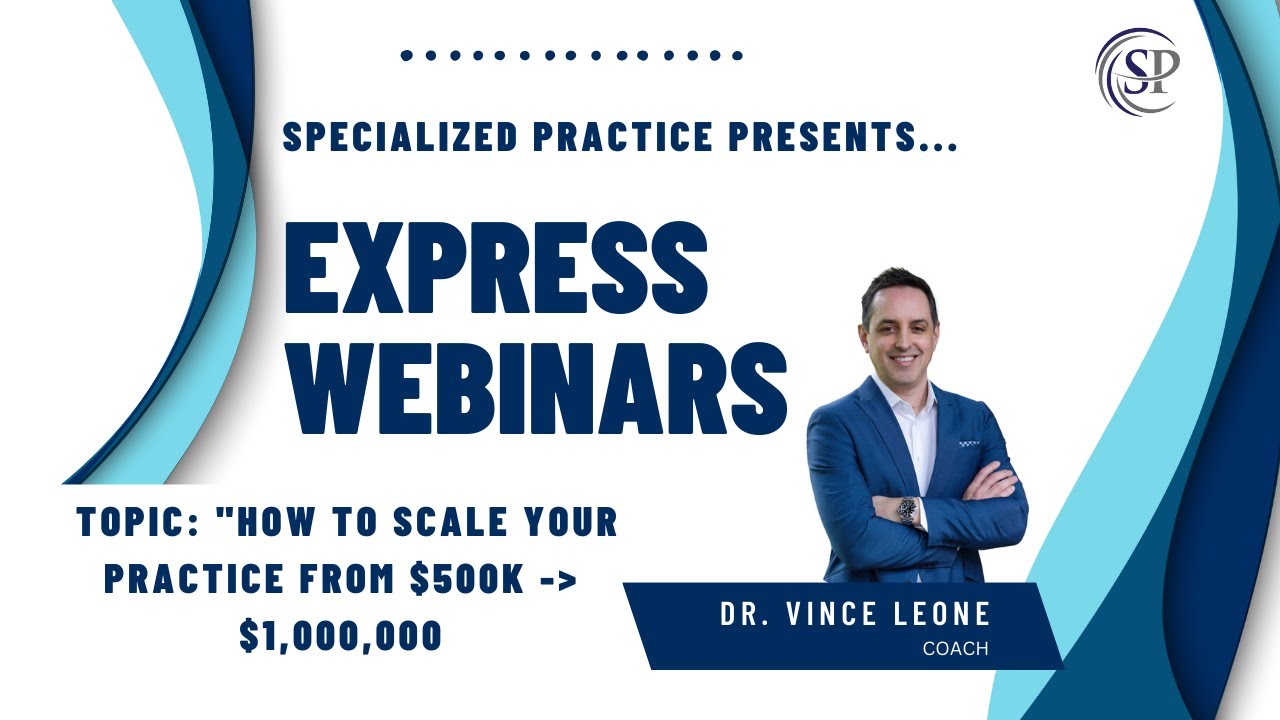
In this 30‑45 minute Express Webinar, Dr. Vince Leone of Specialized Practice walks chiropractors through a proven system for growing a traditional chiropractic practice that earns roughly $500,000 a year ($45K‑$50K per month) to a seven‑figure business ($1M annually, $100K per month). He explains why most doctors hit a revenue ceiling around $45K/month, then outlines four pillars for breaking through: (1) adding multiple high‑ticket niche services (decompression, knee pain, neuropathy) to diversify income; (2) building the right staff structure—including a fractional operations/finance director, associate doctor, trained receptionist, case‑manager, and techs—to support higher volume; (3) creating a comprehensive, diversified marketing strategy that consistently brings in high‑value cash patients, using a “25% rule” that splits new‑patient sources across paid online media, referrals, SEO/reviews, and community sponsorships; and (4) avoiding three common scaling mistakes—trying to go it alone, not hiring the proper team, and under‑investing in advertising. Throughout, Dr. Leone shares concrete metrics (ad‑spend as 10% of target revenue, staffing cost ranges, case studies of doctors who grew from $45K to $100K/month), and then presents his Platinum Program—a year‑long, all‑in coaching, agency, and systems package with performance guarantees. The webinar ends with a call to action for interested doctors to apply for the program.
Chapters
Let's dive in. Okay, here's the, uh, the webinar that we're going to talk about today. We call these our Express Webinars. In other words, we should be getting through this in probably 30 to 45 minutes. You know, we just want to deliver high-quality information to you guys. How to Scale Your Practice from $500,000 a Year Up to $1 Million. Um, and, uh, again, Express Webinar from Specialized Practice, my company. Um, and we're a little— Specialized Practice is a little bit different now. We have some You know, some clients are on this call. Some non-clients are on this call. It's valuable for everybody because this is information that is important to anybody that wants to grow, right? And wants to go to that next level in practice. SP is a little bit different from other consulting companies in that we have obviously our training and coaching program where we help doctors grow high-ticket niches like decompression neuropathy, knee pain, plantar fasciitis. But we also have a full-fledged marketing agency, right, where we run paid media for decompression, neuropathy, knee pain, plantar fasciitis. Are you catching a trend here? This is what we specialize in, right? Just like you guys are specializing in these high-ticket niches, we specialize in, you know, within chiropractic, which is its own little niche within healthcare. We go even farther down to just focus on these niches. Why? Because this is what I did, and I just teach what I did. So, there will be a Q&A at the end. Now, if you have questions between now and the end of the seminar or the webinar, feel free to put 'em in the chat and I will answer them as we go. But what are we gonna cover today? 4 main topics here. One, why doctors hit a ceiling around $45,000 a month. And so look, I'm throwing out $45,000 'cause that equals $500,000. You could be doing $40,000 a month, you could be doing $50,000 a month. But what do we do to break through to that next level? Number 2, how to determine the staffing that you'll need at $100,000 a month. This is key, guys. This is massive. If you don't have the right staff and team around you, you will not grow. And if you do grow, you'll come back to wherever you're at now because you have got to have the right team in place. Number 3, how to create a comprehensive marketing strategy that consistently generates high-quality and high-value new cash patients. And then finally, number 3, the 3 biggest mistakes doctors make when scaling up to $100K a month and how to avoid them, of course. Now quickly about me, just so you know that, hey, at least this information is valid. This guy's done it before, built a 7-figure decompression practice. Actually, it was decompression and neuropathy. We did both and we did some knee pain and obviously we had chiro too. Wrote 3 ebooks. We did one on neuropathy, one on decompression, and one on high-ticket niches. Obviously founder of Specialized Practice, and from a marketing perspective, and this is why I started the agency, is because I had a lot of experience with marketing, right? So for our clinic and our 2 sister clinics, which collectively is known as Sound Pain Solutions and is still going on, we got a significant return on our investment, 7 to 1, and we all, you know, we were in, you know, about anywhere from $50,000 to $60,000 a month in paid media between the 3 clinics. Clinics and all the clinics did great. They're all 7-figure clinics, 7-figure clinics. So full-time coaching consultant and I have, I have an extensive YouTube channel. You should check it out. Just search Dr. Vince Leone on YouTube. There's tons of training there. And, you know, been on podcasts and NBC and obviously we advertise all over Facebook and Instagram. And it's, you know, all about high-ticket niches, right? How do we start them? How do we grow them? You know, how do we give the, the support to them? You know, staff systems, clinical marketing—that is what we do. And I just finished up hosting with Hill DT our Decompression Summit certification in Dallas. That was September 23rd. You can see me here. Do you see me right in the middle? Right in the middle. But this was awesome. This was our first annual. The reason why I wanted to do this. Is because I went to— I will not name the other consulting company, but they host a boot camp or some summit, or I don't know, they don't call it a summit. I don't know what the heck they call it, but it's in Florida. That gives you an indication. Point being, it was all fluff. It was all fluff and sales. You know, they would have their big-time clients come up and, you know, parade them. They had a football player, but then they had like 10% actual training. So we've— we absolutely flipped that script. To 90%, minimum 90% training, 10%. Yeah, we're gonna offer, tell people about what we do and how we do it. And the sponsors got to talk a little bit, but it was mostly content. You know, again, 90% content, and it was awesome. We had 90 between doctors and staff, 90 people there, and we really had a great time. So there will be bonuses for those that stick around to the end. Sorry guys, I just got off the plane, so I am dehydrated and I will be drinking water. My bad. But there are bonuses, so stick around till the end. These are the 3 books I wrote: Ultimate Guide to Neuropathy for Chiropractors, Riches and Niches, 6-Figure Decompression Map. And so I'll show you how to get those if you stick around to the end. All right, you guys ready? How many people do we got on here? I can't even see. I got 5 people. Great. Awesome. Okay. Why doctors hit a ceiling around $45K a month and what to do to break through to the next level. So the practice that is around this number, and again, it's not, it doesn't have to be exactly $45K, right? It could be $40,000. It could be $50,000. But the point being is it's in that neighborhood. You know, you're making around $500K a year. It's a successful traditional chiropractic practice. In other words, we're doing, you know, fairly high volume, fairly low fee, probably insurance-based, but the doctor is good, right? And so they built up a practice, and so they have a strong chiropractic practice, but they've usually added one niche, right? So they've added decompression or neuropathy or something like that. And so it's, it's supplemented, right? So we have mostly chiro. The chiro is usually around $30,000 a month, and then they have another $10,000 to $20,000 maybe in with the niche, right? Whatever that may be. It's mostly through referrals, right? So they have a strong referral practice, which again is great, right? The fact that you have a strong referral practice means that you know what you're doing. You're delivering good results. Patients are happy with you. They're sending their friends and family. So congratulations on that. But minimal advertising right now. You may be doing a little bit of Facebook, like $1,000 a month or something like that, but it's minimal advertising, and you typically don't have enough staff, right? And we're going to get into staff obviously in a second. So this is kind of what the— this practice looks like. And I've, you know, I haven't been in the industry 50 years, but I graduated in 2007. And, you know, Grew a seven-figure practice, and then have been consulting since 2016. I I started specialized practice as a side hustle, and then in 2018 went full time. So I've I've talked to a lot of doctors over the years, and so I've just got a really good sense. I mean, by the way, if I when I when I meet a doctor at a seminar or something, I can literally usually within about five minutes. I I know within about five thousand dollars a month. How much they make? Twenty K a month, thirty K a month, forty K a month. I can just tell, right? Ask a couple key questions, and it's pretty easy. So this is this has been my understanding. Now this is a successful practice. I'm not saying it's not. So the fact that you've gotten to this, you're probably in the top, probably in the top, you know, thirtieth percentile, right? Twenty, you know, you know, maybe thirty, twentieth percentile. You know what I'm saying? One percent is like seven figures, right? So a hundred K a month, you're in the one percent. You're in the, you know, like I said, maybe 20, top 20% or something like that. This is great. Great. Now, is this where you— now, if you're here, you probably want to go higher, right? That's the whole point of this webinar. So how do we go from here to $100K? So if you're here, great, you're motivated. But this is what this looks like. And if you stay with this, with what we're looking at here, you will stay at this revenue level. Now, what do you do about it? How do you go? You know, this is we're going to talk about some other things, but here's some key things. What do you do about one? Got it. It helps to add another niche. So in other words, if your Cairo is doing thirty to forty thousand a month in collections, right? Mostly insurance-based. Obviously, there's some cash with copays and all that type of stuff. And you want to, and you only have one niche, right? So say it's decompression. Um. It is a little bit of a challenge to add 50K in decompression alone. Now, can you do it? Yes, you can. How do I know? Because I did it. But, but the point is, is it is easier to do it with 2 niches in addition to your chiro practice, right? I like decompression, and then I like knee pain. Neuropathy is a great niche, but it's complicated. Add to on top of that another consulting company that they're selling, you know, plans for 10 grand, and then they're sending home people home with, you know, they're doing home care, sending stuff home. You know, some people, some doctors are saying they're getting good results, some saying they're not. In my experience, that's not enough for a really sick diabetic, you know, neuropathy patient, but that's just my opinion. So I'm not going to throw shade on what's going on over there. What I'm saying is in the marketplace, people are kind of getting wise to this. And they're not crazy about it, right? Because they can go buy anodyne, like a rebuilder and anodyne for $1,000 on their own or $1,500 on their own, and they don't have to pay $10,000, right? Because they're not seeing the doctor. It's all at home. But my point is, you will have a better chance at getting to $100,000 a month if you add another niche. So you have your chiro, you have your niche number 1, and you have niche number 2. Now, why is that easier? It's because your chiropractic practice is, you know, you're probably getting, if you're at $45K a month, month, then you're probably getting about 20 new patients a month, somewhere in that neighborhood. Sometimes it's 15, sometimes it's 25, sometimes it's 20. Point being is that flow is really important to feed the niches, right? Because some of those patients will be decompression patients, some of those patients have knee pain, right? So what you do, and one of the easiest ways to grow revenue, is to add a service to a successful business, right? So if you're Starbucks and you have all these people coming through your store, why not just sell— hey, now I'm going to start selling You know, mints, and now I'm going to start selling breakfast sandwiches, and now I'm going to start selling mugs. You have all this traffic; you've paid for all this traffic, all your advertising and all your work to get people coming through your business. Now you just start offering them other stuff. Now you put that on steroids. Instead of selling them mugs, you're selling them a five instead of a mug for five bucks. You're selling them a knee pain package for five grand. Okay, so you see how that can ramp up quickly. So now. If we're at 45-ish a month, and we can do now 20 with decompression. So if your care plan's five grand, then you just need four decompression patients and four knee patients. So now you're at $85,000, and you're you know, and then we'll talk about how do we get up a little further. So that's one way to to get give you a better chance of getting $100K a month. Next, and by the way, if you went to five decompression patients and 5 knee patients, now you are officially at, you know, $100 grand, right? 50/50, etc. Okay, increase advertising spend. Most doctors do not spend enough money on advertising. Okay, they don't. And I don't know why this is, because a lot of marketing agencies, they don't push their clients. They're trying to compete in a crowded marketplace on Facebook with $1,000 a month. In most markets, guys, That is, that's like peeing in the wind. Like, I don't mean to be vulgar, but it's not doing you a lot of good. These, these Google, Facebook, these are auction sites. So it's like you're going to an auction, right? And you're bidding on a car and it's a $30,000 car and you're bidding $10,000. How much traction are you going to get? Not very much. Is he going to recognize you? He'll say, oh, hahaha, yeah, $10,000. No, no, not this. A $30,000 car. So point being is when you are not competitive with what your, your ad spend is, you— Facebook will take your money, it will show your ad, but it will not show it as much as someone— like, if you're spending $1,000 a month, it will not show your ad as much as someone that's spending $5,000 or $10,000 a month. And oh, by the way, your competition is not necessarily the chiropractor down the street advertising. For decompression, it's anybody advertising on Facebook to your demographic, right? Because we're marketing to patients that are 30 to 60. Well, you know what? There's a whole lot of other companies and businesses that are advertising to people that between 30 and 60. You know what I'm saying? So you are competing with all of them. So if you are not, if your budget is not strong enough, you will not be competitive. You will not get the eyeballs. You need the eyeballs. So. You need to increase your advertising spend if you want to get to $100K a month. Now, you do need to optimize your systems because if you do start— excuse me— if you do start increasing your advertising spend and you're getting more leads coming in and you're getting more consultations and they come in and it's a crap show in the office— in other words, they have to wait too long, the doctor looks all harried, there's not enough staff They're gonna be like, wait, you want me to pay 5? Like, you don't even know what— like, it doesn't seem like you know what you're doing. Your office is not, you know, it's not running efficiently. I had to wait. Like, you know, your exam was kind of subpar. Like, you know what I'm saying? Like, those systems, like your day 1, your day 2, they have to be optimized. Your exam has to be optimized. It has to be efficient. You have to be— you have to look like a rock star. This is where you Separate yourself, right? This is what we talked about at the summit. Like we had Dr. Penkin talk for an hour and a half just on how to do a world-class 10-minute exam, right? 10 minutes, world-class. Can you do that? If you can't, that's something that you need to shore up. You know, when patients come into their office, into your office, are they getting an extraordinary experience? Because if they're not, You need to make it so. You have to, if you want to make $1 million a year, like, in other words, we will not get what we do not deserve, right? You are rewarded in life and in business by the amount of value you put in the marketplace. If you put a subpar effort forward, you will get a subpar result. I didn't make up the rules. It just is what it is. You know what I'm saying? So, you must optimize all your systems. Right? And the rule of 10% is until you hit your target revenue, you should be investing roughly 10% of your target revenue in ad spend. So let me say that again. Your target revenue, whatever you want that to be, you should be investing that in your ad spend, 10% of that in your ad spend. So if you want to do $100,000 a month, then you're going to need somewhere in the neighborhood of $10,000 a month. Okay? Does that make sense? So now you're going to— I know what you're thinking. You're like, well, hey, but I don't have to spend $5,000 a month to get to $50,000. It's because you have your referral base, but your referral base will never get you to $100 grand a month with niches, with doing what we're doing. You've got to supplement. And we're going to talk about marketing here in a second, a little more deeper, but you've got to supplement with paid media. Now, do you always have to be at 10%? No, but you have to be prepared to do it and you have to ramp up and prepare to go to that number. Now, if you get to $100 grand a month, in other words, you're able to generate $50,000 in paid media with your niches. Now, do you have to spend $10,000 to get there? Probably not, right? Can you get there with $5,000? Maybe, maybe. But what I'm saying is you're Most clinics are not spending enough. And so to sustain this, because you'll get other chiro patients out of your, your ad spend, right? Because not everyone that comes in is, is going to be a perfect candidate for decompression or knee pain or whatever, but you can maybe still help them with chiropractic. But my point is, use the rule of 10% and be prepared to invest in your advertising. Again, if you want to get to $100,000 a month, do you necessarily need to spend $10,000? Not necessarily, but over the long haul, to stay present in your marketplace, right? To stay competitive, you will need to spend significant— in my— well, I think in all of our opinions, probably a significant amount of money per month, right? So at a minimum, if you want to generate $50,000 in decompression and say knee pain, you will need to spend a minimum of $5,000 a month, a minimum. Okay, so, and most likely a little bit more. And every— and the reason why I'm saying there's a fluctuation, there's a, there's a range there, is because every market's a little bit different. If you're in a competitive market like LA, Dallas, Seattle, San Diego, you will need to spend 10 grand a month. If you're in a rural area, you can spend less, right? Dr. Pankinen, so when he started with me, where he was doing about $45,000 a month, Funny that we should mention that. This is exactly what the webinar is about. He puts about $5,000 a month in advertising, okay, between Google, Facebook, newspaper, and radio. And he's doing $100,000 a month now. He does that— $103,000, $111,000, $110,000. So he— but he's on the low side, right? He's on a— he's in a very rural town, town of 800, draws from 50 miles around. Right? So it's not that competitive. So that's what I'm saying. Use the rule of 10% as you're guiding. If you're not hitting your numbers from paid media and you're only spending $1,000, it's not enough. And then finally, you're gonna need to add staff, and we're gonna talk about, you know, what and who to add from a staff perspective. But you will need to add staff because you don't have enough hands To do everything, and you don't have enough brainpower to do everything at $100K a month. If you did, you'd be there right now. Okay, so how to determine the staffing. So let's talk about staffing. How to determine the staffing you'll need at $100K a month. This is what a typical practice doing about $500,000, $400,000, $500,000, $600,000— this is about what it is. One doctor, the owner. A receptionist, an office manager, and then like a tech or two, right? So this is a typical staff for a doctor that has a success— successful chiropractic practice, is doing $30,000, $40,000 a month. And then he's got one niche, knee pain, neuropathy, decomp, and it's doing $10,000, $15,000 a month. One doctor. So he's doing everything. He's doing all the chiro exams, all the chiro treatment, all the niche exams. You know, not all the niche treatment. Now, sometimes you're still putting people on the table, which is terrible, right? We want to use staff systems and technology to deliver patient care in the niches, right? So, but we have a receptionist usually, and it's usually a female, and you know, she's picking up the phone and she's not super trained up, and you know, she's being paid $15 an hour, and and she's giving you the results of a $15 an hour. She's not. You know, usually not going to seminars, but this was cool about the summit, right? Bunch of staff there getting trained up, and Holly Burkhardt was training, and she was awesome. So you should definitely be at the next one with your, with your staff because it was, it was great training. But anyway, so you have a receptionist up there and she's not paid enough. You have an office, an office manager. Now, in typical chiropractic office, an office manager started as a CA or sometimes as a patient and just knew kind of, you know, knew how things worked. And did they have skill sets of, you know, how to track stats and how to run marketing and how to train and manage staff and, you know, how, how to coordinate with like your accounting company and, you know what I'm saying? No, no, typically not. So an office manager is, is typically just a CA, right? And then you have a tech or 2, you have someone that's, you know, you've trained, now they know how to put patients on the table, etc. Or to use the laser. Okay, this is typical. This is about $45,000 a month. Now let's look at what you'll need at $100K a month. Okay, you will, you will be the medical director. Okay, you're the owner and you will focus your time and energy on the niches, right? Because these, this is, they're, they're providing significant revenue for the practice. You will have a fractional operations and finance director. Guys, this is the secret sauce. When I hired this individual, this type of person for my business, things radically changed, right? All of a sudden, you know, we had projections and we had quarterly leadership meetings and we had, you know, a yearly budget and we, I mean, it just all of a sudden it actually looks like a true business. I've never even, I've never, I rarely have heard of a chiro practice having this type of role. But what I can tell you is in the bigger practices, like we just have a new client, um, group of clients sign up, Tangello Health, like big, you know, they have 3 clinics and they're all doing, you know, it's, it's a 7-figure operation. Um, they have someone like this, right? So the beauty of the fractional though is that you can find these people that they'll work On a fractional basis. That's why they're called a fractional operations finance director, because they're working for other companies, right? So they charge like $2,000 or $3,000 a month, but they're going to, you know, budget out, they're going to manage operations, they're going to help you systemize your business properly. They have the training, they have the background, they have the skill sets, and you'll, you'll be like, oh my gosh, this is amazing. I never thought it could run so smoothly. So that Individual is crucial, and they professionalize your business. Then they will coordinate with your accounting team, right? So they'll know—you'll know every single month exactly. You know, like do you look at your PNL? They'll actually—they'll actually go through and they'll show you and tell you what it means. And so you'll know if certain numbers are bad, where to focus your time and energy to fix the problem, right? Which levers to pull to increase net revenue. This is important because if when you're operating at this higher level, you have— I mean, you have more opportunity. So, um, so anyways, that individual is super important, um, and can help you and take a tremendous amount of stress off your plate, right? All of a sudden you don't have to worry about taxes because they're already built into the budget and taken out and paid, and you don't even have to worry about it. How cool is that? So, you know, and, you know, you actually get a True salary, and then you can have distributions and based on you know the performance of the company and all this type of stuff. But everything is is it's like a well-oiled machine. You need that at that hundred K level. An associate doctor. This doctor now associates, you know there's a there's a right way to have an associate and a wrong way. But we're not going to get into that. That's that's for another training. But the point being is in a good associate doctor, they're going to handle all the exams for chiropractic, and they're going to do all the treatment for chiropractic. Right? So, and I know you guys love to adjust, but the exams can be tiresome over time, right? You're like, oh my gosh, I got, you know, 3 exams today. Point being is you need an associate doctor, and I'm going to tell you why in a second, but you need an associate doctor to handle that, take that off your plate so you can focus on the niches and be a true expert in disc recovery or chronic knee pain treatment, right? So you can just really focus there. Can you still treat patients that have seen you forever? Yes, 100%. But your main focus, right, is going to be on the niches so that when you sit down with a patient, you know, hey, if this patient's a good candidate and we enroll them into care, that's going to be $5,000 to the bottom line. Next, receptionist. It's a receptionist, right? But, you know, someone that's actually trained, someone that tracks their stats, someone that knows how to lead a conversation on the phone so that when a patient calls, They can walk them through a mini consult, pre-qualify them, let them know that insurance doesn't take or doesn't pay for the niche services, but do it in a way that they don't hang up on them immediately. Tracks their stats and then gets bonus based on that, and they're paid decently, so they stay right. That's, that's a, an asset in a receptionist position. And then an office manager slash case manager. Or closer, if you want to call it that. I don't love the term, but I call case manager, right? They're going to do the finances with the patient, so you don't have to do it. So in other words, like when we teach our ROF training, we have the front half, the transition, and the back half. Back half's finances. So you're in the ROF, you're going to do the front half, you're going to do the transition, and then you're going to hand off to your case manager to do the financial. And then you have about three full-time techs. Right? So if you're doing decompression and knee, you have one. One for the one tech can do two decompression tables, right? So two decompression tables can get you to, you know, plenty of money. Point being is now if you're going to go to say three tables is kind of weird, right? Because you need you're you need you need three tech or sorry two techs for three tables. Could if you have a really good tech that maybe could do all three, but we had four tables. And we needed 2 techs, right? Not 4, 2, just 2. But for the lasers, we needed 1 per laser. So, and we had 4 lasers. So you're gonna need 3 full-time techs, because what you're gonna have is 2 tables, 2 lasers, and then maybe a shockwave. Okay, so 3 full-time— 3, gosh, why do I keep doing that? 3. It was a long day of traveling. 3 full-time techs. I call this practice nirvana. Why? Because now you can go on vacation and not pay for it twice. Because now when you leave and you go to the Bahamas for a week or 2 weeks, the clinic stays open, right? All the chiropractic patients continue to get care. The niche patients continue to come in. They're just evaluated by the associate and then they're handed off to the case manager. Now, will revenue dip a little bit? Probably. But will it go to zero? 100% not, right? And so now you can go on vacation and enjoy yourself, right? This is practice nirvana. Now, can you walk away indefinitely? Maybe. Probably not. Probably not. I think it's still going to be reliant on having a medical director, someone that's steering the ship on a regular basis. Now, could you cut it down to 2, 3 days a week? Yeah, 100%. 100%. So this is what a staff looks like. And I think you would probably, if it's done right, then you, you should probably have around $20,000 to $30,000 in free cash flow after you're paid. Okay? Does that make sense? So you get your salary, you know, you get, you figure out what, $10,000, $15,000 a month, whatever you need. Um, and then, you know, you're paying all these people properly. And you should have about $20,000 to $30,000 in free cash flow each month at $100K a month. Okay, so that's your staffing for $100K a month. Now let's talk marketing. Any questions? Is this— I can't see. This is really frustrating. Let's see, anyone in the chat? No one in the chat. Any questions? Okay, moving on. Quiet group today. All right. Hey, no big deal. Let's talk marketing. How do we create a comprehensive marketing strategy that consistently generates high-quality and high-value new cash patients? Well, we got to be thinking stability through diversity. Okay, stability through diversity. What do I mean by that? Think about if you were going Deep sea fishing. Okay, now you're gonna get this big fancy boat. You're gonna go out twenty miles. You're gonna you know wake up early. You're gonna you know pack all this you know bait and blah blah blah blah blah. Would you go out there and throw one line in the water? Probably not, right? You would probably say, well shoot, shouldn't we put as many lines as we can get in the water? Yes, you would, and that would be a smart thing. Same thing for marketing. We want as many poles in the water as possible right now. To simplify it, let's use the 25% rule. 4 key new patient streams is what you should be focusing on. Okay, so let's look at those individually. So 25% should come from paid online media: Google, Facebook, YouTube, Instagram. Okay, Google, Facebook, YouTube, Instagram. Now, should you be using all those? Yeah, yeah, you should, because Facebook is super competitive. Leads tend to not be of great quality unless you really put them through a significant kind of sifting and sorting process, which is what we do. But still, Google's always gonna have higher quality leads because people are actually searching for us, right? So there's 2 types of advertising. There's push advertising, right? So that's Facebook and Instagram. We're pushing our message in front of people. They're not looking for us. They're just on social media dinking around and then all of a sudden, boom, they see our ad. That's push advertising. Pull advertising is Google and YouTube because people are searching, right? They are searching for back pain treatment or spinal decompression near me or, you know, chronic knee pain treatment or whatever they're searching for. They're actually searching for it. That's why they're better quality. Now, do you have to pay more for them? Yeah, you do. But, you know, like we have Dr. Shane Stanley's in Michigan, and he went through 5 agencies. They all did Facebook. I don't understand why all these agencies don't only do Facebook. Anyways, 5 agencies, all they did with Facebook, none of them worked. Started with me, right? And I said, he said, are you gonna do Facebook again? I'm like, no, heck no, I'm not gonna do Facebook again. I mean, look, are all these agencies terrible? No. Are they all great? No. But out of 5, I figured some of them are probably pretty decent, right? So I'm not gonna go try to reinvent that wheel. What I am gonna do is go to Google because I love it. And, and now he's cranking 1 to 2, 3 new patient starts a week, and not even that much, like 2, you know, maybe $2,500 a month. And we are ramping up, right? Continually ramping up. Someone raised their hand. Andrew raised his hand. I got it. There it is. Andrew, if you have a question, I don't, I don't know how to answer your raised hand. Just put it in the chat. Whatever question you have, just, just put it in the chat. So, so 25% is going to come from paid online media. Okay. 25% is going to come from referrals. Okay, so you should be getting— so let's say we're— we want 10 new starts a month, right? Okay, 10 decompression. So we're doing decompression in knee, so we want 10, 2.5, you know, uh, new starts. Wait, what am I saying? 2.5? It doesn't matter. Point being, 10 new patients a month. So we want 2.5 from paid online media, 2.5 from referrals, 2.5 from SEO, and 2.5 from some type of community sponsorship. Now, that doesn't seem so hard now, right? So, oh, I only need 2 to 3 new patients from my paid online media. Well, that's not bad. I can do that. I have the chat disabled. Oh, well, what the heck is— I have— how— why is the chat disabled? Hold on. Oops. Thank you for telling me that. I'm not seeing where I can enable the chat. Let's see, show chat previews. Andrew's a rock star here. He's telling me how to do this. Um, ah, attendees can chat with no one, hosts and everyone. Okay. All right, we're good. We should be good. Andrew, check that, will you? And let me know. Ah, boom! There we go. Gosh, I've been using Zoom for years. I can't believe that's such a rookie mistake. Sorry about that. Okay, so now the chat is enabled. Now I know why no one was saying, yes, I'm here. Yes, I have a question. Okay, so use the chat if you have any questions. Where the heck was I? Okay. We want 10 new starts, right? So 10 new starts. We're getting 2 to 3 from Google, Facebook, YouTube, Instagram. We're getting 2 to 3 from referrals. So guys, if you're getting, say, 20 new patients like chiro patients a month, 10 to 20% of those are disc patients. Now, whether you're able to recognize them, evaluate them, and enroll them into a decompression plan is a totally different story. But in my experience, both in practice and now with consulting, about 10 to 20% of all chiro patients are a disc patient, especially if you're doing PI. Right? That's the number one cause of disc is trauma, right? MVA. So referrals, you should get 2 to 3 into your niches from your referrals. And now when I say referrals, I'm also referring to your past patient base, right? So you can, you should be communicating with your past, your current patients and your past patients via email, social media, like on a regular basis, right? Sharing good, good, good valuable information about what you do. SEO and reviews. We covered this at— by the way, Andrew, I— the image, I can't see the image for whatever reason. Oh, there it is. Yeah. All right. Thank you. So SEO and reviews, we covered this at the Decompression Summit. How do we get more reviews? My— so my challenge to everyone at the summit was 1,000 Google reviews. Now you, you may be like, holy cow, I only have like 100 or 200. How can I get to 1,000? Well, we talked about a very simple way. It's not— you're not able to do this in all states, right? Because, um, we're using an inducement, $25, $25 gift card. You get a little sign that sits on the front desk and it says, you know, all Google reviews get a $25 gift card. And so there's— and what you have, a little QR code, they shoot it with their phone, and then they can write a review right there. Okay, so it's a really easy way to get reviews. But between SEO and reviews, you should be able to get 2 to 3 stars, right? So you want to build up your SEO, you want to build up your reviews. And now, why did I pick the number 1,000? Because I have a client in Florida and he has 900 4 and 5-star reviews. You know how many new patients he gets every single month? 50. Do you know how much marketing does? None. So guys, it's an asset if you can build up your reviews, right? Positive Google reviews up to 1,000, or at the bare minimum 500. You will start to get patients from that because it's social proof. Question here, we got someone in the chat did it and 10 reviews from the desk stand since. Oh, nice job, Dr. Chris. So Dr. Chris Cameron, new client, was at the summit and he, you know, gosh, he actually did what I recommended. So it works. It's just super simple. By the way, you can also use that for referrals. And I would, what I would do is, so don't do it the same place. Like, it's like one offer in one place. So on the front desk, use the little, and by the way, if you're like, what is this little sign you're talking about? Just Google QR code stand, like referrals or something like that. And it'll show you there's, there's, you know, all these vendors that'll sell you for like $30, right? So they'll put a link to your Google My Business on this little stand. You can have it say whatever you want. And then when they shoot that, it'll take them to a Google to write a review for your business if you want more referrals. And oh, and sorry, so when they give you a Google positive Google review, you give them a $25 Amazon gift card. So we, so we said, okay, well, what are the metrics here? I want to make sure we're on time. So what are the metrics? What if you give out— all right, well, if we're going to get to 1,000 Google reviews, that would be $25,000. If each patient— so my, my, what I taught was, hey, set a 3-year goal, $25,000 invested over 3 years 5 patients pays for it. Do you think you can get 5 patients from all these reviews? Yes, of course you would. So with referrals, you can same thing. Hey, we love referrals. You know, $25 Amazon gift card for every referral you send in. Now you want to track it, obviously. You know, have your front desk track it. Okay, Joe Bob sent in Sue Smith and da da da. But anyways, so you can start to generate more referrals that way. I would. Again, have it on the wall framed nicely. Have a designer do it. Like, don't, you know, don't put cheap stuff on the wall. Never put, never put anything on your wall that is not framed, by the way. That, that's like an old rule. Andrew says we use HighLevel and when we place them in the right column, it sends them a review link. Yeah, 100%. We use HighLevel for all our stuff too. So anyways, SEO and reviews. And then finally, community sponsorship. Right? So what we're trying again, stability through diversity. How can we and who can we partner with in the community that would make sense for our ideal patient? Right? Is it like Dr. James is sponsoring the golf course? You can sponsor the golf course. You could sponsor the YMCA. You could sponsor the BNI. I mean, like guys, just you you want to be involved in your community. You want to meet other business owners. Right? That is going to— if you meet and develop relationships with other good business owners, other, you know, other people that are like, you know, they're, they're doing well in businesses also, then they will start to, hey, what are you doing? And oh, and you can develop relationships, what are called JVs in the online community, where, you know, we have one guy that sells marketing and one guy that sells, you know, speaking gigs, and then they can— hey, they'll email their list for each other. It's called a JV partnership. It's the same thing, and it's just a— it's an old business thing. But the point being is, if you can get and develop relationships in your community with other business owners, you have access to their patient base or their customer base, right? So dentists, you know, I mean, just go down the list. It doesn't have to be healthcare. Right? It could again, it can be any business that caters to your ideal patient. Now, who's not an ideal partner? Someone that runs a jungle gym, right? If you unless you want to for kids, like jungle gym is a is a kids little you know dink around gym. If you want to treat kids, yeah, that's a good that that would be a good partnership, but not for if you want to do decompression, right? Or chronic knee pain because that's you know that's forty, fifty, sixty-year-old people. So you want to find another business. And ideally multiple other businesses that have that ideal kind of customer base, and then you develop relationships. Now, is this going to happen next week? No. But you guys are, you know, you're going to be in the business for— in business for the next 10, 20 years, right? So you want to set yourself up, start thinking, you know, 1, 3, 10 years down the road. What the decisions I make now, what impact will it have in 3 years or in 10 years? Now, if you got 1,000 Google reviews for your business, when you go to sell your business in 10 years and still everyone is dinking around at, you know, 100 or 200 reviews and you have 1,000, don't you think that that sets you apart in terms of like an asset for your business? Yes. So does a niche. So does consistent marketing. So does having a fractional CFO. This is why we're talking about this, because we want to actually create a business. Right now, most chiropractors own a job, a high-paying job typically. You know, if you're doing $45,000, $50,000 a month, you're doing pretty well, right? So that's a high-paying job, but if you don't show up, you know, the money stops flowing. So what we're trying to do is create a business that if you don't show up, it continues to operate, right? At least without going to to zero. Maybe it won't be as, you know, as high if you're not there, but it will give you a tremendous amount of freedom, right? Versus— certainly versus, you know, probably what you are now. So that's the marketing strategy. All right, next, moving on, let's talk about the 3 biggest mistakes doctors make when scaling to $100 grand a month, and then we're going to wrap up. One, trying to figure it out on your own, guys. It's like, why would you? It's like you want to learn golf, so you're going to go buy a bunch of clubs, spend a bunch of money on clubs. You know, you're going to buy some balls, and you're going to go whack at that thing for hours and hours on the driving range, and maybe at some point you, you know, will will start to hit it and hit it straight and hit it far versus if you. Hire a coach, right, that is going to show you, hey, this is where your feet go, this is where the ball goes in your stance, this is how you grip the club, you know, this is where you want to be in this part of your swing, this is where you want to hit the ball on the clubface, this is how far a 5-iron should go, this, you know, do you know what I'm saying? You see the difference? So now it's trying, instead of trying to figure it out, you're just, you just have to master it. You're just like, oh, so this is what I need to do for that. Boom. Okay, I'm gonna do that. I'm gonna work on that. I'm gonna work on my grip. Now I know, I know what the grip looks like. Now I'm gonna work on it and get comfortable with it. So when you're trying to be in the top 1%, the chances of you doing that, trying to figure it out on your own, will you get there eventually? Maybe. Maybe. Will you get there quicker if you follow a proven model? 100%. You will get there faster. If you follow a proven model, and there's plenty of people. Obviously, I teach this, and there's other you know companies out there that teach decompression and how to do it and all that type of stuff. But my point is, it's like if you try to figure it out on your own, it's going to be take more time. It's going to be more expensive, and it'll be more frustrating for sure versus if you know you have someone in your corner that is. Giving you the roadmap, right? And you just follow it, and you just— as long as you implement, right? I mean, just because you buy the roadmap doesn't mean that your practice goes to $100K a month. No, you gotta actually do the work. Um, and by the way, if like anyone trying to sell you guys an easy button, like, hey, you just, you know, push this button and your practice is automated and money falls from the sky, I promise you it doesn't work. It's a really good way to market to people, right? Because it's, it's like easy money. But in my experience, you got to work for it. And that's— now maybe, maybe there's another experience, but everyone I've talked to that has made lots of money and had successful businesses, not just chiropractic businesses, but, you know, construction businesses and paving businesses and, and online, you know, other types of online business, they've all worked really hard. You know, now, were they able to delegate and hire in people to take over different tasks so they could do less of that busy work? Yeah, 100%. That's called scaling up. That's called growth. That's— we talked about that with the team members. We— you hire those team members to take those low-value activities off your plate so you can focus on your highest-value activities, right? Highest-value activities: generating new patient consultations, evaluating new patient consultations, And enrolling new patient consultations. If you can focus on those 3 things and not turning on the lights and paying the bills and training the staff and adjusting patients all day for $20, and you can focus on these 3 things, you will grow and you will be less run down and less frustrated. So that's mistake number 1. Mistake number 2 is not building the proper team. If you're going to try to do this all, guys, all on your own, You'll, you'll be so frustrated and you'll be overwhelmed and you probably won't get there. I mean, I'm just, just, I'm the guy that's going to tell you the truth right now. That doesn't always serve me from a business perspective because some people just want to hear, you know, lollipops and unicorns. But I'm, I'm going to tell you the truth. If you don't build the proper team, you will not get to a million-dollar practice and sustain it. You have got to have a team. You know, you've got to be able to focus on those highest value activities. You've got to have your systems dialed in. You got to have your finances dialed in. You've got to have your marketing dialed in. You know, you have to have patient care dialed in. You have to have protocols that deliver excellent results. Like all those things need to be taken care of, but they don't all need to be taken care of by you. Because you're the owner, you need to recognize what needs to be done and then, and then find, you know, it's the, it's the who, not how, right? There's a great book, I highly recommend it, by Dan Sullivan and Dr. Ben Hardy. It's called Who Not How. And it's like, hey, it's not how can I do this, it's who can I get to do this activity, right? Okay, so that's mistake number 2, not building the proper team. And 3, not investing enough into marketing. So we talked about this, and this is just—I mean, I have to state it because it happens so much. I just hear doctors like, "I'm so frustrated with this, this you know Facebook agency." Okay, what's your ad spend? Fifteen hundred a month. Oh my gosh! Fifteen hundred a month, and you're in Dallas. Are you serious? Do you know how many people are advertising at fifteen hundred dollars a month? It's just—you're—you're just not competitive enough. You know, at the bare minimum, double it. I mean, triple it. Tell your agency, hey, I don't care, spend $5,000 this month. I just want to see what happens. Take a risk on $3,500 extra. Who cares? You won't miss it in a year, but you may get 4 extra new patients at $5,000 each. And all of a sudden you're like, whoa, I put in $5,000, I just got $20,000 in revenue. Can I do this again? And how many times can I do it? What if I put in $7,000, do I get 7 new patients or 8 new patients? And now I'm at $40,000, $30,000, $35,000, whatever. So you need to take a risk there. Now, if the company doesn't know what the heck they're doing, then that's a different, you know, that's a different story. But my point is, if you're doing what everybody else is doing and just investing what everyone else is investing, $1,500 a month, probably gonna get what everyone else is getting, which is not very much. All right, so does that make sense? Anybody have any questions? So let's look at some doctors. We love Dr. Pankin. So Dr. Pankin, you know, when he started with me, he was doing, you know, $45,000, I think, $45,000 a month, $48,000, something like that. Um, and, you know, did he do it overnight? No, no, it took him a couple years to get there, but now he's doing $100,000 a month. Dr. Karami, look at this, $10K. $10,000 because she does, she does knee and decompression combos. Dr. Abrams, he's all cash, all cash, no insurance. And when he first started with me, so he's going into year 3 now, when he first started with me, he was doing $30,000, and then in 8 months he went up to $90,000. Now he has since pulled back because he wanted to pull back. He was at a frenetic pace, so he didn't want to Go that hard and that fast. So he's, but he's still like $80,000. Anyways, crushing it. So if this is something that you want help with, okay guys, I'm just now I'm gonna tell you what I do. I'm gonna, I'm gonna offer you my services. Now here's what's interesting is if you don't, I just remember my dad, you know, he's a chiropractor, been a chiropractor for 50 years, talks chiropractic with anybody. Right? Anybody and everybody, anyone that will listen to him. But you know what? Always had a big practice. So if you don't feel confident talking about your services, then, then there's, there's an issue there, right? Either you don't feel like you can deliver the results, or you don't like what you do. Now, I can't help you if you don't like what you do. I can help you if you, if you, if you don't think you can deliver the results, because we have proven protocols that kick butt and deliver outstanding clinical outcomes. But I know that we deliver outstanding results for our clients. So I don't have— I don't consider this selling. I'm going to offer you— I'm going to tell you about my services because I believe in it, right? Our doctors average at least $20,000, $30,000 a month. So, and some much more, right? So let's talk about it. Let's talk about what I do. I call it the Platinum Program. I offered this at the summit. It covers everything, everything you need. Systems, right? Your day one, your day two, your ROF, your phone, your staff training—all your systems covered. And by the way, there's not fifty systems, right? There's you—you really only need about three or four good systems, and you're dialed. Then you just gotta you know hone them and optimize them. Two clinical. We have got—if we're gonna ask someone for five grand, man—we've got to deliver results. We have to, and. By the way, our protocols deliver excellent results. Dr. Pankinen tracks every single patient he's had since the past like five years, so we have all the data. Our protocols are awesome. So we have all the clinical stuff, and we have you know weekly calls with Dr. Pankinen. We have weekly calls with me. So you guys have all the support you need. Marketing will run all your paid advertising, right? Remember full-fledged agency. All the coaching. So everything, it's all under one roof. We're not gonna refer you out to some agency and then get a kickback or anything like that. It's our agency and we focus on this. I actually write the ads myself. Coaching, right? I'm gonna coach you up because this is what I did. I know how to do it and I'm giving you the roadmap, right? So this is the whole thing is like, do you wanna figure it out on your own or do you want a coach to Give you the roadmap of how to do it properly. You know, did I have a coach? Yeah, I've had four coaches. We had a coach for decompression, but then I think he passed away. But he had everything like you know on on discs, and so we just studied those. And and you know, did it was it awesome? No. Was it was did it work? It helped. You know, we figured a lot out. Sometimes it felt like we were running through a forest with a blindfold on. You know, we got beat up a little bit. But when I started my consulting company back in 2016, you know, I just started thinking like, well, look, if I was starting from square one and I wanted to get to where we're at now, what would I need? You know, literally step by step, what would I need? And that's how I built the coaching program. So you get coaching and staff training, right? Just like we talked about, what staff do you need? What roles do they need to play? What training do they need so that they can support you properly? It is all included. Then accountability, right? So, not only accountability with me, your Coach, but accountability with our group, right? You will develop relationships with other doctors in the group, right? You come to our summit and that is going to be a regular thing for us. Accountability is important, right? It is one thing for us to say, OK, I am going to do this. It is another thing when we tell someone else, I'm gonna do this. Big deal. So this is what it includes. So 1 year— it's a 1-year program, 1-year elite mentorship— our holistic digital advertising suite. In other words, we do all the online paid media platforms. AIM, the AIM Protocol integration. So the AIM Protocol is something that I created, the Artificial Intelligence Marketing Matrix. That's what AIM stands for. And this is a new and unique way that we're using Facebook That saturates our community with our message, with high-value information, so that we can position ourselves as an expert. No one else is doing it. Our educational assets, right? So these pre-consultation videos, pre-report of findings videos, webinars, all types of stuff so that you can educate patients before they come in or after day one. We have our weekly live Zooms, one on Tuesday, one on Thursday. Tuesday is clinical, Thursday is practice building. It's possible, but you need to really be good. And we have the training for that. Advanced marketing tools. So we have newspaper ads, radio ads, Facebook ads, all of that available for you. Mindset coaching. We have a whole module just on mindset because it's something that I really dig and it's interesting to me. So I, I read a lot, I consume a lot of information on the topic, and then I turn around and Give it to you guys. Our daily mindset journal so that you can set goals and set yourself and keep yourself accountable. Our private community. You know, if you wanted to go to do radio or TV or newspaper, we can help you with that because I've done it. ROI tracking. Of course, we have stat tracking for for all the key stats, right? We don't inundate our doctors with with like a million stats. We just You know, 4 to 5 stats is all you need to track, but most doctors aren't even doing that. How to market to your internal patient base? You know, how do you, how do you do an effective email campaign, social media, postcards, mailers, all that type of stuff? Some of that old school stuff still works. Email marketing still works. That's how you guys got here to the webinar. You're on, you're on my email list. I, I try to email every single week. Sometimes I miss, but most time I'm emailing every single week some type of value. And then once in a while, I'll host a webinar. We optimize your care plan, right? We— so when doctors come on board, we always, you know, we have a 30-day onboarding, right? So we're going to do fast start consultation. So that's a one-on-one call with me, right? We are going to do a lot of things. Where are you at now? Where do you want to be in 12 months, right? But part of that is optimizing your care plan and price point for you and for your city. Advertising assets, talked about that before, one-on-one consulting. So at the end of each month, we're going to look back, just one-on-one, you and I, accountability too. But we're going to look past 30 days, you know, what went right, what went wrong, what can we do better, then plan for the next 30 days. And then again, again, our client concierge. So in bonuses alone, it's $35K or sorry, $37K. So what would it be worth if I could help you get to $100,000 a month? So if you're at $50,000 a month, Now, that would be an extra $600,000 over the next 12 months in cash, right? So if I charged $100,000, which I'm not, but some people do. AMI is pretty close to 100 grand. It's 85 grand. There's another one. What is their name? They charge $150,000. Practice something. Practice Masters. Anyways. There's, there's people charging that, right? But that would be a 6-to-1 ROI. If I charge $60,000, that would be a 10-to-1 ROI. Remember, we're doing all your marketing, all your coaching, everything. So for this, we're doing $3,500 a month or $35,000. You can do a one-time payment of $35K for the whole 12 months, right? Or $3,500 a month. It does not include your ad spend. Okay? Because a lot of doctors ask that. It does not include your ad spend. That is covering your agency fee, that is covering your coaching, that's covering your one-on-one. Okay, it's our Platinum program. It's our top-tier program. And the reason why I created this program, because I looked at the doctors that are doing the best, like Dr. Pankinen, and that's what they're doing. So I wanted to offer what we— what the doctors need the most. Now, If you said, well, gosh, Dr. Vince, I have an agency and they're working great. You know, can we break this up? Yeah. You know, jump on a call. We'll figure it out. But if not, then this is the way. This is the plan for you. We this is gonna expire. You always have a little urgency, scarcity. So that's gonna expire next Friday at two. We have two guarantees. One, in the first thirty days, right? So in the first thirty days, you're gonna have a call with me. You're gonna have a call with Dr. Pankin. You're going to get your what we call our Creating Wealth Game Plan. You're going to get integrated into the training platform, integrated into the Facebook group. You'll get on, you'll get on a couple of calls and you'll have your first 30-day call with me. If at 30 days you are not happy for any reason whatsoever, you just let me know and we'll part ways. I'll tear up the contract, I'll refund any money that you invested, and we part as friends. No harm, no foul. Guarantee number 2. I don't know anyone doing this, guys, but I feel very confident if after 12 months you have not tripled your investment in our program— does not include advertising spend, includes what you've invested in specialized practice— we will continue to work for free until you do. Okay? So just to give you an, uh, you know, a rough number, say you wrote a check for $35K for the whole year. If you don't— what is $35K times 3? I think it's $105,000. So if you don't get to $105,000 within 12 months, we're going to keep working until you do for free. All right, so we only have the capacity to properly onboard 5 new clients each month right now. We— I just hired a bunch of people. Not a bunch. I mean, we have a team about— what is it, 6? 5? 5 or 6? But we— that's what we can do right now. And, and oh, by the way, we, we've— we have 4 clients at the start of this month. So, um, we, we, uh, 1 to 2 left for this month. So if this is something you're interested in, highly recommend go here, drvincecalendar.com, and you are going to fill out an application, find a time on my schedule, and then we will jump on a discovery call and we'll figure out if it is a good fit for us. Bonuses. If you, uh, thank you if you're still here, thank you so much. Um, go to— or sorry, email me support@drvinceleone.com and then, um, uh, put in the subject line webinar bonuses, and then I will send you those 3 books for free. All right, so guys, that is it. Um, I hope this has been helpful for you. Right? There will be a replay. So if there is some information on here that you, you know, wanted to go back and look at, a replay will be available for you. If you are interested in the coaching in the Platinum Program, go to drvincecalendar.com and get signed up for a discovery call. I am going to do a last call for questions here. Going once, going twice. Okay, so thank you all for joining us. I really appreciate your time. I know it's kind of an odd time, um, but, um, you just never know where one piece of information can make the difference in your practice and in the next 3 to 10 years. I mean, you just never know, right? One piece, one lever that you pull could change your practice forever. So this is— I love doing this. I love teaching. I love coaching. I hope that has come across, and I hope this has been helpful for you. Tell a friend, and, and because I would— I want to help as many doctors as possible add and grow these high-ticket niches. So that's it. I'm Dr. Vince Leone from Specialized Practice. Thank you so much, and we'll see you next month on our next Express webinar. Take care.










