Eckhart Tolle LIVE on The Dark Night of the Soul: The Way Out of Suffering in Tumultuous Times
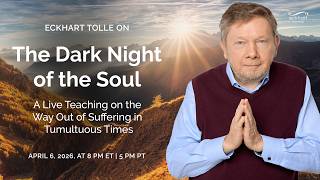
In this live YouTube session hosted by Tammy Simon of Sounds True, Eckhart Tolle introduces and explores the concept of the Dark Night of the Soul. The program begins with a brief guided stillness exercise that invites listeners to become aware of the present moment beyond thoughts, memories, and future projections. Tolle then defines the Dark Night of the Soul as a prolonged period of suffering and meaninglessness that goes beyond ordinary emotional upset, often triggered by the collapse of a personal narrative, belief system, relationship, or life circumstance. He traces the term’s origins to the 16th‑century mystic Saint John of the Cross and explains how modern interpretations of suffering (loss of faith, evolutionary nihilism, collective crises) can intensify the experience. The session addresses three audience questions: 1. Imelda’s question – How to recognize the Dark Night and stay true to spiritual practice. Tolle outlines the signs (persistent suffering, a pervasive sense of pointlessness, bodily tension) and suggests staying present, observing thoughts, and recognizing the body’s response as a doorway to awakening. 2. Ron’s question – What single message can help someone in the “midnight” of the Dark Night. Tolle advises watching the repetitive, negative thoughts, witnessing them without identification, and accepting the bodily feeling without resistance, thereby creating the space for awakening. 3. Souviede’s question – How to support others and shift humanity out of the collective Dark Night. Tolle expands the discussion to a planetary scale, describing cycles of growth and regression in consciousness, the role of suffering as a catalyst for evolution, and the importance of maintaining a witnessing presence that does not react to collective turmoil. He references historical epochs of heightened consciousness (Buddha, Tao, Greek philosophers) and the current regressive period marked by wars, pandemics, and environmental crises. He emphasizes that each individual’s conscious presence contributes to the collective field, and that staying awake, compassionate, and non‑reactive can help lift the collective darkness. Throughout, Tolle stresses the practice of present‑moment awareness, body awareness, and the witnessing self as the primary tools for navigating both personal and collective Dark Nights. The session also promotes an upcoming six‑week online program, “From Suffering to Spiritual Awakening: How to Use the Dark Night of the Soul to Ignite the Light of Consciousness,” beginning April 9, which will deepen these teachings.
Chapters
Hello and welcome. On behalf of our good friends at Eckhart Teachings, I want to welcome you to this special live session with Eckhart Tolle on the Dark Night of the Soul. My name is Tammy Simon. I'm the founder of Sounds True, and it's an honor to be here with all of you. I also want to mention that this live session is part of a larger exploration that you're invited to join. It's an upcoming 6-week online program with Eckhart called From Suffering to Spiritual Awakening: How to Use the Dark Night of the Soul to Ignite the Light of Consciousness. The new program features a full 6-week curriculum plus 2 live teaching sessions with Eckhart Tolle. It begins on April 9th, which is this Thursday. People have already registered for the online series and have begun submitting their questions about the Dark Night of the Soul. Our team has combed through these questions and selected those that seem to have the most universal application, and those are the ones that are going to be shared in this session. I do want to answer one question right away that several people have asked, and it's how is this particular upcoming course different from the mini course Awakening Through the Dark Night of the Soul, which was released 2 years ago and was a short compilation of several talks that Eckhart previously gave on this topic. The short answer is that since we created that mini-course, it's become one of the most popular topics that people ask Eckhart to talk about. And due to the large amount of interest, Eckhart wanted to create this all-new course, which was newly filmed in its entirety just a few months ago in order that we can as a group dive deeper into this topic and Eckhart can support people on their journey personally through the dark night and through the collective dark night that we're in. Again, the all-new course begins on April 9th, and you're all very welcome, invited to come join us. You can click the Learn More button that's on the player page, or if you're watching this on YouTube, there's a link underneath the player in the YouTube description, or you can visit EckhartTolle.com to learn more and register for the new series. And now it's with great joy that I welcome Eckhart Tolle for this conversation on the dark night of the soul.
Eckhart, thank you, Tammy. Hello everybody, lovely to be with you. Before we go to the questions Let's have a moment of stillness, which is the essence of meditation and also the essence of who or what you are. Without using any technique, let's just see if we can become aware of the deeper dimension within ourselves, beyond all the memories of past thoughts about future interpretations, opinions, viewpoints, likes and dislikes, and direct our attention within A good starting point is becoming aware of your breathing, and then it slows down a little as you become aware that you're breathing. And become aware of yourself, not in an ego sense. Becoming aware of yourself— this self does not refer to your personality or your person, because that operates continuously in most people's lives. So becoming aware of yourself without reference to memory or anticipation. So there's only this moment, which ultimately there is only this moment, but most humans live as if past and future were more important. There's only this moment, and you become aware of yourself without reference to ultimately any thought about yourself. So you let go of trying to interpret Let go of trying to interpret yourself, your life, or problems, or even try to interpret the world. Let's go of that. And what remains without reference to past or future, which is thought Past or future are created by thought. What remains of yourself here and now? Don't think about it. A silent presence. Is silent power. There's a knowing in that, and the knowing is I am the knowing that you are the being of you, timeless, nothing to do with your age, your history. Your gender, your race, your position in the world. Nothing to do with any of it. Getting in touch with that silent power that connects you with something much vaster than the little self, connects you to the source. And acknowledging that is of vital importance in your life. Perhaps many times during the day, let go of mind activity, become present. Before doing anything important, become present. This is a realization. One could say the realization of being, sometimes in some traditions called self-realization. The real self-realization is when it never leaves you. It's always in the background, sometimes in the foreground. But here, for many of you, it begins with glimpses of that transcendent state that frees you from yourself, the limited personal selfhood. That's the— this is the essence of all spirituality. Well, let's start with the first question.
This is a written question that we received, Eckhart. It's from Imelda in the United States, who writes, how does one know one is experiencing the dark night of the soul? How does one navigate it and remain true to spiritual practice?
Thank you. How do you know you're going through the dark night of the soul? Dark, by the way, dark night of the soul is a term that's been around for a few hundred years, mostly used, mostly used in a religious context. First used probably by medieval Spanish mystic San Juan de la Cruz, Saint John of the Cross, who described that state that he experienced as the dark night of the soul, which was a state of disconnection from God. Or seeming, an apparent disconnection from God. And he even wrote a, a poem about it. It precedes the awakening of, in ancient terms, realization of God within you. So how do you know? Well, the most— in the most simplest— in the simplest terms, you suffer. Not just very briefly, because brief moments of suffering happen very frequently in most people's lives. When you get irritated with something, it's a little bit of suffering. When you get anxious about something that with more suffering. When you get angry with someone or about a situation, that also is suffering, not usually recognized. When a person gets angry, in that moment they're in the grip of anger and they don't realize it's a form of suffering. The body knows, your body knows that you're suffering because it, it has an adverse effect on the body and the functioning of the body. When you're angry, it disrupts the free flow of energy through the body. So the body knows that it's a form of unhappiness, but you, when you're in the grip of anger, you don't know you're suffering. Because that is an unconscious state which is called ego. It's not— ego can assume many forms. When you're in the grip of an unconscious state, you don't know it. You're identified with it. You are it. It possesses you. The energy field possesses you. So an angry person doesn't know that he or she is suffering. In fact, they want more of it because they're in the grip of the anger movement, which is an energy, a manifestation of particular energy at a particular frequency. So there's that kind of suffering, but Dark Night of the Soul is more prolonged suffering that goes on for not just days but can go on for weeks or months. Like living under a dark cloud. And it's not usually anger, it's usually a sense of meaninglessness. So it's associated— there's a mental aspect to it, there's the emotional aspect to it. On a mental level, you may experience certain thoughts that are telling you that all life or your life is completely pointless. That kind of narrative often accompanies the dark night of the soul. There's no point to any of it. Then you interpret life through the screen of that narrative, and then emotions reflect that type of thinking— the meaninglessness of it all, or the meaninglessness of my life. Often it's— maybe quite often it's triggered by an event in your life. Not necessarily, but often something collapsed around you in your life situation. That often triggers some big loss, or something that gave meaning to your life suddenly becomes meaningless. Could be a thing that somebody, uh, somebody close to you, a loved one, dies, or there's huge loss. Your entire life collapses, your social position. Your income, your home, correct? Or a certain belief system that gave meaning to your life is suddenly recognized as not valid. That could be religious. Sometimes Dark Night of the Soul, as I mentioned, traditionally it's a religious term and connected with the loss of belief in God. So it's not uncommon for humans who grow up with belief in God, suddenly or gradually the belief dissolves, or something happens and they suddenly decide, well, that means God must not be real. There are religious people who faithfully go to church every week and practice their religion, but quite often— I have seen it quite a few times— something something very challenging happens in their lives, that they experience a very challenging situation. Their partner leaves them or gets seriously ill and then dies, or their child gets seriously ill and dies, terrible events, or something very destructive happens in their lives, and they say, how could God allow this? —also happens when people— it may not even look at happening to you, you can look at the world situation or something happening to somebody else, all the suffering in this world. You ask, how could God allow this? If I were God, so the narrative goes, I would not allow this. God is supposed to be omnipotent, which means he, she, whatever, could do anything. Omnipotent. Now, if an omnipotent God allows the suffering, all the suffering of this world, then the omnipotent God either has lost interest in humanity completely— is he, she— traditionally, the traditional image of God is associated with the he pronoun. Maybe he's just walked away and lost interest, or maybe now the traditional interpretation in the Middle Ages and beyond of religious people is whenever they experience suffering, they say, "God is punishing us. We deserve it." So that was the traditional interpretation, collective one. Almost everybody subscribed to that. And so God is punishing us, And we need to atone, we need to sacrifice something, all kinds of things people did. But in a way, that mental interpretation of suffering kind of almost helped them a little bit not to fall into not to be swallowed up in the dark night of the soul, because then it's still— there's still some meaning behind it. If God is punishing us, life still has some meaning. However, in modern times, when humans experience suffering either happening to them or in their vicinity, and vicinity could be anywhere on the planet because through our modern devices we now can witness the suffering that happens in other parts of the planet. And so the modern interpretation often is not that God is punishing us, the modern interpretation tends to be If there is a God, how can he allow that suffering? If there is a God, God must be omnipotent. If he's omnipotent, how can he allow all that suffering? And now what's the conclusion after— did you draw after that? Therefore, either it means God has become completely irrelevant, he He has lost interest in us, so we are justified in losing interest in him. Or the interpretation is actually, if I were God, I could— many people think that if I were God and omnipotent, I would not allow this suffering. Conclusion. I am actually morally superior to that entity that I call God, because I would not allow that he does. I would not. These are thoughts that arise when people contemplate the fact of suffering. Of course, they're all false because they're based on a complete and childish view of the meaning of God. So, but however, so this human then come to the conclusion, actually it was all a delusion, there is no God. If you were brought up within a religion, that can lead to the dark night of the soul, but that— because that takes you into a sense of a feeling of pointlessness, of the feeling that there is no inherent meaning in the universe. It's all random. It's all pointless. That narrative in your mind can be very toxic and harmful, and you— because then you believe in it, because you have just justified to yourself that if there were a God, he would not allow this suffering. Omnipotent God, therefore there is no God. So all this is just— and of course this ties in with the One goes back to the 19th century, the theory of evolution of Darwin, with whom it started, and which has affected— there is a truth to the theory of evolution because it seems to be the case that there is evolution, yes. But the theory behind this, Darwin's theory of evolution, is these evolutionary processes are completely random. And so over millions of years, the random developments fortuitously create these life forms. They're ultimately in modern terms, the coming together of atoms and molecules in a random fashion, producing life. Nothing is behind it, there's no purpose to it, it's just a random event. This was in the '90s. That gradually, that belief has affected all of humanity, even all the humans who have never heard of Darwin, eventually became affected by this collective, became a collective belief in mainstream culture, which has become increasingly non-religious. In mainstream culture, this has become a collective belief. It still is, except for there's some exceptions of great scientists were able to transcend that, but many are still trapped in that belief of the randomness of the universe, the pointlessness of it all. And so some humans, when they experience loss in their lives, they become acutely aware of— they suffer, and then a narrative arises out of the suffering of how pointless this all is. We even have this in the Bible, in the famous book Ecclesiastes in the Old Testament. Starts with the writer of this particular book in the Bible— we don't know exactly who that was— he must have experienced that dark night of the soul, and so he started his famous piece with the phrase, "Vanity of vanities, all is vanity." Vanity, by the way, had a different— the modern meaning of vanity is exaggerated pride of your appearance. But vanity, the original meaning of the word vanity means pointlessness, emptiness, meaninglessness. 'Vanity of vanities, all is vanity.' Then, and then he writes about the pointlessness of existence. In more modern translations of the Bible, it's actually translated as 'it's all utterly pointless.' It's not as poetic as the old, but, but people can relate to it better. 'It's all utterly pointless.' that often underlies the loss of meaning, often underlies the arising of this, the state of consciousness that we call dark night of the soul. Now, it's not always a religious loss of meaning. Your meaning, the meaning that you have given your life, may have been a kind of personal one. Your life had meaning because you said you're working towards a career, you're trying to build up your career, and you're trying to succeed in this world. That's great, it gives good thing, it gives meaning to your life. And every day you got motivated to succeed and to achieve your goals. And that's fine. This could keep you going for the rest of your life. But it's also possible that you suddenly encounter a huge obstacle to what you're doing. You work for years building up a business, and then it all collapses. Or you work for years, rising in the company, and suddenly the company is swallowed up by some other company and you lose your job and your sense of identity that was connected to your function. It was all illusory, of course, but it can lead to Dark Night of the Soul. So I used the term illusory, and here we come to an important fact. Often what triggers the dark night of the soul, this deep sense of pointlessness and the emotion that goes with it, the deep despondency, the sadness, the heaviness, It's often triggered by the collapse of a certain— ultimately, a certain narrative that gave meaning to your life. But not only that, that narrative not only gave meaning to your life, it also provided you with a sense of identity, of self. You could also, let's say, your meaning is you have a child or you have children, and your children give meaning to your life, which is wonderful. You do everything for your children. You do everything to help them do better. And then they grow up, or let's say it's one child. And you do everything you— and then the child does something really stupid and walks away from it all, disregards all, all that you have done for him or her, and gets into awful situations, throws everything away, or even worse becomes ill and maybe even dies. It does happen. And you're— if that was the need, everything collapses in your life. Everything. You're, you're not just deeply sad at the death of a loved one, which is normal, but you become despondent and you become consumed by the sadness, and the sadness becomes a darkness that envelops you, and it can go on for a long time. Something has collapsed. But so it's always— there's a, there's a narrative that you have that tends to be a a common trait in the arising of the dark night of the soul. There's a narrative in your mind that suddenly collapses, and therefore not only the narrative but also your sense of self begins to crumble and collapse. It's very painful. So we've approached it now from that angle, the Maybe our next question will take us a little bit further into it.
We have Ron with us here live from Halifax, Nova Scotia, and Ron, we'll go ahead and bring you on and you can ask Eckhart your question.
Hi, Ron. Hi, Eckhart.
Thank you. Yeah, I'm wondering when you're in this Uh, right in the middle of the dark night, what would be the most important message you could hear? It just seems like the wisdom that comes with through this journey is described by people who have been through it and they're already on the other side, you know, they've benefited. But when you're caught in it where things have no meaning or purpose at that moment, what can, what can, uh, help when you're at, say, the midnight of the dark night?
Right. Thank you. Thank you. Well, um, It would probably help to become aware of the thoughts in your— that go through your mind continuously. What kind of thoughts are going through my mind? Just have a look at the thoughts and you will find that the thoughts are extremely painful. If the Dark Night of the Soul was triggered by an event, maybe going back several weeks, months, or even years— it was— if it was triggered by an event A, something bad, very bad happening, some kind of great loss, uh, an event that would normally be considered very unpleasant, bad, and perhaps will create emotions of sadness. That would be quite normal. But this event is being kept alive and interpreted in a particular way that creates the dark emotions that you feel. So what are, what are the thoughts that go through my mind? And you may discover that you were in the grip, that you are in the grip of these thoughts. And most importantly, you completely believe in the narrative that goes through your mind. You can do— what are the thoughts? What are you thinking on a daily basis? What are the main repetitive thoughts in your mind? And you most likely will find they are very, very negative about the world and how awful, how meaningless it all is, and you would rather die. The— what these thoughts— you were in the grip of these thoughts, you believed completely in the narrative in your mind. And your body interpreted this, which the body does. The body, as we probably know, the body cannot tell the difference between an actual event or a thought that you have. That's, for example, when you are in a fearful situation, a dangerous situation, you experience fear. But often your mind creates a fearful thought and you experience the same kind of fear because the body cannot tell the difference between an actual event or something that's just happening as a thought. So when these thoughts go through your mind, they're not being— there's a complete lack of awareness. You completely, you're completely in the grip of that particular narrative. And it's very dark and awful, and you completely believe in every thought that comes into your mind, and they are repetitive, and that produces the body's reaction, which is the emotional reaction to those thoughts is the same frequency, so to speak, vibrational frequency, as those thoughts— very dark and heavy. So there is the, the darkness of the— this— the energy field of Dark Night of the Soul has a mental aspect and the emotional aspect. You look at the mental aspect, then awareness can come in. But by looking at it and asking yourself, realizing that you completely believe in that particular narrative— isn't that interesting? I completely believe in what I'm telling myself. I've been telling myself for months. How awful my life is, how pointless it is, or whatever it is the narrative is. You're in the grip of that interpretation, and then you suddenly become aware of it, and then the next thought that arises would say, but it's true. That's another thought that comes in. And then awareness comes in, and then some other thought will come in. But you know very well that this is exactly about it. Okay, another thought. Thought will come in to defend the structure, the existing structure of thought. But you continue to be there as the witnessing presence. That means the possibility of awakening out of that darkness is suddenly there. What is that? The awareness is there, the ability to observe your inner state. Wow. And then you— at that moment, all you need is to realize that there are certain thoughts in your mind Are they all totally true? If you ask yourself the question, another thought will come in: yes, of course they are true. But you continue to observe, so some awareness comes in. And then you observe the heaviness in your body, the emotion, and You accept that this is what you feel in your body right now without demanding that it should be different. That's just— this is what is. That could be the beginning of coming out of it if you're ready. You may be able to at some point look at a tree without the interference of thought, or the sky, and realize the unhappiness is just in— is an energy field that lives in you. It's not in the tree. The tree is fine. The sky is fine too, and the water is fine. There's no unhappiness in the water I'm drinking. It's all in here. You become aware of the unhappiness. That awareness is the key Whether then from brain or it may— you may awaken gradually or suddenly, we don't know. Thank you. Thank you, Eckhart.
We have one final question for this particular session, and this is also a written question. It comes from Souviede. From Ottawa, Canada. And here's what she wrote in. Dearest Eckhart, I went through the dark night of the soul over 20 years ago, a total collapse of meaning after my old teacher got discredited. I remember it as the most challenging time of my life. It took a lot to work my way out of it, including a loving husband, a great therapist, a lot of writing, and God's grace. When you said this is what humanity is going through now, I recognized it right away. So I've decided to take this course for the sake of humanity. How do I support others and help the world shift out of our current collective dark night of the soul? Thank you so much for being here. For us at this time.
Thank you. Thank you. Yeah. No, dark night of the soul is a form of suffering. Suffering, important term. There's suffering that happens on an individual level because you're being— as an individual, you're being challenged in your course of your life several times. You will most likely encounter big challenges in your life from time to time. They come whether they are to do with Relationships very often is that relationships are the source of suffering, individual suffering for many, many people because humans are very difficult. Relationships are a source of suffering. Your job situation, your professional situation can be a source of suffering. Suffering, your living situation, your financial situation, your health situation. All you're being— you will be challenged from time to time on any of these levels. Um, and unless you're really conscious, you, you would suffer when you're— when these— when things— something goes badly, very wrong in your life, and that does happen. That's also always an opportunity for awakening. The strange fact is that humans do not awaken when they're in their comfort zone. There's little chance. There's some— also exceptions are always possible, but you're most likely to awaken spiritually, uh, when you're being challenged, you are taken out of your comfort zone. That's where change happens, that's where evolution happens. Every life form needs to experience being taken out of their comfort zone in order to evolve and to to manifest whatever powers they have in this. So every life form is continuously challenged, and only that is the driving force behind the evolution of all life forms, the awakening of consciousness, because gradually life forms on this planet and anywhere in the universe matter gradually is becoming more and more complex, exhibiting more and more complexity. If you go back on the planet, the planet, I believe, geologists have found the planet has already experienced, I believe, 5 mass extinctions. Each mass extinction, a large percentage of life forms became eliminated. There are different reasons for mass extinctions. The last one was the death of the dinosaurs, when it was not only the death of dinosaurs, also extinction of many other species, probably 70-80% of life forms gone. And so it's only— now, the planet always regenerated. It took a little while, just a few million years each time. The planet regenerated, and each time new life forms evolved and were more complex than the previous life forms. So the planet had to go through chaos, and then out of the chaos, a new higher order developed. And then that lasted a few million years, then another period of total chaos, and then rebirth Death and rebirth. Good Friday, we had a few days ago, and Easter, death and ascension. So this was the planet. Now, as far as humanity is concerned, you— I just mentioned, you may be challenged, you're challenged as an individual by difficult situations in your life, suffering. But you can also be challenged collectively. Collective challenges is when a large group of people, sometimes millions at a time, are experiencing the same challenge, affected by the same challenge. And this is, for example, when there's warfare between nations or conflict within a nation or conflict between— civil war, pandemic, all things where there are collective challenges. Now, just as the planet experiences every few million years a death and renewal, the evolution of humanity has certain similarities there because it is a general— it is a universal pattern here, and that is humanity also goes through periods of evolution. They go forward, consciousness grows, civilization arises, they learn new things, create new things, gradually become more conscious. With these, there were time periods when the— we can recognize now retrospectively that consciousness was growing, and there was a new, a huge influx of consciousness. A very significant time period, for example, was 2,500 years ago, with a few centuries there, when in many parts of the planet consciousness grew and grew. It was a time when the Buddha was alive. It was the time when Some of the books of the Old Testament were written. It was a time when Tao, the Lao Tse, who wrote the Tao Te Ching in China, was alive. I believe also Zoroaster in Persia was alive at that time. And the ancient Greek philosophers started there, about 2500, enormous growth in consciousness. It lasted a few, gradually a few hundred years, and also produced civilizations. And then collapse. We all know about the Greek civilization, much began to diminish, but then the Roman civilization took over. But they were still very well linked to the Greek civilization and derived a lot of knowledge from that, and were really— antiquity can be considered almost as one civilization. And then, as we all know, Roman civilization at some point collapsed, first gradually and then suddenly, and then about the year 350, 400 the Western Empire dissolved. It still survived in the East because it had been divided into the Western Empire and the Eastern Empire. In the Eastern, Byzantium, in the Eastern Empire, it survived for a few more, few hundred years more, but also collapsed eventually. Then it was followed by a period of regression. Sometimes we call it, in Europe we call it the Dark Age, when people, all the philosophies disappeared. People lost the ability, even reading and writing. Very, very few people could still read and write. Mostly they lived in monasteries, monks. Living, building. They couldn't build complex structures anymore, and there was no— there was a lot of violence, a lot of lowering of consciousness, a lot of very dark superstitions, and And yet, and this lasted— one can argue how long it lasted, but you could say almost 1,000 years of Dark Ages before the Renaissance came and so on. But even within the Dark Ages, there were individuals who were very conscious. So even even the dark— mostly in religious terms, they were religious people, quite awake, quite enlightened, although the majority of the population was a fairly low level of consciousness. So it was, and so This long story, I'm— what I'm aiming at here is to show you that the evolution of consciousness for humanity is not a straight line that goes up. It goes in cycles. In the same way that the evolution of the planet goes in cycles, the evolution of consciousness goes in cycles. It's a cycle of growth and a gain in consciousness, and then there's a cycle of regression a loss of consciousness, and usually the cycle of regression is also associated with an increase in human suffering. So what we are experiencing at the moment, especially in large parts of the world, collectively we are going through a cycle of regression. You might have noticed if you watch the news Although the news is not everything, there are many other things happening that's never mentioned in the news. But we are going through a cycle of regression when humans become more unconscious again and produce more suffering for themselves and others, because the greater part of suffering that humanity has experienced the greater part of suffering. Yes, there has been some suffering through natural disasters and disease, but the even greater part of suffering was inflicted by humans on other humans. Self-created suffering out of an unawakened state of consciousness. The unawakened state of consciousness, collective consciousness, creates suffering. And so we are now— we have entered a regressive period when many humans encounter more suffering. And it's important to recognize that this cycle, otherwise you may misinterpret what you're seeing and see how you might tell yourself, thoughts in your head may rise and say, you see, we haven't learned anything and we're just repeating the same mistakes and we're not going anywhere. It's all utterly pointless. And that you might feel— and then you can feel the suffering you contemplate, because the suffering kind of comes almost into your living room through our modern devices. And you see suffering other parts of the planet. This is so terrible. It is. Why does humanity have to suffer? Well, first, it's self-inflicted by you. It's the victim and perpetrator, but the roles are sometimes interchangeable. Victim, perpetrator. And why? Because why are humans doing it? Well, it's out of the dysfunctional state of consciousness that we call the ego. And so we're creating that As you know, we had another regressive period in the first part of the first, first half of the 20th century was particularly bad as far as regression was concerned. The first 50 years of the 20th century was with the two world wars, countless of other wars, genocide, horrible, unbelievable, unimaginable. Uh, so this is— so the, the suffering is dreadful, but if it— obviously you will, you can, you feel the empathy and the compassion, but you, you don't need to be consumed by it. It's important that you As a large section of humanity is in the grip of the regressive movement, loses some consciousness. Don't underestimate the importance of your state of consciousness, because your state of consciousness is connected to the totality of human consciousness. You can look at human consciousness as underneath the sense-perceived reality, all humans are connected and interconnected. There is such a thing as the one collective human consciousness. Carl Jung called it the collective unconscious. Well, of course, in many ways it is very unconscious. I call it the collective consciousness. And a lot of the collective consciousness, yes, is still very unconscious. You are connected, you are a cell, to speak, within the collective consciousness of humanity, and your state of consciousness affects the totality. So it's very important that you do, that you do, that you don't become part of the regressive movement. You don't have to be. As I mentioned before, even in the medieval, uh, so-called Dark Age, there were always humans, some humans who were very highly conscious. And now there will be more humans, far more humans who will be able to stay conscious. So, and if a vast number of people stay conscious here which means you're not drawn into reactivity, anger, or develop some kind of mental interpretation that causes you to become despondent and enter the dark night of the soul. You can look at it as a witnessing presence, still feeling compassion. And if you If you— it might even come to you, the suffering, at the moment. Most of it is still— you should contemplate it in more distant parts of the planet, but it may come close to you, closer to you before you know it. And that's fine. You are— your function is to stay conscious here, to represent the awakened consciousness. Be the witnessing presence, the observer. Don't go into reactivity. Don't personalize things. Sometimes it looks as if one or two people were responsible for all the upheavals, but really they are just a manifestation of the collective unconsciousness. Sometimes the collective unconsciousness comes into, into certain people personified. They personify the collective unconsciousness. And all that is part of the awakening. It's, uh, humans now, before need to finish soon. Humans awaken. This is the fact, the importance of suffering. Humans awaken through suffering. Suffering provides the driving force behind the evolution of consciousness. It's like a nightmare when you're having a pleasant dream Why would you want to awaken? It's quite nice. When the dream turns into a nightmare, you will want to awaken because you can't stand it anymore. And you have the nightmare self-created. Humans create it for themselves and each other. So when life turns into nightmares, you need to awaken into higher state of consciousness. The awakened state where the ego doesn't operate anymore. And so what do other humans who die as a result of all the suffering? Well, no human is an autonomous entity. Every human is an expression, a temporary expression of the one universal consciousness. That has taken form as a particular human life form. And then when the physical form dissolves, it assumes another form and another form. So you are a ray of the universal consciousness. You are consciousness. That's the real— that's the realization. What we started with, that in our session today to realize yourself as the underlying I Am, the being which is consciousness. You're not a person. The person is a garment that consciousness puts on for a little while, and then the garment dissolves And the conscious, that ray is still there. It has its own individuality still, and then it takes on another garment, and then another, and then another. Between the essence of you is actually timeless, and a point will come in the evolution of humanity when humans look back at these time periods as a very bad nightmare out of which they have woken. I myself can look back on time periods in my life when I was very unhappy and experienced a dark night of the soul, and when I look at it now, it's like a nightmare out of which I awakened. And so that's what the suffering is. It's a self-created bad dream, ultimately. On its own level, it's very real. When you're in the bad dream, that is your only reality. So I'm not denying the reality of suffering on this level. There are different levels of truth. So on a higher level, you look back on the suffering and it is seen as a dreamlike thing, a nightmare. And now the paradox, the strange paradox, is you needed it in order to awaken. The individual needs it, and sometimes it's a collective nightmare. So that is the suffering, is a very vital part of the evolution of humanity. Both— let's just, before we finish, briefly look at this. The central theme of Buddhism, in the words of the Buddha, is Dukkha. I teach suffering and the end of suffering. That was the words of the Buddha, which meaning I teach suffering means I show you how suffering arises and I'll show you how it can end. Jesus, what is the central image of Christianity? A suffering man on the cross and the death The cross, the torture instrument, and then death comes, and then resurrection, a new birth, resurrection comes. And the cross, the torture instrument, is also a symbol for the divine. So that is the suffering in Christianity. The central image of Christianity is suffering and the transcendence of suffering. The cross signifies both suffering and the transcendence of suffering. This is an image. Buddha expressed it in words: I teach suffering and the end of suffering. Exactly the same. And let this be sufficient for our session today. I thank you. Thank you for being here.
Thank you so very much, Eckhart, and thank you to our friends at Eckhart Teachings and for each and every one of you for being with us. As I mentioned earlier at the very start, the session today is an introduction to Eckhart's teachings on the Dark Night of the Soul. We'll be exploring this topic in depth in Eckhart's new upcoming series. It's called From Suffering to Spiritual Awakening: How to Use the Dark Night of the Soul to Ignite the Light of Consciousness. It's a 6-week in-depth program. It starts on Thursday, April 9th, and it includes all new weekly teachings that were just filmed a few months ago, including two live question and answer sessions with Eckhart. There are live community sessions, a robust discussion forum, and access to Eckhart's new AI. You can— ah! You can visit EckhartTolle.com for more information and to enroll in the course. From Suffering to Spiritual Awakening. Again, Eckhart, our deepest thanks to you, and a thank you for our studio audience and for everyone for being with us. Thank you, friends. Be well.
More from Eckhart







Why alcohol feels like relief, and what it is really giving you | Eckhart Tolle


