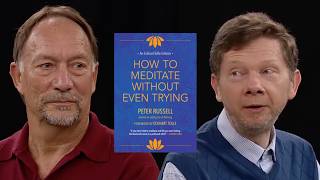
In this conversational interview, Eckhart Tolle and Peter Russell explore a non‑effortful approach to meditation. Russell describes meditation as simply allowing attention to relax, letting go of the habitual tension that arises when the mind is constantly thinking. They discuss how formal techniques and the desire to "do" become obstacles, turning the practice into another mental activity. The dialogue emphasizes noticing subtle resistance, being the spacious awareness that holds whatever arises, and even relaxing into that resistance so it dissolves. Both speakers stress that true meditation is experienced as ease itself, not as a task to be mastered, and they encourage a shift away from the conditioned doing‑mind toward effortless presence.
Chapters
And so you teach meditation, and— but the meditation you teach is not formal meditation, it's a— what can you say?
Yes, I mean, I've done more formal meditations, but over the years I've just realized that for me, it's just about letting the attention completely relax. Because all the time we're engaged in thought, the mind becomes slightly tense, slightly constricted. You can always feel the consciousness just focusing. And to me, meditation is just like— is letting that go. And in that, just stepping out of the thinking. It's not trying to stop thought. I know when I first got involved in meditation years ago, it was like I had all these— I read all these books and thought it's gonna take a lot of effort, a lot of concentration, and maybe after, you know, many lifetimes you will finally reach nirvana or cosmic consciousness or whatever it was the book was talking about. And I think we all did. We all had these very, you know, complex ideas of what it was about, what awakening was about. And over the years, for me, it just got simpler and simpler and simpler and simpler, and it's about not doing anything. But the mind wants to do something, wants to get involved, it wants to follow this, wants to get there. And so I'm just interested in helping people spot— just to sit. I call it sometimes just noticing, just noticing what is. And just to notice when that slightest bit of trying comes in, that slightest bit of wanting, it's like 'Oh, this isn't quite as good as yesterday. Maybe if I just sort of actually did this, or maybe if I just relaxed a bit more, and if I just relaxed.' But even that is like that very slight bit coming in. And so I just get to say, 'Well, just include that. That's also part of the present.' The most insidious thoughts in meditation are the ones that are about the meditation. We can recognize the thoughts that say, 'I must remember to buy this,' and 'If so-and-so calls tomorrow, what should I say?' and 'What I did yesterday 'That was really neat, that was nice, I like that.' Those thoughts we recognize, but in the thoughts that say, 'Okay, how am I doing? This is okay, I wonder how much longer I've got to do here.' Those little thoughts, and just say, 'That's also part of what is.' And even when there's that, what I find happens is there can be a very slight holding or resistance that comes in, which is just resisting the present in some way. Yes.
The very idea that I am doing a meditation, I become an obstacle. Because that comes in between you and simply being, recognize that beingness. So often the technique becomes the obstacle rather than the opening. So in a way, there's no technique in your meditation.
Right. You can't do meditation, but it's an exercise of awareness, bringing awareness to what is. And it's the resistance that keeps us locked in. And so even bringing awareness to the resistance. And so when you notice there's some slight holding or resistance, to notice what that feels like.
Yes.
How does it feel to be resisting what is, to be resisting the presence?
And it can be the space even for the resistance. Yes. Because then you step You take a step back from there. There's the resistance. You have space for that.
Yeah.
Whatever arises, you can be the space for that.
Yeah. So I often say to people, you know, just don't resist the resistance. But paradoxically, you can relax into the resistance.
Yes. Yes.
It's there. You don't try to get rid of it. You know, there's a faint sense of tension here. I'm just resisting. Okay, just notice it. What's it like? Okay. 'Now relax into that.' And of course, as soon as you do, it dissolves and you just drop back to being. Yeah.
Yes, yes, that's lovely. So that's, uh, sounds quite easy.
It is totally easy.
It is ease itself.
It is ease itself. However, these minds have been trained to do things and to train to do things well, and we could always do things a little better. And maybe if I just 'If you tried a little bit harder, it would be even better.' Yes, yes. Yeah, we're so trained in this mindset that— to do, to try, to make things better.
Yes.
And in some ways, meditation for me is an untraining of the mind, or stepping back from all that conditioning that we have through our lives. It's just stepping back from that. Yeah, yeah. Wonderful.