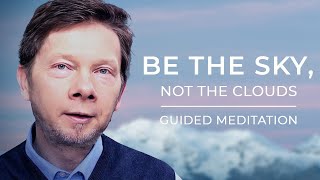
This is a YouTube video titled "Embodying Stillness | A Guided Meditation by Eckhart Tolle" containing a guided meditation session led by Eckhart Tolle. The content focuses on mindfulness, awareness, and meditation techniques, emphasizing acceptance of thoughts and external disturbances as part of the meditation process. The session encourages transcending distractions and embodying spacious awareness.
Sa. No, drifting off into thinking. That's the Zen master speaking without the stick. Awareness. If thoughts arise, don't get involved in them. Just let them drift past. Drift in and out of awareness. Be the sky, not the thoughts, not the clouds. You are the sky. Occasional cloud, doesn't matter. You are the space. It's. It's you. You may encounter boredom sometimes in meditation, because meditation is not interesting. So you encounter a little barrier inside the. Oh. And then you surrender to that and you go beyond boredom. Impulses may come, you want to get up, start thinking about something, and you observe that. And then it arises and passes away many things. In meditation you can practice the arising of feeling, or a thought or some impulse. You can watch it. And if you don't have a reactive relationship towards it, you don't give it excessive importance. It subsides again. And then you're left with just you as spacious awareness. And then the next thing comes and you're still there as spacious awareness, even though the thought has come in. And then it subsides. And then the body gets restless. And then the mind says, I need to get up. I can't sit, carry on sitting here. And then you watch that. You watch restlessness. Everything is allowed in the present moment. Any external disturbance immediately becomes part of your meditation. There's never anything outside, unless you're physically attacked by a mountain lion. There's never anything outside that can actually disturb your meditation. Even a big, what they call in England, pneumatic drill. I can't remember what it's called here, but same thing, it starts up next door, imagine. And you say, I can't meditate in conditions like this. Yes, but the surprising thing is you don't need ideal conditions for meditation. In other words, every condition is ideal for meditation. If you totally accept the so called disturbance, you surrender. It becomes part of the meditation you have transcend it. If you want to overcome the pneumatic drill, you have to run out there and say, stop that. Then you have either overcome it or you are in an argument. Transcendence is meditation. Whatever arises and that then becomes the way in which you live your life. That you never oppose anything, anything that comes in you. And then you go, you go with it around it. You don't oppose, it's accepted. The present moment is accepted. So. And you can practice that during your meditation.