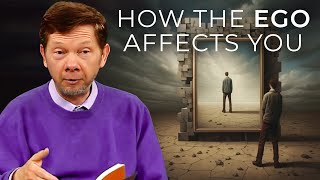
This is a YouTube video titled "How the Ego Affects You | Eckhart Tolle Explains the Story of Narcissus" created in October 2023. The content features Eckhart Tolle delivering a monologue or lecture discussing the mythological story of Narcissus as a metaphor for the ego and self-identity, exploring themes of self-worth, body image, and suffering related to ego attachment.
Your sense of self worth is diminishing. And that's the source of great suffering. So the story, if we go back to the beginning, the story of you, let's travel back in time to prehistoric mythological time, where we encounter the young man going for a walk in the woods. And his name, according to ancient Greek mythology, is Narcissus. Narcissus, the young man walking in the woods, very happy, contemplating nature, not disturbed yet by incoming text messages or Facebook postings or Instagram or possible Tinder dates. Not distracted by anything, just being there, present, enjoying the aliveness of the present moment. And then this young man came upon a pool of water or a little pond, very still pond. And of course, at those times there were no mirrors yet. There was no technology. Mirrors had not been invented. He looked into the pond and he saw his own reflection in the pond. And he was amazed at the beauty of his own reflection. Now you might think, is that perhaps a very ancient prophecy of the selfie? Can't take my eyes of it. No, it was not a prophecy of the selfie. But there's a connection. Of course there is a connection. This is the glass surface of the selfie. And here we have the reflection of the image of his own image in the water. Now, the story goes that he fell in love with. With his own reflection. And he could not get away from it. He got drawn back to it again and again. And although the story says that he fell in love with his own reflection, a more precise way of putting it would be to say that he became obsessed with his own reflection. Because ultimately, I don't know if you have experienced it ever. Falling in love is a kind of obsession. Not loving love is something else. I'm talking about. Falling in love, of course, is a very obsessive thing. I need you. Don't you ever leave me. And then of course, he or she leaves or you leave. That's a long story, we all know it. And he lost his happiness. He was no longer happy. There are different versions of the story, but in the more ancient versions, eventually he commits suicide. Suicide. So that story in mythology often expresses a deep truth which otherwise humans would not understand or could not express in any abstract way. The truth needs to be embedded in a story. And there's a very deep truth here that points to the arising of a mentally created self image that people have and live with. So it's almost as if you had a phantom that walks with you wherever you go. That is your mind created image or concept of who you are. And that Is what we call the ego. The ego is a mental image conditioned by the past, conditioned by your environment and many other factors. A mental image, a conceptual sense of self that you identify with so completely that you disappear in it and live through it. You believe that that is who you are and that is the conditioned mind made self. It consists of layers, different layers. At the most fundamental level, first of all, everybody identifies first of all with your physical body. That's the most fundamental level of identification. You are. You believe that you are the body. You identify with the body that you are. And the body, of course, already is a problematic thing to identify with. Because you compare this body that you say I am, this body, this physical form, and then you compare to others. And it can be a source of pride. If your body is better looking or stronger than most other bodies, the ego gets in there and feels inflated greater. And it can also be a source of suffering or shame. If your body is not the way you think it should be, or society tells you should be, or when you compare it to others, it's not as strong or as beautiful as others, then again, you suffer. You have a sense of self that feels less than on the other side. You might have a sense of self that feels more than people who have a strong or beautiful body. When I was young, I would have given 20 years of my life if God or the universe had said to me, I can give you a beautiful, strong body and make you into a good looking man that attracts countless women. I would have said, It's a deal. 20 years of my life, I'll be happy. But it didn't happen. But I can see how people who are good looking or strong or both, how easy it is for them to find, to seek a large part of their identity in their external appearance. And that can be fine for a while. But inevitably, of course, what is a source of pleasure for some years, gradually and perhaps even quickly turns into a source of suffering. Because the body does not last. And a day comes when you look in the mirror and the mirror image is no longer the same as it was 10 or 20 or 30 years ago. Especially if you have a photo of yourself next to the mirror. Something went very wrong here. And then it becomes a source of suffering. Now, in our civilization, there are repair jobs that you can do that for a while will help you feel you're still okay, good looking. But inevitably you suffer, begin to suffer more and more. Because who you think you are is diminishing who you think you are, the value, your sense of self worth is diminishing. And that's the source of great suffering. And of course, humans who identified with a negative body image, they are suffering already. When they are young, they don't have to wait until the body grows old. So we have identification with the body. And then you put clothes on the body. Of course, they become an extension of the body. And they can add something. They can hide things, they can conceal things that don't look so good, or they can enhance things that look good. And then it's nice, people are looking at me. It feels good to the ego, Sa.