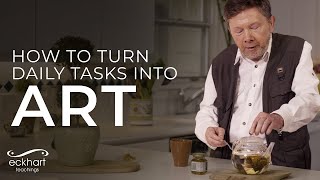
This is a YouTube video titled "The Power of Concentrated Action | Conscious Tea Ceremony with Eckhart Tolle" featuring a monologue by Eckhart Tolle. The content involves Eckhart Tolle discussing the practice of performing everyday actions, such as making tea, with full consciousness and respect, drawing on examples like the Japanese tea ceremony and Zen influences to illustrate mindful, high-quality action. The video was created in August 2023.
I'm going to make a cup of tea. And again, this is just a little example or illustration of performing an action consciously rather than reducing it to a means to an end. So the water has already boiled a little bit. Let's see if I can bring it back to boil. You may have heard of the Japanese tea ceremony that's been practiced in Japan for centuries under the influence of Zen. And the Japanese tea ceremony is to be conscious, acutely conscious at every step of the action of making the tea. So it's been perfected a little work of art. The making of the tea is not a means to an end. It's become a work of art. Now, it doesn't have to be every time you make a cup of tea. You don't have to perform necessarily the tea ceremony, but to bring some consciousness into the doing, into something that is actually a very simple but enjoyable action that is extremely helpful. So let's. I'm bringing the kettle here. I've got this interesting tea. It's green tea, and apparently it opens up in the form of a flower when you pour hot water over. And now we wait a little. Now, in ordinary life, it's. You may perhaps, while you wait, perhaps be engaged in other things. But if you can, this little waiting period itself can be of meditation. Another thing they practice in Japan, again under the influence of Zen, is flower arrangements that you might have heard of. This is to place flowers artfully into a vase. And it's very slow, conscious movements. It's done intuitively. If it's performed by her master, it's done intuitively. So it's. One could call that consecrated action. Consecrated action. That's actually a term used in the Bhagavad Gita. There's also a kind of almost say, respect that you have for the objects that you handle. You treat them with respect. It's a strange thing, perhaps, for some people, because for many people, most of the objects that they handle are just a means to an end. They wouldn't really give attention to the object itself. But you treat the object with respect, even the way you put it down. There's even a way of placing something on the table consciously and their way of placing it unconsciously. I have observed. I'm talking a little while we wait for the tea. Oh, yes. I have observed in some. In restaurants, some waiters, they just. They put their plates on the. The plate on the table just like that. Occasionally you find a waiter who actually does it consciously, who places a waiter. There's care in which the waiter places the plate on the table. And it's always very enjoyable when that happens. It goes like, carefully, like this, consciously. It's a high quality. I call it high quality, quality action.