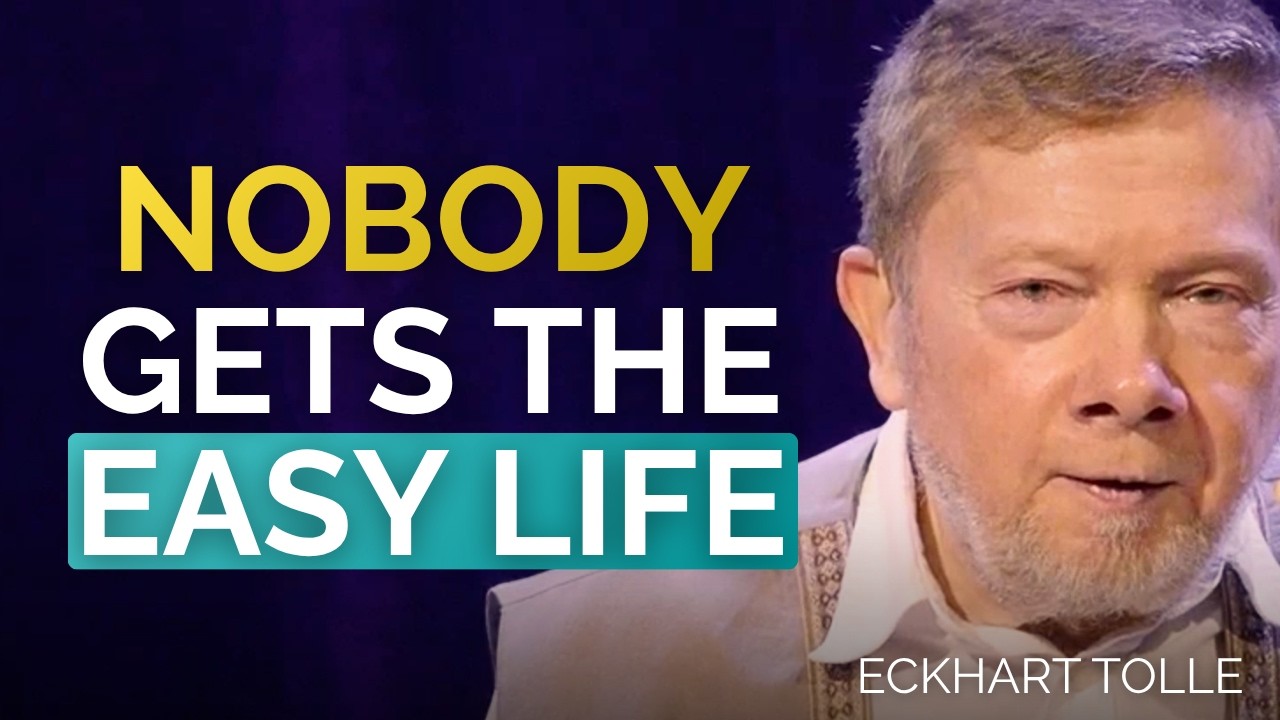
In this monologue, Eckhart Tolle explains that human life is designed to present challenges, not to maintain comfort. He argues that suffering, when it arises, serves the purpose of awakening consciousness, but once presence is cultivated, suffering becomes optional and can be relinquished. Challenges that continue to appear no longer generate suffering; instead, they deepen the state of presence. Tolle extends this principle to humanity as a whole, describing how the collective ego and mass psychosis create widespread suffering that ultimately drives a collective awakening. He discusses the ego’s reliance on feelings of superiority and fear of inferiority, noting that transcending these dualities simplifies life and relationships. Tolle then recommends the Stoic philosopher Epictetus, highlighting his background as a former slave and his core teaching that unhappiness stems from our mental interpretation of events, not the events themselves. He shares an excerpt from Epictetus emphasizing resilience and presence. Finally, Tolle uses the myth of Hercules to illustrate that without trials, strength and purpose would never develop, reinforcing the idea that challenges are essential for growth and awakening.
Chapters
We are here to face challenges, and the challenges are here to awaken us. And no, not— we are not here to avoid challenges, to continuously seek out comfort zones. And there's a deeper truth in that, because you can see the The seemingly bad things in your life have a purpose too. The suffering has a purpose. It is here to awaken you and to get to the point where it is no longer required. Compulsory— suffering is no longer compulsory. It's optional. And if it's optional, you say, I'd rather not have it. Challenges continue to come, but they are no longer transformed into suffering. That's the difference. Challenges continue to come, but challenges will then— if you no longer transform the challenges into suffering, becoming, in other words, making it becoming an unhappy me, Complaining and unhappy and— What then the challenges do, they just intensify the presence in you when the next challenge comes. Instead of pulling you back, they intensify the presence. And that's why you still need challenges. Life knows that. The intelligence that pervades the universe knows that, and it will give you challenges. And then, especially if there's a if you begin to drift out of presence for a while, life's getting too easy again. Okay, and then suddenly, flak! Oh, oh, right. Okay, I forgot. Right. Okay. Oh. Oh, okay. And what applies to an individual applies also to the collective. There is an enormous amount of suffering generated by the collective of humanity. In other words, humanity causing its own suffering through being trapped in the collective ego, through being trapped in mass psychosis, creates havoc on the planet. And then collectively, It drives you, it drives humanity to a point of awakening. So you gradually then, less and less do you live through a self-image and you're able to be yourself rather than Be something else and acting something out. Be yourself. And that comes with certain simplicity and makes life so much easier when you no longer need to compare yourself to others. And all sense of inferiority disappears, but also all sense of superiority disappears. The ego cannot live without a sense of superiority, one area or another. Even if you consider yourself the greatest victim, it's a sense of superiority. So the ego needs superiority and it fears inferiority. You step out of that, superiority and inferiority become meaningless. That makes life so much easier. Also, relating to other human beings becomes so much easier. So the successful life is a conscious life, and that consciousness is here now. Are you conscious now? Are you present now? Are you aware now? And then can you embody that? It doesn't matter how you got here. How you got to this awakening doesn't matter. Oh, I have another book recommendation for you. Obviously, it's a Greek philosopher, not terribly well known. I mean, everybody's heard of Socrates or Plato or Aristotle, and this philosopher's name is Epictetus. Epictetus. Epictetus. I used to say Epictetus, and then I realized that stress— the stress is on the second syllable. Epictetus. Epictetus. A great philosopher of ancient Greece. Interesting fact about these philosophers is that they came from all social classes. Social classes were— some philosophers Came from a very high social class. Plato, fairly high social class. Plutarch, high social class. Epictetus was originally a slave, and eventually he was freed. And Epictetus also had a physical disability. He called himself a lame old man, so he probably had some kind of paralysis. So he learned his philosophy through suffering, through being a slave for many years, through being burdened with a physical disability, probably some kind of paralysis. And he became a great philosopher. And his philosophy is very simple. The central point of his philosophy is you're not unhappy because of events that happen, but because of what you're telling yourself about the events of your life. In other words, it is your mind that makes you unhappy, not the situation or the circumstance. How you approach the circumstance, how you interpret the circumstance, is determines your happiness or unhappiness. So I highly recommend Discourses and Selected Writings, Penguin Classics. I'll give you a very brief sample of it. Some of it is— it's a good translation. It's very— it's almost— it's contemporary language. It's almost as if he was speaking to you today rather than 2,000 years ago. This is just a little excerpt. Nothing can trouble or upset me or even seem annoying. Instead of meeting misfortune with groans and tears, I will call upon the faculty especially provided to deal with it. The faculty especially provided to deal with misfortune, so-called misfortune, is You could call it resilience, fortitude, but ultimately presence. I will call upon the faculty especially provided to deal with it. Now somebody says, but my nose is running. What do you have hands for, idiot, if not to wipe it? But how is it right that there be running noses in the first place? That must have been a dialogue between a disciple and him. But how is it right that there be running noses in the first place? Instead of thinking up protests, wouldn't it be easier just to wipe your nose? What would have become of Hercules? Hercules, the mythological figure, who did the labors of Hercules, who performed incredible feats. What would have become of Hercules, do you think, if there had been no lion, no Hydra, stag, or boar, and no savage criminals to rid the world of? What would he have done in the absence of such challenges? Obviously, he would have just Rolled over in bed and gone back to sleep. So by snoring his life away in luxury and comfort, he never would have developed into the mighty Hercules. And even if he had, what good would it have been done to him? What would it have done to him? What would have been the use of those arms, that physique, and that noble soul? without crises and conditions to stir him into action. We are here to face challenges, and the challenges are here to awaken us. And no, not— we are not here to avoid challenges, to continuously seek out comfort zones.