Becoming a World-Class Scientist & The Rules of Enzymes with Margaux Pinney
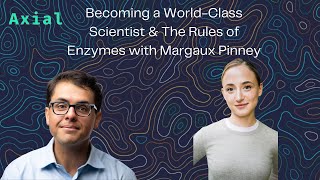
Margaux Pinney went from community college during the Great Recession to running her own enzymology lab at UCSF. She discovered that a single amino acid controls whether enzymes prioritize stability or speed, and now trains scientists in the techniques needed to study how enzymes adapt to temperature.
Chapters
Welcome to the Axial Podcast. Axial is an early-stage investment firm based in San Francisco. We partner with great founders and inventors investing in early-stage life science companies, often when they are no more than an idea. Axial is fanatical about helping the rare inventor who is compelled to build their own enduring business. Okay, we're recording, Margot. Get really excited.
All right.
Just had a little chat for 10 minutes.
I guess I, I'll just start and say I grew up in Washington State. I grew up in a small town that's outside of Seattle, but anyone who's been to the suburbs in Washington will know that you don't have to go that far out of Seattle until you're like in the forest. Like, it doesn't take that— like, the suburbs kind of quickly diminish into more rural areas. And so I grew up in a town called Black Diamond, and it was named that because I don't know, somewhere sometime in the early, early 20th century, they used to mine coal there. And it was supposed to be like the best coal in the western United States. And they called it Black Diamond because it was supposed to be relatively clean burning. And so anyway, it's kind of the history of the little town. And it was kind of, it was always a joke really because, you know, we're not really burning coal anymore. Although I think they did kind of ramp up production at some point, like during the Trump administration, and then as far as I know, kind of dropped back off. So there is, there is still, I guess, a coal mine out there. But I, I grew up there and I grew up in a family where, I mean, my parents, they like science, they appreciate it. But no, they weren't, they weren't scientists. And, you know, we— it's not like we knew scientists or knew physicians. It was, I guess, kind of outside of what was normal. And I— but they always encouraged me to be really creative and to think about, you know, careers in these types of fields. But we didn't really know. I never really knew what to do, I guess I'd say. And I always like, was a person who was obsessed with details. Like, I loved the nitty-gritty details of things. And so I really ended up thriving in chemistry where understanding reaction mechanisms and the details of that was really important. And I took a high school chemistry class where my teacher, he was maybe the first teacher who really told me, like, you're actually good at this. And honestly, I don't know. I think, like, humans are motivated by praise. And it was one of those things where I'm like, I think I am good at this and I do love it. Um, and this was around my like sophomore year of high school, which would have been 2008. Uh, we are kind of entering the Great Recession. Um, I think for a lot of people of my age group, like that time, especially if you were graduating high school or graduating college, was like very formative. Um, because It's not like I think for people who are maybe younger and who have experienced the last 10 years of prosperity, you know, it's kind of surprising, I guess. And for me, that was like a very formative time where I was like, oh, okay. And so I took part in a program in Washington State where instead of entering, um, I, like, a 4-year college immediately, I actually started a community at a community college, and I did that partially during high school. So I left my high school and went to a community college instead. Um, and, and that was incredible because one, it saved me money. Like, I, this the state of Washington paid for that. Um, I got college credits, and it was a small school. It was called Green River Community College at that time. They've since turned it into a 4-year college called Green River College. Um, but I look back on it, and it was the best decision that I ever made. Honestly, it was, it was great because I had professors there who really took an interest in me, who really encouraged me, who, who told me like, this is how you transfer to a 4-year school, this is how you apply to graduate school, all of these things that I just didn't know and I had no one to tell me. And it was, it was the people at Green River Community College, specifically Keith Clay. He was my physics professor and he was incredible. It was him, and I had an organic chemistry professor too who I remember sat me down and he said, like, I think that you're the type of person who can do anything you want. Like, don't limit yourself. I think you can do whatever you want to do. I think about it all the time, actually. Like, I have it burned into my mind, this person sitting me down and telling me this.
So, like, um, I went to high school around the recession too, and it was very impactful to see, like, family friends go bankrupt and lose their houses. And you're like, in high school, you're like, oh geez, I better I think it's made me a very cheap person in some ways of money. And so what was it like to be in high school and go to college? Like, just like, did it force you to like become more mature? Did it force you to maybe take chemistry more seriously, science more seriously? Like, did it like, what was the impact? Like, it seems like you got a lot of encouragement, but for you in terms of like progressing in life, How did it— like, just to go from high school to college, it's a very mature thing. You do it so early, like 2 years earlier than most people, 3 years. Like, did it force you to like think, I got to really be good at design? Did it force you to work harder? Maybe that's the best— better question.
Oh my gosh, yes. Well, I think, you know, this time was really hard. It was hard for my family. It was hard. For a lot of the people around me. And it just, I felt like the stakes were high. Like when I started in college, I felt like the stakes were high. Like I, like there was no room for failure, which isn't, which is not true. And, you know, I try to, you know, now encourage the people in my lab that, you know, you can fail, we'll figure it out, you know, don't. But at that time I felt like there was no room for failure. And so it was like, I think I had to grow up pretty quickly because I was, at this point, I, I started— I did— I started in my junior year of high school, I think. And so I was around 16. I had a car, so I drove myself to the community college. I worked jobs, um, and I like was a hostess at a restaurant. I was also a waitress for a while, um, and you know, there was just like no, um I guess I put my whole self into everything, everything that I did at that time. And I mean, I still do. And I think that it also taught me that, like, I needed to be really independent. Like, my, you know, my family had things that they were dealing with at the same time. And so I just felt like I— and I was also the oldest. I have a younger sister. And so I didn't really also have a person ahead of me who had done this before. As far as a sibling goes. And so it was very much like, you figure it out. I did. Like, I mean, of course there are ups and downs and everything.
Yeah, you definitely figured it out. I didn't know you were going to come to college. That's really cool. Okay. I thought you just went to Washington, then you went to Stanford, and then now you're here. I thought— I just assumed, like, a really vanilla trajectory, but I can see why you do the work you do because you know, you'd be all in so young. And so was there like an experience where you realized, I want to be a professional scientist? Or maybe did you always believe that, that this could be a job, not just like something I felt too when I was— you do scientific research, it's just fun initially, but then there's a moment where you realize maybe I can do this for a living. Like, when did that spark click? Was it like a professor telling you? Was it reading something?
It was definitely when, when I was at Green River, because I didn't know. I thought that my, like, the best trajectory for a person with an interest in science was to go to medical school. And so my trajectory at this point was mostly, was like, go to medical school. And it was at this time that I was talking to my professors and in particular Keith, and he said, no, you can go get a PhD and you can be a professor. And professors don't just teach, you know, some of them also do research or they primarily do research. And this is what this looks like and this is how you do it. And it was through those types of conversations that I really set up this long-term plan where it was like, okay, I'm going to transfer to the University of Washington. It's an amazing research school. Like, I need to find a lab as soon as possible to take me and like mentor me in research. So the summer before I transferred, I just emailed everyone I could. I said, this is, this is what I'm interested in. You know, this is where I'm coming from. Will you let me in your lab? And, you know, I got a lot of non-responses, but I eventually got a response from a scientist in the chemistry department there named Jim Mayer. Jim is not at UW anymore. He is at Yale. But Jim was just so wonderful, really, really supportive, really took me in. And so I started with him the summer before I transferred. And he really like, he, him and also my mentors within the lab really, I think, nurtured, nurtured me as a young scientist because I mean, I didn't really, I didn't know anything when I started about like true research and they, they helped me a lot. And I, so when I started, We were studying this property of some cofactors that are in certain enzymes in the body. And we were studying something called proton-coupled electron transfer. We're studying a property of them. But it was just the cofactor. And I, coming from chemistry, enzymes were like amazing to me. Because like they're specific and they're fast and they do these really complicated reactions and they're so mysterious. So they just seemed magical. And so when I started with Jim, we were working on these cofactors and I'm like, I just, I really want to work on an enzyme. And no one in his lab had worked with an enzyme before. And so I ended up working for a little bit on it, on an enzyme that I think We just like purchased it from Sigma. I didn't purify it or anything, but he at least like indulged me to that, to that extent. And then through interacting with him and reading like primarily the work of Francis Arnold and Danny Toffik, I just became totally enthralled with enzymes, enzymes, how they evolve, how you can force them to evolve in the lab, how you can look at them in nature. Um, and so I knew I wanted to go to a biochemistry department when I went to grad school. And so I wrote this like NSF proposal. I didn't even tell Jim, I think, until I had already written it. And I was like, I wrote, I'm writing this NSF proposal for a graduate research fellowship. And it was all about how we were going to use directed evolution to evolve this enzyme that I don't know, it was going to do something cool. And I, you know, gave it to my mentor, gave it to Jim, and they're like, yeah, sure, submit it. And I submitted it and I ended up also getting funding. And so I ended up coming in with an NSF research graduate research fellowship. When I was like applying to grad school, I'd already applied and then I knew I got it. And so at that point I became like a pretty competitive applicant.
Everybody wants it, right? You paid for it. So everybody's like, Come on in wherever.
Yeah, definitely. I think at that point, 2 people were like, you know, I interviewed around. I primarily interviewed in California because I knew I wanted to leave Washington. I didn't want to go as far as the East Coast. I wanted, you know, I'm right now I'm within a 2-hour-ish flight from my family. And so it just seems like a good fit. And so I interviewed all over California.
Interviews are so fun.
Oh man, they're so much fun. So much.
I use the best part for me, at least the best part of grad school is interviewing. It just goes Stanford, Berkeley, and they just have a great 2 days talking to scientists, talk to scientists all day and just party. It's like the best thing ever.
And it's surprising. I was like shocked that like they pay for them.
I was like, what? I went to like 20 interviews. Like one time I did 10 days of interviews, went to Caltech, UCSF, Berkeley, to Washington. I did a whole little— it was like awesome because you're in college and you get to jump on an airplane on the weekend and then you're just like, oh yeah, a little getaway. It's really fun.
It was really fun. It was— I remember it being like super busy because I was a senior in college and I like had finals and I cared a lot about my GPA. And so I was like, shit, I have to, I have to like keep up on my homework and do all these like fun things. But honestly, it was amazing. And so I, I interviewed all around and it ended up like basically my final choices were all the Bay Area schools. It was like, am I going to go to UCSF? Am I going to go to Berkeley? Or am I going to go to Stanford? I ended up going to Stanford and, you know, we don't know if it would have been— my outcome would have been different going to one of these other places, but Stanford was amazing. It was a really, really great choice. And so I started in 2014. In Stanford biochemistry. And one of actually the motivating factors for going to Stanford is that that time they had some— they had a dual degree program that wasn't— so it wasn't the MSTP program where people do both MDs and PhDs fully, but this was a degree program for people who were interested in translational science but didn't want to see patients. You know, a lot of MSTPs, they end up doing only research, right? And so for me, I thought this seemed like a really cool opportunity. Um, and so in addition to my PhD, I did a Master's of Science in Medicine. And so it is effectively the first 2 years of medical school, um, and a short clinical rotation, but you don't go back to the clinic after your PhD, um, like many, uh, MSTPs do.
So I kind of think it's the worst part of med school, to be honest. I have friends in med school that are going to— and like the first 2 years are the worst. Why would you, why would you do that? Why'd you— like, what was the game plan there? Was it like you wanted to do research? Was that long-term plan to do research that would have human impact, or was, or just something else?
But also, I think it was just, it just felt like an opportunity that I just did not want to give up. Because it was free. Like, I, I didn't pay tuition for medical school. Um, I'd been coming from chemistry, so I actually didn't know a lot of human biology. Um, and so you start in medical school, and I also am like a person who was pretty good at test-taking, so it wasn't particularly like stressful for me to take a lot of exams. Um, so I started and I took like immunology, I took like developmental biology, I dissected an entire human being from toe to head. And so it was experiences that I felt like I could not have gotten if I didn't take advantage of this program. And even if I never did anything translational, which is not true, but if I never did anything translational ever, it just— It just seems like a transformative experience I didn't want to give up. Um, and so I did that, but I also kind of— maybe like the level of intensity of me at that moment, uh, I tried to also do my PhD concurrently. So I didn't like do just medical school and PhD because I didn't want to push myself too long. So I did like the medical school courses along with with like doing my rotations and yeah, it was, it was a crazy time.
That's, that's nuts. That's nuts. Okay, so let's maybe focus on the— so like choosing a lab, you were presenting in Hirschblatt.
That's correct.
And so I'm assuming a lot of— I'm assuming every lab wanted you to join because you had fellowship and hardworking, just like a perfect, perfect person. So I'm assuming you had everyone get you all in. Everyone coming down to you trying to get you to join. How did you end up choosing Daniel's lab out of all the choices you've had?
Well, you know what's so funny is that like, I think at that time I didn't realize that like students are hot commodities and people want them to join their labs. I think like, and this is something I try to tell the students now, is that you have a lot of agency actually when you're coming into graduate school. You have a lot of agency. And, but none of us feel that way. And I mean, well, okay, maybe other people do. I didn't feel that way. And so I, um, I was doing like these medical school courses. I knew I wanted to study enzymes. It was almost just like a guaranteed choice. I would join Dan's lab. Um, and I mean, Dan comes, Dan Hershogue came from Bill Jenks was his graduate mentor. So it's like a long history of really, really impressive enzymologists, like people who were foundational in that field.
Tom Scheck as well, if I remember correctly.
He did. He was his postdoc. Yeah. So part of the lab studied ribozymes and RNA-binding proteins, and then part of the lab studied protein enzymes. I guess another thing that was very important to me, and I, I also try to tell students this now, is that, I mean, yes, I was very interested in the science, but also, you know, I'm a person who's interested in a lot of science. I actually can get really into a lot of science, and I think it is as important or even more important to choose your mentor. Um, like, that is an important aspect of choosing a lab. And I just knew from my interactions with Dan and from talking to people that Dan was a person who was committed to mentorship, like, very, very committed. Um, would push you. Like, he— his was a lab that you would grow a lot. And I felt like— I mean, maybe at that time too, I was just like, I, I just came from a community college here, and it's and then UW, then here I am at Stanford. Like, I want to take full advantage of this experience. Like, I want someone to, to like push me to, um, be the best I could be. And I, I felt like Dan was that person. Um, and so, and I remember talking to some of his students at the time, and I was like, what, you know, should I choose based on science or mentorship? And I'm like, I'm leaning towards seeing, like, choosing my lab mostly based on the mentor. And some senior students who I really respected were like, yes, that's the choice that you should make. And I think that it, like, that was definitely the right choice.
Yeah, I think it's always like the tension of like, do you join a real famous lab, big people, maybe less hands-on, or do you try to find a lab that's— it's often like the thing is like the old lab or the new lab. And so, and you start your own lab, there's probably certainly be your track more willing to take a risk and join an up-and-coming lab than the lab that's already established. Did you have any of that too, where it's like Dan's already established? Or did you— maybe not, but yeah.
Yeah, so I definitely think you're right in that sense, although I think maybe Dan's lab was an anomaly in the sense that it was an established lab with kind of like in some ways a new lab energy in the sense he was involved. At that point, the lab was relatively large, but, you know, by my second or third year, we were kind of a smaller and cohesive group. And, you know, Dan is very busy, still is busy, was busy, but always made the time for you. So, I mean, I talked to him about science weekly. We emailed very frequently. It was the kind of thing he was very involved, as opposed to, you know, there are other very large labs where there just isn't enough time for the PI to go around. Right. Like, I really empathize with that now. Just how much of your time you lose. But somehow Dan had time for all of us. So it was nice.
How much would you say— did a ton of diligence for this decision? Like, or did you— or is it kind of a gut feeling where it's like, okay, you talk to people.
It was a gut feeling. It was totally by the— by my gut. Yeah. Um, because I, I did 2 rotations and I, I did Dan's rotation and I said, I'm joining your lab. So I didn't, I didn't belabor this decision too long. It was kind of like, this is a good feeling. And I think also, like, there are decisions a person should not make, right? It's like very clear, like, you should not make this decision. Um, but sometimes you have multiple good options And the best thing you can do as a person is to choose an option and commit to it fully. And that's what I did.
Okay. I'm just kind of getting, you know, just your— Margot's all in and then she just takes full advantage of everything.
I'm trying.
That's kind of the characterization, that's the common thread that's happening in your story. And so you're at Stanford and you're joining Dan's lab. How did you choose a project? Did Dan give you some ideas? Did you come in with ideas? Was it iterative? Did you have some failures halfway through and have to start again? What was that kind of— I'm always jealous of the people who get a paper published in 2 years. You know, there's that PhD and they're doing the rotation, they already have a publication. Those people frustrate me. Those people I really dislike just because I'm jealous. But you joined Dan's lab. How did that process go in choosing a project? And then actually implementing it and then maybe solving challenges that do come in the way?
Yeah, so I actually started on the RNA side of the lab, and I remember during my rotation, we— let's see, I tell the story to my students. It's kind of like a— it's intended to be a bit of like proverbial, I guess. It's like, um, I was— it was during my rotation. I had a wonderful rotation mentor, and I don't even— I don't even quite remember what experiment we were doing, but we were measuring, I think, the binding of a catalytically dead ribozyme to a bit of RNA, something like this. And we were running these big gels, and at that time we were running these really thin, large RNA gels, and I I don't know, they're like a foot tall and a foot wide or something like this. They're huge. And we had a lot of conditions that we wanted to test. And my rotation mentor was like, let's just run one condition, one gel. And I was like, but we've got 9 gel boxes. Like, let's run 9 gels. And he was like, that's insane. Like, you can't run 9 gels at the same time. And these gels are finicky. They're huge. They leak. It was just kind of like a total mess. And I set up, I stayed up really late and I like, I set up all these gels and of course every single one of them failed, every single one. And so now I like, well, whenever my students are like, I'm going to do all this stuff, I'm like, all right, this is a 9 gel situation. Like maybe we should like stick to one gel. And so I think maybe that experience, I don't know why I was like, maybe, I don't know, maybe I won't work on the RNA side of things. Maybe go back to my original love, which is protein enzymes. And so after my rotation, I started on protein enzymes. And Dan had like this long-term project studying the role of hydrogen bonds in enzyme catalysis in the active site. And it was very fundamental work. It was the kind of work that you would see in a textbook kind of thing. Because there have been a lot of models about to what extent and to what magnitude hydrogen bonds are contributing to enzyme catalysis. And, you know, some people said like you can account for all of enzyme catalysis based on hydrogen bonds within the active site that are really short and really strong. But a lot of work from previous students in Dan's lab, so it started with Shuo Shan, who was one of Dan's first students. She's now a professor at Caltech. That work had kind of been picked up by Paul Segala, who is now a professor at the University of Utah. And so when I started, I started studying hydrogen bonds, I kind of picked up this historical project. And I worked on that. And then at the same time, I was also reading a lot about enzyme evolution and this like idea that enzymes are not static. They are actively evolving, and they have history too. And that just, like, blew my mind. And I said, I want to also, you know, you know, we have this project. It's really cool. We have— we're using this model system. I also want to study how enzymes adapt and evolve. And at first, Dan was like, and he will tell you this, he'll say like, he told me not to do this project. He's like, it's like, this is not a good idea. Like, stay doing what you're doing. Um, and I think I just like did it anyway, or I'm sure I told him, but maybe I didn't tell him. I don't know. At some point, this project, I started taking on this project and doing it kind of on the side, um, studying enzyme temperature adaptation. And when we started to get— like, I started to get some, some really interesting results. And at that point, Dan admitted he was like, oh yeah, this is, this is cool. This is a good idea.
Oh, so then like, that's kind of often— that's often the history of like science is like the, the data in the garbage can becomes interesting or side project works out. And so it seems like you had a defined project and then you got inspired to do something else from that initial start. And so like, what was the key experiment you did that you realized that, oh, like what thread did you pull? You start realizing, oh, that may be that like you're kind of redefining how enzymes adapt to temperature. You know, I think there's the common theme to this, it's like epistasis is like the common framework and then your paper kind of, kind of shifted towards a different direction. What was that key experiment you realized, okay, I've got it, I got the story?
Okay, so we had been, we've been using this model system, this model enzyme system in the lab, and it's called ketoesteridase. A lot of people have studied it. It's kind of classic. But even though there had been almost 70 years of research on this enzyme, Um, it only— two, pretty much just two orthologs of the enzyme, and by orthologs I mean like versions from different organisms, basically just two orthologs had been studied. And kind of for non-enzymologists, um, like enzymes can have the same general function, they can have the same role within the cell, but vary in sequence identity enormously. So these two particular orthologs in this particular family that this enzyme is from, it's pretty divergent in sequence space while maintaining a common fold and a common function. So I started to look at like multiple sequence alignments of this particular model enzyme that we really only studied like two of them. And I started to notice, within these multiple sequence alignments that there were, there were changes in the active site of, of this enzyme, which typically you don't see. Oftentimes you see like active sites are 100% conserved and it's the stuff around them that changes throughout evolution. And so I just ordered a few different orthologs. I mean, at the time when getting like a gene synthesized started to become a lot cheaper. And so I just ordered a few orthologs. And I had in this earlier project been studying hydrogen bonds in the active site of ketoceratase. And one of the residues that's different in the active site between different orthologs was one of these hydrogen bond donors. So it was like this key residue that I had already been studying and we thought was so important. And we know when you mutate it, that catalysis goes down. So I was like, why is it changing? Like, why would some other organism mutate, have this residue mutated, and it wouldn't cause like a deleterious fitness effect? So I was perplexed by this and we ordered the genes. And it also just happened that that organism is a thermophilic organism. So it grows in hot temperatures. And as temperature increases, proteins, including enzymes, are less likely to be folded. So if you have a protein that's, you know, from a human or something that's adapted to more moderate temperatures and you were to put it at hot temperatures, it would unfold and you'd have no function. And so it turns out that this single residue within the active site of ketosteroid isomerase helped to confer thermostability. So if you mutate it from its tyrosine, which you find in most mesophilic or medium-temperature-loving orthologs, you mutate that to a serine— oh, sorry, excuse me, it's an aspartate, sorry, it's an aspartate in mesophiles, and then if you mutate that to a serine, you increase stability. And so that enzyme is more stable at high temperatures. But you decrease activity at the same time. So there's this trade-off at this residue. And so we worked out all of the mechanisms, the molecular mechanisms that were happening that conferred these different phenotypes at different temperatures.
Like, it seems like a lot of the stuff was like hidden in plain sight because people hadn't really just compared, like, I think your paper analyzed 1,000 families of these Is it the steroid isomerase? Like, yes.
We kept having these kinds of conversations between Dan and I, and we're like, someone has to have done this. Yeah. Like they have to have, it just seems obvious. Right. But it was one of those cases where, you know, people have been studying temperature adaptation for a while, but it was either like not the right system or we just didn't have the sequencing data to start looking at all these families. Because that is one thing is that the last, let's say like about the last 20 years, there's been explosions of technology in different fields that really are now enabling us to do new things. And one of them is sequencing. So we've like, sequencing's a lot cheaper. So now you can just go into these databases and you can get sequences from tens of thousands of organisms, and we now have computing power to be able to make alignments of them and to start analyzing them in ways we weren't able to before. So I think that's maybe why people hadn't done these types of things prior.
Um, yeah, I think there's kind of this like asking the right questions with the right data. And so you have to like, yeah. I have friends like that too, publish papers on some really seemingly simple thing. And then it's like, why did nobody ever think about this? And it just took— when you look back on that, what kind of state of mind or like what do you think that success was? Was it just being a grad student and having a beginner's mind? Or was it some training, some other problem you worked on before? Did some past thing you worked on set you up to do this? Or something you read maybe? By happenstance?
Yes. Okay. So, I mean, there, there were two very formative papers actually, and they're not in big journals or anything. It's just that I had been reading the literature about enzyme evolution and there was a paper, maybe 2001, from Francis Arnold. And it was, it was like a review mostly of some of the work they had been doing at that time, doing directed evolution for temperature adaptation. So it was like, that particular paper, along with another paper from Dan Toffik's lab about also enzyme temperature adaptation. And that's what made me start thinking, like, temperature is really an interesting axis to study enzymes particularly, but proteins in general, in part because it puts, like, unique selection pressures on proteins with respect to properties of enzymes that we care a lot about, like One of the big kind of goals of enzymology for the last, I don't know, century, I guess, is could we eventually design an enzyme with a particular property? But that's really, really hard. And the properties we really care about, though, are activity and stability. And those are the properties that are under selection when enzymes adapt to temperature because Like I said before, as temperature goes up, the probability that a protein will be unfolded increases. But as temperature goes down, all reactions, all chemical reactions, including enzymatic reactions, decrease in rate. And that's why, you know, you can put your food in the refrigerator and bacteria grow really slowly because all their metabolism is really slow at those temperatures. And so that was really the motivation for studying temperature adaptation. I think temperature is also very relevant for our current time period where the environment is not static, it's changing, things are getting warmer and we have more temperature extremes. So organisms like basically every non-mammal organism has to adapt to different temperatures and they have to do that at the molecular level. So I think that it's relevant to that. But really, my— the way I got into it is how do we use this axis of temperature to to narrow our focus on parts of proteins that are important for either activity and/or stability. And so that's kind of where I came from and still, I think, what motivates some of the stuff that we do in my lab now.
Yeah, I think, I think what the best-selling protein at high temperatures, like Taq polymerase. So yeah, finding proteins that function at high temperature, even cold ones, like extreme relevance for tools in the context of climate change and also just like synthetic biology and even therapeutics. So maybe we can shift gears near the end. So you, you, you get— you kind of make this discovery, they do all this work to publish the paper. Maybe we could talk about another time. How did you make the transition from grad school to a postdoc to a fellow at UCSF? And then how did you then, as you set up that lab, set research directions, think about the problems you want to solve, right? Your long-term vision and where you see the lab going.
Okay. So at this time, like basically all of the experiments that I had done in graduate school, I did them as a benchtop biochemist would. I purified proteins from huge vats of bacteria. I did experiments in plate readers and spectrophotometers with cuvettes. It was very low throughput. And as we started doing all these sequence analyses, we were like, there's so much I want to do. There's all these mutations I want to make. I need to be able to get to higher throughput to be able to explore. More. And at the same time, the Hershlag lab, Dan's lab, and Polly Fordyce, who was an assistant professor at the time at Stanford— she is now a full professor.
And I think recently, a few days ago, I think the announcement for Polly.
Yeah, she just got tenure. Yeah, she's got tenure. Yep. And So they had had this collaboration to use these microfluidic devices that Polly had developed when she was a postdoc to study enzymes. And Craig Markin, who was a postdoc in the lab, and Daniel MacTari spent a lot of time doing, like, setting this up, doing all, like, proof of principle experiments. They did like got Kcat and Km values for hundreds of different pathway orthologs. And it was, you know, a Herculean effort really. And at that time I was like, oh, this is amazing. Like, this is, this is, this will solve my throughput problem. And so I was— this was like pandemic time. I had written my thesis. I was about to defend. Pauli was on my committee. She had been a mentor to me also throughout graduate school. I would come to her with data, she'd give her opinion, and it was always a relationship I really loved. And I decided with Pauli, and then also there was a— through an interaction, I guess at the time, what I really wanted to do is not only increase throughput for doing entomology, but I also wanted to integrate biochemical experiments with things in vivo, in vivo, like fitness measurements. And so I approached Gavin Sherlock, who is in the genetics department at Stanford. He's a professor there and Pauli. And I said, can I join your lab as a postdoc jointly? But I, and I also said, I also want to let you know I'm applying for this Sandler Fellows program at UCSF. So there's a chance I won't be here that long. And they were really supportive, honestly, wonderfully supportive. And they said, yes, you can come. We will support you in your independent position if that happens. And I think at the time I kind of was like, you know, I may not— I probably won't get this position, but I'm going to go for it. And so I ended up getting an offer from UCSF to start my own lab as a Sandler Fellow. Like a month into my postdoc, basically. And so I ended up delaying my start so that I could have more time as a postdoc learning these methods. And then I brought them to my lab here at UCSF. And so we are doing high-throughput biochemistry with microfluidics here. We're, um, are kind of pushing the limits of this technology, I think, developing new assays and new systems. And it's really exciting. And it was very much enabled by having great mentors.
And I know you have a hard stop, so I don't want to— I want to— maybe we can talk about your new— your research you do now, 2 years from now, uh, and then we can talk to you at the end. But maybe one quick thing is just making that transition from doing the science to lead a group that does science, and especially for research like yours that's interdisciplinary, how did you— one, how do you think about like assembling a lab and how did you learn to lead a lab and set directions and, you know, be, you know, let people do that side project and, you know, set those values so you can, you know, make great discoveries consistently?
Okay. Yeah, so, because the type of microfluidics that we're doing in the lab is so niche, I basically don't expect anybody to come in knowing how to do this. Like, there's maybe a handful of labs in the whole world that can do this type of microfluidics. And because it's quite complicated, so I don't expect anybody to know how to do this going into it. And so there's a strong emphasis on We are going to train you from the ground up to do a little bit of engineering, to do biochemistry, to do technology development. And so I would say, like, we're now— so we're a year in the lab and we're kind of— people are kind of, like, specializing a little bit more than I anticipated. I joke with my lab members who are totally going to find this and make a ton of fun of me. That we, we have almost like cores in the lab. Like, I have someone who is like really good at cloning, and so they're like the cloning core, and we have the protein purification core, and we have the computation core. Um, and but of course everyone's young, everyone is learning too, but it, it, it's a really kind of— yeah, it's really interesting. And I think maybe I Coming into this, I don't know if I had like a plan per se, because human beings are kind of unplannable in a way. You assemble a group and you adapt. You adapt all the time, constantly about like, what do we need to do? And as far as setting research directions, I think like we— like I had a plan. I was like, we are going to study, we're going to continue studying temperature adaptation. And, you know, that's the direction. The lab is going to go mostly. But of course, you start here at UCSF. UCSF is amazing. There's all of these people studying super interesting things. And so we like are quickly diverging and we're studying viral proteins, we're studying drug resistance, which is a really interesting evolutionary pressure to go after. We're studying enzymes that are anti-cancer targets. We're developing new technologies for the devices so that we don't just do We don't just measure enzyme kinetics, but we measure protein, protein interactions. We measure like other interesting, unique things. And I guess I would say like as far as the, like the extra projects, I found, and I really believe this, that it's like people are really motivated to work on things that they are intellectually and personally responsible for. We— I talk to a lot of the people in my lab all the time, and we are constantly being like, right, what are you interested in? Like, how can we— how can we take that interest and combine it with our expertise in the lab and the goals to push things forward? Yes, in the trajectory that I imagine, but also with your own unique flavor. And so everyone's projects have their own flavor that really, I think, captures their own intellectual creativity. And I love that.
Cool. Okay. And maybe I think a common theme across this whole conversation is like, one, you're always all in, and then two, you have great mentors, and then you're conferring that mentorship, you know, you're passing it along. Any lessons maybe like, you know, for somebody who was in your position when you were 10 years ago, maybe they're in college, you know, maybe they're entering grad school, coming out of grad school, any kind of lessons in terms of like making a good decision for yourself, whether it's starting a lab, getting an industry job, maybe becoming an artist or whatever, but like any kind of lessons you want in terms of decision making.
Yeah. So I think like it's impossible to know whether you're making the right decision. You know, it's kind of like you brought up this concept of epistasis. It's like there's epistasis within our lives too, right? You make a choice and sometimes that choice has, you know, unintentional effects. But I think that it's important, one, to be flexible, you know, reevaluate as necessary, but also, you know, commit to your decision. Things are going to be hard, but in hindsight, they're never as challenging as you think they are in the moment. And we all make it through things. And, you know, science is very both cyclical in the sense it's really intense at times, less intense at others, but also is a marathon. And I think like, you know, reevaluating but also making those decisions when you're not in a time of like really intense work or struggle is a good idea.
That's awesome.
Um, no, yeah, I guess the other thing I'd say is for advice is like choose your mentors very wisely because you're gonna end up like them a little bit. Like a little bit of your mentor is going to be you. And so you kind of should choose someone you like. Like choose somebody who you respect and choose someone you like.
Oh my, you end up becoming your mentor.
You do, it's inevitable, honestly. That's crazy, that's funny. You can't help it.
Okay, well, Margot, thank you for doing this. It's going to really help a lot of people. We'll touch base in 2 years or so, and you have all these papers, and I'm sure this stuff you're going to publish in the next few years is going to be really awesome. I'm going to look forward to reading it, but I really appreciate you taking the time to do this.
Great, it was really fun.
Thank you so much.
More from Joshua







Scientist Stories: Hans Waterham, The value of phenotypic assays in peroxisomal disorders




Scientist Stories: Joel Zlotogora, Genetic carrier screening programs for reproductive purposes